New Jersey Tries Again With a Small Business Finance Disclosure Bill
January 26, 2020 For the third year in a row, New Jersey has a small business finance disclosure bill on the table. S233 is the latest iteration of S2262 from prior years.
Introduced by State Senator Troy Singleton, the proposed law would impose disclosures on loans, factoring, and merchant cash advances on transactions less than $500,000.
In addition to APR requirements, brokers who arrange such financing would be required to disclose their fee to prospective applicants separately from the financing contract and prior to the consummation of the transaction.
Singleton is a Democrat. The Democrats in New Jersey control the Senate, Assembly, and Governor’s office.
Online Small Business Borrowing Decisions Not Driven By Costs or Disclosures, Fed Study Finds
December 23, 2019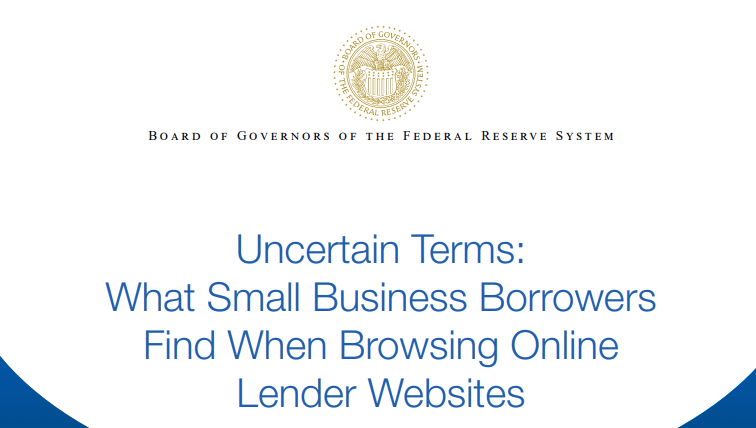 A new study on transparency conducted by the Federal Reserve on non-bank small business finance providers indicates that borrowers are not driven by costs or disclosures. The #1 reason for a business to apply with an online lender was the speed of the process, the study showed. #2 was the likelihood of being funded. Cost ranked near the bottom of the list.
While a focus group pointed out many areas that are ripe for improvement, the Fed was left to conclude that “clearer information—in the form of standardized disclosures—will not necessarily alter the decisions of some small business borrowers about whether and where to obtain financing.”
The Fed further commented that some loan applicants revealed that they had already “committed the expected loan proceeds” before a lender could even present rates and terms. Others borrowers wished they could know their approved rate and terms before even providing a lender with any data. These findings seem to undermine the potential value of enhanced uniformity in disclosures.
The report, which attempts to paint a bleak picture of online lending in spite of the data, seems to validate what online lenders have been saying all along, that speed is supreme. Even where transparency is lacking, it cannot be overstated that big banks scored lower on transparency than online lenders did.
Uncertain Terms: What Small Business Borrowers Find When Browsing Online Lender Websites evaluated BFS Capital, CAN Capital, Credibly, Fundation, Funding Circle, Kabbage, Lending Club, National Funding, OnDeck, Rapid Finance, PayPal Working Capital, and Square Capital.
California DBO Making Progress On Finalizing Rules Required By The New Disclosure Law
July 29, 2019 Last October, California Governor Jerry Brown signed a new commercial finance disclosure bill into law. The bill, SB 1235, was a major source of debate in 2018 because of its tricky language to pressure factors and merchant cash advance providers into stating an Annual Percentage Rate on contracts with California businesses. The final version of the bill, however, delegated the final disclosure format requirements to the State’s primary financial regulator, the Department of Business Oversight (DBO).
The DBO then issued a public invitation to comment on how that format should work. They got 34 responses. Among them were Affirm, ApplePie Capital, Electronic Transactions Association, Commercial Finance Coalition, Fora Financial, Equipment Leasing and Finance Association, Innovative Lending Platform Association, International Factoring Association, Kapitus, OnDeck, PayPal, Rapid Finance, Small Business Finance Association, and Square Capital.
On Friday, the DBO published a draft of its rules along with a public invitation to comment further. The 32-page draft can be downloaded here. The opportunity to comment on this version of the rules ends on Sept 9th.
You can review the comments that companies submitted previously here.
New Jersey MCA & Business Loan Disclosure Bill Update (S2262)
February 6, 2019 Bill S2262 in the New Jersey State Senate mandating disclosures on MCA and business loan contracts, was amended last week. In its current form, the bill, if it became law, would require MCA providers to disclose:
- the total dollar costs to be charged to a small business concern, assuming the small business concern delivers all purchased receivables to providers at the time they are generated or at a mutually agreed upon time, and all required fees and charges that are paid by the small business concern and that cannot be avoided by the small business concern;
- the amount financed, which shall mean the advance amount less any prepaid finance charges; and
- for a cash advance that calculates repayment costs dependent on the small business concern’s future receivables, the estimated annual percentage rate, provided as a range, with at least three different repayment times provided and a narrative explanation of how each rate was derived. Any estimated annual percentage rate is to be calculated using a projected sales volume that is based on the small business concern’s average historical sales or the sales projections relied on by the provider in underwriting the cash advance; or
- for a cash advance that calculates repayment costs as a fixed payment, the annual percentage rate, expressed as a nominal yearly rate, inclusive of any fees and finance charges.
Brokers would also be required to provide uniform fee disclosures to both the small business owner and lender or MCA funding provider in a document separate from the funding contract before a small business consummates a loan or MCA transaction.
Previously, the bill defined merchant cash advances as loans. The latest draft updated the definition to mean a financing option that allows a small business concern to sell all or a portion of its future sales collections or other future revenues in exchange for an immediate payment. It refers to this as an asset-based transaction.
You can follow the bill’s updates and read the latest drafts here.
S2262 was originally introduced 11 months ago in March 2018.
NJ Legislature Aims to Classify Merchant Cash Advance as a Loan in New Disclosure Bill
October 15, 2018 S2262 in New Jersey, a bill to require disclosures in small business lending, was amended this afternoon to define merchant cash advances as small business loans for the purposes of disclosure.
Banks and equipment leasing companies are exempt from the bill.
You can listen to the hearing here. Debate on S2262 begins at the 6 minute, 12 second mark.
The bill’s author (image at right) is Democratic Senator Troy Singleton who represents New Jersey’s 7th legislative district.
Testifying on Monday’s hearing against the bill were Kate Fisher of the Commercial Finance Coalition and PJ Hoffman of the Electronic Transactions Association.
New Jersey Moves to Regulate Small Business Loan Disclosures and Brokers
October 15, 2018A committee within the New Jersey State Senate convened today at 1:30pm to discuss S2262, a new small business loan disclosure bill. Similar to SB1235 in California, this bill would require all of the following on small business loan contracts less than $100,000:
The APR(This was removed during the committee hearing)- The annualized interest rate
- The finance charge
- The maximum credit limit available
- The payment schedule
- A list of all broker fees and a description of the broker’s relationship with the lender and any conflicts of interest the broker may have
- These terms must be presented before a business accepts a loan
In addition, any change to the terms that would significantly affect the responsibilities or obligations of the small business concern under the loan must be noticed 45 days in advance.
During the hearing, the bill was amended to define merchant cash advances as small business loans. Kate Fisher of Hudson Cook, LLP who represented the Commercial Finance Coalition (CFC) during the hearing, strongly opposed that amendment. The CFC is a trade association representing small business lending and MCA companies.
Also testifying against it was PJ Hoffman of the Electronic Transactions Association. Other Trade groups are gearing up to oppose the bill as well, AltFinanceDaily has learned.
The bill was voted through the committee and will continue to move forward.
Kate Fisher’s testimony has been transcribed below:
Senator Pou and committee members: Thank you for the opportunity to present testimony today regarding business loan disclosures.
My name is Kate Fisher and I am here today on behalf of the Commercial Finance Coalition, a group of responsible finance companies that provide capital to small and medium-sized businesses through innovative methods. I also am an attorney who helps providers of commercial financing comply with state and federal law.
The Commercial Finance Coalition supports efforts to make business financing more transparent.
The problem is the proposed amendment would define a merchant cash advance as a loan. A merchant cash advance is not a loan.
We all know how a loan works – the lender advances money and the borrower promises to pay it back.
A merchant cash advance is a factoring transaction, in which a business sells a percentage of its future receivables at a discount.
Take for example, a pizza shop. The pizza oven breaks and the owner needs cash to replace it.
In a loan, the pizza shop borrows the money and promises to pay the money back to the lender with interest.
In a merchant cash advance, the pizza shop sells its future receivables to a merchant cash advance company. In exchange for the money to buy that pizza oven, the merchant cash advance company will take 10% of each dollar the pizza shop makes.
If the pizza shop’s sales go down, it will pay less. If the pizza shop’s sales go up, it will pay more. And if the pizza shop is damaged by a hurricane and has to close for repairs, it will pay nothing until it can reopen its doors.
This uncertainty of repayment is why a merchant cash advance is not a loan – the pizza shop in our example, only pays if it sells pizza. Courts have overwhelmingly agreed that a merchant cash advance is not a loan. To quote a recent court decision:
“Receivables purchasing is an accepted form of business transaction, and is not a loan.”
Because a merchant cash advance is not a loan, and there is no fixed payment term, requiring an APR or annual interest rate disclosure would be misleading. For a small business looking for financing, these types of disclosures would only add confusion.
I’m very optimistic that New Jersey can lead the way in providing businesses with disclosures that are helpful – and not misleading.
Thank you.
California Now Requires Mandatory Disclosures on Commercial Finance
October 1, 2018California Governor Jerry Brown has signed SB 1235.
As of Jan 1, 2019, commercial finance companies in California will be required to disclose the following on their contracts:
(1) The total amount of funds provided.
(2) The total dollar cost of the financing.
(3) The term or estimated term.
(4) The method, frequency, and amount of payments.
(5) A description of prepayment policies.
(6) The total cost of the financing expressed as an annualized rate.
To find out if this bill affects your company, contact an attorney.
The California Business Loan & MCA Disclosure Bill Has Passed
August 30, 2018The bill has passed. With the governor’s signature, all business loan contracts and merchant cash advance contracts in California will soon require a uniform set of formal disclosures including an annualized rate of the total cost. The precise formula for that rate will be determined by the state’s regulatory agency, the Department of Business Oversight.
Update: The bill’s death in committee was challenged by the bill’s author, Senator Steve Glazer, and ultimately allowed to come up for a vote after he complained to the senate majority leader that a committee’s decision is merely a recommendation, not a deciding factor on the bill itself. At 2:10 AM EST, it passed.
Update: The bill has died in the Senate Banking Committee. Daniel Weintraub, who serves as chief of staff to the bill’s author, tweeted after midnight eastern time that the bill was not moving forward.
Thanks to all who supported small business and #SB1235. Unfortunately the Senate Banking Committee killed the bill tonight. We fell one vote short of the four we needed to send the bill to the Senate floor. https://t.co/30ztdW2LbD
— Daniel Weintraub (@DMWeintraub) September 1, 2018
Update: The bill passed the Assembly unopposed and is slated for a late night vote by the Senate Banking Committee.
Update 8/31/18: Today is the last day for the legislature to pass this bill. We will keep you updated
California’s bill to mandate certain disclosures on business loan and merchant cash advance contracts is looking a little bit worse. The Annualized Cost of Capital method (Explained here) that some folks in the industry were accepting of, has been scrapped in favor of whatever formula a state regulator decides to pick. That means if the Commissioner of Business Oversight decides on an APR disclosure, which many industry trade groups believed they had already successfully lobbied against, all loans and non-loans alike would have to report an APR, a mathematical impossibility for a product like merchant cash advance. At present, however, all that is known is that the Commissioner’s choice must be an annualized metric.
According to Bloomberg, the amended version of the bill needs to get approval in both the Assembly and the Senate by Friday before the legislative session ends.
Trade associations that have weighed in on this bill include the Electronic Transactions Association, Commercial Finance Coalition, Small Business Finance Association, and the Innovative Lending Platform Association.
You can view all of our previous coverage about the bill here.