
Heron Raises $16M Series A to Bring the AI Revolution from Silicon Valley to American Businesses
July 15, 2025Backed by Insight Partners, Heron automates document-heavy workflows in insurance, lending, and finance — bringing reliable AI to businesses and allowing humans to focus on complex tasks
Heron, a startup using AI to automate workflows in business lending, equipment finance, and insurance, has raised $16 million in Series A funding led by global software investor Insight Partners, with participation from existing investors Y-Combinator, BoxGroup and Flex Capital. The Series A will support Heron’s next phase of expansion, helping the company scale its AI-driven solutions to more segments.
While many AI startups target developers or other technologists, Heron is at the frontier of deploying AI into real-life business operations in traditional industries like lending, banking, and insurance. Heron’s mission is to free up humans to focus on judgment-based work and complex edge cases while software handles the repetitive, monotonous work. Heron focuses on serving companies without large engineering departments, enabling more businesses to reap the rewards of the rapid advances in AI.
Heron’s system can automate time-consuming manual workflows end-to-end, completing tasks automatically or flagging edge cases for human review. That reliability has led many customers to fully offload entire processes to Heron — freeing up their teams to focus on critical work.
For example, SMB lenders employ teams of underwriting analysts that spend hours on repetitive intake work — scanning email inboxes for submissions, downloading and renaming files, checking packet completeness, manually entering data into CRMs, and running basic eligibility checks. Using Heron, these hours of work can be accomplished in seconds, and with higher accuracy, full auditability, and no manual overhead.
This focus on reliability and solving problems end-to-end has attracted more than 150+ customers to Heron, including insurance carriers and FDIC-insured banks, and enabled the company to process over 350,000 documents per week. One lender cut submission-to-decision time by 60%, while an insurer used Heron to automate over 80% of its inbound submission triage.
“Anyone who tells you they use AI to automate work with 100% accuracy is probably lying to you. Instead of chasing accuracy, we focus on clearly understanding where our software is successful and where humans still need to review. This allows customers to use Heron in situations where millions of dollars are at stake and reap the rewards of the AI revolution in a reliable fashion that drives business outcomes,” said Johannes Jaeckle, co-founder and CEO of Heron
Founded in 2020 by Dom Kwok, Jamie Parker, and Johannes Jaeckle, Heron launched out of Y-Combinator’s Summer 2020 batch, initially building products for financial services companies with earlier generations of AI in the pre-ChatGPT era. The company eventually landed on a core insight: traditional industries weren’t waiting for flashy new tools — they were drowning in unstructured data, and paying millions of dollars a year to deal with it. In 2023, as LLMs matured, Heron pivoted to focus on AI document workflow automation. With minimal outside capital, the team tripled annualized revenue in 2024 and has continued to expand its presence in insurance and specialty finance this year.
“Heron’s AI models with vertical specific context automate the end-to-end data processing workflow, enabling automation and driving competitive differentiation in industries where speed to decisioning is of the essence,” said Philine Huizing, Managing Director at Insight Partners. “Heron’s founding team—Johannes, Jamie, and Dom—are an experienced trio that has proven their ability to adapt and execute. We’re thrilled to partner with them and the entire Heron team as they continue to scale up.”
The new capital will be used to scale Heron’s presence in insurance, equipment finance and SMB lending, while expanding into adjacent verticals that have shown demand for Heron’s solution. The company plans to grow its engineering and go-to-market teams in New York and London, and continues to invest in internal AI Tooling to enable a small team to serve more and more customers.
“We’ve proven we can win in one segment,” said Jaeckle. “Now we’re going workflow by workflow, industry by industry — giving people hours back in their day by eliminating time-intensive manual work.”
About Heron
Heron automates document-based workflows across industries like lending, insurance, and equipment finance. By turning unstructured documents into structured, actionable data, Heron helps companies process information faster, more accurately, and with less manual effort. Heron is based in New York and London, with the team bringing a wealth of experience from top-tier tech companies including Facebook, Spotify, N26, Revolut and Taptap Send.
Learn more at herondata.io
About Insight Partners
Insight Partners is a global software investor partnering with high-growth technology, software, and Internet startup and ScaleUp companies that are driving transformative change in their industries. As of December 31, 2024, the firm has over $90B in regulatory assets under management. Insight Partners has invested in more than 800 companies worldwide and has seen over 55 portfolio companies achieve an IPO. Headquartered in New York City, Insight has offices in London, Tel Aviv, and the Bay Area. Insight’s mission is to find, fund, and work successfully with visionary executives, providing them with tailored, hands-on software expertise along their growth journey, from their first investment to IPO. For more information on Insight and all its investments, visit insightpartners.com or follow us on X @insightpartners.
CFPB’s Funding Cut Almost in Half
July 3, 2025The current Administration’s “Big Beautiful Bill” that passed Thursday includes a paragraph that modifies the CFPB’s annual funding budget. In 2010, The Consumer Financial Protection Act, which created the CFPB, stipulated that that no more than twelve percent of the annual total operating expenses of the Federal Reserve System shall be transferred to the agency. The new law has amended that down to 6.5%.
For perspective, the CFPB received $729.4M from the Fed in FY 2024 but could have drawn up to $785.4M. Had the new cap already been in place, the agency would’ve only been entitled to take up to $425M.
All eyes had been on the CFPB in the small business finance industry where massive regulations relating to how such companies collect data were supposed to have gone into effect this month. The agency ultimately suspended compliance with the rules by one year and said it intends to rewrite those rules in the interim. The agency is required by the fifteen year-old statute to implement some form of data collection on small business lending.
Online Search is King for How Merchants Shop For Funding, Survey Reveals
June 4, 2025Perhaps the most surprising statistic to come out of a 2025 small business lending survey conducted by IOU Financial is that 12% of merchants said they started their search for business funding options from a cold call. But as one might expect, phone calls are not necessarily the direction in which business is moving. Forty-one percent of respondents, for example, complained that they received too many phone calls from multiple reps.
The number one origin point—far above cold calls (12%), friends/referrals (8%), and social media (7%)—was online search (63%). And they’re not just looking at the first website and firing off a form. Fifty-eight percent, for example, said that online reviews were among the most valuable factors in choosing the right business funding provider, while loan calculators and comparison websites/tools also weighed heavily at 49% and 40%, respectively.
Historically, online search primarily meant Google, but according to a TD Bank survey, 30% of small business owners are already turning to AI assistants like ChatGPT for insights on financial health or financing.
And most merchants skip their bank. “More than 70% of small business owners do not apply for business funding with their bank before exploring non-bank options,” the IOU survey found. “This trend highlights a major shift in trust and preference away from traditional banks and toward alternative lenders—which could be driven largely by the desire for speed, flexibility, and ease of access.”
Carl Brabander, EVP of Strategy for IOU Financial, discussed some of the recent findings of this survey at Broker Fair 2025 this past May in New York City.
Dodd-Frank 1071: Regulatory Uncertainty in Small Business Financing
May 28, 2025Jeffrey S. Paige is the Chief Legal Officer of CFG Merchant Solutions. Visit: https://cfgmerchantsolutions.com
A Changing Regulatory Landscape for Commercial Finance in New York & Beyond
When President Trump returned to office on January 20, 2025, he signed several executive orders with significant implications, particularly for New York’s commercial finance sector and the revenue-based financing industry. One such order was a regulatory freeze that could impact rules issued by the Consumer Financial Protection Bureau (CFPB), specifically those concerning small business financing data collection under Dodd-Frank Section 1071. The rationale behind this freeze is that the CFPB, an agency not directly controlled by Congress, exceeded its intended regulatory scope.
Trump’s order not only halts the issuance of new rules but also mandates the withdrawal of any rules previously sent to the Office of the Federal Register. More critically, it directs agency heads to “consider postponing” any rules that have been published but have not yet taken effect, creating a 60-day review period for reassessment of their legal and policy implications.
“Should actions be identified that were undertaken before noon on January 20, 2025, that frustrate the purpose underlying this memorandum, I may modify or extend this memorandum to require that department and agency heads consider taking steps to address those actions,” the order concludes. This places Section 1071 in limbo, leaving financial institutions uncertain about compliance obligations moving forward.
However, New York funders may still need to prepare. Under 12 U.S.C. § 5552 of the Dodd-Frank Act, individual states (including their respective financial regulators and attorneys general) have the authority to enforce federal consumer financial law, specifically, the Consumer Financial Protection Act and 18 enumerated consumer laws such as TILA, EFTA, FDCPA, GLBA, and regulations issued by the CFPB. Simply put, New York has the ability to enforce these laws and regulations, including Section 1071, by bringing suit in federal or state courts or other appropriate proceedings against any “covered person or service provider” as defined and not excluded by the Dodd-Frank Act’s terms. It is therefore prudent for non-exempt lenders and funders to take a proactive approach.
What Is Dodd-Frank 1071?
The Dodd-Frank Wall Street Reform and Consumer Protection Act, enacted in 2010, sought to address vulnerabilities in the financial system exposed during the 2008 financial crisis. On March 30, 2023, Section 1071 amended the Equal Credit Opportunity Act (ECOA), empowering the CFPB to collect and report key data from financial institutions on small business financing. The compliance deadline varies based on the size of the institution, with the earliest deadline set for July 18, 2025, affecting Tier 1 providers, defined as high-volume financial institutions.
The goal of Section 1071 is to identify and address disparities in small business financing by analyzing key metrics such as:
- Demographics of business owners (race, gender, ethnicity).
- Financing terms, rates, and credit outcomes.
- Geographic data, including trends in underserved regions.
By requiring funders to disclose this information, the regulation seeks to foster accountability and ensure that small businesses—especially those owned by minorities and women—have equitable access to credit and capital.
CFPB & Section 1071 Timeline
2010: Dodd-Frank Act Enacted
- Section 1071 of the Dodd-Frank Wall Street Reform and Consumer Protection Act is established.
2011: CFPB Established
- The Consumer Financial Protection Bureau (CFPB) is created as an independent agency overseeing consumer financial protection laws, including small business lending regulations under Section 1071.
2017: CFPB Faces Legal Challenges
- Industry groups challenge the CFPB’s authority and structure, arguing that it lacks proper congressional oversight.
- Under the Trump administration, regulatory focus shifts toward deregulation, and CFPB rulemaking efforts on Section 1071 slowed down.
2020: U.S. Supreme Court Decision – Seila Law v. CFPB
- The Supreme Court rules that the president can remove the CFPB director at will, weakening its independence but allowing it to continue functioning.
2021: Biden Administration Revives Section 1071 Rulemaking
- The CFPB under Director Rohit Chopra prioritizes implementing Section 1071, aiming to enhance transparency in small business lending.
2022-2023: CFPB Proposes & Finalizes Section 1071 Rule
- The proposed rule is released in 2022, requiring lenders to collect and report loan application data, including business owner demographics.
- In March 2023, the final rule is issued, with compliance deadlines set for 2024 and 2025 based on lender size.
2023-2024: Legal Pushback & Court Challenges
- Industry groups file lawsuits, arguing that Section 1071 creates excessive regulatory burdens and violates constitutional limits on CFPB authority
- In October 2023, a Texas court stays the rule for certain plaintiffs, pausing enforcement for some lenders.
- In 2024, additional lawsuits escalate concerns over the rule’s implementation.
January 20, 2025: Trump Returns to Office & Freezes Regulations
- On his first day back in office, President Trump issues an executive order freezing pending regulations, including Section 1071.
- The order:
- Blocks new CFPB rulemaking,
- Withdraws rules not yet finalized,
- Delays implementation of already published rules for a 60-day review period.
- President Trump’s justification: The CFPB is an unelected agency that overstepped its authority, and its rules should be reassessed.
2025: Uncertainty & State-Level Action
- The CFPB’s authority remains in question, leaving financial institutions uncertain about compliance requirements.
- New York may independently implement similar reporting requirements, as it has done with previous commercial financing regulations.
- Many New York funders continue preparing for potential state-level enforcement despite the federal freeze.
How Alternative Financing Providers Can Adapt
Funders in the alternative financing space should remain agile and prepare for multiple scenarios. Even if Section 1071 is rolled back, transparency and fair funding practices remain critical for fostering trust and maintaining credibility in the market.
Steps funders can take include:
- Investing in technology to automate compliance processes, ensuring readiness for future regulations.
- Engaging with industry stakeholders to advocate for practical regulatory approaches that balance fairness and business efficiency.
- Maintaining transparency in financing practices to build stronger relationships with merchants and partners.
Looking Ahead
As the financial industry navigates the potential rollback of Dodd-Frank 1071 (Republican Congressman Roger Williams of Texas has introduced H.R. 976 seeking to do just that), alternative financing companies should focus on long-term strategies that prioritize both compliance and innovation. This is especially true in New York, where the legislature is currently considering a bill called the Fair Business Practices Act, modeled after Title X of Dodd-Frank, that would among other things expand the New York Attorney General’s enforcement powers and enhance penalties in this industry sector for UDAP violations. This further signals that New York as well as other states is seeking to fill any void left by the weakening of the CFPB. Whether the regulation remains in effect or is dismantled, financial institutions should stay proactive in adapting to changes while ensuring fair access to capital for small businesses.
The State of Washington Launches a Revenue Based Financing Business
May 25, 2025 The State of Washington is getting in to the revenue based financing business. Coinciding with Broker Fair 2025 on May 19th, the Washington State Department of Commerce announced it was launching the Revenue-Based Financing Fund (RBF) loan program for small businesses. Its administered by Grow America.
“This is one of the most innovative loan programs we’ve ever launched,” said Commerce Director Joe Nguyễn. “It’s not a typical business loan. It’s a Pay-As-You-Earn loan that works with the reality of running a small business. Instead of fixed monthly payments, businesses repay based on what they actually make. So if sales slow down, payments stay low. If business picks up, payments adjust. It’s flexible, it’s fair, and it’s the kind of practical solution we need to support small businesses across Washington.”
$13M in funding has been allocated to this program so far. Funding works similar to a business loan from Square or PayPal where there is technically a term and minimum monthly payment required, but the repayment system is based on a percentage of sales, namely 20% of them.
“At Grow America, we’re excited to launch the Washington Revenue-Based Financing Fund,” said Daniel Marsh III, Grow America president. “This program offers flexible capital, empowering Washington’s small businesses, especially entrepreneurs, to scale operations and achieve sustainable success.”
“Revenue-based financing provides you with flexible upfront capital, and its payback terms are customized to your cash flow and fluctuate based on your revenue,” the marketing materials state. “It’s ideal for small businesses that are seasonal, may not have a consistent income, or require an alternative to a traditional loan.”
Dragin Technologies Launches the First True AI Pre-Underwriting Tool for Revenue-Based Financing, Redefining the Future of Digital Business Intelligence
May 16, 2025New York, NY — May 16, 2025 — Dragin, the automation engine behind some of the fastest-growing and largest revenue-based financing companies, announces the launch of its latest breakthrough: True AI Web-Based Pre-Underwriting. This powerful new AI tool delivers real-time digital presence analysis to deal teams just before offers are made.
Designed for Revenue-Based Financing
In an industry where speed, accuracy, trust, and decision confidence drive every dollar moved, Dragin’s new AI functionality equips funders with a clear picture of a merchant’s online credibility and activity, automatically pulled before a human ever touches the file.
Here’s what it uncovers:
- Ownership and business addresses
- Business website, social media pages, storefront images, and location markers
- Incorporation information, SOS details, and NAICS codes
- Legal exposure including lawsuits, arbitration, and personal risk
- News coverage and media presence
- Financial signals and business health
- Registrations and licenses
- Customer reviews (Google, Yelp, Trustpilot, etc.)
- Top social media posts and engagement
How It Works
The moment a deal hits your inbox, Dragin’s proprietary automation stack kicks in, extracting deal info, organizing docs, applying pre-decline logic, and now, launching the AI agent. In under 30 seconds, it builds a hyperlinked, easy-to-read Digital Presence Report and attaches it directly to the CRM deal view. No clicks, no searches, no lag.
Why It Matters to Funders
For revenue-based financing companies, every delay risks a lost deal. Every gap in diligence risks a burned book. Dragin AI closes those loops.
✔️ Cost savings
✔️ Faster pre-qual checks
✔️ Early fraud detection
✔️ Deal confidence pre and post contracts
✔️ Fewer merchant falloffs post contracts
✔️ Streamlined ISO and internal decisioning
From Dragin’s Founder
“In the revenue-based financing space, you need to move fast without missing the red flags,” said Mark Ross, CEO of Dragin. “This tool gives funders real time signals, whether the merchant is real, active, and viable, before you send an offer. No more hours of review.”
Part of a Larger Ecosystem
Dragin AI is just one tool in Dragin’s full-stack deal automation platform, which includes:
- Email parsing and file classification
- Bank PDF and application extraction
- Pre-qualification, auto-approve, and pre-decline logic
- Instant CRM syncing
- Auto-contract generation
- Merchant offer portal for real-time negotiation
and much more
About Dragin Technologies
Developed specifically for the revenue-based financing, alternative lending, banking, and insurance spaces, Dragin’s suite of underwriting tools automate deal intake, streamline underwriting, and gives funders a smarter way to scale. With its Machine Learning and AI-driven tech stack and its powerful CRM suite, DraginForce, Dragin is powering the next wave of fast, AI-powered, and compliant funding operations. Learn More About Dragin at https://www.dragin.io
Congressman Dan Meuser Visits CFG Merchant Solutions™ to Discuss Small Business Finance and Regulatory Trends
April 24, 2025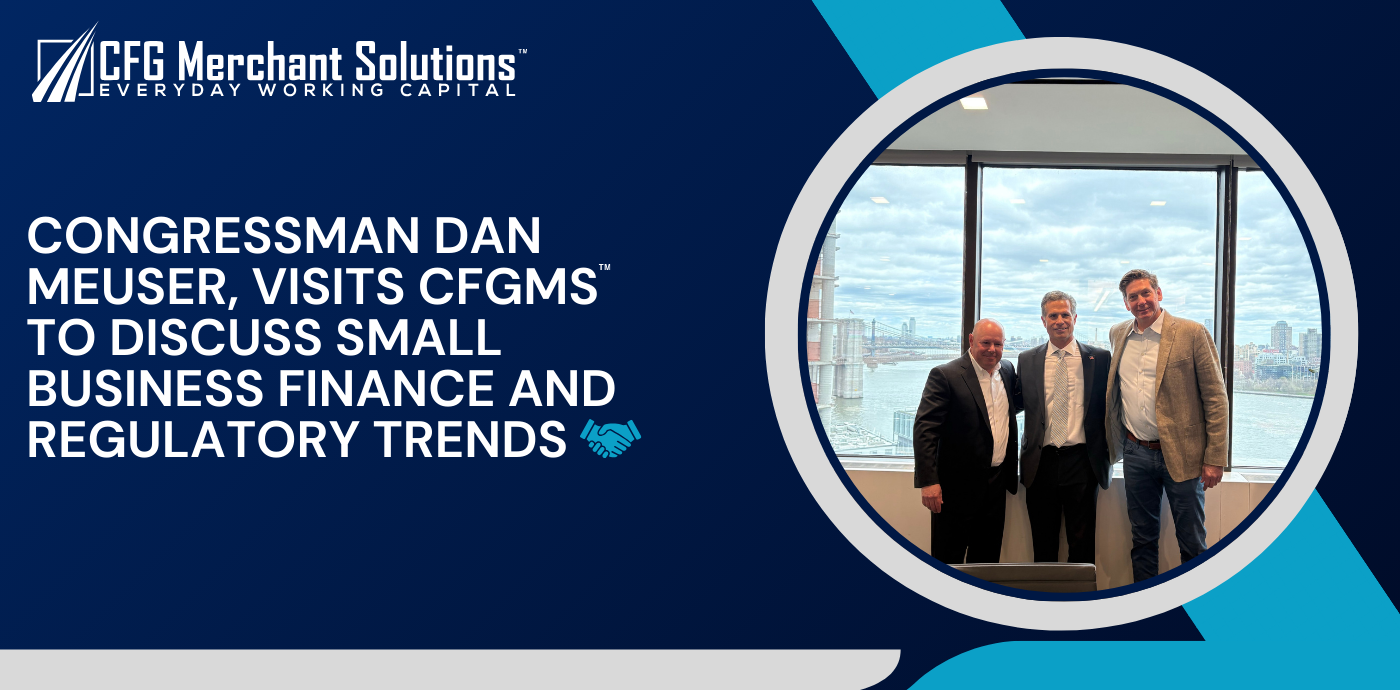
CFG Merchant Solutions™ (CFGMS™), a leading provider of revenue-based financing, was honored to welcome Congressman Dan Meuser (R-PA, 9th Congressional District) to its New York office for a discussion on the evolving landscape of small business finance and the importance of regulatory transparency.
During his visit, Congressman Meuser engaged with CFGMS leadership and staff to exchange insights on the current regulatory climate impacting small business funders. As a prominent member of the House Financial Services Committee—where he serves as Chair of the Subcommittee on Oversight and Investigations—and the House Small Business Committee, Rep. Meuser’s visit underscored his ongoing efforts to ensure small businesses have access to responsible, innovative funding solutions.
“CFGMS is committed to setting the highest standards of compliance, disclosure and transparency in our industry,” said Bill Gallagher, President at CFG Merchant Solutions. “We’re proud to work alongside policymakers like Congressman Meuser who understand the critical role small businesses play in our economy and who are advocating for smart, balanced regulation.”
Rep. Meuser has represented Pennsylvania’s 9th Congressional District since 2019. Prior to his election to Congress, he served as Pennsylvania’s Secretary of Revenue, where he was credited with making the department more efficient and customer focused. Earlier in his career, he was an executive at Pride Mobility Products, helping the company grow from $2 million to over $400 million in annual sales.
CFGMS continues to lead the industry in championing ethical, growth-driven funding practices for small businesses across the country. The company remains steadfast in its mission to expand access to capital while fostering transparency and accountability.
About CFG Merchant Solutions™
CFG Merchant Solutions™ (“CFGMS™”) is an independent, technology-enabled alternative funding platform focused on providing capital access to small and mid-sized businesses that have historically been underserved by traditional financial institutions and may have experienced challenges obtaining timely financing. CFGMS™ uses its historical transactional data, proprietary underwriting, predictive analytics, and electronic payment technologies and platforms to assess risk, and provide access to flexible and timely capital.
Media Contact:
Nick DeFeis
Head of Marketing
CFG Merchant Solutions™
(844) 662 – 3467
ndefeis@cfgms.com
cfgmerchantsolutions.com
FundThrough Acquires Ampla, Strengthening its Digital-First Invoice Funding Solution
April 22, 2025HOUSTON and TORONTO – April 22, 2025 – FundThrough, the leading fintech invoice factoring platform for small and medium-sized businesses (SMBs), today announced its acquisition of Ampla, the leading provider of financial technology solutions for consumer brands offering working capital, business banking, corporate cards, and analytics. Ampla surpassed +$2B of loan originations and handled +$5T of transaction volume through its platform. This strategic acquisition strengthens FundThrough’s digital-first ecosystem, creating an unrivaled platform explicitly designed for small businesses that sell to larger companies and wait to get paid after invoicing.
Building on its successful acquisition of Bluevine’s factoring business in 2021, FundThrough again demonstrates its ability to identify and seamlessly integrate game-changing SMB technologies. Today, FundThrough’s expanding footprint now delivers crucial invoice factoring solutions across diverse B2B sectors, including retail, manufacturing, oil and gas, technology, professional services, and food supply and agriculture, with 85 percent of its funding helping American clients.
“Business owners have increasingly been forced to act like banks for their much larger customers who extend invoice payment terms beyond reasonable lengths. They need a seamless way to bridge the cash flow gap, and FundThrough provides a tech-enabled financial solution,” said Steven Uster, FundThrough’s CEO. “Now, Ampla’s technology significantly enhances FundThrough’s AI-powered model, enabling us to level the playing field further. With Ampla, we can scale faster, enhance our credit underwriting and monitoring processes, and help even more businesses solve their number one pain point, cash flow. I’m excited to work with Anthony, a proven entrepreneur with vast knowledge in this space.”
Ampla’s CEO, Anthony Santomo, will remain a strategic advisor to FundThrough and will be joined by his core team. “I’m excited about Ampla’s acquisition by FundThrough and the potential of the combined platform to support small businesses. This strategic move enhances commerce capabilities and provides operators with greater resources to succeed,” said Santomo.
Concurrently with the acquisition, FundThrough also raised $25M in equity capital led by existing investor Klister Credit Corp., an early, large investor in both Shopify and FundThrough. This strategic investment fuels aggressive expansion into key growth areas, including further acquisitions, investments in technology and AI, enhanced UX, and accelerated product innovation.
“Steven’s leadership has firmly established FundThrough as a bellwether in the fintech and specialty finance industry. FundThrough’s track record over the past years of uncertainty is impressive. FundThrough has stayed tightly focused on robustly serving the needs of small businesses forced to hold receivables from their much larger, better-capitalized customers,” said John Phillips, President of Klister. “The outlook for small business growth continues to be positive, and my increased investment reflects my confidence in the FundThrough team’s continuing focus on serving this important market through the best service and continual product innovation.”
“As small businesses navigate the evolving global tariffs, the best thing they can do is preserve their cash flow. FundThrough helps bridge the gap by providing peace of mind for business owners during these uncertain times,” concluded Uster.
FundThrough continues to earn recognition for its growth and technology, landing spots on the Deloitte Fast 500 and Globe & Mail’s Report on Business Top Growing Companies List.
About FundThrough
FundThrough is the leading fintech invoice factoring platform for small and medium-sized businesses (SMBs). Based in Houston and Toronto, FundThrough’s digital-first ecosystem leverages real-time financial data and predictive analytics, offering flexible, tailored financing solutions for growing businesses. Since its founding, the award-winning organization has funded over $2.7 billion of invoices. For more information, visit fundthrough.com.
FundThrough Media Contact
Nadia Milani
VP, Marketing
nmilani@fundthrough.com