
Kabbage’s Next Growth Phase
May 9, 2017 Victoria Treyger, Chief Revenue Officer, Kabbage
When you consider the recent milestones Kabbage has achieved it makes it difficult to think of the fintech lender as a startup. In recent weeks Kabbage surpassed a couple of major milestones comprised of extending $3 billion in funding to 100,000-plus small businesses. More than half of those loans were directed toward existing credit lines. Kabbage also recently priced a $525 million private securitization, which tips the company’s hand on strategy.
After barely letting the paint dry on those achievements, Kabbage already has the next phase of growth in its sights. Victoria Treyger, Kabbage’s chief revenue officer, took some time to discuss those details with AltFinanceDaily, ranging from serving larger businesses with bigger loans, to expanding its partnerships to providing more niche-based features to customers.
Kabbage is pursuing its growth plans all while performing a confidential search for a new chief technology officer, details for which are expected to unfold in the coming months.
Personal Touch
As chief revenue officer, Treyger oversees the customer experience across both sales and marketing. She describes the Kabbage experience as a cross between a loan and a credit card.
“Ours is a living, breathing product that automatically adjusts for the needs of a business. Once you apply with Kabbage and link your data sources, you never have to do anything again,” said Treyger, pointing to the example of an ad agency. “If you’re an ad agency your highest cash needs are January through March. That’s when the agency’s customers invest their marketing budgets. So the Kabbage credit line automatically adjusts your credit line during your busiest time.”
And while most customers already take out multiple loans per year, with some accessing as many as 10-20, Kabbage is looking to streamline the customer experience even more. “The next stage of Kabbage is about personalization,” said Treyger, pointing to its automated underwriting platform that is connected to over a million live data points about business’ performance and allows the company to understand the cash flow needs of customers across industries.
Kabbage’s sales and customer service teams are also staffed with team members possessing industry vertical expertise ranging from e-commerce to construction.
Partnership Pipeline
At the LendIt USA 2017 event, Kabbage co-founder & CEO Rob Frohwein alluded to the online lender’s plans to reach new territories, details for which were scarce. Treyger shared, however, that Kabbage’s global growth plans are somewhat tied to the company’s pipeline of banking partnerships.
“They are all very large, global banks. I can’t say who they are but there are over half a dozen large relationships that are in the works,” said Treyger, adding that details surrounding those new partnerships will unfold over the next year.
“It’s not that banks don’t want to serve smaller small businesses. But with manual processes they often don’t have the capacity to serve these customers. Kabbage’s automated platform allows them to automate these manual processes and therefore serve more businesses of every size,” said Treyger.
Kabbage already counts as partners household names including Santander, ScotiaBank, and ING, all of which license software from Kabbage. Meanwhile, as big banks are accessing smaller businesses, Kabbage’s growth blueprint includes serving larger ones.
For instance, Kabbage is drawing on its recent $525 million securitization to fund small business loans. The credit facility is larger than previous deals, and for a good reason.
“One reason it is larger is that it was designed to support Kabbage in expanding our product offering to serve larger small businesses, which means two things — larger credit lines of $150,000 to $200,000 and eventually higher; and also longer-term products, not just six-to-12-months but 24, 36 months and different terms. The new larger facilities allows us to expand to serve even more small businesses across all size and funding needs,” said Treyger.
Early Innings
Meanwhile in terms of the small business community’s awareness of fintech and tech-based lenders, Treyger believes the industry is in the early innings. “That’s a great thing. There is a tremendous growth opportunity for the company,” she said.
Alternative Lending Is Dead
April 30, 2017At LendIt, Kabbage co-founder & CEO Rob Frohwein, blew the roof off the house with his presentation. Titled, “Alternative lending is dead, long live data,” he explained what he believes the industry should really be about.
On why the term alternative lending doesn’t make sense:
Think about Uber, when they talk about their business. Their tagline is ‘when you don’t feel like taking a taxi.’ They don’t call it alternative transportation at its best
On how most companies have been answering the wrong question:
The question answered by most online lenders is, ‘can you fill the void left by banks?’ I will tell you right now that the question that should’ve been answered by folks going into online lending would be ‘why aren’t banks filling this void?’ When you ask a different question, you get a different answer.
I’m not trying to prove that small businesses need capital. That is blatantly obvious. I’m trying to prove that there is a better way to do it.
Most online lenders tried to disrupt banks by proving they could grow fast and they could acquire capital, but there is only one problem with that approach. You don’t disrupt banks by focusing on the advantage that banks have over you. Banks have customers and money. That is mostly what they have. They have customers and money. So why disrupt the space with the two items that they actually have? The question that should’ve been asked and answered is, ‘why aren’t banks filling this void?’
The answer to that is, because they can’t profitably, for our industry, they can’t profitably serve small business customers. When you ask that question and you figure out the reason, you start building your business a little bit different
On why an online application doesn’t make you a technology company:
Most online lenders thought that by calling themselves a technology company, that they were one, but that wasn’t the case. The biggest piece of technology that most of them promote, is an online application. That’s it. If you think about it, it’s an online application. Everything else is manual. There is nothing, nothing special about an online application.
And outside the US, we’ve already launched in Australia, Spain, the UK, Canada and Mexico. And we’re going to be announcing two other territories in the next several weeks. And by the way, we have no employees in those markets, because we’re able to operate everything remotely because we’re a technology company.
If your business is scaling really fast, and your opex (operating expense) is doing anything but going down, you’re not operating a technology company. Everyone else is flat or up on opex, but we can continue to go down. If you’re running a technology company, you don’t have to lay people off at the slightest hint of trouble and do you know why? Because you don’t have too many employees. Your business scales. Right?
The Secret to Reviving Your Alternative Lending Business
April 14, 2017 It’s no secret times are changing for Small and Medium Enterprise (SME) lending. I think we can all agree the easy return on investment has given way to rising defaults and an origination engine that sounds like it’s barely chugging along. We all know the basic math in this business. Put lots of money on the street and hope the factor rates cover the losses while managing operating expenses to achieve a rate of return acceptable to private equity investors. So, when originations stall and defaults increase, the math becomes scary.
As the fintech business leader for DataRobot, the leader in automated machine learning, I’ve had the opportunity to meet many SME business owners at LendIt in New York, and more recently at the Innovate Finance Global Summit in London. It’s very clear interest in machine learning (a branch of artificial intelligence used by many lenders to build risk-based pricing models) is at an all-time high. We’re grateful for the support of our customers, and we take our leadership role in predictive analytics and automated machine learning very seriously. We don’t just see ourselves as a software vendor. We’re innovators that listen intently to our customers (and potential customers), and build solutions that help them achieve their goals. So, when I see this critical juncture in the SME lending industry, I feel compelled to comment.
I believe the response in the industry to the current problem of growing defaults and dwindling originations is the wrong approach. Lenders seem to be doing one of three things (and potentially all of them): lowering underwriting standards, raising factor rates, or pushing independent sales organizations (ISOs) to bring in more applications by handing out one-time commission bumps or in-kind resources such as marketing support. I believe these actions are indicative of lenders who don’t fully realize the wealth of data they have in their companies. Let’s review what I would call a “prototypical” merchant cash advance or business loan lender. First, as Sean Murray, publisher of AltFinanceDaily, recently pointed out in a LinkedIn post (see, https://www.linkedin.com/feed/update/urn:li:activity:6253411111144685568/), most of the applications lenders receive are of very low quality, and in some cases are fraudulent. This will never be an industry where 50 percent of the applications will result in an offer. From the perspective of someone who talks to lenders almost every day, a company is lucky if 25 percent of its applicant pool can justify an offer. The fact is there just aren’t enough applicants in the industry to force that percentage to go much higher while still maintaining an acceptable default rate. And in terms of default rate, I’d question any lender who says their default rate is single digits. What that leaves us with is the number of applications which are approved and result in a closed deal (i.e., the “win-rate”). And this is where lenders are missing opportunities.
If lenders want to win in this industry, they need to win the right kind of deals that work for their individual business. If all lenders pursue the same strategy of pushing originations and taking on more risks, then many lenders are going to fail because a one-size fits all response to the current funding environment doesn’t work because there is no such thing as a one-size fits all portfolio. For example, if you specialize in “C” and “D” paper in the 3rd or 4th lien position, you want to win deals that look much different than lenders who want “A” paper in the 1st or 2nd lien position. Knowing how to increase your “win-rate” for YOUR type of deals is the key to success. And the key to the lender winning more of their type of deals is being able to understand their underwriting history and immediately spot deals that fit their framework, price them accordingly, and aggressively secure them before the competition. And that only happens if lenders understand their own data and have a risk-based pricing system which is lightning fast and makes the right decisions.
I’m not going to tell every lender to pursue automated machine learning. If a lender is brand-new to the market and isn’t keeping their data for analytical purposes, then deploying advanced machine learning algorithms is an inferior solution to good old-fashioned rules-based underwriting. But for everyone else, here is something you need to know. Many private equity funds are using machine learning algorithms to allocate their investments. It doesn’t take much imagination to consider those funds may start asking themselves why they are using machine learning to allocate their investments to companies not using machine learning to manage their risk exposure. The key to achieving success in a tightening market such as SME lending is to intimately understand your business. There is no more room for one-size fits all strategies. Consider what would happen if you simply doubled your “win-rate” for the deals that fit your business without looking at more applications? You would start spending a lot less time beating the originations drum and have more time to deliver superior customer service to increase your renewal rate. Automated machine learning can make that happen.
Does Fintech Have a Distinctively British Accent? – From Congressman McHenry’s Speech
April 1, 2017Regulation around technology-enabled lending has generally been a point of contention in the US. Even regulators are finding themselves at odds with other regulators, like the OCC vs. the NYDFS for example. Might relationships like these be contributing to America’s innovative decline?
At LendIt last month, Congressman Patrick McHenry (R-NC) said, “Is it any wonder that Fintech has a distinctively British accent these days? It’s good reason. We have regulatory competition around the globe, but we don’t have the right regulatory competition here in the United States. And while we have a patchwork of conflicting, and overlapping, and confusing regulations, in places like the U.K., they’re creating an entire ecosystem of financial innovation and allowing it to flourish. And they become the model for the rest of the world and the intellectual property center for the rest of the globe when it should be here in the United States.”
Forward-looking regulation has helped a nation like Kenya make the movement of money cheaper in their country than it costs to move money here, McHenry said. “They’ve moved generations ahead overnight,” he exclaimed.
If you haven’t seen the video, check it out below:
Or you can read the full text from our transcription of it:
“And thank you all for being here. This is a wonderful celebration on, you know, a stereotypical February or March day here in New York. Cold as can be. Good to be inside. But thank you for taking the time to gather. The work that you’re about improves the American economy, gives more options for my constituents and for the citizens across this great country of ours, and gives them better options and opportunities to make decisions for themselves and put power back into their hands in a very competitive environment.
In fact, it’s really liberating to be out of D.C. especially at moments like this. You don’t know what the latest news story is gonna be or the latest tweet, so good to talk about something meaningful over the long run. And the reason why I’m here is because my focus legislatively has been around utilizing technology for innovative forms of finance.
I came about this in a very simple way that’s relatable to other people. But you know, the idea of Fintech, in 10 years, in 20 years, the term “Fintech” will be scoffed at kind of the way that we scoff at how they described Amazon 20 years ago. They said it was an e-Commerce site, that it was a webpage. Right? And we laugh at people that would describe it that way today. Every company that’s in the retail space has an e-Commerce site. Everyone is competing in this new form that Amazon represented the new wave of 20 years ago. So, the term “Fintech” may be much like referring to something as not a website, but a webpage. And in time, the way people are interacting with the banking system is going to continue to change in fundamentally different ways.
 It’s exciting to think about how consumers and small businesses across America are gonna find these new ways to access capital over the next generation. And you all are at the forefront of that. And at D.C., I’ve tried to lead the change of that change in mindset. And you know, this is not only about helping Fintech companies, but also about fundamentally altering how regulators interact with innovative companies. And so, the focus on lending, helping families access capital as I said in the beginning, I came to it in a very natural way.
I saw my father start a small business as a child. When I was a child, the youngest of 5 kids, I saw my father start a business in the backyard mowing grass. Very simple, relatable thing. Most of us have mowed grass at some point in our life. And my father started that small business in our backyard and he used the great financial innovation of his time to buy his second piece of equipment, which he put on a MasterCharge. Great financial innovation and that helped him start a small business.
Now, that small business didn’t change the world, but it changed my brother’s and sister’s lives and put the 5 of us through college. That’s a meaningful thing and that is the American dream as my father defined it and as I define it. Now, that’s not creating Facebook. It’s not this other sort of revolution of internet technology, but it certainly made a huge difference in our community and for our family.
So, how did we utilize technology and help those small businesses like my father access and grow? The plight of small business in America though right now is real. The next generation of small business owners are struggling to get off the ground. The facts are that small business loans used to make up a majority of bank balance sheets. Now, 20 years— Well, in 1995, they were majority of the bank balance sheets. Now, it’s 20% of bank balance sheets.
Now, you also see small town America, which used to lead the country in small business starts, small counties, small communities across the country have lagged. So, smaller counties used to lead the nation in new businesses even as late as the 1990s, mid `90s. But just in this decade alone, small counties have lost businesses. U.S. counties with 100,000 people or fewer residents lost more businesses than they created. We see stagnation among small business owners and small business starts. This is why Fintech is so vital and so important. Technology is the only way to ensure that we spread and democratize capital outside of Austin, Boston, Silicon Valley, and New York.
How do we get the rest of the country, small town America, and even the urban areas that don’t get the focus and attention? And so, I think the power of harnessing big data is gonna fundamentally change the way we look at debt. It’s already happening. And you’re the leaders of it. Instead of relying on the credit score, which was a great innovation in the 1970s, fixed the problem in the 1970s, today, companies are using big data to better understand who will and who should qualify for loans. And what we’re discovering is that the way we help people out of debt is by understanding the data behind the debt.
Look at the way technology is fundamentally changing lives and places like Kenya. Think of this. In Kenya, the phone, your smartphone, our smartphone is that way to financial inclusion in Kenya. The movement of money cheaper in Kenya than it is here because of this simple device. It’s more powerful in that jurisdiction than in ours because of regulation and forward-looking regulation. And instead of loading buses filled with luggage that’s filled with cash in moving money in Kenya, they’re now doing it through a fast transfer over their mobile device. They’ve moved generations ahead overnight. And in fact, in many ways, they’re leading the world in Fintech deployment. So, we’re living in a new and exciting era in financial services. It’s actually matched the best interest of consumer protection with the demands of global smartphone-led revolution that we, as consumers, are driving. Now, that’s what’s happening in the real world.
So, let me translate back to you what is happening in the analog world of Washington. D.C. The regulatory challenges of Fintech are real. It’s major in Washington. We have a diversity of regulators. That’s certainly part of our American system. And that’s not gonna change any time soon. So, what is the current landscape? If you are in Fintech and you wanna make sure you’re complying with financial laws and regulations, where do you go? Who do you ask? Who do you talk to? Is there an open door in Washington? Do you know who your regulator is? Do you know who your regulator should be? Do they meet with you? Are they willing to meet with you? What’s your legal and compliance cost before you even get a product hashed out? These are major things you have to wrestle with in starting your businesses or growing your businesses. So, believe it or not, the difficult question is who do you talk to in Washington? And there is no simple answer. And because there’s so little clarity on which regulator to go to, often there’s even less clarity of how the underlying laws or regulations are being enforced by that regulator in this new marketplace.
And so, this is the hidden secret of Washington. The regulators themselves are so behind when it comes to understanding technology that they themselves do not really know how to apply regulation to innovations in Fintech. They just simply do not know. And trust me, I realize this as a legislator. 5 years ago, I helped craft what is called the JOBS Act. I wrote a piece of the JOBS Act. It resulted in 14 pages of legislative text around investment crowdfunding. 14 pages of legislative text. 3 years later, the Securities and Exchange Commission wrote 700 pages of regulation around my 14 pages of law. And if you are all involved in investment crowdfunding under Title 3 of the JOBS Act,— three of you, right— there will be a lot more had they written good regulation and actually complied with the mindset of Congress when we passed the JOBS Act.
So, I see this when regulators don’t actually know how to meet the demands of innovation and what’s happening in this information revolution that we have. And so, as a result, America is actually falling further behind the rest of the world. And unlike other areas of the world, which have created regulatory sandboxes for banks and technology companies to innovate and find a light-touch regulation, here in Washington or there in Washington, regulators are struggling to adapt.
And is it any wonder that Fintech has a distinctively British accent these days? It’s good reason. We have regulatory competition around the globe, but we don’t have the right regulatory competition here in the United States. And while we have a patchwork of conflicting, and overlapping, and confusing regulations, in places like the U.K., they’re creating an entire ecosystem of financial innovation and allowing it to flourish. And they become the model for the rest of the world and the intellectual property center for the rest of the globe when it should be here in the United States.
Well, while we’re all trying to figure out whether or not virtual currencies are more like property or money here in the United States, top countries around the world are using digital currency to move payment platforms overnight, change payment platforms, make it cheaper, more affordable to move funds for the smallest and the biggest. So, while the world’s rapidly adopting new financial technology to expand the middle class, our country’s regulators have created capital deserts here in the United States in rural and in urban areas. We understand the notion of an urban food desert. If you can get good food that is close to your home in an urban area, you can actually feed your children wholesome meals. We understand that. That’s a big discussion. Well, likewise, we’re starving off small business innovators in urban areas and let’s say less desirable zip codes in urban areas and less desirable zip codes in rural areas. And so, we’re starving off opportunity and that has a result in small business starts and the rise from the turn in the economy from those that are living on the margins to those that move up to the upper middle class and upper class based off being starved from capital.
We have to fix that. Fintech is the solution, but the regulation has to change. And that is something that I’ve been focused on over the last 6 years. And I think we have a trilogy of good ideas that I would submit to you this morning. First is let me just tell you my mindset in regulating and legislating. And to borrow from startup culture, the bills that I try to focus on are minimal viable bill. It’s a simple idea.
One idea that focuses on solving a discrete problem. Something in the marketplace that needs a regulatory fix in order to flourish. And it will help the greatest number of people and have the greatest impact on tech companies, bank startups, and small business folks and families. So, looking at the headache test, one of the areas of interaction with the government that’s creating unnecessary delay is the IRS not having a piece of technology that will allow people to verify income data.
And so, as a result of that, I’ve — legislation that is called the IRS Data Verification Modernization Act, 45060 for those of you who are in the game on this, but it simply will do this. It will automate a bottleneck manual process that is utilized via e-mail and fax with the IRS in verifying basic information that you, as lenders, need to allow mortgages, student debt, refinancing, and small business loans. It’s the taxpayer’s information. You pay for the service to verify it. We should have better service rather than the shoddy service IRS is currently giving you. You should be able to get this in an instant with an API rather than getting something faxed to you in 7 to 10 days. It’s absurd that the IRS can’t update and we’re gonna force them to update.
Our second bill, it goes directly to returning consistent uniform systems for our capital markets, which I believe is a fundamental thing in our 50-state regime with a variety of regulators. We have to have some base level of understanding on what is valid. And the bill is simple. It codifies the Valid-When-Made Doctrine that we’ve had in this country for nearly 100 years. And that was an established legal precedent prior to the Second Circuit Court’s decision in the Madden case. Madden versus Midland. And our view is the Second Circuit’s opinion was unprecedented. It’s created uncertainty for Fintech companies, banks, and the credit markets; making credit less available and more expensive. So, the simple fix is returning to the Valid-When-Made Doctrine. Congress under our constitutional system has the right to make this very clear to the courts of our intention when we pass the original law and nothing has changed when it comes to this. And this is the second bill that I’ll be pushing this year.
And finally, a third piece of legislation that is broader in discussion and it’s the Financial Services Innovation Act. This bill creates a new paradigm for regulators in Washington. It says in a first of a kind way, it forces regulators to meet the demands of rapid innovation in financial services. Instead of the old analog version of command and control regulation that’s messy and rigid based off of opinion, not fact, my bill requires agencies of jurisdiction to create offices of innovation that will engage with entrepreneurs and provide a regulatory on-ramp for financial innovation. It basically forces all the regulators, all the financial regulators to create a new door for financial innovation. A welcoming door. Come in with your ideas. Let’s talk about regulations that can enable this technology to flourish. And in getting data in return, the agency would be in permanent beta testing mode, which would give them data to prove out consumer benefit or consumer harm. It will give them data to adopt the whole footprint of regulation in all these financial regulators.
Now, that is a major mindset shift for our financial regulators, a major mindset shift for any regulator in our American system of governance. But with thorough analysis, I believe that innovators will be better off in this regime when you have data that is driving the decision making of regulators and regulators driving decisions that are informed rather than opinion based.
Now, saying that we’re gonna base our politics off of fact these days is its own enormous political challenge, but I think it’s important that we all agree facts are important things and we should base our decision-making solely on that set of facts in order to do the right thing for our country, the right thing for our economy, right thing for families, right thing for small business starts. So, permanent beta testing involves continuously evolving, testing, and proving. It’s what you do everyday as innovators.
Now, those are 3 major pieces of legislation that can have an impact, but the mindset in Washington is much— Well, it’s much different than you might think. Legislators are eager for new ideas, for new information. They’re eager to hear what you are about and what you’re doing. And given the nature and the speed of innovation, you have an obligation to be engaged in Washington. If you’re not engaged in Washington, Washington is still gonna be engaged in what you do. You’re just gonna get worse rather than better. So, if you inform decision makers you have data to backup what you’re expressing, what you’re advocating for, we’re gonna be better off, but you all in your pitches, right, have to— The basic startup pitch, you’ve got to answer one question. Why now? Why now? I think American financial innovation is at an inflection point. I really do. We’ll either lead the world in the next few years or we’re gonna be left behind. It’s our choice. It’s our choice. And it’s time that regulators treat innovation no longer as a threat, but as an opportunity to consumers. It’s time to recognize that regulators need to recognize— I think it’s time that they recognize that consumer protection and innovation are not mutually exclusive. Now, that’s the reason why it’s now, but it’s not gonna happen unless you engage in Washington and make your voices heard. You’ve gotta make your voices heard in order to get the results we need so we can have innovation flourish in this country, that we can be the market leader for the world, that we can be an exporter of these ideas rather than having to export ourselves to different markets in order to take that data and that mindset and deploy those resources globally.
Let’s make sure that we can lead this market to better and greater things. With your engagement, we can. Without your engagement, we’re gonna be left behind. So please, please engage in Washington. Make your voices heard. And with your voices being heard, I think we can have change for the better. So, thank you for your leadership. Thank you for the opportunity to be here with you. God bless.”
Citing Unnamed Sources, Reuters Reports Kabbage Possibly Looking to Acquire OnDeck
March 23, 2017 Reuters is reporting that Kabbage is in talks to raise equity capital to potentially use for acquisitions and that OnDeck is one of several targets under consideration. As Reuters attributed the OnDeck portion to just one of their multiple unnamed sources, it’s entirely speculative at this point.
From a theoretical perspective, would such a thing make sense?
Kabbage has momentum on their side right now. Their recent half billion dollar securitization that was finalized earlier this month was oversubscribed. Although they only originated about half the loan volume of OnDeck last year, Kabbage’s last private market valuation ($1 billion in Oct 2015) is nearly 3x as large as OnDeck’s current market cap.
Valuations in the industry have changed a lot over the last 18 months but there’s no doubt that Kabbage has become a unique competitor. At LendIt, company CEO Rob Frohwein revealed a bit of their secret sauce when he said that their customers borrow from them on average 20-25 times over the course of 4 years, whereas their competitors make only 2.2 loans to their customers on average.
There is a general view in this industry that acquiring a competitor adds little value other than more marketshare. Kabbage, however, may potentially believe that (1) OnDeck is too undervalued to pass up (2) That OnDeck could generate better margins using Kabbage’s strategy (3) That OnDeck’s partner relationships would add additional value (4) That the company cultures are compatible enough to make an acquisition work (5) that the combined entity would allow them to better align their political and regulatory agendas.
We mustn’t forget however that a single unnamed source is pretty weak to go off of. One possible reason that someone would want to report that OnDeck is an acquisition target is to cause a temporary spike in their stock price. (and I certainly do not have any position in the stock)
For now, it’s fun to think about such an acquisition scenario and we’ll report more, if and when we hear anything.
Are Those Shopping for an Online Loan More Risky?
March 18, 2017ID Analytics is enabling online lenders to know a thing or two they might not be able to find out on their own. For example, did a loan applicant apply for other loans on the same day? There’s a good chance ID Analytics can tell you the answer since they claim their Online Lending Network has achieved visibility into 75% of marketingplace lending activity in the US.
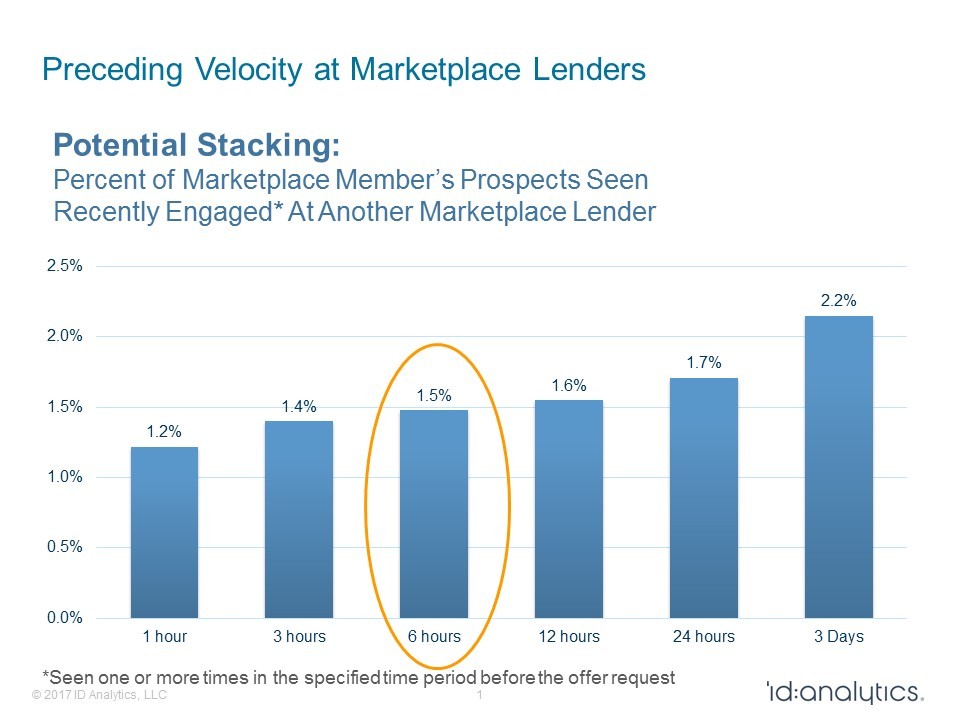
Their network includes business lenders but it’s the individuals behind the businesses that they monitor and data shows that 1.5% of online loan applicants applied for additional loans elsewhere within six hours of submitting their application. Conventional wisdom might suggest that a shopping borrower is an engaged and responsible borrower but ID Analytics’ early research found that this group was twice as risky as the average online loan applicant.
During a brief interview at LendIt, company VP Patrick Reemts said that their service isn’t limited to the point-of-application. Members can monitor their borrowers for up to 90 days and see if they apply for other loans or take other loans, Reemts explained. How lenders make use of that data is up to them though, he added.
Members of the Online Lending Network must report all their volume for the value of the data to be effective. They can’t selectively decide which applicants or borrowers to put in the system. ID Analytics is also not a startup, Reemts said. Having been in business for 15 years, they’re tapped into some of the nation’s largest credit card issuers so they have visibility into traditional credit sources too.
The company is a subsidiary of LifeLock, Inc.
How Whitepages Turned Their Data into an Identity Verification Tool for Online Lenders
March 15, 2017 Whitepages might be a 20-year old company but the data they’ve amassed over time can add significant value to online lenders, the company claims. Whitepages Pro, which offers identify verification, allows lenders to gauge if an individual is real. “It examines fraud risk, not credit risk,” company CEO Rob Eleveld said in a brief interview at LendIt last week.
A simple query of an individual’s name, phone number, email, address or business name will return results not easily accessible elsewhere, like how long that person’s email address has been in their system or the likelihood that the email address was generated by a bot, not a real person. A match is good, no match might not be good, they say. Their system can also do things like identify the carrier the phone number belongs to and whether or not that carrier, if it’s VOIP or something, might have a higher propensity for fraud.
Eleveld said that an impostor could try applying for a loan with a stolen social security number, but it’s harder for them to fake an entire online profile. These queries, he confirmed, can all be done through an API since online lenders are typically driven by speed. Big names are already using it such as Quicken Loans and loandepot, and those are just a couple of names from the online lending space alone.
“The company houses more than 5 billion global identity records,” according to their website, and customers such as “Wells Fargo, Microsoft, Western Union, Under Armour, Priceline, and American Airlines use Whitepages Pro data to mitigate risk and improve the customer experience.”
Kabbage CEO Rob Frohwein Pokes Fun at “Alternative Lending”
March 14, 2017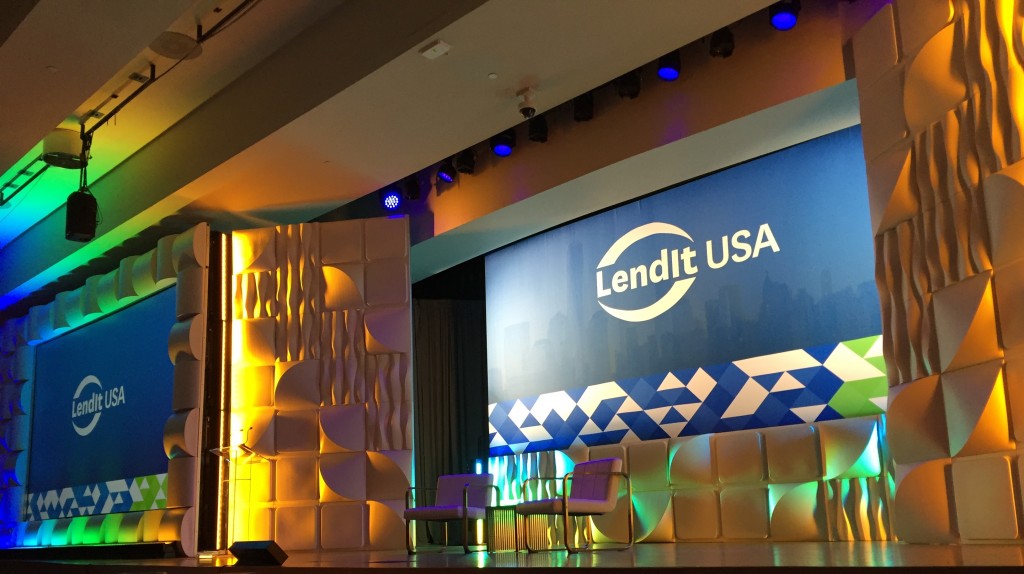 At LendIt, Kabbage CEO Rob Frohwein poked fun at alternative lending, suggesting that it should just be called lending. His presentation, titled “Alternative Lending is Dead Long Live Data,” put the last few years of irrational exuberance into perspective. Below are some of his one-liners:
“You don’t disrupt banks by focusing on the advantages that banks have over you.”
“Most online lenders thought by calling themselves a technology company, they are one.”
“However, the biggest piece of technology that most of them promote is an online application.”
“There’s nothing special about an online application.”
Frohwein also revealed some interesting facts about Kabbage during the presentation, including that their customers borrow from them on average 20-25 times over the course of 4 years, whereas their competitors only make only 2.2 loans to their customers on average.