Last Chance to Comment on SBA’s Proposal to Lift SBLC Moratorium
January 4, 2023 In November, the Small Business Administration formally proposed a rule to lift the moratorium on licenses for Small Business Lending Companies (SBLCs). The moratorium wasn’t some pause borne out of the covid era. It’s been in place since 1982, creating a market of just 14 licensed SBLCs over the span of 40 years. Originally this moratorium had only gone into place because the SBA “did not have adequate resources to effectively service and supervise additional SBLCs” but now in modern times the SBA has determined there’s a problem, “that certain markets where there are capital market gaps continue to struggle to obtain financing on non-predatory terms.” Their solution? Lift the moratorium.
The proposal was published on November 7th and the public’s ability to comment ends on January 6th. One potential outcome of lifting the moratorium is that fintechs could potentially become licensed SBLCs. That appears to be a desired outcome for Funding Circle who shared their comment on social media on Wednesday.
“We need the SBA to lift the SBLC moratorium in order for us to apply to originate 7(a) loans nationally,” Funding Circle wrote. “This would allow us to leverage our platform technology and more than a decade of lending experience to expand access to 7(a) loans for underserved communities and to do so quicker, at a lower cost and with a superior customer experience.”
With more than 60 comments garnered on the proposal so far, Funding Circle is virtually the only fintech to have weighed in at all. A number of comments from the traditional finance realm were highly critical of the idea of allowing fintechs to become SBLCs, citing their supposed inexperience and perceived failures to responsibly dole out PPP funds. Others expressed a belief that the SBA still did not have the resources necessary to supervise additional SBLCs even after 4 decades and that the agency is already stretched too thin as it is.
“SBA should not expand 7(a) Program until it requests, and receives from Congress, an appropriation to fund the additional SBA staff necessary to supervise additional 7(a) lenders,” the American Bankers Association wrote.
There are complexities and nuances to the pros and cons of the arguments, but the opportunity to comment at all is running out. The deadline is Friday January 6th.
Anyone can submit their own comment here.
Update: Upstart, another fintech, had their comment processed by the SBA after this story was posted. The company also supports lifting the moratorium.
How the Amazon / Parafin Merchant Cash Advance Deal Came to Be
November 2, 2022Back in December, Parafin, then a fintech startup with 20 employees, submitted a proposal to Amazon to roll out a potential Amazon merchant cash advance product. At the time, Parafin was little known to the general public and its surprise deal with DoorDash wouldn’t even become public until a month later.
 The prospect of an MCA would not have been foreign to Amazon given that the company already offers direct business loans, lines of credit through Marcus by Goldman Sachs, and other loans thanks to a successful pilot with Lendistry. But the team behind Parafin were virtual unknowns in the merchant cash advance industry itself. The company’s 3 co-founders, including CEO Sahill Poddar, all hail from Robinhood, the investment app that became wildly popular especially with younger adults over the last several years.
Coincidentally, more than a dozen people employed by Parafin, including the co-founders, are former Robinhood employees, according to profiles reviewed on LinkedIn. It’s part of a trend, it appears, as other members of their team hail from well known Silicon Valley firms like Lending Club, Stripe, Funding Circle, Google, Amazon, Facebook, StreetShares, and more.
Ultimately, Parafin’s big bet paid off. On Tuesday, November 1st, Amazon announced that the Parafin team was the one it had chosen to debut its official merchant cash advance product.
“Amazon is committed to providing convenient and flexible access to capital for our sellers, regardless of their size,” said Tai Koottatep, director and general manager, Amazon WW B2B Payments & Lending, in the announcement. “Today’s launch is another milestone in strengthening Amazon’s commitment to sellers, and builds on the strong portfolio of financial solutions we already provide. This latest offering significantly expands sellers’ reach and capabilities, and broadens their access to capital in a flexible way—one that helps them control their cashflow, and by extension, their entire business.”
“We founded Parafin with the mission to grow small businesses, and we’re thrilled that we have the opportunity to do that by providing Amazon sellers with this merchant cash advance option,” said Vineet Goel, co-founder of Parafin. “It’s a privilege to count ourselves among Amazon’s suite of financial solutions, and we look forward to making a difference for Amazon.com sellers looking to expand their business.”
The product is already listed on Amazon’s website and was rolled out to some US businesses immediately. It will be available to hundreds of thousands of additional sellers by early 2023, the company claims.
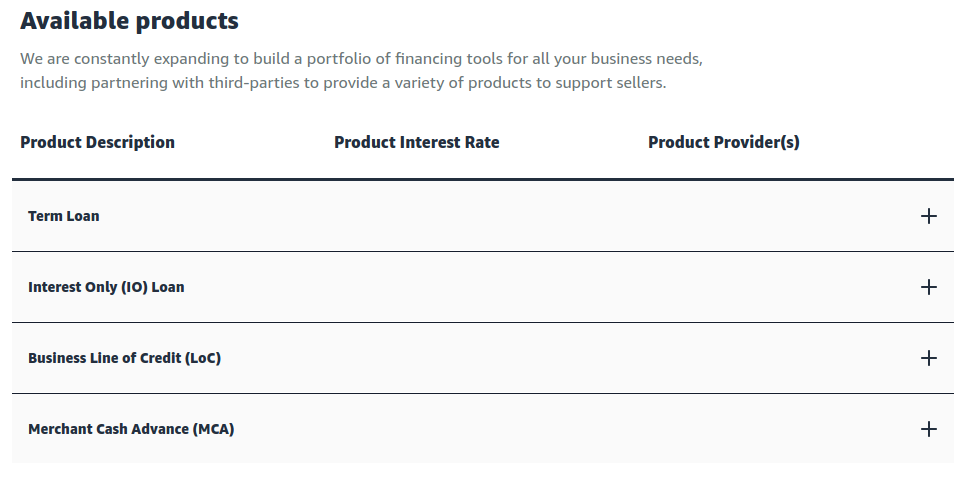
Unique to an Amazon MCA is that funding amounts can start as low as $500 and go up to $10 million.
Amazon’s entrance into the merchant cash advance market coincides wih a unique moment in the product’s history as several states are in the midst of imposing strict regulations on their sale.
IOU Financial Originated $161.5M in Loans in 2021
March 22, 2022 IOU Financial is coming off of its biggest year ever. The company has revealed total loan originations of $161.5M for 2021, up nearly 100% year-over-year. The figure puts it ahead of rival Funding Circle USA in 2021, according to origination data compiled by AltFinanceDaily.
In a public statement, IOU President and CEO Robert Gloer said, “The success of IOU’s marketplace strategy announced in 2021 is allowing us to scale up faster than previously possible. We’re proud of the team for breaking new origination records and giving us the extra latitude to further reduce corporate debt.” The latter comment was in reference to the company’s intention to repurchase approximately $1.2 million of its convertible debentures at par.
IOU’s full year 2021 financials are expected to be released next month.
Congress Introduces New Restrictive Small Business Financing Bill
November 19, 2021 A new bill introduced by Rep. Nydia M. Velázquez, the Chairwoman of the House Small Business Committee, and Senator Robert Menendez (D-NJ), hopes to “stop predatory small business loans” by applying broad consumer protections to small business borrowers nationwide.
This would be done by including small businesses as a covered party under the already existing Truth in Lending Act (TILA).
The proposal, if successful, would arguably become more restrictive than New York’s recently passed commercial financing disclosure law.
Among the supporters of the bill are LendingClub and Funding Circle. No republican members of congress are listed among the sponsors in the official announcement.
The bill is similar to one introduced last year that failed to advance, the Small Business Lending Disclosure and Broker Regulation Act of 2020. That bill never made it out of the House Financial Services Committee. The makeup of Congress now, however, is different than it was last year.
SBA Task Force Set to Begin Campaign
October 19, 2021 In response to an unprecedented economic situation, a mixed group of regulators, bankers, small business owners, funders, attorneys, and social media representatives are coming together in a task force to work with the SBA, members of Congress, small businesses and entrepreneurs to transition small business into a “new phase.”
Dubbed the SBA Task Force at last week’s Bipartisan Committee summit on small business recovery, the group’s goals are to address the state of small business in the U.S., how the current economical and political climate is impacting the practices of merchants across the country, and to address concerns from interested parties directly to the federal government.
“The SBA is at a crucial moment: its laudable performance during the COVID crisis has thrust upon the agency new expectations and new responsibilities,” said Pradeep Belur, former COO of the SBA and co-chair of the committee. “To fulfill those, [the] SBA needs not only enhanced capacity but also modernization to enable it to execute effectively. I’m honored to help chair this task force and pursue measures that will support the agency and help the heart of America’s economy.”
Alongside Belur as co-chair of the committee is Ann Marie Mehlum, a Senior Advisor at FS Vector with almost four decades of experience in banking. Much like Belur, Mehlum is committed to continue the largely unfinished project of improving the operating conditions for small businesses.
“The work of assisting small businesses is never finished—the SBA has continually sought to respond to new needs and reach more types of small companies,” Mehlum said. “The members of this task force, which I’m delighted to help chair, are committed to working with the agency and Congress to improve the ways in which that work is carried out.”
The founder of the committee, Angela McIver, is the owner of an after-school math program for children based in Philadelphia. When faced with pandemic related troubles, McIver pivoted her business from a brick and mortar learning program into a fully virtual, nation-wide learning platform.
“One of the smartest things I did was develop a relationship with a community bank” said McIver, when asked what advice she would give to small businesses at the BPC’s summit. “We didn’t have a lot of the challenges that small businesses had because we had a relationship with a small bank that knew who we were, knew our challenges, and [they] were able to step in when it was necessary.”
Other members of note on the force are Christopher R. Upperman, a Manager & Team Lead in the Governance Organization at Facebook, Jessica Johnson-Cope, President, Johnson Security Bureau and co-chair of the 10,000 Small Businesses Voices National Leadership Council, and Ryan Metcalf, Head of U.S. Public Policy and Global Social Impact at Funding Circle.
“Our participation in the BPC’s task force reflects our ongoing commitment to advocate for government policies that are in the best interest of small business owners” said Metcalf, exclusively to AltFinanceDaily. “We truly believe that the strongest path forward for the SBA involves leveraging the proven capabilities of fintechs to quickly and efficiently reach typically underserved communities through a modernized approach to government-backed small business lending.”
Metcalf and his company seemed to be excited to take part in the committee, having a direct impact on the space in which their business operates. “On behalf of Funding Circle, I look forward to working with stakeholders across the lending landscape to support an effective bipartisan SBA reauthorization that best prepares the agency to help small business owners,” he said.
Members of the committee are confident that the group will help modernize the practices of the SBA while also empowering them. “The government agency dedicated to supporting [small businesses] must do the same and adapt its systems and programs to support that evolution,” said BPC Board Member and former Senator and Chair of the Committee on Small Business and Entrepreneurship Olympia Snowe. “I’m confident that this task force will successfully develop ideas and recommendations to enable the SBA to do that.”
Fintech Lenders Did Better Job Meeting Intentions of the CARES Act, Study Finds
February 18, 2021 Fintech lenders doling out PPP not only reached smaller businesses on average but played an essential role in extending PPP loans to Black-and Hispanic-owned businesses, according to a study conducted by professors at the NYU Stern School of Business.
“Fintech lenders originated much smaller loans than other lenders, suggesting they served smaller firms on average,” researchers found. “Overall, we find that, relative to other lenders, [Minority Development Institutions] nonprofits, and fintech lenders make a substantially larger share of their loans to minority borrowers, particularly Black- and Hispanic-owned businesses.”
The team of economists looked over 3.4 million PPP transactions to determine what category of lenders had the highest minority share among their loans. Ryan Metcalf, Head of Public Policy for Funding Circle, member of the Innovative Lending Platform Association (ILPA), shared the full study on LinkedIn, pointing out that six ILPA members had contributed to saving jobs.
“(Funding Circle US, BlueVine, Kabbage, Inc, OnDeck, Fundbox, Lendio) provided more than 476,000 #PPP loans totaling $16.5 billion with an average loan size of ~$30,000, median loan size of $15,000, and helped save more than 2 million jobs,” Metcalf wrote. “And that was just in 2020.”
The study found that fintech lenders did a better job meeting the intention of the CARES act. While most lenders were giving out larger loans to large firms, fintech better reached actual small businesses with smaller loans on average.
“Section 1102 of the CARES Act explicitly specified that the program should prioritize ‘small business concerns owned and controlled by socially and economically disadvantaged individuals,'” they wrote. “However, the SBA did not issue specific guidance for distributing the loans, leaving private financial institutions administering the loans to independently determine which businesses to serve first or at all.”
Instead, as has become clear, many funds went to larger firms and seemed to miss minority communities. The team compared the mean and median loan amounts for different Lenders, finding the smallest in both types were fintech loans.
Researchers put first and last names through a mathematical model to predict race because that data was not available from the majority. Then predictions were compared to the sample borrowers that self-reported race. The algorithm was 78% accurate in guessing black names, 84% in guessing Hispanic, 95% for Asian, and 99% accurate for white names.
2021: The Year of Uncertainty
January 7, 2021 For alternative lenders and funders, 2021 is starting out with a question mark and will lead (hopefully) to a resounding exclamation point of recovery.
Many industry participants waved goodbye to 2020 with relief, and are welcoming a bounce-back in 2021, despite some trepidation about potential bumps along the way and how long a full recovery will take. While things started to improve somewhat toward the latter half of 2020 after grinding to a halt earlier in the year, the pandemic is still raging, with economic growth highly dependent on the immunization trajectory. Then there’s the incoming Democratic administration and the possibility of new rule- making, along with January’s runoff elections in Georgia that could change the balance of power in the Senate, and thus impact the new president’s law- making abilities.
Beyond these macro-issues, the funding industry is also dealing with its own uncertainties. Small business lenders and funders have been hit particularly hard, with underwriting decidedly more difficult in this environment. Some industry players have been forced to find alternative revenue streams in order to ride things out. Not only that, but there are scores of small businesses still reeling from pandemic-induced shutdowns and lighter foot traffic, with some gloomy estimates about their ability to bounce back. Many alternative players are weighing diminished returns against a widely-held bullish outlook for the industry long-term. Many are simply hoping they can hunker down and stick it out long enough and to avoid additional carnage and consolidation that’s widely expected over the short-term.
Ultimately things will get better, but it’s unclear precisely when, says Scott Stewart, chief executive of the Innovative Lending Platform Association. “It’s going to be a bumpy ride for the next year to figure out who is going to be able to survive,” he says.
Here’s a deeper dive into how industry participants see 2021 shaping up in terms of the challenges, competition, M&A, regulation, changing business model, expansion opportunities and more.
SPECIFIC CHALLENGES FOR SMALL BUSINESS FINANCERS
Companies that focus on consumer financing haven’t struggled quite as much amid the pandemic as their small business brethren, and they could continue to see demand grow in 2021. Even amid high unemployment rates, many consumers still need loans for home repairs or as a stop-gap to pay necessary expenses, helping to mitigate the impact on firms that focus on personal loans.
Small business financers, however, got pummeled in 2020 and the situation remains precarious, especially given the prognosis for small companies broadly. Consider that 163,735 Yelp-listed businesses closed from the beginning of the pandemic through Aug. 31—at least 97,966 of them permanently. Further underscoring how dire the situation is for small businesses, 48 percent of owners feared not earning enough revenue in December to keep their businesses afloat, according to a recent poll by Alignable, an online referral network for small businesses. What’s more, 50 percent of retail establishments and 47 percent of B2B firms could close permanently, according to the poll of 9,204 small business owners.
A SHRINKING COMPETITIVE LANDSCAPE
For many lenders and funders, the latter part of 2020 proved more successful for originations, though business is still a far cry from before the pandemic. A number of players who suspended or reduced business operations for a period of time during the first wave of the pandemic have dipped their toes back in and are in the process of trying to adapt to the new normal. For some, though, the challenges may prove too great, industry observers say. Given that many brokers and funders that were on the fringe have been hurt by the pandemic, more shake- out can be expected, says Lou Pizzileo, a certified public accountant who advises and audits alternative finance companies for Grassi in Jericho. N.Y.
And, with fewer competitors, there will be more of a need for those who are left to pick up the slack, says Peter Renton, founder of Lend Academy. Beyond being a lifeline for many alternative financers, PPP loans helped open the eyes of many small businesses who hadn’t previously considered working with anyone but a bank. In the beginning, when it was so difficult for small businesses to get these funds, they looked beyond banks for options and some found their way to online providers. This could be a boon for the industry going forward since alternative providers are now on the radar screen of more small businesses, says Moshe Kazimirsky, vice president of strategic partnerships and business development at Become.
He predicts that larger, stronger players will gradually ease some of their lending and funding criteria early on in 2021, but no one is expecting a quick revival, with some predicting it could be well into 2022 before the industry is on truly stable footing. “I think it’s going to be a very slow recovery,” Kazimirsky says.
M&A
In 2020, the industry saw bellwethers like Kabbage and OnDeck get swallowed up, and with so many businesses pinched, there are likely to be more bargains ahead from M&A standpoint, Pizzileo says. “The damage from Covid is palpable; we just haven’t seen the real impact of it yet,” he says.
No matter what product you are providing, if you’re a smaller player who can’t find your way, you’re going to have a hard time staying in business,” says Stewart of the Innovative Lending Platform Association. “There will be some collateral damage going into next year,” he predicts.
In terms of likely buyers, Renton says he expects other fintechs to step in, and possibly even mid-size community banks snap up some alternative providers. If you can buy something for “a song” it’s compelling, he says. “I expect to see a few more offers that are too good to refuse,” he says.
CHANGING BUSINESS MODELS
Pizzileo, the CPA, predicts there will be ongoing opportunities in the year ahead for well-positioned, strong businesses with available capital. In some cases, however, this may require tinkering with their existing ways of doing business.
Before the crisis, some lenders applied the same or very similar lending model across industries. “That is going the way of the dinosaur. That’s not going to be a successful model going forward,” Renton says. Lenders will focus more on having a differentiated model for the businesses they serve. “I think the crisis created this necessity to treat each industry on its own merits and create a model that has some level of independence, he says.
The year ahead is also likely to be one in which e-commerce lending continues to thrive. According to the third quarter 2020 report from the U.S. Census Bureau, U.S. retail e-commerce stood at $209.5 billion, up 36.7% year over-year. E-commerce accounted for 14.3% of total retail sales in Q3. Because it’s such a high-growth area, and many businesses that didn’t have this vertical before are moving in this direction and more lenders are focusing on it and growing that part of their business, says Kazimirsky of Become.
It will also be interesting to watch how lenders and funders continue to reshape themselves. Sofi, for instance, is continuing to pursue its goal of receiving a national bank charter. Other lenders and funders may also seek to reinvent themselves as they attempt to stay afloat and compete more effectively.
“Monoline lenders that rely on a single product will have more difficulty supporting customers in the wake of Covid,” says Gina Taylor Cotter, senior vice president and general manager of global business financing at American Express, which purchased Kabbage in 2020. “Small businesses need multi-product solutions to not only access working capital, but also real-time insights to help them be more prudent with their cash flow and accept contactless payments safely to encourage more business,” she says.
CHANGES IN RISK MODELING
Another pandemic-driven change is that lenders have had to tweak their risk modeling. Everyone understands the economy is not in the greatest spot, but their challenge in 2021 will be developing a way to assess future losses in the absence of a baseline, says Rutger van Faassen, head of product and market strategy for the benchmarking and omnichannel research group at Informa Financial Intelligence.
Consumer behaviors have changed, for instance. So even though the pandemic will end, it’s too soon to say what the structural impacts on an industry will be and how that affects the desirability of lending to especially hard-hit businesses, such as restaurants, cruise lines and fitness centers. “Clearly the behavior that everyone is showing right now is because of the pandemic. The question is: how will people behave once the pandemic ends,” he says.
“In the meantime, a lot of lenders will have to do more in-the-moment decision-making, until we get to a point when we’re truly in a new normal, when they can start recalibrating models for the longer-term,” he says.
OPPORTUNITIES TO HELP SMALL BUSINESSES
One certainty in the year ahead is the need to help existing small businesses with their recovery, says Cotter of American Express. “Small businesses represent 99 percent of all jobs, two-thirds of new jobs and half of the non-farm GDP in America. Our country’s success depends on small businesses, and financial institutions have a great opportunity to meet their needs to recover and return to positions of growth in 2021,” she says.
How to make this happen is something many alternative financers will grapple with in 2021. Another opportunity may exist in providing funding solutions to new businesses or those that have pivoted as a result of the pandemic. Cotter points to the inaugural American Express Entrepreneurial Spirit Trendex, which found 76% of businesses have already pivoted their business this year and 73% expect to do it again next year. “New-business applications have reached record heights as entrepreneurs pivot and adapt, indicating a surge of new ventures that will require financial solutions to build their business,” Cotter says.
REGULATORY WATCH
Several regulatory issues hang in the balance in 2021, including state-based disclosure laws, expected rules on third-party data aggregation and demographic data collection, and the status of a special purpose charter for fintechs, says Ryan Metcalf, head of U.S. public policy, regulatory affairs and social impact at Funding Circle. With a new administration coming in, the regulatory environment could become more favorable for measures that stalled during Trump’s tenure.
Armen Meyer, vice president of LendingClub and an active member of the Marketplace Lending Association, says he’s hoping to see a bill pass in 2021 that requires more transparency for small business lending. He would also like to see more states follow the lead of California and Virginia and make the 36% interest rate standard of Congress’s Military Lending Act, which covers active- duty service members (including those on active Guard or active Reserve duty) and covered dependents, the law of the land. “We’re calling for this to be expanded to everybody,” he says.
CANADA
Meanwhile, our neighbors to the North have their own challenges and opportunities for the year ahead. The alternative financing industry in Canada originated out of the 2008 recession when banks restricted their credit box and wouldn’t lend to certain groups. While conditions are very different now, “this period of economic uncertainty is going to be an incredible fertile period of time for fintechs to come up with new and interesting and creative credit products just like they did entering the last financial crisis,” says Tal Schwartz, head of policy at the Canadian Lenders Association.
Open banking continues to be on the Canadian docket for 2021 and how the framework shapes up is of utmost interest to fintech lenders in Canada. Schwartz says he’s also hopeful that alternative players in Canada will have a role to play in subsequent government- initiated lending programs. He’s also expecting to see more growth in the e-commerce area, particularly when it comes to extending credit to e-commerce companies and in financing solutions at checkout for online shopping.
Ho Ho… Hold Up. NY Governor Signs Industry-Altering Small Business Lending Law
December 24, 2020 Merrrrry Christmas. New York Governor Andrew Cuomo reportedly signed SB 5470 into law late last night, a bill that forever changes and complicates nearly all forms of small business financing in the state.
The law gives regulatory enforcement authority to New York’s Department of Financial Services, requires APR disclosures on contracts where one can’t be mathematically calculated, and mandates that customers be told if there is any “double dipping” going on. And that’s just the beginning of what it contains.
A coalition of small business capital providers fiercely opposed the language of the bill. Steve Denis, executive director of the Small Business Finance Association, wrote in an op-ed that “the lack of cogency and lazy approach to this legislation is a disservice to the hard-working entrepreneurs who continue to open their businesses while facing daily economic uncertainty.”
The bill was also opposed by fintech lenders like PayPal.
Proponents of the bill celebrated the news on social media in the early morning hours of Christmas Eve.
Ryan Metcalf at Funding Circle, a company not even based in New York that moved all of its tech jobs out of the US to the UK this summer, wrote on LinkedIn that the bill will “save New York #smallbiz between $369 million and $1.75 billion annually.” Funding Circle, as a member of the Responsible Business Lending Coalition (RBLC), was heavily engaged in the advocacy process.
Several of RBLC’s members have already ceased small business lending in the US, some permanently.
Unique circumstances also exist at an ally of the RBLC, the Innovative Lending Platform Association (ILPA), which Funding Circle is also a member of. Two out of the 11 members were acquired before the bill could even be signed, Kabbage and OnDeck.
NY State Assemblyman Ken Zebrowski and State Senator Kevin Thomas, who sponsored the bill, cheered the signing of it.
“Thanks to Governor Cuomo for signing our Small Business Truth in Lending Act,” Zebrowski tweeted. “Extremely proud to have worked with many to establish the most comprehensive small business disclosure law in the nation. With the pandemic surging on, small biz owners need these critical protections now.”
“The signing of the New York State Small Business Truth in Lending Act is a victory for New York’s small business owners,” Thomas wrote on twitter. “Thank you for signing New York’s first-ever small business lending transparency bill into law.”
“I think that the companies and organizations that support this legislation don’t fully understand what’s actually in the bill,” SBFA’s Steve Denis said to AltFinanceDaily in August. “[…] They have no problem pounding the table and taking credit for its passage, but I guess they don’t realize it will subject them and the rest of the alternative finance industry to massive liability, massive fines—upwards of billions of dollars worth of fines.”
And yet Senator Thomas tweeted, “This will help a lot of small businesses trying to get back on their feet during this pandemic.”
It is unclear, of course, who they expect to provide such capital now to do this.