
Shopify Capital Originated $430 Million in Loans and MCAs in 2019
February 17, 2020 Shopify Capital, the e-commerce giant’s small business financing arm, originated $430 million in funding through loans and merchant cash advances in 2019. Shopify now has more than 1 million e-commerce merchants on its platform, the company says. Earlier in the year the company began rolling out funding to merchants that are not using its payment service.
Though 2019 year-end reporting for the industry is still sparse, the company’s origination figures will likely cause Shopify to move up the rankings maintained by AltFinanceDaily.
PayPal, who AltFinanceDaily predicts will keep its #1 spot, did not disclose its annual origination figures in its already-reported Q4 earnings.
Idea Financial Chimes In On New Hire
February 17, 2020 Last week Idea Financial announced that it had appointed Gregory Sandler as its Chief Operating Officer and General Counsel. Having served as General Counsel to both Beyond Finance and Spruce Finance after working as VP and Corporate Counsel to Bayview Asset Management, Sandler believes he’s well positioned to help Idea.
“I have a sense of gratitude to them, because I feel like I’m piggybacking on a lot of the hard work they’ve already done over the last three years,” Sandler told AltFinanceDaily in a phone call. “But part of the reason for bringing me on I think is that as we move from a startup to a more mature company certain skill sets are needed, and they put the trust in me that I have the skill set that can help them get to that next level.”
Before providing counsel to alternative finance companies, Sandler served as an Associate Director at Bear Stearns in the mids-2000s.
“We’re about to cross into our one hundred million dollars in funding threshold, which is a big deal, very soon,” Justin Leto, CEO of Idea, explained over the phone. “That’s a major accomplishment, and it just shows that we’re in a position right now where bringing on the strongest and the brightest people is exactly what we need. And I think Greg is a symbol of what this company has become and what it will continue to be.”
N26 Exits UK Market Citing Brexit as Reason
February 13, 2020 The challenger bank N26 pulled out of the UK market this week, citing Brexit as the reason for its departure. Saying that it will no longer be able to service Britain now that it has left the European Union, N26 has stopped onboarding new customers and will be closing all British accounts on April 15th.
The news came as a shock to many N26 users as the company has, as recently as October 2019, published multiple blog posts assuring customers that Brexit will not disrupt their service. These posts have since been deleted.
In a statement, the neobank advised its UK customers to empty their N26 accounts before April 15 and apologized for the inconvenience. “With the UK having left the European Union, N26 has today announced that it will be leaving the UK market. The timings and framework outlined in the Withdrawal Agreement mean that the company will in due course be unable to operate in the UK with its European banking license.”
Having its headquarters in Berlin, the neobank holds a German banking license. Under EU law, passporting rights enable any banks that hold a charter granted by an EU member state to operate in any other EU country. And while this of course means that N26’s license will no longer be enough for the UK market, temporary permissions exist that allow EU fintechs and financial services companies to continue operating under the same rules until December 31st, 2020, allotting time to draw up new deals and ink new charters.
This detail, as well as the fact that none of N26’s competitors, Revolut, Starling Bank, and Monzo, have announced their exit, has led commentators to reason that the high investment cost associated with applying for a UK banking charter is influencing the decision to pull out, rather than the feasibility and process required.
Speaking to AltFinanceDaily, a spokesperson for Starling said that “We’re not affected by N26’s decision. Some digital banks appear to have been focusing on growth at all costs. At Starling, we’ve always gone for sustainable growth and have long mapped out our path to profitability. We expect to hit breakeven by the end of 2020 and to turn a profit by the end of 2021.”
Having entered the UK market in October 2018, more than two years after the leave vote, N26 will be cutting service to its +200,000 UK customers. Most of the dozen or so staff members the neobank had in Britain will be repositioned elsewhere in the company, which has offices in Berlin, Barcelona, São Paolo, Vienna, and New York.
The challenger bank has been available in the States since August 2019, garnering over 250,000 customers in the market since then. Valued at $3.5 billion in its July funding round, N26 has received investments from Peter Thiel’s Valar Ventures, Li Ka-shing’s Horizon Ventures, and China’s Tencent Holdings Ltd.
New York Appellate Court Overturns QFC, LLC v Iron Centurian, LLC
February 7, 2020The Appellate Division, 2nd Department of The Supreme Court of New York, overturned QFC, LLC v Iron Centurian, LLC and Mohamed Sadiqui last month, granting victory to a merchant cash advance company. The case can be summed up as follows:
A Confession of Judgment (COJ) was filed by plaintiff against defendants for breach of contract. Defendants argued by way of motion that the COJ should be vacated and agreement voided because the underlying transaction was really a criminally usurious loan. The trial court concurred and ruled in favor of defendants, vacating the COJ and voiding the “illegal” merchant cash advance transaction.
Plaintiffs appealed.
On January 29, 2020, the Appellate Division unanimously sided with the plaintiffs and overturned the lower court’s decision. Similar to two other rulings issued the same day (Volunteer Pharmacy, Micromanos), the Court said that a COJ cannot be vacated in the manner in which defendants sought it.
Goldman Sachs-Amazon Deal to Offer Small Business Loans in the Works
February 3, 2020
Tech giant Amazon is reportedly in talks with Goldman Sachs to offer business loans to those small and medium sized merchants operating on its marketplace, according to sources that the FT describes as “two people briefed on the discussions with the online retailer.” One of these sources said that it could launch as soon as March.
The news comes after CEO David Soloman spoke at the bank’s Investor Day recently, explaining that Goldman would be pursuing a “banking-as-a-service” model this year that would see the bank white labeling their products for third parties to use. As well as this, Solomon commented on a shareholders call last week that the bank is seeking to increase revenues from new channels such as consumer banking and wealth management.
One such channel is Goldman’s partnership with Apple last summer that saw the launch of Apple Card, a credit card solely available to Apple’s +100 million users in the US. The card’s launch was lauded by Solomon; and according to Business Insider, cardholders had $736 million in loan balances by the end of September, one month after the card was released to the public.
The Apple and Amazon deals highlight how Wall Street banks are employing and partnering with Big Tech to leverage advantage over fintechs, and ultimately gain access into markets that are historically not domains of the uber rich. Traditionally a bank that catered to elites, Goldman Sachs has been edging its way into consumer and small business banking ever since the launch of Marcus, its personal banking platform.
Amazon has been offering loans to merchants on its platform since 2011, using algorithms to determine which sellers would be best positioned to receive and repay a loan. Having previously partnered with Bank of America to finance such loans, the terms of these were for 12 months or less, with amounts funded ranging from $1,000 to $750,000. According to the FT, Amazon had $863 million in outstanding SMB loans on its balance sheet as of the end of 2019.
The digital nature of Amazon’s marketplace would accommodate Goldman Sachs’ neglect of brick-and-mortars stores, which have historically been a waypoint for small- and medium-sized businesses seeking finance.
LendIt Chairman and Co-founder Peter Renton described Goldman’s progression in the fintech space as “impressive,” noting that the speed at which it has been operating isn’t to be overlooked: “I thought something like this would happen but not in such a short space of time. Apple Card was only six months ago.”
As well as this, Renton was wary of how expansive the deal would be, admitting skepticism of it being a large project for either company. Given how both Amazon and Goldman have shown themselves to be selective in who they provide financing for, this assessment may prove correct.
One Of The Most Devastating Court Decisions Against Merchant Cash Advances Has Been Overturned
January 29, 2020 Merchant Cash Advances have sat on comfortable legal footing in New York ever since an appellate court ruled in favor of Pearl Beta Funding, LLC against Champion Auto Sales, LLC in 2018, but even so, it hasn’t stopped lawyers from trying to invalidate merchant cash advance (MCA) contracts on behalf of aggrieved customers.
That’s because an MCA provided by New York-based Merchant Funding Services LLC to a business known as Volunteer Pharmacy in 2016 was ruled by New York Supreme Court Judge David F Everett to be so “criminally usurious on its face” that the normal process required to vacate a Confession of Judgment could simply be bypassed without even having to evaluate the merits of each side’s arguments and the matter automatically won in favor of Volunteer Pharmacy. The judge’s written decision, which voided the MCA contract ab initio, was replete with a scathing opinion of MFS’s business model.
The decision quietly stunned the merchant cash advance industry. MFS understandably appealed.
Dozens of lawsuits against MCA companies in the ensuing years went on to cite Judge Everett’s decision in Volunteer Pharmacy with limited success. And while the industry sat around to find out what would happen in that case, Pearl Beta Funding, a rival to Merchant Funding Services, won an appeal of its own, the landmark usury case in March 2018 that seemingly solidified once and for all the commonly held understanding that such MCA agreements were not usurious.
Despite this, the uncertainty of Volunteer Pharmacy still lingered in the background, that is until now.
On January 29th, 2020 the Appellate Division, 2nd Department, of the Supreme Court of New York, overturned Judge Everett’s decision and ruled in favor of Merchant Funding Services. The panel of judges said they need not even weigh a lot of Everett’s contentions because he was wrong on the underlying procedural issue, that a judgment by confession could be vacated in such an instance without having to go through the normal legal process.
The ruling ultimately provides clarity on the process that determines how a judgment by confession can be vacated. One major impact is that lawyers seeking to invalidate merchant cash advance agreements will no longer have Volunteer Pharmacy as a crutch to rely on.
Report Finds Canadian Alternative Lending Market Making Gains
January 8, 2020 A study released by Smarter Loans this week indicates that the Canadian alternative finance industry has grown since last year’s iteration of the report. Titled ‘The State of Alternative Lending in Canada 2019,’ the report highlights how the market has developed in regard to the age and gender of its customers, the level of trust in online lenders compared to financial institutions, as well as the levels of satisfaction felt by Canadians dealing with alternative funders.
The first of these, regarding aspects of the customers’ identities, demonstrates that generational gaps are as wide as they’ve ever been amongst customers. Each age bracket questioned by the study showed differing priorities when seeking a loan. Generation Z, fitting in between those aged 18-24, paid attention to funders’ track records and reputation when looking for funding; whereas millennials (25-34) sought speedier applications and approvals. Generation X (45-54) however appeared more money-minded, with the priority being placed on terms and interest rates; and Baby Boomers (55-64) demonstrated a desire for having someone to talk to, putting customer service at the top of their list.
Vlad Sherbatov, Smarter Loans’ President and Co-founder, told AltFinanceDaily that these differences can be summed up as the values each generation has developed through experience. Explaining that Gen Z is “all about the personal brand,” Sherbatov said, “People that are younger now really associate with the company they work for, they ask, ‘Am I aligned with or would I be embarrassed supporting this brand?’” While the Millennials’ response indicates a greater desire for results, “as the age progress the intent increases.” Gen X is “more educated and experienced people,” who appear to place the greatest importance on money; and Baby Boomers, the least digitally fluent group, just want the online applications to go smoothly and to have ready access to assistance.
As well as age, gender appeared to divide customers, with women more likely to spend more time researching loan providers than men; and more men saying that they were interested in approaching a traditional financial institution for a loan in the future, with half of them being of this opinion compared to just 39% of women. As well as this, it was found that women are more likely to find the application easier, but are less likely to be approved than men.
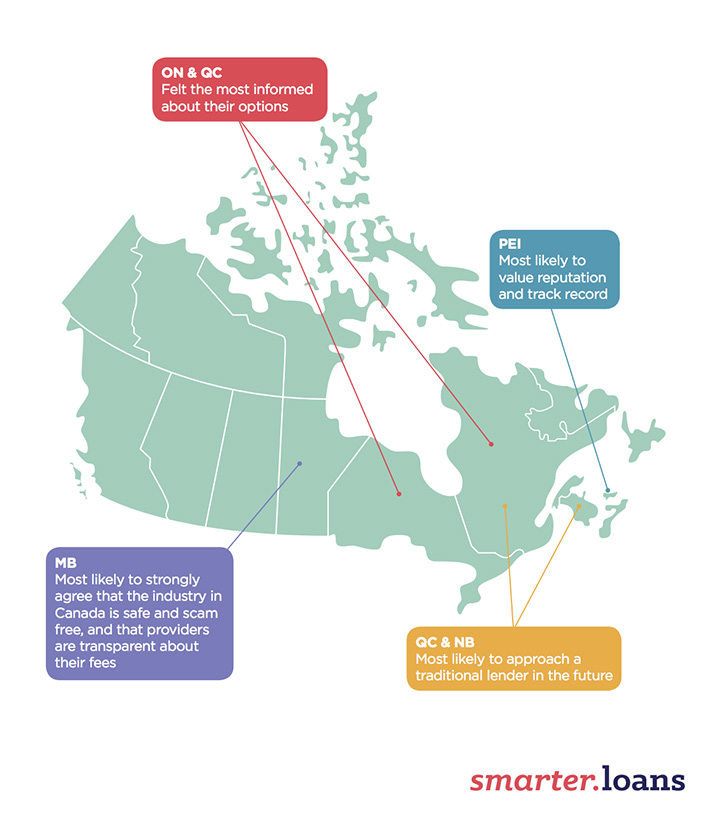
Regarding trust and transparency, roughly 70% of Canadians believe alternative finance to be a safe way of getting a loan. With 80% of customers feeling that they are informed enough of the industry’s practices and 69% saying that they believe online loan providers are transparent about their fees, interest rates, terms, and conditions.
According to Sherbatov, “this is a trend that’s been moving in a positive direction” over the years. With the 2018 version of this study emphasizing the need to build trust with Canadians to reduce that 30% which is holding out on, Sherbatov maintains the need to do more. “The more transparency from lenders, the more trustworthy it’ll be, the further the industry will advance.”
Customers appear to be mostly satisfied with the service they received from alternative lenders in 2019, with the average rating taken from the 2,415 respondents being 3.4 out of 5. This being a 0.2 bump up from last year’s score. Interestingly, one of the sectors reporting the highest levels of satisfaction were those customers who received payday loans, noting that they appreciated the speed with which they were approved.
Altogether, the report paints a picture of the Canadian scene as a market still in flux, where growth is happening, albeit slight, and both the customers and the lenders still have much to learn from each other.
United Capital Source Placed $199M In Deals In 2019
January 5, 2020 United Capital Source, a commercial finance brokerage based in New York, placed 3,883 deals in 2019 for a grand funding total of $199.3 million. Company CEO Jared Weitz said on LinkedIn of the milestone, “Our employees all saw growth (again) this year both professionally and personally. As we come into 2020 we are going into our 10th year of business!!!!! I cannot wait to see what these next year(s) hold for us. I’m so thankful for our Funding Partners and most of all our wonderful staff.”
Weitz is scheduled to speak at deBanked CONNECT MIAMI on January 16th at the Loews Hotel on a panel discussion about how to make money in 2020.