The Aftermath: What Industry Experts Had to Say About The Future Alignment of People and Data
July 20, 2020
Like never before, the ways in which people and data are employed are overlapping more in a post-covid economy. Nearly three months of slow-down and, in some cases, complete economic shutdown have forced brokers and funders alike to view businesses differently than before. New documents, metrics, and terms are being incorporated into underwriting with the belief that it will provide a much more comprehensive picture of each business applying for funding.
Broker Fair Virtual took the chance to explore these new perspectives in The Aftermath, a panel featuring Moshe Kazimirsky, VP of Strategic Partnerships and Business Development at Become; Heather Francis, CEO of Elevate Funding; and David Snitkof, Head of Analytics at Ocrolus. Here, the industry experts discussed what the future of data and people may look like, what the new things that funders are looking out for are, and how the coronavirus has changed consumer and merchant behavior.
First up was Heather Francis, who gave a run down of how Elevate has adapted to the constantly shifting environment created by covid-19. “There were slim pickings on what we could fund,” Francis noted of the early lockdown period. Explaining that many businesses didn’t fit their criteria in the early days of lockdown, Elevate began the process of including new metrics and lenses through which to ascertain if businesses were financially viable.
National, state, and local restrictions became a daily check-in, rather than monthly; with one person being assigned to cover changes in local and even county regulations. As well as this, Francis explained that the company shifted its focus from underwriting the business owner’s activity to underwriting the consumers’ activity. This meant that foot traffic was constantly reviewed via FourSquare, trends that showed which industries were seeing upticks and downturns were monitored, and what customers in varying geographies were comfortable with was gauged.
 “There are some areas in our country that were not heavily impacted,” Francis explained, commenting on the discrepancies between locations, particularly for bars and restaurants. “I know some of us have our optics on what’s going on in our daily lives, and a lot of people in our space are located in New York or California, and these were the very heavily regulated areas where everything was shut down and there was not much to do. Here in Florida, it was easier, with open-seating dining.”
David Snitkof echoed Francis’s points, saying that “the old way of businesses underwriting credit is no longer sufficient … If you were to only look at people’s repayment histories, their credit profiles, and things like that, you wouldn’t get all the data you need to make the right decision. Generally there’s this idea that the past is prologue and the greatest predictor of future results is past behavior, and this type of pandemic makes that no longer the case … we need to think beyond the traditional data sets that people have used to underwrite credit.”
According to Snitkof, the old models for underwriting and funding have been overturned, with funders adhering to three principals going forward as they chart new methods: more data, more time, more detail. This means incorporating more data and analytics than before, pushing for more data-driven strategies; requesting information and data from merchants that cover longer periods of time, with the hope of gaining further insight into the pattern of the business; and upping the thoroughness with which each merchant is scrutinized, recording more information that is unique to their industry, location, and business management.
“Lenders will realize that in order to make a credit decision, we need to have access to very deep, detailed, and wide time-framed data of our customers; and we need to be able to process it in an automated and efficient way,” Snitkof asserted.
Still, while it looks like data is due to play a larger role in the future, Heather Francis took care to mention that important data is currently missing from their metrics. Credit and delinquency reporting are on hold, just as rent is paused for many tenants; meaning that in two or three months, many funders could be in for a surprise when they realize their merchant is having trouble.
 Speaking on the Paycheck Protection Program as well as the Economic Injury Disaster Loan, both Snitkof and Francis expressed that while it is good to see deposits for the government programs, questions must be asked regarding them. They can’t be viewed as revenue, since they do not reflect a business’s ability to generate revenue, said Snitkof, but rather they offer a chance to view how a company manages its cash-flow, with how they spread out PPP and EIDL funds being a key insight.
Looking forward, the panelists noted that the experiences of economic shutdown; PPP; EIDL; and how many business owners’ banks supported, or did not support, them could lead to a shift in how non-banks are viewed.
“It’s definitely a time and place for us to really highlight how our industry is placed to assist small businesses,” Francis stated. “We should really take this opportunity to expand on what we can do and how we can help. I think it’s our moment to shine because a lot of banks have pulled back on what they’re able to do in this time.”
This pulling back by banks became clear during the peak of the PPP application period, when many business owners complained of a lack of or poor communication between themselves and the bank they applied to. Highlighting the importance of the customer experience, Snitkof pointed out that this aspect of alternative finance may only become more important as time goes on.
“We have this golden age of customer service. Customers are going to demand good funding, on the right terms, with full transparency, with good speed of decisioning, with a good relationship, and if they can get that from someone who is not a bank, but is an alternative finance provider, then that’s a great funding scenario for them.”
More generally though, the panel ended on a note of ambiguity over the future, with the speakers agreeing that what comes next will be uncertain and challenging, as Francis reminded the audience of what 2020 has in store: a presidential election and a possible second wave of the novel coronavirus.
But there may also be opportunity for those who are there to take it, according to Snitkof, who finished off by saying that “the silver lining of what we’ve just been through as a country, as a world, as an industry, is that all those things that were good enough, they were on pause. So it’s given people the time and space to reimagine what they could do and actually look at the capabilities that we’ve available to us and say ‘maybe we can provide a great personalized customer experience to every small business and customer out there. Maybe we can be more automated and data-driven in our decisions. Maybe we can actually extend better terms on financing to people because we’re able to determine risk better, and optimize our market spend and cost of capital better.’ One of the good things about a disruption is it takes away a lot of the stuff that was good enough; a lot of those sacred cows are now ready to be disrupted and maybe in a few years we’ll see rapid innovation along those lines.”
New York State Legislators Resume Push of Commercial Finance Disclosure Bill
July 17, 2020 A bill (A10118A / S5470B) intended to create uniform disclosures for comparison purposes while also placing control of the commercial finance industry under the purview of the superintendent of the New York Department of Financial Services, is moving forward.
The March 2020 initiative was picked back up this week by members of the Assembly where it passed the banking committee and codes committee on a unanimous and bipartisan basis.
“When enacted, this bill will become the strongest commercial lending disclosure law in the country that covers all commercial financing products,” wrote Ryan Metcalf, Head of US Regulatory Affairs and Social Impact at Funding Circle, on LinkedIn. “It includes strong provisions that ensures enforcement and eliminates loopholes that will prevent gaming & abuse, & requires APR to be disclosed for all products.”
Metcalf further wrote that they and the Responsible Business Lending Coalition (RBLC) have been working diligently with NY state legislators for the last year or so to craft this bill. Among RBLC’s membership is Fundera, Nav, Lendistry, LendingClub and about 4 dozen other companies.
Clearbanc Launches Valuation Service for Founders
July 16, 2020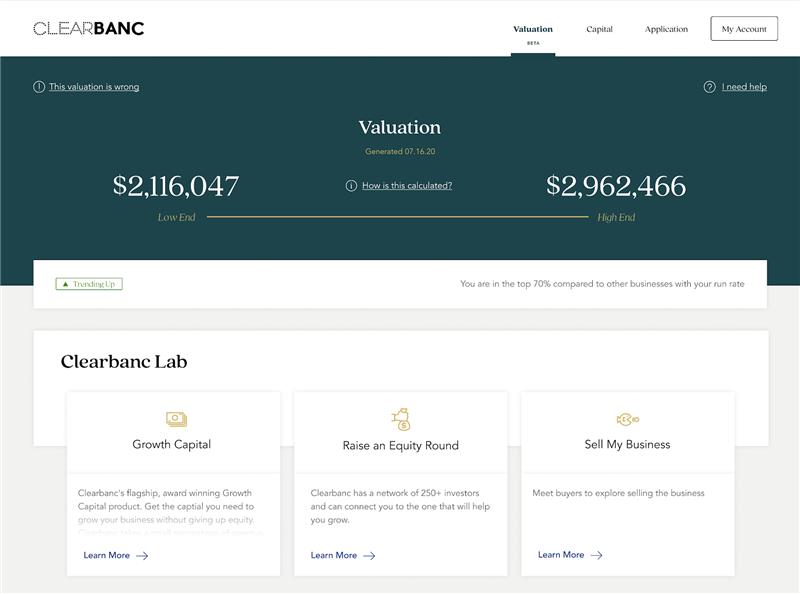
Today Clearbanc, the Toronto-based alternative finance company, has launched its latest service, Valuation, allowing founders to gauge their company’s value. Being an extension to Clearbanc’s platform, the service will be free to everyone and promises an estimation within 24 hours that can be checked weekly.
Valuation also offers three options to founders upon receiving their company’s value: the chance to access capital via Clearbanc’s funding channels, connect with investors in order to raise an equity round, and investigate possible acquisition opportunities. For the last two of these options, Clearbanc makes introductions to a selection of venture capital investors that have connected with the program.
As per the requirements, founders will have to connect a selection of private data points. Their business accounts, payment processor, accounting platform, and their admin account will all be required. As well as this, public data is also used to arrive at a valuation, basing the estimations on information specific to the company as well as the industry it is in.
“We think this could be as revolutionary as what Credit Karma did when they launched free credit scores for everyone and gave consumers access to their own information,” explained Clearbanc CEO Michele Romanow. “We’re really excited about this as it represents our first non-capital launch, and we think that it’s part of a much bigger vision of how we help founders win in this environment.”
Breakout Capital Weathered The Storm And Came Out With Expanded Access to Credit
July 8, 2020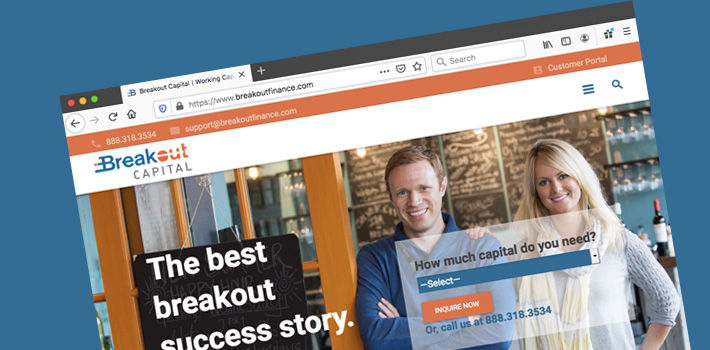 Breakout Capital never stopped funding. That’s what CEO & President McLean Wilson recently shared with AltFinanceDaily. The company not only weathered the storm but has come out with expanded access to credit totalling $20MM with Medalist Partners, one a current term loan facility and the other a new term loan facility with “attractive” forward flow features.
The company said in its announcement that these facilities will allow Breakout to increase loan originations across all of its product offerings, including its term-loan product, FactorAdvantage®, and its newest factor product, FactorBridge.
“Small businesses are at the core of our economy and they were, as we were, largely blindsided by recent economic interruptions,” Wilson told AltFinanceDaily. “We adapted quickly and rolled with the punches and never stopped funding. It is a testament to the resiliency, loyalty and borrower first mentality that Breakout Capital has not only weathered the storm, but has strengthened our company throughout the past few months. We quickly adapted to a new way of thinking, which helped us serve our clients in real time and forge ever closer relationships with our factor partners, lenders, online marketplaces, ISOs and borrowers.”
John Slonieski, Director of Private Credit for Medalist Partners, said in the announcement that “We are pleased to enhance our relationship with Breakout Capital in our asset-based lending strategy. Their high-quality underwriting and SMB-friendly lending solutions, coupled with their talented credit and management team, provide us confidence as we continue working closely with them to successfully scale their lending program.”
Every Business That Got $150,000 or More in PPP Funds (The List)
July 7, 2020In the interest of transparency, the SBA dumped a list of more than 660,000 businesses that got $150,000 or more in PPP funding.
You can download the entire thing right here.

Keeping Up With The Winklevii
July 6, 2020 Spending the previous three and a half months indoors, locked away from others, and sat at homebound desks have had differing effects on everyone. Some have had a period of intense productivity, some have fallen into bad habits, and some have spent an inordinate amount of time on social media. The Winklevoss twins, famous for playing a role in the founding of Facebook, are of the latter sort.
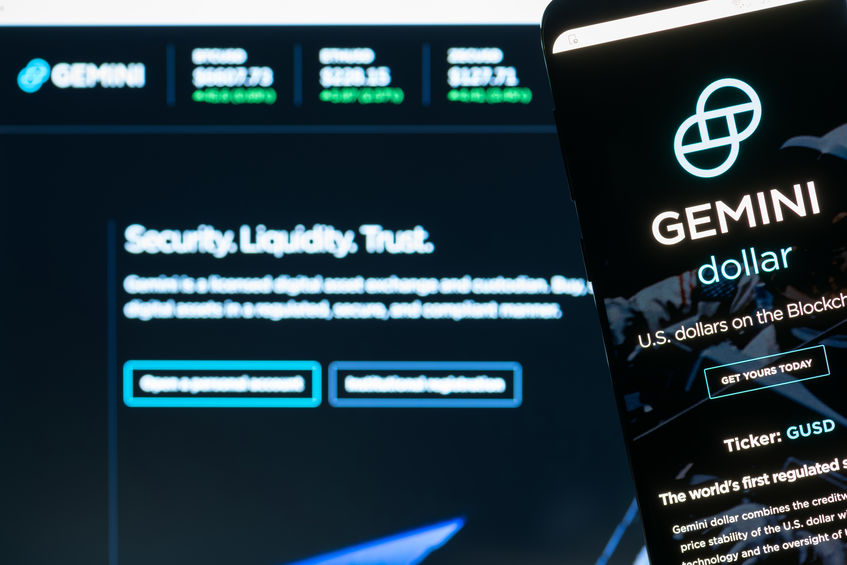
Cameron and Tyler, aged 38, are two entrepreneurs with a particular focus on cryptocurrencies. Having experimented with social media in its early days with Mark Zuckerberg at Harvard, the pair later sued the Facebook CEO in 2008, the same year they rowed for the USA in the Beijing Olympics. From here the twins went into venture capital; led a seed-funding round for BitInstant, a Bitcoin payment processor; claimed to have accumulated 1% of all Bitcoin by 2013 between them; and launched Gemini, their own cryptocurrency exchange, in 2014. Since then, as Bitcoin’s value has surged and fluctuated, the pair have become figureheads for the cryptocurrency, having been proponents of the decentralized currency from the days when it was worth less than $10, to its highest valuation in 2017 at just below $20,000, to its current price of just over $9,000.
And with quarantine providing all the time in the world to ponder the future of Bitcoin, the twins have been posting daily on Twitter about the crypto, relating it to any and all topics that proved popular. Cancel culture? There’s a tweet for that. George Orwell’s magnum opus, 1984? There’s a tweet for that. Vaccinations and their alleged comparability with cryptocurrency? There’s a tweet for that.
 Beyond comparing and relating Bitcoin to everything that comes up in the news cycle, the twins brought up an idea a number of times on social media over quarantine: that the pandemic has set the stage for a decentralized world.
While it is clear that this has happened to a point already, given the global move toward working from home, Cameron believes it will go further, mentioning in a tweet that the pandemic will be “an inflection point for Bitcoin and the Metaverse.” Choosing not to expand on this lofty statement, the specifics of Cameron’s claim can’t be known for sure, but the idea behind the Metaverse, a collectivized virtual space based off the setting of a 1992 sci-fi novel which is capable of replacing the functions and opportunities granted by the real world, is one well suited to Bitcoin, or, at least the idealized vision of what Bitcoin could become.
 As well as this prophesizing of a virtual utopia, the brothers displayed an intense distrust and paranoia of government, currencies that are regulated by centralized banks, and the role of big tech. With tweets criticizing the Federal Reserve’s decision to inject $1.5 trillion into the economy, YouTube’s ongoing debate over whether the First Amendment applies to a private business, and warnings against the threat of a government willing to grab more power during a pandemic, the billionaires’ tweets appeared at times to reach Elon Musk’s recent anti-government messages via Twitter.
With the twins having noted their disappointment in the US government earlier in the year at a conference in January, that time regarding the government’s slow adoption of cryptocurrencies, it is not so much of a surprise to see these further critiques, especially with them largely taking aim at the government’s employment of federally printed money, or “toilet paper,” as they call it.
All this being said, the twins appeared to be just like everyone else during quarantine: left with not much to do with a stable internet connection and a charged phone. And so conspiracies and cryptocurrencies aside, the brothers also made time for the irreverent and the relatable, posting about the possibility of a Groundhog Day-style scenario during quarantine as well as the importance of “sunsets, the stars, and true friends” in a tweet that wouldn’t be amiss in a Disney film.
Ultimately though, the sooth-saying and future-gazing done by the Winklevii in quarantine will take years, if not decades, to come about, if it ever does. One thing is certain though, the twins won’t stop talking about it until then.
Google Pay Launches SMB Loans in India, Plans to Expand American Features
June 30, 2020 This week Google announced that it is expanding its service offerings in India, with small and medium-sized businesses in the country now being able to apply for loans via the Google Pay for Business app. The result of partnerships with banks, Google also announced that it will be rolling all of its SMB-related services into one platform; these include Google My Business, an app that allows owners to make a business profile and get a Google Maps listing; and Google Pay Spot, which lets entrepreneurs customize their digital storefront, as seen by customers in the Google Pay app.
This is just the latest of features released in India by the tech giant, with it launching the ability to transfer money between Google Pay users earlier this year. What makes this interesting though is that in a recent interview with Business Insider, a Google spokesperson noted that the company’s decisions in global markets have become increasingly more influenced by its trialing of new features in India.
“We’re always trying to understand and learn from changing consumer behaviors worldwide so we can build more helpful features,” the spokesperson explained. “Our learnings from Google Pay in India will enable us to make digital money experiences simple, helpful, and accessible and create new economic opportunities for both users and our partners around the world.”
So does this mean Google will soon be joining the likes of Square and Clover and begin offering funding to American small businesses? The future is not so clear, but with the company announcing two weeks ago that it plans to incorporate digital storefronts into Google Pay, serving as an in-app portal to purchase goods, it appears that long-time features of the Indian version are beginning to bleed into the American counterpart.
Having announced its intentions to offer checking accounts in 2020, and with leaks earlier this year pointing towards a Google Pay debit card, it appears as if Google is following in the steps of its rival, Apple, and wading further into the financial services sector.
Good Internet Connection: A Recap of Broker Fair Virtual’s Debut
June 17, 2020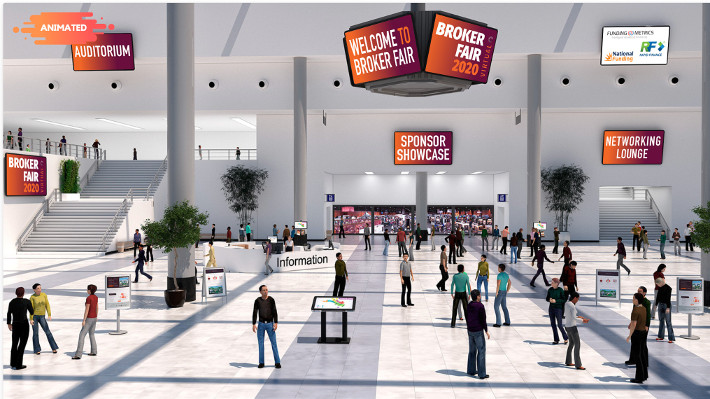 Last week’s Broker Fair Virtual was the first of its kind for the industry. The day-long event offered talks and networking, just like the in-person event, albeit without the catering service and open bar. Offering a digital space that included a virtual auditorium, networking lounge, expo hall, and individual company booths, the event attempted to recreate the experience of connecting and mingling with the rest of the industry, as much as was possible.
Kicking off with a Matrix-inspired introduction to the virtual space led by alternative finance’s version of Neo’s mentor, Mur-pheus (Murray as Morpheus), the show then went in numerous directions, with panels and talks covering a variety of topics and sectors.
Funding Metrics’ David Frascella took to the virtual stage to talk about how his company and the industry at large have been getting through the pandemic; what’s to come for America was up for discussion with Scott Rasmussen, the veteran pollster, who elaborated on how business could be effected by the upcoming presidential election; the future of combining people with data was debated by figures from Become, Elevate Funding, and Ocrolus; Canada’s lending situation and prospects were talked through in Covid and Canadian Credit;The new normal was discussed by NYC’s Fintech Women; and John Henry, an entrepreneur and star of VICELAND’s ‘Hustle,’ spoke of his experience running businesses and what made his story a success.
As well as this selection of talks, another standout was the cannabis panel. Led by a number of industry veterans, which broke down the difference in funding marijuana-based companies compared to other deals, and what could be down the road for the industry as more states consider legalization.
National Funding’s CRO, Justin Thompson, held an extended Q&A session, fielding queries about how National has been faring through these times and what its approaches are as the economy begins to open back up.
How long-term is long-term for the coronavirus’s impact? Are SBA deals the way to go? Does the industry need to go further with its adaption to this new normal? All these questions were asked and answered in The Great Debate, a panel made up of industry figures from various backgrounds.
And brokers’ futures were considered by Lendio’s Brock Blake, United Capital Source’s Jared Weitz, National Business Capital & Service’s James Webster, and The Watson Group’s Gerald Watson. Here, the idea of a recovery, how each struggled through March and April, and PPP were all debated by the panelists, with perspectives of what’s to come leaning both ways.
There’ll be an evolution of new industries and how we do business,” Gerald Watson noted in his closing words, “just look at this conference for example.”
There was no lobby to find brokers and funders hashing out deals in relative privacy away from the expo hall, instead this was replaced by private messages exchanged. Rather than line up for some chicken wings, people chowed down to whatever was in their home on that day. And instead of gathering around a bar and finishing the day after the final talk, attendees cracked something at their desk and chatted it up in the networking lounge, recalling previous events and what was once taken for granted: the ability to connect effortlessly.
The coronavirus continues to physically keep people apart, but for one day last week the industry was able to come together and network, make deals, and gain insight; albeit in a different way, internet connections providing.