
New Jersey Legalizes Recreational Marijuana
November 4, 2020One chill result from the 2020 election was the legalization of recreational marijuana in New Jersey for adult use. In a 2-1 victory, Option One on New Jersey ballots passed, paving the way for a regulated environment for recreational use, possession, and cultivation in the Garden State.
4:20 PM.
Time to legalize it. pic.twitter.com/157WC7qgof
— Governor Phil Murphy (@GovMurphy) October 28, 2020
Before the vote, Gov. Murphy showed support
We did it, New Jersey!
Public Question #1 to legalize adult-use marijuana passed overwhelmingly tonight, a huge step forward for racial and social justice and our economy. Thank you to @NJCAN2020 and all the advocates for standing on the right side of history.
— Phil Murphy (@PhilMurphyNJ) November 4, 2020
The amendment was billed as not only a chance to increase tax revenue but as civil rights reform. Advocates argued that prohibition laws disproportionately harmed minority communities.
The change was initially put before the legislature in 2017 but failed to pass by 2019. A bipartisan supermajority put the choice up to the public referendum. Appearing in Willingboro on Tuesday, long time advocate of legalization, Gov. Phil Murphy, spoke on voting day in last-minute support.
“I got to supporting it first and foremost due to social justice,” Murphy said. “We inherited when I became governor the largest white, nonwhite gap of persons incarcerated in America, and the biggest contributor to that was low-end drug offenses.”
New Jersey was one of four states with legalization on the ballot, and all succeeded, bringing adult use to Arizona, Montana, and South Dakota as well. After Tuesday, more than 111 million Americans- a third of the country live in a state where recreational marijuana is legal.
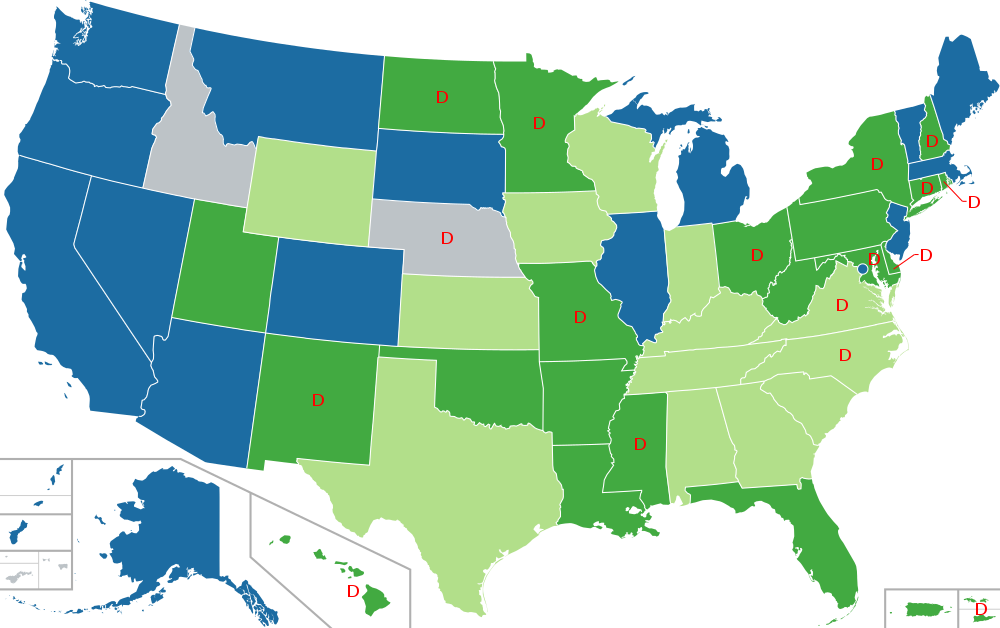
Image SourceKEY
Blue = Legal
Dark Green = Legal for medical use
Light Green = Legal for medical use – limited THC content
Grey = Prohibited for any use
D = Decriminalized
Cannabis legalization advocates, like Doctors For Cannabis Regulation (DFCR), saw the day as a significant victory for industry and social progress. Dr. David Nathan founded DFCR in 2015, where he serves as president of the board. Dr. Nathan stood up and spoke out against the prohibition of marijuana 11 years ago and said he was one of the first accredited mainstream physicians to do so.
“I’m not a medical cannabis physician, I’m a psychiatrist who sees how much damage cannabis prohibition does compared to the drug itself,” Dr. Nathan said. “I’ve really been given the platform to speak up, but at the same time, it was hard to get colleagues to speak up on an issue.”
After working for NJ United for Marijuana Reform, Dr. Nathan founded DFCR to create an organization to facilitate physicians who wanted to get involved at a national level. The success of Tuesday’s vote demonstrates how far legal cannabis advocation has come, from a resounding no to a majority yes.
“A lot of doctors who understood cannabis prohibition as a tragedy and a mistake were concerned about what their peers would think about them if they spoke out,” Dr. Nathan said. “Now we’ve got a group of highly respected physicians organized and advocating strongly, not just for legalization but much more importantly for effective regulation.”
Dr. Nathan sees the NJ amendment as a significant chance for improvement in public health. Despite legalization, it is unclear how the new law will go into effect. Per the amendment, the state will create a regulatory framework and tax the sale of marijuana at 6.625%, but implementation is up for debate.
Legislators still have to agree on how a new Cannabis Regulatory Commission will function. The state will also have to choose how decriminalization, possession limits, growing limits work, and forgiveness of past marijuana crimes.
All of which will be figured out and are necessary to the fair implementation of the passage of the amendment, Dr. Nathan said.
But those changes may come fast. NJ, like many states, is hurting during the COVID recession. Last month New Jersey officials approved a budget that is set to borrow $4.5 billion from the Federal Reserve to plug pandemic-sized holes in state spending.
Basing estimates on Colorado’s experience after legalizing cannabis in 2014, the state legislature predicts NJ could see tax revenues of up to $126 million a year from recreational sales.
“According to the Colorado Department of Revenue, retail cannabis sales, excluding medical cannabis, totaled $1.2 billion in calendar year 2018,” The report said. “Assuming New Jersey experiences similar per capita sales of recreational cannabis as Colorado, total retail cannabis sales for New Jersey could reach $1.9 billion, yielding sales tax revenues of up to $125.6 million annually at the current 6.625 percent sales tax rate.”
With such high revenues, some suspect New Jersey to lead the way for other northeastern states; income will spur jealous neighboring Pennsylvania and New York to legalization in competition.
“If this gives both Pennsylvania and New York a push, that would be great,” Dr. Nathan said. “I do think it’s going to have an impact, now that there will be a state right in the middle of the Mid Atlantic that is going to have regulated sales.”
But even with tristate legalization, the cannabis industry faces a problem with funding.
Most firms in cannabis supply chains- from growers to dispensaries- are small businesses that suffer from a lack of access to bank funding. Because marijuana is an illegal Section 1 drug like Heroin on a federal level, banks and venture capitalists have their hands tied when it comes to credit. But with Tuesday’s victories for legalization, federal regulation is closure to changing.
“I think that each state that adopts, sends a stronger message to the federal government,” Dr. Nathan said. “The voters in those states are giving resounding victories to the notion that cannabis should be de-scheduled not rescheduled, and then regulated.”
deBanked has been following the SAFE Banking Act since it passed in the House last year, a piece of legislation that hopes to address cannabis banking problems by allowing legal pot firms to open banking deposit accounts.
The law was bundled into the HEROES act with the rest of business aid projects, stuck between the GOP-controlled Senate and the blue House since the summer. Depending on the Senate’s layout when ballots are fully counted, financial institutions that have left pot companies de-banked may be-danked.
Let The Games Begin
November 2, 2020 In the run-up to the 2016 election, a Capify survey recorded that small business owners felt Trump had their best interests at heart over Clinton by a 2 to 1 margin.
The alternative finance industry, meanwhile, was largely preparing for a Clinton administration. Then Trump won.
And a lot has changed since then.
AltFinanceDaily has refrained from conducting any formal survey on the matter and takes no position on a candidate, but anecdotal conversations I’ve personally had with industry participants and a review of industry chats across social networks all lean in favor of Trump.
Those positions are drawn in part from resistance to future business shutdowns, which devastated the small business finance industry, views on taxes, and views on regulatory enforcement. All in all, it’s a business decision.
Talk about Biden has been virtually non-existent. The election is a referendum on Trump.
Once a candidate is elected, we will explore what the next 4 years could be like.
The OnDeck Roller Coaster of 2020
October 30, 2020 “2019 was an important year for OnDeck and we finished strong,” said OnDeck CEO Noah Breslow in the year-end earnings call that took place on February 11, 2020. “Financially, we had our second full year of profitability. And strategically, we are making significant progress positioning the company for improved performance and even greater long-term success.”
OnDeck reported net income of $28 million for 2019 and its share price closed at $4.07 the day earnings were announced, giving it a market cap of roughly $240 million. This was down significantly from its IPO value of $1.3 billion, but up from the lows it had hit in 2017 and 2019.
Over the next 30 days, however, the price fell by 50% on fears that the looming novel coronavirus could cause catastrophic disruption. The company also announced the departure of its Chief Accounting Officer.
As the industry looked on with wonder, news coming out of the company seemed strangely at odds with reality. For example, OnDeck announced a “first-ever” NASCAR sponsorship on March 10th.
 “OnDeck is proud to sponsor the JR Motorsports team and driver Daniel Hemric for races during the 2020 NASCAR Xfinity Series season,” said a senior vice president of marketing at OnDeck. “So many of our small business customers are avid motorsports fans and we look forward to joining them to cheer on Daniel and the No. 8 car decked out in OnDeck colors at the Atlanta 250 and the Chicago 300.”
On March 23, OnDeck closed at 70 cents. The market, it seemed, valued OnDeck at a paltry $41 million.
 Publicly, OnDeck kept up the optimism. The company applied to be a PPP lender as the program was just beginning to roll out. “We are excited to be one of the fintechs delivering PPP loans as a direct lender,” Breslow said. “Our team has been working around the clock getting us ready and now we wait and hope we are approved soon!”
Simultaneously, the company suspended the funding of its “Core” loans and lines of credit to new and existing customers. The company then went on to report a Q1 net loss of $59M due to covid-related damage, wiping out all of its 2019 profits and more. It also furloughed many employees while reducing the pay for those that stayed on.
That same month, OnDeck’s management “commenced a review of potential financing options to secure additional liquidity and potentially replace [its] corporate line facility and began contacting potential sources of alternative financing, including mezzanine debt.”
The response it got was grim.
 “The interest rates offered by those alternative financing sources ranged from 1-month LIBOR plus 900 basis points to 1,700 basis points (in addition to an upfront fee) and all but one required a significantly dilutive equity component,” the company later disclosed. “The one proposal that did not include an equity component was at an interest rate of 1-month LIBOR plus 1,400 basis points to 1,700 basis points.”
OnDeck engaged in negotiations with four potential sources of alternative financing, but two dropped out as the economic effects of the pandemic worsened. At the same time, it was speaking with Enova about something else entirely, a potential merger.
On the frontend, OnDeck was keeping the public abreast of its negotiations with creditors. The pandemic had put them in a technical breach of its terms with several of them but the company was experiencing some success with securing workouts and reprieves.
Regardless, the stock continued to trade below $1 as the world looked on to see what would become of their Q2.
 On July 28th, bombshell news broke. Enova, an international lending conglomerate, announced it was acquiring OnDeck for the price of approximately $90 million.
“Following an extensive review of our strategic options, we believe this is the right path forward for our customers, employees, and shareholders,” Noah Breslow said on a call with Enova executives the following day.
Some shareholders had a different opinion and thought that the deal and the terms looked a little fishy, all considered. Nine different shareholder lawsuits were filed over the next two months with the intent to delay or block the acquisition.
How could this possibly be the best deal or the right path?!
That was the underlying question being posed between the lines of the various claims asserted. OnDeck ultimately settled with all the parties by releasing supplemental information to the public about its financial situation and thought process that led up to the Enova merger. All the objections appeared to fade as shareholders approved the deal by an overwhelming majority.
On October 13th, Enova announced that it had completed the acquisition of OnDeck.
But by that time, was OnDeck merely a hollowed out shell of its former self? Not quite, according to disclosures made two weeks later. Enova announced that OnDeck’s portfolio performance was already exceeding their expectations.
 “On the small business side, the makeup of the demand is surprisingly similar to a year ago,” said David Fisher, CEO of Enova. “You would expect so many differences given what the economy has been through but there’s actually very very few. It’s pretty broad based. Credit quality look really really strong. If anything it’s stronger- I think it’s the stronger businesses that are trying to borrow at this point that are trying to lean into covid, not the ones that are just trying to survive so if anything on the demand there is a slight improvement on credit quality in small business.”
Fisher was also bullish going forward. “We believe now is a great time to be increasing our presence in
small business lending. The pandemic has devastated many small businesses across the country. Their
revenues are down and small business owners are digging into their savings to survive until the pandemic subsides and the economy reopens.”
Enova reported monster quarterly earnings of $94 million, a company record.
“Together Enova and OnDeck will be well positioned to further support small businesses and consumers in the wake of the pandemic,” Fisher said.
Franklin Capital Group Has Been Acquired
October 23, 2020 This month, Franklin Capital Group was acquired by Wing Lake Capital Partners with the help of Rocky Mountain Bank. Franklin Capital will change its name and add funding capability- but the entire team will stay on. CEO Shaya Baum was happy to announce the deal, explaining that the firm would use acquisition funds to create more deals and continue to grow.
“It gives us the ability to fund many deals that are outside of our box previously,” Baum said. “We’re going to be launching a couple of sister funds alongside what we currently have and scale the business.”
Franklin Capital was founded in 2012 as an equity fund for companies in financial trouble during, before, or post-bankruptcy. The firm discovered a market for refinancing MCA advances, finding companies that should have never obtained cash advances in the first place. Franklin Capital began offering a product to refinance cash advances through traditional loans.
“We buy out the cash advance deals,” Baum said. “In fact, most if not all of our deals come from brokers in the cash advance industry saying ‘Hey can you get us out of these deals?'”
Baum said that his firm had seen a continually growing demand for capital this year.
“I know the cash advance companies have gotten killed, but we’ve actually had the opposite problem,” Baum said. “We don’t do one-off restaurant [advances.] We’re dealing with companies that are larger, more established: they’ve all pivoted into industries that have grown during this period of time.”
Revisiting Miami in 2020
October 23, 2020AltFinanceDaily reporter Johny Fernandez flew down to Miami in September to find out how the South Florida non-bank small business finance industry has been getting along since covid. The following are some excerpts of interviews:
Jordan Fein, CEO of Greenbox Capital
“I’d be lying to you if I told you that, well it was fine for us. It wasn’t fine for anybody. We got hit pretty hard. I’d say that anywhere between 20 – 24% of our Canadian and about 25 – 28% of our US market got wiped out. And we shut down funding from mid-March to the end of April and we started funding again in early May. We’ve just increasingly been bringing back people from furlough and getting our legs back under us and now I think we’re really cooking right now.”
Craig Hecker, CEO of Bitty Advance
“So I think [the covid crisis] taught us a lot. And I think that when you face challenges like this pandemic, it really pushes you to reinvent yourself or reinvent certain parts of your business that you never thought were possible. And one of those things that we’ve learned is that we have a lot of folks that prefer to work at home, they’re actually more efficient working from home, they’re not in any hurry to come back into the office setting. Of course, we have certain employees that their jobs require them to kind of be with other employees, etc. but I think it’s really forced us to adapt, and to just embrace the new normal.”
Larry Bassuk, President of Idea Financial
“I think that we’ve been consistent in our risk management approach from the beginning. When we first surveyed the alternative lending space to see where we thought the best opportunity was for Idea Financial, we decided to focus on the higher credit quality segment of the market. our credit standards reflect that, our risk management principles reflect that, and quite frankly, our product reflects that. So during the covid crisis, when it was very acute in March, April, May, we got to see in real time, how our risk mitigation principles were functioning. It was a real test of all the theory that crisis, we got to see things shake out, and we got to see things being proven. A lot of assumptions that we were very strict on, really helped us manage the crisis. Going forward, we see that we’re going to be doubling down on those risk management principles, doubling down on how we underwrite and keeping a very close watch on how the businesses perform pre-covid, during covid, and then hopefully post-covid.”
You can watch the full 12 minute, 35 second TV episode AltFinanceDaily produced here.

An Update on Section 1071 of Dodd-Frank
October 23, 2020 After more than a decade, Section 1071 of The Wall Street Reform and Consumer Protection Act (AKA Dodd-Frank) is finally moving along. The law expanded the Equal Credit Opportunity Act to require that the Consumer Financial Protection Bureau collect demographic data from small business finance companies. For ten years, a whole lot of nothing happened to roll it out, so you’ll be forgiven if it seems like the latest updates are a bit vapid.
But then the CFPB got sued for its failure to carry out its duties and it resulted in a settlement that requires the agency to hit certain milestones by certain timelines. Section 1071 is all about collecting loan applicant data in commercial finance to measure if there are disparities in the ability to access credit, particularly for female-owned and minority owned businesses. It necessitates a mechanism to comply, which will
ultimately cost time and money.
But in the meantime, the milestones to even get to the point where data collection is being carried out, are roughly as follows:
1. Convene a panel of small business lenders
2. Have that panel issue a report
3. Propose what the rules on collection will be
4. Collect feedback on the proposal
5. Formulate a final rule
6. Issue a rule
7. Set a time for when that rule will go into effect
We spoke with one alternative finance company that has been engaged in the process.
“I am representing, and Greenbox Capital is essentially representing, the industry,” CEO Jordan Fein told AltFinanceDaily in regards to his role as a Small Entity Representative to the CFPB’s panel of small business lenders. “There are some banks, there’s Funding Circle, but other than that, it’s Greenbox Capital serving in the industry.” Fein said that panelists give their opinion and engage in discussion on how companies will be impacted. He also said that he was very happy to participate in the process.
“It’s an honor to be selected to the industry panel providing feedback on section 1071 of the DoddFrank Act ensuring fair lending laws to women- and minority-owned businesses,” said Fein. “Over 2 million businesses across the U.S. are either women or minority owned and it’s vital they can secure funding as easily as non-minority owned businesses.”
The panel must complete a report within 60 days of convening. With several more milestones to go, a final rule is unlikely to go into effect prior to 2022. But until then, know that Section 1071’s implementation will probably happen during your lifetime.
Greenbox Capital on Official Panel to Aid Section 1071’s Rollout
October 21, 2020 This week, Greenbox Capital, the Miami-based alternative finance company known for its MCA and SMB financing, announced they are serving as a Small Entity Representative (SER) to the Consumer Financial Protection Bureau (CFPB) as the organization proceeds with the rollout of Section 1071 of the Dodd-Frank Act.
“I am representing, and Greenbox Capital is essentially representing, the industry,” CEO Jordan Fein said. “There are some banks, there’s Funding Circle, but other than that, it’s Greenbox Capital serving in the industry.”
Fein, who founded Greenbox in 2012 and has since facilitated MCAs and business loans across America, Puerto Rico, and Canada, wrote in a press release that it was an honor to be selected to provide feedback on Section 1071.
“Over 2 million businesses across the U.S. are either women or minority-owned,” Fein wrote. “It is vital they can secure funding as easily as non-minority-owned businesses.”

Congress passed the Dodd-Frank Act in 2010 in response to the Great Recession. To further protect consumers, the CFPB was born. Section 1071, an amendment to the 1974 Equal Credit Opportunity Act, mandates financial institutions report demographic information to the CFPB. But much was left undefined about how to go about doing that and who would technically be subject to it.
Ultimately, the intent behind the law was to measure potential disparities among factors like the race and gender of applicants. Ten years later, the rollout is finally moving along.
As part of this, the CFPB created a board of firms representing the affected industry, on which Greenbox sits, to ensure the law works with the industry, not against it. The first panel was on October 15, in compliance with the 1996 Small Business Regulatory Enforcement Fairness Act (SBREFA.)
“They’re going through the SBREFA process, which is a structured process where they have a panel of industry representatives, and they share what they’re planning to do,” Fein said. “They run it by companies like us and we give our opinion and talk about how we think companies will be impacted.”
According to an invitation letter the firms received, they will have until November 9 to respond.
Fein said Greenbox would ensure any suggestions it made would positively impact the industry. Especially during a pandemic, Fein said it is essential to create regulation with firms in mind.
Drama, Health Challenges Revealed in CircleUp’s CEO Switch-Up
October 19, 2020 CircleUp, a fintech company that’s raised more than $250M between debt and equity, saw a change in leadership last week, with more than a fair share of transition drama. Co-founder and CEO Ryan Caldbeck stepped down, giving way to President Nick Talwar.
After stepping down, Caldback took to Twitter and Medium, opening up in a 41 tweet story about why he chose to leave. A scathing private letter from Caldbeck to an unknown investor and chair of the board at CircleUp also circulated social media.
“I made many mistakes during this time, thinking I could just grit it out alone,” Caldbeck wrote. “I thought keeping everything to myself would allow me to handle the professional challenges more effectively. My approach was wrong.”
CircleUp is a tech-driven entrepreneurial investment company, known for supplying funding to consumer firms like Halo Top Ice cream. Caldbeck founded the firm in 2012 with Roy Eakin, as a platform to connect entrepreneurs to investors.
On Twitter, Caldbeck shared his internal hardships during the C Series pivot. Facing immense stress at work while his company pivoted, fertility troubles at home, and cancer diagnoses beginning around 2017 and continuing into the present, Caldbeck went from burnout to drawn-out depression.
“There’s no doubt my mental health was suffering during that period,” Caldbeck wrote. “Some think they have no choice but to ‘tough it out’ in front of the teams, customers or investors, despite what’s going on inside their heads because doubt isn’t respected in venture.”
Caldbeck said that the “normal level” of CEO exhaustion was something he thrived on, including catching sleep in the restroom in the spare minutes he had before board meetings. But when his fertility testing found cancer, and his stress brought headaches that were feared to be brain cancer, Caldbeck said even a papercut would set him off.
Simultaneously, a board member at CircleUp was acting so disruptive that Caldbeck later complained that he was throwing the entire team off. Just this past week, Caldbeck sent an email that got shared all over the internet to that board member as advice, and in part retribution for how the investor acted.
According to Caldbeck’s letter, the disrupter invested their way onto the team and treated the rest of the board with disrespect. They talked down clients, disrupted meetings, projected insecurity and paranoia, and forced the sales team to market their stake when they wanted out.
“The data suggests that venting doesn’t actually help mental health- it hurts,” Caldbeck said. “I’m not writing this to vent, I am writing this because I am hopeful it will help future entrepreneurs you invest in.”
While Caldbeck was facing cancer, the board member was reportedly putting down the entire company. Caldbeck said he should have seen a red flag that he didn’t even meet the investor before they were sitting on the board and that many other executives share his negative opinion.
“Your involvement was incredibly difficult for all of CircleUp and our board,” Caldbeck said. “My hope is that over time you can process some of this information below and make the necessary changes if you decide to stay in venture.”
Luckily, his brain scans came back negative, and his cancer was removed by operation, and Caldbeck and his wife had a secound child. However, the 12 to 18 month period of exhaustion had taken its toll. Caldbeck had reached the end of his rope, signified when his five-year-old daughter said, “Daddy, you always look sad.”
In 2019, Caldbeck sent a letter to his board explaining his intent to step down, after serving as CEO since founding in 2012.
After a long transitionary period waiting for a replacement, Caldbeck finally shared his story, hoping to inspire other leaders to be open about their struggles and feel less alone. Nick Talwar, a 20-year industry vet, was hired as president of CircleUp in July. Caldbeck wrote that he is excited for the CircleUp team despite his time of struggle as he becomes the Executive Chairman.
“I feel immensely proud of what we have built at CircleUp,” Caldbeck wrote. “The team is truly extraordinary, and I think the technology (Helio) will transform consumer and private investing. We’ve helped hundreds of entrepreneurs to thrive, and we will help thousands more.”