
Follow us at the ETA Expo
April 30, 2013May 3, 1:00am: I underestimated how easy it would be to make frequent updates. Wednesday was fantastic. I uploaded a couple dozen photos and updates all at once earlier today over on DailyFunder. As soon as the show was over, I found myself on Bourbon Street at the Discover party followed by the Priority Payments party. Both were a great time.
My Recap of the show is up now: ETA Expo Recap
Soul Mates: Merchant Cash Advance and Silicon Valley VCs
Original story about On Deck Capital’s investment from Google Ventures and Peter Thiel
My theory on why On Deck Capital took a paltry $17 million from Google Ventures and Peter Thiel
Photos and updates from the ETA
————————————–
May 1, 1:00am: Great start to the show this evening. Merchant Cash Advance providers and alternative business lenders continue to have a very strong presence in the payments industry. The booths I saw include: RetailCapital, NextWave Funding, Merchant Cash Group, On Deck Capital, Capital Access Network, Strategic Funding Source, American Finance Solutions, Swift Capital, MotherFund, and Principis Capital. GRP Funding and Paramount Merchant Funding are also on the exhibitor list but I didn’t spot their booths yet. That’s pretty substantial and it omits the major presence of Merchant Cash Advance companies that aren’t exhibiting. I bumped into Merchant Cash and Capital and walked the floor a bit with David Rubin of Capital Stack.
I met the guys behind Super G Funding which lends money against residuals. They’re great guys and they have such a unique role in the industry.
I think every funder I spoke with was quick to mention that they do 12 month deals and either offer direct debit repayment or will have it soon. The ACH train has disrupted the split-funding market pretty severely though many funders continue to do big numbers via split.
Nobody seemed to have an appetite for low FICO score deals (500s and below) except for Merchant Cash Group and Capital Stack which target the higher risk market intentionally. And when I say “don’t have an appetite for,” I literally mean when asking a funder if they do below 500 credit, the answer is some version of “HECK NO!!”
Overall tone, and perhaps its because opening night included open bar, but it was very optimistic. Most funders seemed intent on expanding and are eager to service as much business as possible. I definitely get that sense that there is a real focus these days on the bigger fish ISOs ($1 million+ in referral business a month). When newbie brokers enter the space, funders spend an enormous amount of resources developing them and many times they just don’t pan out. Either the brokers don’t have the capacity to do more than a handful of deals, or they just don’t “get it.”
If you’re a mom and pop ISO and you have just 1 or 2 deals a month, it’s more difficult these days to get time and attention from a funder. Capital is flooding into the industry and everybody wants partners that can produce volume. From a resource standpoint, the “1 and done” reps are not an efficient use of time.
Big ISOs have a lot of negotiating power at their disposal these days. In the last 7 years, it was good to be an ISO, then hard to be an ISO and now it’s good again. Many things in MCA have a weird way of going full circle. Hope to see you on Wednesday.
————————————–
Apr 30, 1:00am:  Merchant Processing Resource will be publishing updates as often as we can from the ETA Expo in New Orleans. I am very excited to be down here. Earlier today I had the opportunity to eat beignets at Cafe Du Monde, visit the French Market District, and take a ride on the Natchez Steamboat on the Mississippi River. But starting Tuesday, it’s all business. A schedule of events can be found on the ETA’s website.
You can follow along with everyone else in town on twitter using #ETAExpo2013 or #ETAExpo13
and of course via the DailyFunder Merchant Cash Advance iPhone App.
Some pre-conference tweets:
ETA Expo 2013 on Twitter
pre-conference tweets
Storified by Sean M· Mon, Apr 29 2013 22:21:50
Here’s to learning, networking, and having fun!
– Merchant Processing Resource
../../
MCA Industry Continues Expansion
April 3, 2013 It’s said that one way to measure success or growth of an industry is to count how much capital is being raised. In that case, Kabbage and On Deck Capital have been on fire lately.
Early this morning, Kabbage announced they had secured a new $75 million line, after having just raised $30 million 6 months ago. The Forbes article announcement states that Kabbage has funded 60,000 deals to date and predicts to fund 100,000 deals in 2013 alone, a figure hard to comprehend considering that’s equivalent to the amount of transactions Capital Access Network has managed to do over the course of 15 years. I understand that Kabbage may do smaller, shorter term deals, but Capital Access Network has dominated MCA for a long time. Could Kabbage really do 100,000 deals this year? I’m unsure about this one.
Are traditional MCA funders missing out by letting Kabbage rule Ebay, Amazon, and Etsy unchecked? Is the Internet really that different than the brick and mortar market? Late last year, Amazon entered the financing market but for the purpose of strengthening their selling partners, so there are several reasons funders are tapping that market.
Paypal has been sitting on the sidelines and is perhaps considering jumping in the ring themselves. They are beta testing now with Ebay sellers.
Merchant Cash Advance is exploding in all directions. Did you hear that Yellowstone Capital funded $700,000 to a restaurant with the help of Strategic Funding Source? That’s a lot of money for a restaurant!
Funding for Startups – An Ongoing Struggle
March 6, 2013Startup. Some people like the term and some people hate it. It doesn’t even mean the same thing to everyone. To some, the mega giant Groupon is a startup and they’ve been in business for almost 4 years and earned $638 million in revenue last quarter. To others, a startup is simply an idea for a business that hasn’t gotten off the ground yet. And to the Merchant Cash Advance industry, startups are people who don’t qualify for funding but manage to come storming through the front gates demanding loans while waving around business plans. There’s a real dilemma in this country. Millions of people aspire to go into business for themselves and very few have any idea what to do. I get exhausted just thinking about this because for many years, I’ve been trying to tackle what you’d think would be a simpler problem, funding people that ALREADY have a business.
 It’s finally gotten much easier for existing businesses to obtain capital, so much so that I started to warn the lenders in a recent article about getting too aggressive with their programs. But all that aside, these lenders have been plagued with an ongoing problem for years, a problem that has caused marketing costs to skyrocket, and have made loans for everyone more expensive. That problem is startups. It’s not that startups aren’t appreciated, it’s just that imagine opening a hair salon and seeing there’s a line of a thousand people waiting outside the door to get in. At first, you’d probably think “wow! we’re going to need to hire 50 more stylists to satisfy all this demand,” but then you find out that 900 of the people waiting were men that were completely bald. It’s awesome that they were interested to come out and get a perm, but without hair, there’s nothing for the stylists to do. The business ends up spending a lot of time and money telling folks with no hair that a mohawk will not be possible, causing the price of haircuts to go up for everyone else.
 Some lenders are so inundated with startups that they stop marketing altogether. Others try to board up their pay-per-click ads with specific instructions for startups to STAY AWAY. It doesn’t reflect very well on the brand to do this, but if bald guys were overrunning a hair salon, the poor stylists would have to do something so they weren’t driven out of business. I’m not making fun of startups per se, I’ve been a part of 3 startups, including my own. I’ve been in the position where I was unsure of what to do first, especially since I never knew anyone that funded people whose businesses weren’t already up and running. Yes, I was the guy who knew tons about business lending and I had no idea how to raise capital for a business that hadn’t yet started.
Oh I knew how to set the gears in motion: perform market research, talk to potential customers about what they want, draw up a plan, incorporate, get the necessary permits, draw up an operating agreement, pay for legal advice, and set aside a large enough cash cushion to pay for at least 3 months expenses in case nothing went as planned. I had enough experience to know what I needed to be ready, but I guess I was still shocked the day I went to a bank to finally open a business account. With my account, the bank granted me a substantial unsecured line of credit. I’m fortunate to have an excellent credit score and that definitely played a role, but try to understand that I walked into the bank with no job and no income. I told them I was starting a business, wanted to open a bank account, and had all my business document ducks in a row and within 2 minutes I was approved for a line. This is after I’ve been hearing for years that no banks were lending, businesses with excellent credit couldn’t get money, and startups had no place to go.
Keep in mind though that I didn’t just walk into the bank and tell them all my good ideas and sum it up by asking for money. Heck, I didn’t even ask for money at all, though it was really nice to have it. I went in showing I meant business and walked out with something that everyone said is impossible to get in this country. I’ll admit there’s a few caveats. I live in New York City, have a decent net worth, have great credit, and have a background in business financing. So I’m not going to pretend that what worked for me is what’s going to work for everyone else.
I’ve always wanted to help the people I couldn’t. So I’ve been wracking my brain for some time as to what to do if a hair salon had 900 bald customers waiting on line. Do you help them regrow their hair first?
 I totally believe in the old fashioned way of raising money, which means making sure you have enough of your own money saved up and taking every measure possible to be ready to launch before looking elsewhere for help. I realized though that many people don’t have the capital to get them as far as opening day, some don’t have strong enough credit to be confident that a bank line would ever be possible, and others just have a dream of something they want to do but have no money to even put their idea to the test. I’d say they were out of luck, but new friends of mine were telling me that’s not exactly right.
Crowdfunding – Get familiar
I recently spoke with Rachael Alford, a crowdfunding consultant who told me that you didn’t need to approach startup capital the old fashioned way. A bank? What’s that? The exact conversation between us is available online and I learned that folks with a serious idea can actually raise money just on the IDEA alone. Crowdfunding means raising money from other people so a lot of effort is required to make it work for you. When you go to a bank, the bank is forced to acknowledge that you applied and then decide to either approve or reject your application. With crowdfunding, your campaign to raise money can be outright ignored. It’s not a “hi, please approve me, bye” experience. Rachael said, “the problem is, people think it is as easy as making a page (on Kickstarter, GoFundMe etc.) and then they can just tweet or share the funding request and that is it.”
Driving interest to your crowdfunding campaign to raise money is kind of like a test to sell your product on opening day. If you can’t get anyone interested in your campaign, how in the heck are you going to get them interested to buy your product once it’s done? It should be mentioned that crowdfunding doesn’t necessarily require you pay back the money raised with interest like a loan. Some campaigns can be donation based. Others can be in return for a prototype of the product. Rachael shared this example with me to better explain: “Say Joe has an idea that may or may not cure XYZ disease but he needs to buy a super xyz widget before he can prove his hypothesis. No one will loan him the $10,000 he needs to see if it can work. With crowdfunding, he can’t offer (as a reward) to cure backers who pledge $1,000 or more. He should offer what he has: limited edition t-shirts that read: I’m a hero, I helped Joe Smith try to cure XYZ. Get the point? If it’s a food start up don’t offer to cater a wedding, offer to name a brick, booth etc.”
 So having the idea is a starting point but you have to sell that dream HARD to get people to invest in it. Fortunately, it’s easier than making appointments with scary Silicon Valley venture capitalists and having to sweat out a presentation and then being told at the end that your idea is terrible.
Rachael teaches classes specifically to help people approach crowdfunding in the most efficient manner. If you’d like to know more about crowdfunding, I highly suggest you connect with her.
P2P Lending – Have you really not tried this yet?
On the flip side of raising capital is peer to peer lending. This type of financing has been around for quite some time. Websites like Prosper.com allow people to post loan requests so that individuals can collectively contribute to the amount wanted. Unlike crowdfunding, peer to peer lending is… lending. You can’t offer to name bricks after your peers instead of paying them back. In the case of Prosper.com, they act as the loan servicer but they also determine based on your credit rating the interest rate that your peers will have to charge. Prosper.com works for personal loans and for startup loans, but the key again here is that you can’t post a request and walk away. Instead you to have to rally people to your cause. Prosper.com sums it up with this tip on their website: “Asking your friends and family to invest in your listing and give you a recommendation will increase your chances of having your listing fully funded.”

Selling on Ebay or Amazon makes you official already
A third option for startups is Kabbage. Though they are technically a Merchant Cash Advance financing provider for established businesses, they specifically fund people with ebay and Amazon stores. I find that many people that want a shot at starting their own retail business have already tested out their skills on ebay or Amazon. What they may not know is that Kabbage sees these sellers as businesses already and that they need not feel like a startup at all!
There is no sleep-while-you-get-funded method of raising capital
Alas, raising money for a startup means work. Whether that work means being ready to cut the tape at the grand opening before applying for a loan or furiously banging the social media drum to mobilize people to your cause to invest. To the entrepreneurs that read this, I hope you’re a little bit more informed about where to start. To the lenders, the good news is that startup financing does exist, we just need to guide these people to the right places.
Perhaps there is an opportunity for lenders to set up peer to peer lending or crowdfunding campaigns on behalf of all the serious startups that call in. They could top it off by contributing the first 10% of capital needed to help them generate buzz to raise the rest. Let the market decide if the business plans are viable. If successful, then you can consult them through their grand opening and up through the point that they become eligible for a merchant loan. I would think a fee for this service would be reasonable. Everybody wins.
We need not struggle!
– Merchant Processing Resource
../../
MPR.mobi on iPhone, iPad, and Android
MCA Industry More Fractured
February 1, 2013 Everyone agrees that the Merchant Cash Advance (MCA) industry has grown substantially over the last few years. Our best calculations estimated that $600 million in MCA deals took place in 2010. Some believed that figure was too low, especially when Capital Access Network (CAN) projected they would fund $700 million all by themselves in 2012. Could CAN really be funding more alone than what the entire industry including them funded in 2010?
The debate starts there because they have put a large focus on their NewLogic subsidiary, a company that specializes in short term loans, not MCAs. And like NewLogic, much of the growth the industry experienced in the last few years has not been centered around split-funding purchases of credit card sales, but on the alternatives. We’ve made it a point in previous articles to point out the lack of consensus on what the product is being called now, especially since everyone is offering their own version of short term financing. We even went so far as to say that by 2015, the term MCA won’t even exist anymore. We may have exaggerated a bit, but after playing around with Google’s Trends tool, we realized that prediction was much more than a hunch.
If MCA has grown so much in the last few years, why is it that 38% more people searched for MCA on Google in December 2007 than they did in December 2012? Why is it that searches for MCA information peaked in February 2009 and never recovered? According to Google’s search data, nearly 50% fewer searches are being made for MCA today than there were three years ago.
Notice that MCA as a term did not really exist on the Internet prior to June 2007. We presented our estimate of when that term was coined in Before it was Mainstream. It first appeared in print in May 2005, but didn’t pick up traction until March, 2006 in private Internet forums. The first Merchant Cash Advance Internet blog began in July 2007, weeks before people began to first start searching for information about the term. It is very likely they were also trying find the blog itself.
So is Google’s data just plain wrong? Is something fishy? The only thing wrong is the belief that the MCA industry is just about MCAs. The creation of alternatives and the recent practice of private labeling have contributed to the decline of MCA.
three new terms: merchant loans, ach loan, merchant financing
Business Cash Advance takes a dive. Seriously, who calls it that anymore? Merchant Funding is on the way back up.
There were 500% more searches for small business loans in April 2004 than there were in December 2012.
So what does this all mean? We leave you to draw your own conclusions. 2007-2009 was a period of sudden mass awareness of MCA but there has never been as much money in the industry as there is now. There are experts that say business owners feel that the recession never ended, causing them to continue hunkering down instead of seeking financing to expand. There are insiders who will attribute this to the negative stigma the product had and the need to call it something else. We believe the most likely suspect though, is the fracturing of the MCA industry. It’s possible that people aren’t typing “small business loans” or “merchant cash advance” into Google because so many companies are promoting alternative financing options that people are looking for those specific products instead.
Whatever the answer is, it appears that alternative business financing has grown tremendously but the MCA term has not. Share your thoughts about this with us. We want to hear theories.
– Merchant Processing Resource
../../
MPR.mobi on iPhone, iPad, and Android
Funding Down to a Science
December 21, 2012Account rep: Congratulations, you’ve been approved for $27,000!
Merchant: How did you come up with these figures?
Account rep: It was science. Science did this.
Funny? Maybe not, especially since an underwriting super algorithm may be on its way to the United States. In the days after we posted Made for Each other?, friends, acquaintances, and strangers have been telling us to keep an eye on Wonga’s potential acquisition of On Deck Capital. “It’s not just a european company’s gateway to the US. They’re going to change everything,” a few have said. Aside from their background of being a payday lender, having prestigious VC backing, and the resources to throw a quarter billion dollars at a main street lender in a takeover bid a lot of people didn’t see coming, apparently there is much more to be seen.
Just like MCA in years past, Wonga has worked hard to repel a negative image. Not easy stuff, especially considering they embrace their hefty costs wholeheartedly. Sure, it’s easy to calculate an APR equivalent of a very short term loan and spin whatever number you come up with as the symbol of something evil. If I let a stranger borrow $100 today with the stipulation that they pay me the whole thing back tomorrow plus 1 dollar extra to make it worth my while, would I be evil? That’s an APR of 365%. If I did the same thing with 100 strangers, what are the real odds that all 100 would actually pay me back? Somewhere along the line because of a borrower’s circumstances, bad decisions, or even malicious intent, I’m going to lose the entire $100 I lent out. Others might need more time to pay me back. If one person out of those hundred doesn’t pay back, I break even. If two people don’t pay back, I lose money. If one person doesn’t pay back and another can’t come up with the whole thing, I lose money. You can lend money at 365% APR and lose BIG.
So how do banks manage to charge 4, 7, and 10% APR? Is it just because they’re smarter? No. They don’t make money off loans at these rates either. In the US, interest rates are distorted by government guarantees. Politicians have decided that certain interest rates sound “fair,” then push big banks to lend money at these low unsustainable rates. But of course it doesn’t work and so government agencies sweeten the deal by reimbursing banks for up to 90% of the losses on the borrowers that default. Banks make money on the loan closing fees and other services they sell to the businesses. The loan is the doorbuster offer the bank puts in the storefront window. Once you come inside, they try to sell you on other things so that you don’t walk away with just the loan, otherwise they’re losing money.
So when you hear “banks aren’t lending,” don’t be so surprised. Lending money means giving it away to someone that might not pay it back. That’s a really tough business to be in, no matter how qualified the borrowers are or how good the underwriters are supposed to be.
But somewhere in between the opinions of the Merchant Processing Resource staff and government bureaucrats over what is fair, is a special recipe that determines once and for all what works best. It’s science. Wonga’s lending success is rooted in science and propelled by an advanced algorithm that can systematically calculate risk better than any bank in the world, or so they say.
 One of Wonga’s major investors, Mark Wellport, is a knighted renowned immunologist and rheumatologist that has defended Wonga’s methods against regulation. He believes their data-based process and strong motivation to make their borrowers satisfied places them in an entirely different category than payday lenders.
Wonga takes a human-free approach, something no MCA provider in North America does regardless of how automated their process may seem. In the UK, their business loan application process takes only 12 minutes and the funds are wired 30 minutes later. That’s it. Their max loan is £10,000 but just think about how that compares to MCA in the US. How much time and overhead is being spent on printing documents, underwriters, conference room meetings to discuss deals, setting up the merchant interview, trying to reach the landlord, trying to get page 7 of a bank statement from 6 months ago and the signature page of the lease, etc. etc. Funders might have had the wrong approach all along.
Wonga’s founder, Errol Damelin believes in data. According to some quotes in The Guardian, Damelin believes interacting with the borrower actually impairs a lender’s judgement.
From the Guardian:
Asking for a loan from a financial institution had traditionally involved making a strong first impression – putting on a suit to see the bank manager – then rigorous questioning, checking your documents and references, before the institution made an evaluation of your trustworthiness. In a way, it was exactly the same as an interview, but instead of a job being at stake it was cash.Damelin found this system old-fashioned and flawed. “The idea of doing peer-to-peer lending is insane,” he says. “We are quite poor at judging other people and ourselves – you get to know that in your life, both with personal relationships and in business. You realise that we’re not as good as we think we are at that stuff, and that goes for almost everybody. I certainly thought I was much better at it.
The 42-year-old entrepreneur grew up in apartheid South Africa, and he believes the experience of living in that country in the 80s has had a significant impact on his outlook. He was active in student politics at the University of Cape Town and marched in civil disobedience protests. So, when it came to deciding who should be lent money, Damelin says he wanted to strip away some of the prejudice – decisions would be taken without a face-to-face meeting; you wouldn’t even speak to an adviser on the phone, because people subconsciously judge accents too. The final call on whether to hand out cash would be based on “the belief that data could be more predictive than emotion”.
According to Wired, Damelin and his team created a system to approve or decline applicants all on its own. They tested it on a site called SameDayCash by using Google Adwords and within ten minutes of their ad going live, their system had already approved its first customer. In its early forms, it wasn’t very profitable from a lending standpoint but it did allow them to collect a massive amount of data.
From Wired
its strategy over this period wasn’t just to disburse money — it was to accumulate facts. For every loan, good or bad, SameDayCash gathered data about the borrowers — and about their behaviour. Who were they? What was their online profile? Did they repay the money on time? The site was feeding an algorithm that would form the basis of Wonga, launched a year after the beta experiment that was SameDayCash.
MCA has utilized Adwords for lead generation for years with mixed success, but few have used it for the purpose of accumulating facts. This isn’t to say that the firms collecting information for the purpose of leads aren’t sitting on treasure troves of data, it’s just that none of it to date has led to 100% computerized underwriting. The MCA industry is quite possibly about to undergo a major shift in how they promote their product on Adwords as a result of Google’s ominous warning a couple weeks ago. New disclosure requirements may change the way consumers respond and apply, ultimately impacting the data collected.
So will european science work in the good ‘ol US of A? If Wonga acquires On Deck Capital, you can bet they’ll try to replicate their success. There is a gigantic market of really small businesses that aren’t getting funded, and even the ones that are, they’re waiting 3-7 days to deal with the paperwork, handle the phone calls, fax documents, complete a landlord verification, and in some cases, deal with a credit card processing equipment change. If On Deck Capital becomes a household name as Wonga is in the UK, a lot of smaller funders are going to get squeezed.
Wonga claims to have a net-promoter score above 90%, a customer satisfaction metric that beats most banks and even Apple Computer. It’s a company that seems to be winning on every front.
Critics will say that the American lending market is big enough for everyone, that the loans Wonga has done traditionally are really small and therefore not in the same league as MCA, or that their own company has something similar or better. We believe however, that if this deal goes through that it’s a bad idea to get comfortable. There are Wonga-like companies in the US already, data fortresses that will soon revolutionize how loans are issued and determine what makes a successful business. New York based Biz2Credit is one such example.
We’ve been right about a lot of things in the last couple years and wrong about some. But we believe it is inevitable that any lender ignoring the automation revolution on the horizon is not going to last very long. Go ahead, brush it aside and convince yourself that this whole Automation thing is just hype as BusinessWeek did in 1995 about the Internet. “Automation? Bah!”
As Damelin told Wired in June, 2011, “For me the epiphany was right there. People were online, looking for a solution to a problem.” Ask any funder using Adwords or pouring work into SEO and they’ll tell you the same thing. People are looking online for money. What happens after they fill out the form on the website is what makes the USA MCA/alternative lending industry different from Wonga.
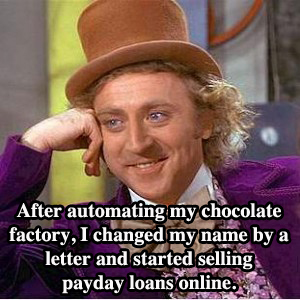 But will a perfected european algorithm work in the US? Americans approach debt and money differently than the rest of the world and small businesses operate in a much more open manner. You never know, the european lab coat wearing scientists could come here and get their butts handed to them. Plenty of smart companies have jumped headfirst into MCA and left after disastrous results. Some veterans that have been in this business a long time will you tell that an impressive resumé, big investors, and a fancy algorithm will help you make it through the first six months. After that, you better know what the hell you’re doing, if you can continue to do it at all.
If in three years the average small business owner thinks Wonga is the last name of a guy that owns a chocolate factory, we promise to write a jingle that admits we were wrong about them. But On Deck Capital has been around the block and knows the business. They would allow Wonga to skip the learning curve and together could quite possibly nail lending down to a science.
Oompa Loompa do-ba-dee-doo, I’ve got another algorithm for you.
– Merchant Processing Resource
../../
There is great feedback to this article in a LinkedIn Group HERE
Is it Just us or are the Deals Getting BIGGER?
October 15, 2012 Two years ago, it was easy to say that the average Merchant Cash Advance (MCA) deal was about $20,000 to $25,000. The claim used to be, funding up to $250,000! And yet very few companies would actually go that high when it came down to it. But now?
A million here, a million there… It’s all just business as usual. Nothing to see here everybody. Go on Tozzi, write another article about how MCA is for minuscule retailers that can’t get approved for a low limit credit card. Whether you call it MCA, Merchant Financing, or Merchant Lending, there’s no doubt that capital has become more accessible to businesses across the country. And the amounts being disbursed are getting BIGGER.
On October 12, 2012, Rapid Capital Funding (RCF), a mid-sized funder in Miami, FL provided $1,250,000 to a national convenience store chain. RCF published an official company announcement about it, but we actually got wind of the deal a week before it closed. AltFinanceDaily staff is friendly with the folks at RCF, particularly with their lead underwriter, Andrew Hernandez. Hernandez is an industry veteran, with five years of MCA underwriting experience under his belt. So while RCF hasn’t had the reputation for taking on big paper in the past, we can’t say that we’re shocked that they’re marching down that path.
Other big deals this year in the MCA space:
United Capital Source – $1,250,000
YellowStone Capital – $751,000
Do you think we’ll be seeing more of this? Send us your comments.
– Merchant Processing Resource
../../
Strategic Funding Secures $12 Million Equity Round and $15 Million Senior Credit Facility
June 27, 2012For Release on MPR / New York (June 26, 2012) – New York City based Strategic Funding (www.sfscapital.com) has announced it has completed a $12 million equity round with an investor group led by Three Layer Capital of Los Angeles, California and simultaneously closed on a new $15 million revolving Senior Credit Facility with Capital One Bank. The new equity and credit facility will be used for ongoing capital needs and to fund the future growth of company.
Strategic Funding is recognized as one of the most innovative companies in the alternative finance industry, providing unique working capital solutions such as merchant cash advance, revenue based factoring (ACH programs) and commercial loans for small businesses. The company’s business model combines sophisticated underwriting incorporating qualitative and quantitative risk analysis with the most advanced enterprise technology available.
“Strategic Funding finances the small to mid-sized businesses of Main Street America” said Andrew Reiser, Chairman and CEO of Strategic Funding. “Since 2006, we have provided thousands of small businesses with the working capital they need to grow and sustain themselves through challenging times. Today’s entrepreneurs have very limited access to bank financing, a void filled by our company and the alternative finance industry – so one might say that we are stimulating the economy, one small business at a time.”
In seeking high yield investment opportunities, Thomas Scoville, a partner at Three Layer Capital stated that, “We were looking for best-of-breed players in the alternative finance space. A lot of companies are currently operating in this arena but few have the disciplines and technology of Strategic. A number of these companies are also beginning to venture into big-data risk analytics, but Strategic has been quietly doing this for years – they’ve got a big head start.” Dan Scholefield, partner in Three Layer Capital added, “Their business model demonstrates remarkably high yields and low default rates while providing financing to traditionally under-banked entrepreneurs. Strategic is very responsive to the needs of the market and economic conditions and provided an outstanding investment opportunity.”
Reiser continued, “We pride ourselves on integrity and responsiveness to the ever changing market and are pleased to welcome our new investors at Three Layer Capital and the team at Capital One Bank.
The Capital One Bank Senior Credit facility replaces the facility provided by Paul Frontier Holdings, which has been a shareholder in Strategic since 2007. Rahul Vaid a managing director of Frontier Capital Advisors, which manages the Paul Frontier Holdings portfolio. He will remain a member of the Board of Directors and his firm will continue their support as a major shareholder of Strategic.
About Strategic Funding
Strategic Funding ( www.sfscapital.com ) is a leading provider of specialty financing to small businesses throughout the United States. Strategic is recognized as the technology leader in servicing the factoring and loan transactions of thousands of merchant accounts for themselves and over one hundred funding partners. The Strategic enterprise technology is at the backbone of the “Strategic Partner” program which promotes syndication among numerous cash advance companies and private investors. Established in 2006, Strategic has its headquarters in New York City and maintains regional offices in Williamsburg, Virginia; Chicago, Illinois and Seattle, Washington, serving thousands of active small business clients in all 50 states.
About Capital One
Capital One Financial Corporation ( www.capitalone.com ) is a financial holding company whose subsidiaries, which include Capital One, N.A., Capital One Bank (USA), N. A., and ING Bank, fsb, had $216.5 billion in deposits and $294.5 billion in total assets outstanding as of March 31, 2012. Headquartered in McLean, Virginia, Capital One and ING Direct offer a broad spectrum of financial products and services to consumers, small businesses and commercial clients through a variety of channels. Capital One, N.A. has approximately 1,000 branch locations primarily in New York, New Jersey, Texas, Louisiana, Maryland, Virginia and the District of Columbia. A Fortune 500 company, Capital One trades on the New York Stock Exchange under the symbol “COF” and is included in the S&P 100 index.
About Three Layer Capital
Three Layer Capital ( www.threelayercapital.com ) is a privately held multidisciplinary fund with focused interests in biotechnology, energy and alternative finance, located in Los Angeles, California.
Contact:
David C. Sederholt, Chief Operating Officer
Strategic Funding
Phone: 212-354-1400
DSederholt@sfscapital.com