Chairman of House Financial Services Committee Requests Information from CFPB on Fair Lending Enforcement Actions, Requests Interview with Director of Fair Lending Office
October 18, 2015 Earlier this month, the Chairman of the House Financial Services Committee, Rep. Jeb Hensarling (R., Texas), sent a letter to the CFPB requesting information related to the Bureau’s recent investigations in to alleged fair lending law violations by auto lenders. This information may be helpful in understanding how the Bureau conducts fair lending focused exams and investigations. The Bureau recently announced plans to conduct its first small business lending focused exams within the next year.
Chairman Hensarling’s letter was co-signed by Rep. Sean Duffy (R., Wis.) and requests emails and other records that document how the Bureau built its recent cases against Ally Financial, American Honda Finance Corp and Fifth Third Bancorp. In each of these cases the CFPB alleged that the companies pricing policies resulted in minorities being charged more than white borrowers. In the three actions, the lenders did not admit or deny wrongdoing.
Chairman Hensarling’s letter also asks if the Bureau will make the director of the CFPB’s Office of Fair Lending and Equal Opportunity, Patrice Ficklin, available for a transcribed interview. An interview may provide lawmakers additional insight in to the Bureau’s efforts to address allegedly discriminatory pricing policies.
Ms. Ficklin recently spoke at the ABA’s Consumer Financial Services Institute where she explained that she expects the Bureau’s upcoming small business lending focused exams to provide the CFPB with useful information about small business loan underwriting criteria. Ms. Ficklin said that this information will assist the Bureau as it begins its work on the small business lending data collection regulations required by Section 1071 of Dodd-Frank.
Chairman Hensarling’s letter requested a response on Ms. Ficklin’s availability by Oct. 13 and the other requested documents by Oct. 20.
CFPB to Begin Work on Small Business Loan Data Collection Rule After Completion of HMDA Revisions; Plans ECOA Examinations Within the Next Year
September 30, 2015CFPB Director Richard Cordray testified yesterday before the House Financial Services Committee. During the session, Director Cordray was asked when the Bureau plans to begin work on its implementation of the Small Business Loan Data Collection Rule of section 1071 of the Dodd-Frank Act. Noting the recent calls for implementation of the rule by members of Congress and a number of community groups, Mr. Cordray stated that the Bureau plans to begin work on the rule following the completion of its overhaul of the Home Mortgage Disclosure Act rules. He stated he expected the Bureau to finish the revisions to the HMDA regulations by the end of the year.
Mr. Cordray also noted that the CFPB plans to begin examinations of financial institutions regarding their compliance with the Equal Credit Opportunity Act as it relates to small business lending. “We have a little window of authority [over small business lending] under the Equal Credit Opportunity Act and we have indicated that we will begin examinations of institutions on their small business lending within the next year,” he said. ECOA is one of the few statutes applicable to small business lenders that is enforced by the CFPB.
The Director’s statement follows the Bureau’s recent ECOA enforcement action against Hudson City Savings Bank for alleged redlining in its consumer lending operations in New Jersey, New York, Connecticut, and Pennsylvania. Given the Bureau’s recent and controversial use of the disparate impact theory, it will be interesting to see if the Bureau expands the use of the theory when it begins its examination of institutions regarding their small business lending operations.
Dodd-Frank and More Paperwork Make Lending Harder
September 19, 2015 It’s not just alternative lenders that have concerns about Dodd-Frank, Section 1071 and the CFPB. Several community bankers recently testified in front of The House Committee on Small Business Subcommittee on Economic Growth, Tax and Capital Access to explain just how detrimental regulations have been to their lending operations.
While the discussion encompassed all types of lending including consumer mortgages, B. Doyle Mitchell Jr, the CEO of Industrial Bank said that, “Dodd-Frank was intended for maybe 50 to 100 institutions. It was not intended for mainstream institutions, minority banks around the country.” Mitchell was speaking on behalf of the Independent Community Bankers of America (ICBA).
While repeatedly making the case about how important community banks were to local communities, he explained that Dodd-Frank had not helped them achieve their goals. “It has only increased our costs,” he testified.
Mitchell also expressed a feeling of perpetual anxiety over the loans they make, worrying that a regulator will not like them.
Dixies FCU CEO Scott Eagerton, who was there speaking on behalf of the National Association of Federal Credit Unions (NAFCU) said, “I really feel like we’re getting away from helping people and making sure that we make the loans that Washington agrees with and I think that needs to change.”
While alternative lenders were not on the agenda, the subject of government mandated transparency and its intent to help make things easier for borrowers is both timely and relevant. Referencing some of the new disclosures required in loan documents by Dodd-Frank and/or the CFPB, Congressman Trent Kelly asked if all the added pages to loan agreements make it easier for their customers to understand.
“Do they understand what they’re signing?” he asked.
Mitchell responded that they do not. “It is not any more clear,” he answered. “In fact it is even more cumbersome for them now.”
Regulators should pay special attention to this especially in light of a Federal Reserve study that came to the same conclusion. In Alternative lending: through the eyes of “Mom & Pop” Small-Business Owners, small business owners were asked if they understood financing terms offered by typical online lenders. The feedback was overwhelmingly positive that they did. But when asked a trick question about annual percentage rates, most got confused. While some advocacy groups interpreted this to mean that small business owners are confused by online lenders, it actually offers pretty compelling evidence to the contrary. A future standard of government mandated transparency as it relates to annual percentage rates would only serve to make it harder for small businesses to understand contracts, not easier.
 Both Eagerton and Mitchell made the case that increased compliance costs undermined the ability of community banks to grow the economy. “You cannot expect a trillion dollar institution to focus on hundred thousand dollar loans,” Mitchell said. And Subcommittee Chairman Tom Rice said, “the burdens created by Dodd-Frank are causing many small financial institutions to merge with larger entities or shut their doors completely, resulting in far fewer options where there were already not many options to choose from.”
Eagerton argued that,”lawmakers and regulators readily agree that credit unions did not participate in the reckless activities that led to the financial crisis, so they shouldn’t be caught in the crosshairs of regulations aimed at those entities that did. Unfortunately, that has not been the case thus far. Accordingly, finding ways to cut-down on burdensome and unnecessary regulatory compliance costs is a chief priority of NAFCU members.”
But Congressman Donald Payne, Jr wondered why the ICBA was objecting to Section 1071 of Dodd-Frank, the part that grants the CFPB authority to collect certain pieces of data from financial institutions. Regulation B of Section 1071, for those that aren’t aware, was intended to study gender, racial and ethnic discrimination in small business lending.
Payne likened the law to The Home Mortgage Disclosure Act (HMDA), pronounced HUM-DUH, in which raw data is disclosed to the public but no penalties are specifically imposed if the data leans one way or another.
Mitchell responded to that by saying HMDA was a good example of something that was already very burdensome and another reason why Section 1071 was a bad idea. “While there is a clear need to outlaw discrimination at any level, I don’t think [this law is] necessary for community institutions,” he said. He pointed out that his bank could suffer reputational damage in the community by disclosing the gender and racial statistics of their business loans to the public at large.
While he did not expand on what he meant by reputational risk, one could fill in the blank that he meant the context that such data would lack. For example, if 75% of Hispanic-owned businesses were declined for business loans while only 25% of African-American-owned businesses were declined for business loans, one might infer from that raw data that there is potential discrimination taking place. Since small business loans are less FICO driven than consumer lending and focused more on the story of the business and the projected financial future, it is impossible to infer anything from raw data as it relates to discrimination.
“Simply put, Dodd-Frank needs to be streamlined,” said Marshall Lux, Cambridge, MA, John F. Kennedy School of Government, Harvard University.
And “the problem with Dodd-Frank,” Mitchell voiced, “is you cannot outlaw and you cannot regulate a corporation’s motivation to drive profit at all costs so while it had a lot of great intentions in over a thousand pages it has not helped us serve our customers any better.”
You can watch the full hearing below:
Should Alternative Lenders Reconsider IPOs?
August 31, 2015 OnDeck has gotten very quiet over the past month as the stock hovers near its all time low, and down more than 50% from its IPO price. The only updates related to them on the news wire lately are reminders from law firms to join in on the existing class action lawsuit. One has to wonder if they regret going public.
To make the things murkier, the Madden v. Midland decision effectively makes it illegal in a handful of states for alternative lenders to rely on chartered banks to originate loans for them at interest rates that violate state usury laws. In states such as New York, that’s a big problem for OnDeck, but fortunately for them and other lenders like them, they can still fall back on a choice of law provision to still be able to make the loans.
Combine that landmark ruling with the Treasury RFI, The Dodd Frank Section 1071 Reg B rule that everyone wants enforced all of the sudden, and a chorus of lenders calling for regulatory action, and we don’t exactly have an ideal environment for other alternative lenders considering an IPO.
But does an IPO really matter?
I am reminded of a long email that Elon Musk sent to employees of SpaceX two years ago regarding their aspirations to go public so that they could monetize their stock options and get rich.
“Some at SpaceX who have not been through a public company experience may think that being public is desirable. This is not so.”
“Another thing that happens to public companies is that you become a target of the trial lawyers who create a class action lawsuit by getting someone to buy a few hundred shares and then pretending to sue the company on behalf of all investors for any drop in the stock price.”
“Public companies are judged on quarterly performance. Just because some companies are doing well, doesn’t mean that all would. Both of those companies (Tesla in particular) had great first quarter results. SpaceX did not. In fact, financially speaking, we had an awful first quarter. If we were public, the short sellers would be hitting us over the head with a large stick.”
“Public company stocks, particularly if big step changes in technology are involved, go through extreme volatility, both for reasons of internal execution and for reasons that have nothing to do with anything except the economy. This causes people to be distracted by the manic-depressive nature of the stock instead of creating great products.”
“It is important to emphasize that Tesla and SolarCity are public because they didn’t have any choice. Their private capital structure was becoming unwieldy and they needed to raise a lot of equity capital.”
“Those rules, referred to as Sarbanes-Oxley, essentially result in a tax being levied on company execution by requiring detailed reporting right down to how your meal is expensed during travel and you can be penalized even for minor mistakes.”
Any other alternative lenders possibly considering an IPO should strongly evaluate whether or not it’s necessary to go public to carry out their objectives. Surely the folks at OnDeck must be at least a little bit distracted by the manic-depressive nature of their stock price, the class action lawsuit, reactions to their quarterly reports, and the unyielding scrutiny by analysts and pundits. Surely it could be argued that they’ve lost some of their PR mojo in the mix.
It’s not easy running a public company, especially a lender in a post-financial crisis world where Wall Street hatred still runs hot. Hopefully if you are in this industry, you are in it for the long haul and not just for an IPO to cash out and give up…
Former SBA Administrator Karen Mills Urges CFPB to Enact Small Business Data Collection Rule
August 11, 2015 Last week a handful of small business lenders announced the formation of the Responsible Business Lending Coalition. The announcement was made at an event held at the National Press Club in Washington, DC. The event’s Keynote speaker was former SBA Administrator Karen Mills.
During her presentation, Ms. Mills called on the CFPB to implement the Small Business Data Collection Rule of the Dodd-Frank Act. Ms. Mills’ request echoes the recent letter signed by 19 US senators urging the Bureau to issue the regulations contemplated by section 1071 of the Act. Ms. Mills argued that the data collection rule will be critical to understanding small business credit availability, especially for women and minority owned businesses.
Ms. Mills’ statements are the most recent in a series of requests to the CFPB to implement 1071. In addition to the 19 senators, multiple community activist groups along with the National Community Reinvestment Coalition have demanded that the Bureau take action.
The White House has remained silent on the issue so far. If the Bureau does decide to act, the new rule could be added to its list of action items as early as this winter.
Less Regulated, Non-bank Lenders? Never Heard of ‘Em
July 20, 2015 Recently, two journalists for the Wall Street Journal sat down with Senator Chris Dodd and former Congressman Barney Frank to ask their thoughts about the Dodd Frank Act five years later.
The WSJ asked Frank specifically, “Do you have concerns that Dodd-Frank rules are driving more activity into the shadow banking system (less-regulated, nonbank lenders), sowing the seeds for a future crisis?”
The response…
Frank: “What activity? The law gives the regulators the power to regulate. When people tell you that activity has been moved to the shadow banking system, ask them what activity because I don’t know exactly what they’re talking about.”
One has to wonder what the awareness level was then when the Dodd Frank lawmakers drafted up Section 1071 to expand the Equal Credit Opportunity Act.
Meanwhile, Frank told me personally last year in a walking one-on-one in NYC that he supported transparency in business loan transactions, such that the borrower should be easily able to identify the terms. The premise behind consumer loan protections was that consumers were less sophisticated, he said. He also that he was not in favor of a federal cap on business loan interest rates.
Federal Government Wants Your Thoughts About Online Lending
July 19, 2015 Whether you’re a funder, lender, broker, or platform, the U.S. Treasury Department deserves to hear your input.
Only July 16th, the Treasury announced that it was seeking public comment on various business models and products offered by online marketplace lenders to small businesses and consumers. One stated purpose of this is to study “how the financial regulatory framework should evolve to support the safe growth of the industry.”
The comment period is only open for six weeks.
Over the last year, many funders and brokers have voiced their opinions on best practices, ethics, and standards. Some want regulation to curb what they believe to be immoral behavior and others just want clarity where the laws are obscure, illogical, or even in conflict with themselves.
In at least one recent case, a merchant cash advance company CEO wrote about the complexity of dealing with an endless amount of state laws. In Lift the Fog, Give us Regulation, Merchant Cash and Capital CEO Stephen Sheinbaum wrote, “It is also better, at least for the financial services industry, if the central government is the one to craft the regulation instead of getting one rule from each of the 50 state governments.”
Meanwhile the Consumer Financial Protection Bureau (CFPB) will eventually start to enforce the amendments to the Equal Credit Opportunity Act, which technically already became the law under Section 1071 of the Dodd Frank Act. As part of that, underwriters of business loans and merchant cash advance alike may no longer be allowed to meet applicants, speak with them on the phone, examine their driver’s licenses, review their social media profiles, or even ask what their business model is or how they market themselves.
One has to look at any opportunity afforded by a government agency to share input before future regulations are implemented then as a duty. It might not matter, but you should do it anyway, just like voting.
Below are the questions, the Treasury wants you to answer (or Click to view on Treasury.gov):
1. There are many different models for online marketplace lending including platform lenders (also referred to as “peer-to-peer”), balance sheet lenders, and bank-affiliated lenders. In what ways should policymakers be thinking about market segmentation; and in what ways do different models raise different policy or regulatory concerns?
2. What role are electronic data sources playing in enabling marketplace lending? For instance, how do they affect traditionally manual processes or evaluation of identity, fraud, and credit risk for lenders? Are there new opportunities or risks arising from these data-based processes relative to those used in traditional lending?
3. How are online marketplace lenders designing their business models and products for different borrower segments, such as:
• Small business and consumer borrowers;
• Subprime borrowers;
• Borrowers who are “unscoreable” or have no or thin files;
Depending on borrower needs (e.g., new small businesses, mature small businesses, consumers seeking to consolidate existing debt, consumers seeking to take out new credit) and other segmentations?
4. Is marketplace lending expanding access to credit to historically underserved market segments?
5. Describe the customer acquisition process for online marketplace lenders. What kinds of marketing channels are used to reach new customers? What kinds of partnerships do online marketplace lenders have with traditional financial institutions, community development financial institutions (CDFIs), or other types of businesses to reach new customers?
6. How are borrowers assessed for their creditworthiness and repayment ability? How accurate are these models in predicting credit risk? How does the assessment of small 10 business borrowers differ from consumer borrowers? Does the borrower’s stated use of proceeds affect underwriting for the loan?
7. Describe whether and how marketplace lending relies on services or relationships provided by traditional lending institutions or insured depository institutions. What steps have been taken toward regulatory compliance with the new lending model by the various industry participants throughout the lending process? What issues are raised with online marketplace lending across state lines?
8. Describe how marketplace lenders manage operational practices such as loan servicing, fraud detection, credit reporting, and collections. How are these practices handled differently than by traditional lending institutions? What, if anything, do marketplace lenders outsource to third party service providers? Are there provisions for back-up services?
9. What roles, if any, can the federal government play to facilitate positive innovation in lending, such as making it easier for borrowers to share their own government-held data with lenders? What are the competitive advantages and, if any, disadvantages for nonbanks and banks to participate in and grow in this market segment? How can policymakers address any disadvantages for each? How might changes in the credit environment affect online marketplace lenders?
10. Under the different models of marketplace lending, to what extent, if any, should platform or “peer-to-peer” lenders be required to have “skin in the game” for the loans they originate or underwrite in order to align interests with investors who have acquired debt of the marketplace lenders through the platforms? Under the different models, is there pooling of loans that raise issues of alignment with investors in the lenders’ debt obligations? How would the concept of risk retention apply in a non securitization context for the different entities in the distribution chain, including those in which there is no pooling of loans? Should this concept of “risk retention” be the same for other types of syndicated or participated loans?
11. Marketplace lending potentially offers significant benefits and value to borrowers, but what harms might online marketplace lending also present to consumers and small businesses? What privacy considerations, cybersecurity threats, consumer protection concerns, and other related risks might arise out of online marketplace lending? Do existing statutory and regulatory regimes adequately address these issues in the context of online marketplace lending?
12. What factors do investors consider when: (i) investing in notes funding loans being made through online marketplace lenders, (ii) doing business with particular entities, or (iii) determining the characteristics of the notes investors are willing to purchase? What are the operational arrangements? What are the various methods through which investors may finance online platform assets, including purchase of securities, and what are the advantages and disadvantages of using them? Who are the end investors? How prevalent is the use of financial leverage for investors? How is leverage typically obtained and deployed?
13. What is the current availability of secondary liquidity for loan assets originated in this manner? What are the advantages and disadvantages of an active secondary market? Describe the efforts to develop such a market, including any hurdles (regulatory or otherwise). Is this market likely to grow and what advantages and disadvantages might a larger securitization market, including derivatives and benchmarks, present?
14. What are other key trends and issues that policymakers should be monitoring as this market continues to develop?
The Treasury asks that you include your name, company name, address, job title, email address, and phone #. You can submit your responses on http://www.regulations.gov/. Just click on the tab that says “Are you new to the site?”
You can also submit by mail:
To: Laura Temel,
Attention: Marketplace Lending RFI,
U.S. Department of the Treasury, 1500
Pennsylvania Avenue NW., Room 1325
Washington, DC 20220
If you have questions, email marketplace_lending@treasury.gov or call 202-622-1083.
Merchant Cash Advance Risks and Myths
October 24, 2014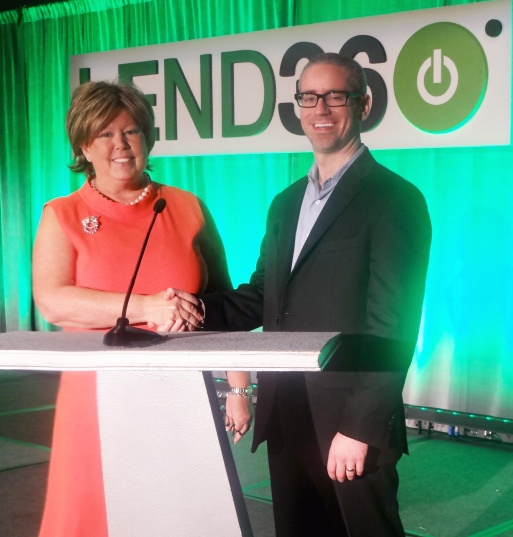 The Lend360 Conference in New Orleans last week had a different vibe from the five other conferences I’ve attended this year. For one, I was a partner in it through DailyFunder. And further, there was a huge focus on best practices, ethics, and regulations. Expert speakers and panelists aired it out to dispel myths and disclose risks.
Most telling about the future was a response from Victory Park Capital’s Brendan Carroll about whether or not he feared looming regulations could hurt the merchant cash advance and alternative business lending industry. As someone who has invested heavily in Kabbage and more recently in Square Capital, he expressed concern about regulations in general but clearly was not convinced they were on the immediate horizon for the industry.
Lisa McGreevy, president of the Online Lenders Alliance moderated the two-man panel which also consisted of John Hecht of Jefferies and she did a great job of digging out the true thoughts from one of the room’s most powerful investors. It’s unlikely a company like Victory Park Capital would invest hundreds of millions of dollars in an industry they believed faced imminent regulatory upheaval.
Merchant Cash Advance regulation is not on any regulator’s immediate agenda but they are doing their homework. At Lend360, it was revealed that several members of the North American Merchant Advance Association met with the Federal Reserve in Washington D.C. months ago for a Q&A. There’s communication occurring now on some levels. Even I’ve been contacted by the Federal Reserve to comment as a part of a broad research assessment.
Eventually I believe the CFPB will try to play a role in the industry through Section 1071 of the Dodd-Frank Act. We’re a long way from there though and it doesn’t mean they’ll be successful. Even internal operatives have expressed doubt on business-to-business jurisdiction.
In the meantime, it’s not all blue seas and sunny skies. Robert Cook, an attorney at Hudson Cook, LLP explained at the conference that the industry is already in many ways supervised by the FTC. And with the FTC, it’s not a question of how high the costs are, it’s about how transparent those costs are. If they’re high, fine, but do the customers understand them and are they marketed accordingly?
Terms like guaranteed, 99% approval rate, and lowest rates can be deemed deceptive if not true.
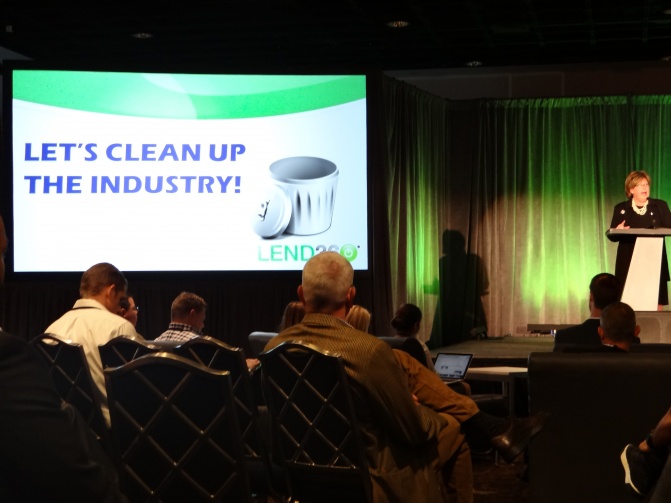 Transparency, ethics, customer experience, that’s what people in the business need to be focused on right now. Stacking, while a polarizing topic, seems to be a matter of contract law. Everybody’s caught up in the stacking debate believing it’s the lightning rod that will attract regulation. If left unchecked, it might draw interest, but it’s the fundamentals that get overlooked that could draw the ire of an agency like the FTC.
If your marketing says “rates from 1.10 and up”, while actually contracting 99% of your customers with 1.49s, that’s something you’ll probably want to address now. Think about the net cost your customer is likely to be charged. If a 1.10 is a buy rate and there’s a 10 point upsell, a 10% closing fee, and 10% origination fee that makes the end cost closer to a 1.40, you probably don’t want to market the cost as 1.10.
Right now it all basically comes down to doing good business in a transparent manner. Costs may be high but explain those costs, make sure the customers understand them. Don’t be deceptive. There will always be critics of high costs, but rational people are being exposed to the sober reality that you can lose money even at a 50% interest rate.
As a word of advice for new ISOs and brokers, stay away from funding companies that don’t even have a paid email account. If a funder is too financially strapped to afford a web domain, they probably are going to cut corners in other places too. The story about working off a gmail or hotmail account in the interim while they try to get their website set up is indicative that they’re getting ahead of themselves. There are way too many solid funding companies to choose from for you to entertain doing business with hotFunding4ISOsNow@hotmail.com. Even middlemen are accountable in the grand scheme of best practices and the customer experience.
Fund intelligently…
– AltFinanceDaily
Also read:
4/11/14 Regulatory Paranoia and the Industry Civil War
8/13/14 Should Licensing and Accreditation come to Merchant Cash Advance?