
Alternative Business Funding’s Decade Club
October 22, 2015 The working capital business is a very different animal now than it was a decade or so ago when many of today’s established players were just starting out.
“At that time, the industry was a bunch of cowboys. It was an opportunistic industry of very small players,” says Andy Reiser, chairman and chief executive of Strategic Funding Source Inc., a New York-based alternative funder that’s been in business since 2006. “The industry has gone from this cottage industry to a professionally managed industry.”
Indeed, the alternative funding industry for small businesses has grown by leaps and bounds over the past decade. To put it in perspective, more than $11 billion out of a total $150 billion in profits is at risk to leave the banking system over the next five plus years to marketplace lenders, according to a March research report by Goldman Sachs. The proliferation of non-bank funders has taken such a huge toll on traditional lenders that in his annual letter to shareholders, J.P. Morgan Chase & Co. chief executive officer Jamie Dimon warned that “Silicon Valley is coming” and that online lenders in particular “are very good at reducing the ‘pain points’ in that they can make loans in minutes, which might take banks weeks.”
The burgeoning growth of alternative providers is certainly driving banks to rethink how they do business. But increased competition is also having a profound effect on more seasoned alternative funders as well. One of the latest threats to their livelihood is from fintech companies, like Lendio and Fundera,for example, that are using technology to drive efficiency and gaining market share with small businesses in the process.
“Established lenders who want to effectively compete against the new entrants will need to automate as much decisioning as possible, diversify acquisition sources and ensure sufficient growth capital as a means to capture as much market share as possible over the next 12 to 18 months,” says Kim Anderson, chief executive of Longitude Partners, a Tampa-based strategy consulting firm for specialty finance firms.
Of course, there is truth to the adage that age breeds wisdom. Established players understand the market, have a proven track record and have years of data to back up their underwriting decisions. At the same time, however, experience isn’t the only factor that can ensure a company will continue to thrive over the long haul.
WORKING TOWARD THE FUTURE
Indeed, established players have a strong understanding of what they are up against—that they can’t afford to live in the glory of the past if they want to survive far into the future.
“With every business you have to reinvent yourself all the time. That’s what a successful business is about,” says Reiser of Strategic Funding. “You see so many businesses over the years that didn’t reinvent themselves, and that’s why they’re not around.”
Strategic Funding has gone through a number of changes since Reiser, a former investment banker, founded it with six employees. The company, which has grown to around 165 employees, now has regional offices in Virginia, Washington and Florida and has funded roughly $1 billion in loans and cash advances for small to mid-sized businesses since its inception.
One of the ways Strategic Funding has tried to distinguish itself is through its Colonial Funding Network, which was launched in early 2009. CFN is Strategic Funding’s secure servicing platform which enables other companies who provide merchant cash advances, business loans and factoring to “white label” Strategic Funding’s technology and reporting systems to operate their businesses.
“When you’re in a commodity-driven business, you have to find something to differentiate yourself,” Reiser says.
FINDING WAYS TO BE DIFFERENT
That’s exactly what Stephen Sheinbaum, founder of Bizfi (formerly Merchant Cash and Capital) in New York, has tried to do over the years. When the company was founded in 2005, it was solely a funding business. But over the years, it has grown to around 170 employees and has become multi-faceted, adding a greater amount of technology and a direct sales force. Since inception, the Bizfi family of companies has originated more than $1.2 billion in funding to about 24,000 business owners.
 Earlier this year, the company launched Bizfi, a connected online marketplace designed specifically to help small businesses compare funding options from different sources of capital and get funded within days. Current lenders on the platform include Fundation, OnDeck, Funding Circle, CAN Capital, SBA lender SmartBiz, as well as financing from Bizfi itself. Financing options on the platform include short-term funding, equipment financing, A/R financing, SBA loans and medium term loans.
Sheinbaum credits newer entrants for continually coming up with new technology that’s better and faster and keeping more established funders on their toes.
“If you don’t adapt, you die,” he says. “Change is the one constant that you face as a business owner.”
David Goldin, chief executive of Capify, a New York-based funder, has a similar outlook, noting that the moment his company comes out with a new idea, it has to come up with another one. “If you’re not constantly innovating you’re in trouble,” he says. “It’s a 24/7 global job.”
Capify, which was known as AmeriMerchant until July, was founded by Goldin in 2002 as a credit card processing ISO. In 2003, the company began focusing all of its efforts on merchant cash advances. Four years later, the company made its first international foray by opening an office in Toronto. The company continued to expand its international presence by opening up offices in the United Kingdom and Australia in 2008. The company now has more than 200 employees globally and hopes to be around 300 or more in the next 12 months, Goldin says. The company has funded about $500 million in business loans and MCAs to date, adjusted for currency rates.
THE CULTURE OF CHANGE
Five or six years ago, Capify’s main competitors were other MCA companies. Now the competition primarily comes from fintech players, and to keep pace Capify has made certain changes in the way it operates. From a human resources standpoint, for instance, Capify switched from business casual attire to casual dress in the office. The company has also been doing more employee-bonding events to make sure morale remains high as new people join the ranks. “We’ve been in hyper-growth mode,” he says.
CAN Capital in New York, another player in the alternative small business finance space with many years of experience under its belt, has also grown significantly (and changed its name several times) since its inception in 1998. The company which began with a handful of employees now has about 450 and has offices in NYC, Georgia, Salt Lake City and Costa Rica. For the first 13 years, the company focused mostly on MCA. Now its business loan product accounts for a larger chunk of its origination dollars.
This year, the company reached the significant milestone of providing small businesses with access to more than $5 billion of working capital, more than any other company in the space. To date, CAN Capital has facilitated the funding of more than 160,000 small businesses in more than 540 unique industries.
Throughout its metamorphosis to what it is today, the company has put into place more formalized processes and procedures. At the same time, the company has tried very hard to maintain its entrepreneurial spirit, says Daniel DeMeo, chief executive of CAN Capital.
One of the challenges established companies face as they grow is to not become so rule-driven that they lose their ability to be flexible. After all, you still need to take calculated risk in order to realize your full potential, he explains. “It’s about accepting failure and stretching and testing enough that there are more wins than there are losses,” says DeMeo who joined the company in March 2010.
ADVICE FOR NEWCOMERS
As the industry continues to grow and new alternative funders enter the marketplace, experience provides a comfort level for many established players.
“The benefit we have that newcomers don’t have is 10 years of data and an understanding of what works and what doesn’t work,” says Reiser of Strategic Funding. With the benefit of experience, Reiser says his company is in a better position to make smarter underwriting decisions. “There are many industries we funded years back that we wouldn’t touch today for a variety of reasons,” he says.
Experienced players like to see themselves as role models for new entrants and say newcomers can learn a lot from their collective experiences, both good and bad. Noting the power of hindsight, Reiser of Strategic Funding strongly advises newcomers to look at what made others in the business successful and internalize these best practices.
One of the dangers he sees is with new companies who think their technology is the key to long-term survival. “Technology alone won’t do it because that too will become a commodity in time,” he says.
Over the years Strategic Funding has learned that as important as technology is, the human touch is also a crucial element in the underwriting process. For example, the last but critical step of the underwriting process at Strategic Funding is a recorded funding call. All of the data may point to the idea that a particular would-be borrower should be financed. But on the call, Strategic Funding’s underwriting team may get a bad vibe and therefore decide not to go forward.
“We look at the data as a tool to help us make decisions. But it’s not the absolute answer,” Reiser says. “We are a combination of human insight and technology. I think in business you need human insight.”
Seasoned alternative funding companies also say that newbies need to implement strong underwritingcontrols that will enable them to weather both up and down markets.
The vast majority of newcomers have never experienced a downturn like the 2008 Financial Crisis, which is where seasoned alternative financing companies say they have a leg up. Until you’ve lived through down cycles, you’re not as focused as protecting against the next one, notes Sheinbaum of Bizfi. “Every 10 years or 15 years or so, there seems to be a systemic crisis. It passes. You just have to be ready for it,” he says.
Goldin of Capify believes that many of today’s start-ups don’t understand underwriting and are throwing money at every business that comes their way instead of taking a more cautious approach. As a funder that has lived through a down market cycle, he’s more circumspect about long-term risk.
 One of the biggest problems he sees is funders who write paper that goes two or three years out. His company is only willing to go out a maximum of 15 months for its loan product, which he believes is s a more prudent approach. He questions what will happen when the economy turns south—as it eventually will—and funders are stuck with long dated receivables. “You’re done. You’re dead. You can’t save those boats. They are too far out to sea,” Goldin says.
Having a solid capital base is also a key to long-term success, according to veteran funders. Many of the upstarts don’t have an established track record and need to raise equity capital just to stay afloat—an obstacle many long-time funders have already overcome.
Goldin of Capify believes that over time consolidation will swallow up many of the newbies who don’t have a good handle on their business. Hethinks these companies will eventually be shuttered by margin compression and defaults. “It can’t last like this forever,” he says.
In the meantime, competition for small business customers continues to be fierce, which in turn helps keep seasoned players focused on being at the top of their game. Getting too comfortable or complacent isn’t the answer, notes DeMeo of CAN Capital. Instead, established funders should seek to better understand the competition and hopefully surpass it. “Competition should make you stronger if you react to it properly,” he says.
Ready Capital’s Q1 and Fintech Footprint
May 20, 2025Ready Capital originated $343M in SBA loans in the first quarter of 2025. It did an additional $44M in non-SBA small business loans in the same period.
“While we anticipate moderation in volume ahead, we view recent policy updates from the SBA as constructive towards reinforcing the program’s long-term strength and integrity,” said Thomas Capasse, CEO of Ready Capital. “Ready Capital continues to deliver performance above industry benchmarks. Our 12 month default rate was 3.2% versus the industry average of 3.4% and our five year charge-off rate has now declined for the fourth consecutive quarter, reflecting the strength of our credit and servicing practices. Additionally, our 12 month repair and denial rate reached a historic low.”
While Ready Capital is known as the fourth largest SBA lender and by far the largest non-bank SBA lender, the company is also among the biggest fintech innovators in the space.
- 2019: Acquired Knight Capital and iBusiness Funding
- 2023: Launched LenderAI
- 2023: Acquired non-SBA assets and talent from Fountainhead SBF LLC
- 2024: Acquired Funding Circle US
- 2024: Inherited Funding Circle’s funding partnership with eBay
On the last point above, eBay brokered more than $100M in small business funding in 2024 alone, with more than half of that believed to have gone to Funding Circle US, now Ready Capital via iBusiness Funding. On eBay, iBusiness Funding offers term loans up to $500k with repayment terms up to 7 years.
The rest of eBay’s funding volume goes to an MCA provider named Liberis.
Ready Capital Grows as Leading Non-Bank Small Business Lender
November 10, 2024 “Ready Capital has become a leading national non-bank lender to small businesses providing a full suite of loan options from $10,000 unsecured working capital loans to $25 million plus real estate-backed USDA loans,” said Ready Capital CEO Thomas Capasse during the company’s Q3 earnings call.
Ready, in some ways, has flown under the radar in recognition. On the one hand the company is the top non-bank SBA lender in the country and fourth overall SBA lender in the country. On the other hand, the company has previously acquired Knight Capital, iBusiness Funding, Madison One Capital, select non-SBA assets of Fountainhead, and Funding Circle USA. The result is that the overall organization is a powerhouse with a current public market cap of $1.25B.
iBusiness Funding, once the technology arm of Knight Capital, has played an integral role for the company. For example, when Ready acquired Funding Circle USA, it did it through the iBusiness Funding brand.
“[In 2019, iBusiness Funding was] a leader in unsecured small business lending,” Capasse said on the call. “And then they adopted their tech to the PPP which was very accretive. And since then there’s been the initiative within the SBA to emphasize small loans below $350,000, which many times are minority women-owned businesses, and so that’s been a significant initiative by the SBA& and so what we’ve done is iBusiness has developed a tech stack, which is now being marketed as a third-party underwriting model for banks. Banks just do not focus on that at all. Even if they do SBA loans, it’s mostly for larger loans again above the $350,000 to the $5 million. So the idea with iBusiness is to grow the revenue stream from this software-based business.”
On Funding Circle, Capasse said that the newly acquired subsidiary would be “accretive to earnings once fully ramped.” The numbers offered so far was that $6.6 million growth in Q3 origination income came from small business working capital loans through the Funding Circle platform.
eBay: ‘We’ve Already Done $40M in MCAs’
November 3, 2024 eBay is coming in hot to the small business financing game. The company reported that it had connected merchants with $100M in funding YTD, over $40M of it being “business cash advances” through Liberis alone.
Liberis is a UK-based company that expanded into North America 4 years ago. It secured $112M in debt funding last year. The partnership between Liberis and eBay only started this past July. eBay’s other big funding partner is Funding Circle.
eBay’s role as a facilitator for funding follows what every other major e-commerce platform is doing. For example, Amazon, Shopify, Walmart, Lightspeed, and DoorDash all offer funding to sellers on their platforms. Technically, eBay was the first considering it had originally partnered up with Kabbage back in 2010. That relationship did not last, however.
eBay Brings Back Revenue Based Financing Product
July 12, 2024eBay announced that Liberis had been onboarded as one of its “Seller Capital” partners this week, making it the second official partner after Funding Circle (which was recently acquired). Liberis, homegrown in the UK, expanded to the US in 2020 and offers a revenue based financing product described by eBay as a “Business Cash Advance.” While eBay has partnered with similar companies in the UK for years, eBay customers in the US have seen this before.
In 2010, for example, Kabbage was arguably the first company to offer revenue based financing to eBay customers, which AltFinanceDaily first covered 13 years ago. And they had it all to themselves until PayPal began to muscle its way in with a similar product starting in 2013. Given that eBay owned PayPal, PayPal held a distinct advantage until the two companies split in 2015. Still, PayPal continued to be the default payment service for eBay until 2018.

Kabbage continued to thrive anyway, evolving beyond the platform at least until covid when Kabbage suddenly imploded and was sold to American Express. PayPal’s working capital product also continued to thrive at least until 2023 when it announced a dramatic pullback after elevated charge-offs.
The result is that in 2024, eBay sellers can now look toward getting funding via Liberis.
“As a pioneer in ecommerce and the home to small businesses in more than 190 markets, eBay understands the challenges small businesses encounter in securing fast, flexible and transparent financing,” said Avritti Khandurie Mittal, VP & General Manager of Global Payments and Financial Services at eBay in the official announcement. “eBay Seller Capital is aimed at fueling our sellers’ growth by providing them with tailored financing solutions that meet the unique needs of their businesses. The addition of Business Cash Advance to our suite of offerings in partnership with Liberis enables us to expand capital availability for our sellers on flexible terms – when they need it the most.”
“We understand the unique challenges eBay sellers face when securing financing through traditional means,” adds Rob Straathof, CEO of Liberis. “Through eBay Seller Capital, Liberis will empower sellers with access to fast and responsible financing. We’re thrilled to partner with eBay to support eBay sellers to operate and grow their businesses.”
Payoneer Funds $80M in MCAs in Q1
June 17, 2024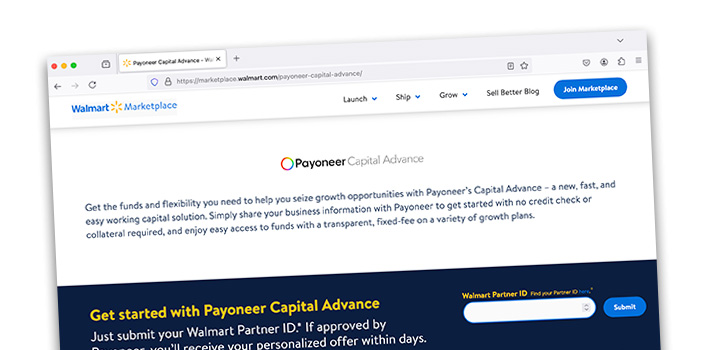 Payoneer, the digital payments provider that also offers working capital on e-commerce platforms like Walmart Marketplace, originated $80M in merchant cash advances in Q1, according to the company’s recent quarterly earnings report. While the company did not draw attention to this stat, it appears in its Statement of Cash Flows. Payoneer originated $299M in funding to merchants throughout all of 2023, which would put the company below Funding Circle in terms of annual funding volume.
When it comes to Walmart, Payoneer offers up to 140% of a marketplace merchant’s average monthly Walmart volume and factor rates that range from 1.015 to 1.10.
“Payoneer will collect a pre-determined portion of each Walmart payout you receive via ACH bank debit from your bank account,” the website states. “Debits typically take place within 1 business day of each payment received from Walmart.”
The program is not new. The two first announced this relationship in December 2021. At the time, a senior director at Walmart said “Affordable working capital is more important than ever to help our sellers grow their business.”
Capify Announces New Growth Phase with Global Marketing Director Appointment
April 2, 2024Leading online SME lender, Capify, has appointed Ash Yazdani to oversee its marketing and customer experience functions in both the UK and Australia.
Yazdani joins from Stockholm-based Hoist Finance, where he spent four years as Global Head of Marketing, Product and Customer Experience.
Having worked previously for two of the largest global media networks WPP and Dentsu Aegis, Yazdani made the move into financial services with Think Money Group, before joining Hoist.
“To be joining Capify at this stage of its growth journey is a massively exciting opportunity,” said Yazdani.
“This is a hugely ambitious business, with an innovative vision to improve access to SME finance for under-supplied areas of the UK and Australian economy. My experience in reaching new segments, developing propositions that meet their needs, and delivering seamless end-to-end customer experience will help us on our mission to do that”.
Capify was launched in the UK and Australia in 2008, against the backdrop of the global financial crisis, when many small and medium-sized businesses were struggling to access funding from banks. Last year it was named the UK Credit Awards SME Lender of the Year (up to £1m). Founded initially in the United States in 2002, it was one of the world’s first online alternative financing companies for SMEs.
Yazdani’s appointment is the latest in a series of high-profile hires made by the alternative lender. Earlier this year, Mike Morris moved from Funding Circle to lead Capify’s advisor and introducer network in the UK.
John Rozenbroek, COO/CFO at Capify, said: “We’re absolutely delighted to welcome Ash to our growing team. In these volatile trading times, the funding needs of business changes fast. Having someone with Ash’s experience will enable us to ensure that SMEs know about – and understand – our funding options.”
“As we scale, he will also help ensure our customer touch points are efficiently optimised to continue to deliver an excellent customer experience. His appointment underlines our commitment to our UK and Australian SME market and represents a further milestone in Capify’s continued growth.”
About Capify
Capify is an online lender that provides flexible financing solutions to SMEs seeking working capital to sustain or grow their business. Originally started in the US over twenty years ago, the fintech businesses have been serving the SME market in the UK and Australia for over 15 years. In that time, it has provided finance to thousands of businesses, ensuring the vibrant and vital SME community can meet the challenges of today and the opportunities of tomorrow.
For more details about Capify, visit:
http://www.capify.co.uk
http://www.capify.com.au
Media enquiries
Sam Gallagher, Director
Amazon Discontinues Its In-House Business Loans
March 9, 2024 After AltFinanceDaily reported that Amazon’s on-balance-sheet business loan receivables had remained steady throughout 2023, the company has abruptly decided to terminate its in-house lending program altogether.
Through an email confirmed to Fortune, Amazon ended its in-house term loan business on March 6. That same story says that they will continue to work with third party lenders and funders as they have been doing for a while. Some of their partners include Lendistry, SellersFi, and Parafin.
The in-house program had been running since 2011 and was first discovered by AltFinanceDaily in 2013.
While the company was shy about disclosing origination figures, it carried approximately $1.3B in loan receivables on its books throughout last year.
The Amazon news coincides with the announcement that business loan rival Funding Circle has decided to exit the US market. Funding Circle US is currently up for sale.
Wow we sort of called this @amazon sellers pic.twitter.com/MOWsPWxcb1
— Amazon Sellers ASGTG (@AmazonASGTG) March 7, 2024