
Is Online Lending Really Just Offline Lending?
October 19, 2015 Two weeks ago the Wall Street Journal postulated that online lending’s biggest beneficiary was the U.S. Postal Service. “In July alone, Lending Club mailed 33.9 million personal-loan offers,” it said. “The average monthly volume of personal-loan offers sent through the mail has more than doubled in two years to 156 million in the year through July from 73 million in the same period in 2013,” it added.
These figures have some people concerned that there is no network effect for these lending platforms. Last month, Timothy Puls, an equity analyst for Morningstar, said that the value of a company like Lending Club doesn’t grow just because more users are on the platform. That means a continuous stream of marketing is essential since they’ll always need to find new borrowers to sustain the business.
To illustrate how sensitive lenders are to this, OnDeck CEO Noah Breslow spoke to the increasing competitiveness of direct mail in their 2nd quarter earnings call and argued their strategy was to “break through the clutter” and “better communicate our value proposition.” Analysts on the call were concerned by that, which prompted a question by Christopher Brendler of Stifel, Nicolaus & Company during the Q&A session.
Question by: Christopher Brendler of Stifel, Nicolaus & Company
You mentioned in the direct channel about a response rate, talking about a response rate to direct mail. Can you talk about the response rate that you are seeing in that channel? It seems like from an outsider’s perspective we’ve gotten more competitive and it sounds like you’ve had a little bit of a struggle there. We just want to see if there is any color you could add on what the competitive environment is having on the direct channel.Answer by: Noah Breslow of OnDeck
I think what we are seeing really is just an intensified set of activities and you can’t really isolate it down to any single or couple of competitors but it’s sort of both in the offline direct mail channel, we are seeing increased mail volumes over where they were six months ago. And then in the online channel we are seeing increased bidding and so forth for Google Adwords and the like.
Nothing to worry about when it comes to that mail stuff though right? Google Adwords, facebook, instagram, and snapchat are where the real action comes from for online lenders, you might think.
According to Marlette Funding CEO Jeffrey Meiler, that’s not the case. In the WSJ, he admits that 90% of the billion dollars in online loans they’ve originated have come from offline channels.
And maybe that’s because the term online lender might be a red herring. Online lenders don’t only exist in cyberspace, they have offices in the real world just like banks do. And sure, they have websites, but then again so do banks. When you start to boil it down, online lenders look a lot like every other business in existence today. And while it may not be typical for a small business owner to walk into the office of an online lender to get funding, several lenders have said this happens. And for the brokers that arrange business loans, it’s pretty common for them to visit the actual businesses and meet with the owner(s). Not a very online experience…
It may be fashionable to say what separates banks from online lenders is that you have to walk into a bank to apply for a loan, but that’s often just not the case. Most banks offer loans through the form of credit cards both online and through direct mail and they’ve been doing this for decades. The only difference is now they’re competing with other lenders that don’t have local branches for the customer to walk into it, the online lenders. And maybe that’s what the difference is, being branchless could be what defines an online lender.
For now though, a heck of a lot of online lending seems to be originated offline.
World Business Lenders Makes Credit Prediction, Employs Different Model
October 19, 2015World Business Lenders (WBL) Managing Director Alex Gemici thinks the next credit correction will take place within three years, he told a crowd at Lend360 last week in Atlanta. When he and his fellow panelists were asked what keeps them up at night, Gemici said, “irrational exuberance.” He clarified that by saying that there was an incredible amount of capital pouring in right now and insinuated that it’s not all being deployed intelligently. He also pointed to the country’s economic history and said we’re naturally due for a shift in the credit cycle.

From Left to Right: Bob Coleman of the Coleman Report, Jason Rockman of CAN Capital, Craig Coleman of ForwardLine, Alex Gemici of World Business Lenders, David Gilbert of National Funding and Jeremiah Neal of Biz2credit
Part of WBL’s hedge (if you could call it that) against a future industry shakeout, is that their loans are actually collateralized, though they didn’t start out that way. When they launched in 2011, they initially offered unsecured loans and eventually evolved towards collateralizing them with all different types of assets. They have shifted even further in that direction and today the only collateral they accept is real estate. That makes WBL’s model quite traditional by comparison to competing products like merchant cash advances and OnDeck loans. Gemici says however, that they believe in technology and data mining to make better underwriting decisions, just like today’s unsecured fintech lenders.
But while they use technology, their process isn’t fully automated and that’s because Gemici believes algorithms aren’t advanced enough yet to make decisions on their own. You can’t ask Siri whether she’d approve a business loan yet, Gemici joked.
Will business loans backed by real-estate give them a long-term edge over unsecured lenders? Only time will tell. One thing many people agree on however is that there will most certainly be a shakeout when the next economic downturn hits.
Palladium Equity Partners Announces Investment in Fora Financial, a Provider of Working Capital Financing to Small- and Medium-Sized Businesses
October 14, 2015 Palladium Equity Partners, LLC (along with its affiliates, “Palladium”), a private investment firm with over $2.0 billion in assets under management, today announced that one of its affiliates has made a significant investment in partnership with the co-founders and management of Fora Financial LLC (together with its affiliates, “Fora Financial” or the “Company”), a technology-enabled provider of financing to small- and medium-sized businesses nationwide.
Founded in 2008, Fora Financial offers loans and merchant cash advances of between $5,000 and $500,000 to small businesses throughout the country. Since inception, the Company has provided total funding of nearly $400 million to more than 8,000 businesses. It has experienced rapid growth and recently was ranked among the fastest-growing companies in America in the Inc. 5000 list. Fora Financial recently expanded its New York City offices to accommodate its growing roster of over 100 employees as it bolsters key capabilities in analytics and technology and aims to continue to execute on its strategy of delivering capital in a timely and cost effective way.
Fora Financial will continue to be led by its two founders, CEO Jared Feldman and President Dan Smith.
“We believe Fora Financial has developed a highly attractive credit offering and technology platform that have made it a valued provider of financing to thousands of small businesses seeking capital,” said Justin Green, a Principal of Palladium. “My partners and I look forward to supporting Jared, Dan and the Fora Financial management team to continue the strong growth trajectory of the Company, including through new partnerships, expanded product offerings and increased lending capabilities.”
Feldman said, “We are excited to partner with Palladium, a firm with extensive financial services expertise and many years of experience supporting founder-owned businesses.”
Smith added, “With this partnership in place, we are well-capitalized to continue offering the small business community the custom, innovative funding solutions that have enabled us to build this Company into a market leader.”
Terms of the investment were not disclosed. Fora Financial was advised by Raymond James & Associates.
About Fora Financial
Fora Financial offers flexible, working capital solutions to small businesses in need of financing to sustain or grow their enterprise. The Manhattan-based company places a high value on trust and transparency and provides businesses with quick, customized financial solutions utilizing its state-of-the-art technology platforms. Founded in June 2008, Fora Financial has more than 100 employees who have provided nearly $400 million to over 8,000 customers. For additional information, please visit www.forafinancial.com, call (855) 515-2413 or follow Fora Financial on Facebook at facebook.com/Fora.Financial.
About Palladium Equity Partners, LLC
Palladium is a middle market private equity firm with over $2.0 billion in assets under management. The firm seeks to acquire and grow companies in partnership with founders and experienced management teams by providing capital, strategic guidance and operational oversight. Since its founding in 1997, Palladium has invested over $1.5 billion of capital in more than 25 platform investments and over 50 add-on acquisitions. The firm focuses primarily on buyout equity investments in the range of $50 million to $150 million. The principals of the firm have significant experience in financial services, business services, food, healthcare, industrial and media businesses, with a special focus on companies they believe will benefit from the growth in the U.S. Hispanic population. Palladium is based in New York City. For more information, visit www.palladiumequity.com.
For media inquiries, please contact:
Todd Fogarty or Peter Hill of Kekst and Company
212-521-4800
todd-fogarty@kekst.com or peter-hill@kekst.com
Fake Business Loan Application Fees Leads to Two Convictions
October 5, 2015 Two men were convicted last week of perpetrating an advance fee fraud scheme. David C. Jackson and Alexander D. Hurt defrauded more than 40 individuals out of $4.5 million, mainly by directing small businesses hoping to get a loan to pay phony application fees, collateral fees, or commitment fees. “These defendants and their co-conspirators took advantage of individuals and business owners who had limited options in acquiring business loans in the difficult financial environment that existed after the recession of 2008,” states a report issued by the Department of Justice.
Deirdre M. Daly, United States Attorney for the District of Connecticut, said that people need to be careful about loan offers online. “Those seeking business loans need to be wary of any provider of funding that requires significant fees in advance—especially those who use the Internet to prey upon trusting people who are unable to verify the representations made,” Daly said.
“Jackson was previously convicted of federal bank fraud and money laundering offenses in October 2006 and was sentenced to 41 months in prison, followed by five years of supervised release,” the DOJ report says. “He was released from federal prison in September 2009 and operated this advance fee fraud scheme while on supervised release.”
The two used a slew of personal aliases and business names to cover their trail. The business names included:
- Jalin Realty Capital Advisors, LLC
- American Capital Holdings, LLC
- Brightway Financial Group, LLC
An archived version of American Capital Holding’s website said the following on the home page:
“In today’s economic climate, finding reliable funding sources can be frustrating. Fortunately, we are partnered with an investment fund that provides commercial real estate development and acquisition projects. Due to our professionalism & honesty we have achieved massive trust worldwide.”
One lesson here would be to cautious of anyone who says they have “achieved massive trust” but another is to conduct background checks on the online lender you’re considering.
And of course never pay a fee upfront for the promise of a loan in return.
Sam Hodges on Fox Business
September 30, 2015Funding Circle’s Sam Hodges appeared on Fox Business on Monday, September 28th. One of the things he said is that loans under $1 million are still out of reach for most small businesses.
He also mentioned that his company has the lowest loss level of any digital small business lender anywhere in the world.
Details about Funding Circle disclosed:
- $1 billion lent to more than 10,000 businesses
- 40,000 investors globally
- $25,000 to $500,000 small business loans
Watch the full video below:
What The BFS Capital IPO Announcement Means for the Industry
September 29, 2015 Under the Jumpstart Our Business Startups (JOBS) Act, “an emerging growth company may confidentially submit to the Commission a draft registration statement for confidential, non-public review by the Commission staff prior to public filing.”
According to the New Yorker, this process “allows companies that are thinking about going public to test the waters—they can gauge investor reaction, get feedback from the S.E.C. on their filings, and so on—before deciding if they want to go ahead with an I.P.O. If a company goes through that process publicly, and then decides to abandon the offering, its reputation gets damaged, even though it often makes sense for a company not to go public. Do it privately, and no one gets hurt.”
That’s what makes BFS Capital’s announcement (formerly Business Financial Services) that they had filed a confidential draft registration so bold. Companies normally choose this method if they don’t want anyone to know what they’re up to. But BFS is a different funder than the ones that came before them. OnDeck submitted their original draft registration confidentially for example and actually tried to keep it a secret.
“The initial public offering is expected to commence after the SEC completes its review process, subject to market and other conditions,” states BFS’s September 25th release.
The intent to go public follows a recent rebrand and the announcement that they had crossed $1 billion in funding since inception.
The most shocking part about a BFS IPO is that it’s not a CAN Capital IPO. While CAN is both older and larger, the industry has heard no word about a CAN Capital IPO since rumors leaked in Bloomberg almost an entire year ago. Back on November 20th, 2014, it was reported that the “New York-based company could be worth as much as $2 billion in the share sale.”
There was kind of a universal expectation that CAN Capital would go public immediately after OnDeck and Lending Club. Some insiders have pointed to OnDeck’s disappointing reception and performance as the reason CAN has delayed moving forward. OnDeck is currently trading at less than 50% of its IPO price and is facing a lawsuit from its own shareholders over it.
Others have said that CAN Capital isn’t waiting for anything because the company doesn’t actually need to go public. Long reported to be profitable and self-sustaining, opening themselves up to the volatility and fickleness of the public markets may not be worth the additional capital.
And still more have pondered if CAN Capital has what it takes to excite investors. Unlike some of the brand new tech startups that dominate the headlines, CAN has been operating since 1998, a time when only 42.1% of American households had computers and only 26.2% had Internet access. Of course the company has evolved and these days is as tech-equipped as their young brethren but a 17-year old lender may not be as easy to sell in a market obsessed with companies such as Uber, Snapchat and Airbnb.
BFS Capital was founded 13 years ago in 2002 so they’re not exactly new either. And their CEO, Marc Glazer, has led the company since its beginning.
BFS has been expanding however both here in the U.S. and abroad. In the U.K., they operate under the name Boost Capital. Meanwhile, independent financial brokerage firms such as Entrust Merchant Solutions are being acquired and rolled up into their organization.
What makes BFS different from OnDeck and Lending Club is that BFS also does merchant cash advances, not just loans. The only other publicly traded company that is significantly involved in merchant cash advances is Enova International and that’s only due to their recent acquisition of The Business Backer. The investor uncertainty surrounding lenders and marketplace platforms might not carry over to a company that got its start by purchasing future credit card processing receivables 13 years ago.
It would be safe to say that there’s a whole group of industry insiders who feel that Lending Club is a poor representative sample of the tech-enabled business financing space and that OnDeck’s unique model prejudices investors into thinking all lenders are like them. A BFS Capital IPO could in effect set the record straight for the industry and revive the IPO plans of their peers and competitors.
It might actually take a BFS IPO for us to finally see a CAN IPO, not that there aren’t plenty of other quality candidates right behind them.
What would a BFS Capital IPO mean for the industry? Perhaps a chance at redemption. There’s a lot of great things happening in this industry and investors ought to know about them.
Business Financial Services Rebrands as BFS Capital
September 21, 2015 CORAL SPRINGS, FL, September 21, 2015 – Business Financial Services, Inc., a leading technology-enabled small business financing platform, announced today that it has rebranded as BFS Capital and launched a new website, www.bfscapital.com. As part of this rebranding, the company has also unified its North American business affiliates.
A champion of small business, BFS Capital provides flexible, timely solutions for customers without access to traditional financing. The new BFS brand conveys a sustained commitment to empowering the growth and success of these businesses. Today, BFS Capital offers loans and merchant cash advances – up to $2 million – to small businesses across 400 industries in all 50 states, the United Kingdom and Canada through its extensive network of independent sales organizations, as well as its direct sales and online channels.
The rebranding reflects the company’s deep experience serving the diverse financing needs of small businesses, its commitment to innovative products and technology, and its expanded market opportunities. “As we have grown and acquired new partners over the years, we saw the need to unify our businesses under a single brand representative of our rich history and bright future,” said Marc Glazer, CEO and co-founder.
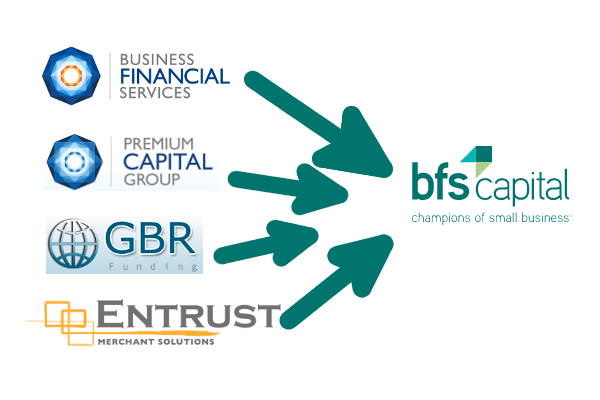
BFS’s affiliates, Entrust Merchant Solutions, GBR Funding and Premium Capital Group, are also known as BFS Capital, which now has more than 275 employees. The former Entrust team has become the BFS direct sales group, led by Ilya Fridman as Senior Vice President. UK affiliate, Boost Capital, will retain its name.
About BFS Capital
BFS Capital champions the long-term growth and prosperity of small businesses by providing timely, flexible financing solutions. BFS’s leading small business financing platform leverages customized underwriting and proprietary algorithms to fund up to $2 million for businesses in all 50 states and Canada, and through its affiliate, Boost Capital, in the United Kingdom. Since 2002, BFS has provided more than $1 billion in total financing to small businesses across more than 400 industries. Headquartered in South Florida with additional offices in New York, California and Georgia, BFS is an accredited BBB company with an A+ rating. For more information, please visit www.bfscapital.com.
Contact
Abby Trexler, Peppercomm
bfs@peppercomm.com
BFS Capital Joins the Ranks of Consolidated Powerhouses in Alternative Lending
September 21, 2015 Coral Springs, FL-based Business Financial Services has joined the ranks of consolidated powerhouses with the announcement of their rebrand to BFS Capital. As part of the move, the company has unified its North American business affiliates.
Entrust Merchant Solutions, GBR Funding and Premium Capital Group will now also use the BFS Capital name. Entrust, who was acquired by BFS Capital on August 26th, has become the firm’s direct sales division. Ilya Fridman, Entrust’s former CEO, is now a Senior Vice President of BFS Capital and will oversee sales.
Boost Capital, their UK arm, is not changing its name.
BFS Capital is the latest small business funding provider to consolidate their affiliates and change their name.
Already this year, Merchant and Cash and Capital became Bizfi, AmeriMerchant became Capify, and RetailCapital became Credibly. Industry insiders have noticed one thing in common about all these changes, that they’re memorable.
“I think people are thinking about going public and want names that are easily identifiable more than wanting to sound techy,” said John Celifarco, Sales Manager at NY-based Sure Payment Solutions. “Maybe a little of both.”
When AltFinanceDaily previously asked Rory Marks, a Managing Partner of NY-based Central Diligence Group, about the name recognition-value of certain funders in the industry including Business Financial Services, he said “when choosing to use words that are ubiquitous in the industry, it could be difficult to distinguish yourself. Ultimately this could potentially impact the customer’s ability to fully understand the nature of your business.”
Business financial services could be confused as a genre or a category, a few insiders commented, instead of a company name.
The BFS Capital brand should remedy any confusion, although Justin Benton, Executive Loan Producer of Lenders Marketing shared, “a simple name that conveys what you do has value, not only in the eyes of your potential clients, but in the eyes of search engines like Google. At the end of the day, if you do your job well and the client is pleased with the loan product and service you provide, your name will be positively associated as a trusted resource.”
Business Financial Services has long been referred to as BFS by industry insiders so unlike other funders that completely transformed during their rebrand, BFS Capital may retain more of their previous name’s goodwill.
“Bringing all your companies under one umbrella can bring each company’s unique strengths together in one collective effort, rowing towards one common destination,” said Benton.
BFS Capital has been a hot news item this summer. In July, they surpassed $1 billion in lifetime funding.