IOU Financial Originates $52.2M in Q3
November 19, 2021 IOU Financial continued its growth trajectory this past quarter with $52.2M in small business funding originations. It was the company’s biggest month since inception.
“Our successful migration to a marketplace strategy has enabled IOU Financial to capture more volume in Q3 than would have previously been possible,” stated Robert Gloer, President and CEO in an official statement. “This has proven to be a win-win that has in turn given us the financial latitude to invest in growth initiatives and further reduce our corporate debt.”
The company was also profitable in Q3, though the company said this was “due in part to a reversal in its provision for loan losses and recoveries of loans previously written off, as well as a reduction in operating expenses due to the recognition of $1.5 million in employee retention credits.”
IOU’s customers have been in business for an average of 11.5 years and borrow $82,688 on average for a weighted average term of 11.9 months.
For the first 3 quarters of 2021, the company has originated $111.9M.
Private Lender Expo Shows The State of Real Estate Investing Industry
November 19, 2021 “We’re here because we’re looking to see if we can branch into real estate lending,” said Porsche Brooks, CEO of Brooks Partners Finance, a company that provides a suite of funding services that include both MCAs and SBA loans.
Brooks was one of many that attended the Private Lender Expo in Atlantic City on Thursday, where financiers, developers and more talked heavily about apartment complex and suburb-centric commercial real estate development.
“There are opportunities here,” said Brooks. “We’re really looking to expand.”
While there was evidence of fintech making its way through the space, companies providing document-digitizing software were hesitant to label themselves as fintech companies.
A representative from CoStar, a technology-centric real estate information company, called themselves “fintechy” but made it clear that they are only looking to function within the current space, not revolutionize it.
Those who hosted booths at the event showed little interest in expanding business operations into small business financing as a way to grow their lending options. As real estate investments continue to pay hefty dividends, lenders who focus on that area aren’t looking to dilute their effort into other ventures.
“Small business lending can be such a headache,” said one real estate investment company representative when asked if they would ever venture outside of their investment property exclusivity into funding merchants. “The amount of money in real estate right now is evident all around us. There’s always a lot of people at stuff like this that will give you a million dollars, but now this stuff is becoming all real estate.”
Congress Introduces New Restrictive Small Business Financing Bill
November 19, 2021 A new bill introduced by Rep. Nydia M. Velázquez, the Chairwoman of the House Small Business Committee, and Senator Robert Menendez (D-NJ), hopes to “stop predatory small business loans” by applying broad consumer protections to small business borrowers nationwide.
This would be done by including small businesses as a covered party under the already existing Truth in Lending Act (TILA).
The proposal, if successful, would arguably become more restrictive than New York’s recently passed commercial financing disclosure law.
Among the supporters of the bill are LendingClub and Funding Circle. No republican members of congress are listed among the sponsors in the official announcement.
The bill is similar to one introduced last year that failed to advance, the Small Business Lending Disclosure and Broker Regulation Act of 2020. That bill never made it out of the House Financial Services Committee. The makeup of Congress now, however, is different than it was last year.
What Works in Marketing Financial Products
November 17, 2021 Social media was at the top of the list for many marketers that AltFinanceDaily spoke with, but there are certain formulas necessary to make it work, they say.
“It’s coming up with new ways to say ‘we want to fund your deals,’” said Cassandra Lund, Social Media Manager at Lendini, when asked what the hardest part of her job is. Being heavily involved in the marketing campaigns of a large small business funding company, Lund believes social media is a prime place for setting up brand legitimacy.
“[Social media] provides something that even other forms of marketing cannot,” said Lund. “It instantly connects you to your audience and allows them to ask questions right away, either through direct message or as a comment.”
Fintech companies are also strategically using social media to start getting their name out there. Jennifer Marshall, Marketing Manager at fraud and dispute software provider Quavo, praised the power of social media; especially platforms that provide a professional environment for both consumers and businesses.
“We see the most results on LinkedIn,” said Marshall, “from both paid and organic efforts. “LinkedIn can take [businesses] a long way if their marketing team leverages tagging and mentioning [on the platform]. In the early stages of a company, when brand awareness is the top priority, [businesses] should leverage their employees’ LinkedIn networks.”
 While Marshall and Lund are marketing different financial products, they both agree on the inherent value of LinkedIn to their respective companies when it comes to a buttoned-up platform for connections and content.
“Just create a Linkedin and Instagram and start posting,” Lund said, when asked how a business could get their foot in the social media door. “You will find people in your industry, potential clients and information about what other businesses in your field are doing. Build out from there, and your business will thank you for it.”
With the opportunity social media provides comes responsibility, and some companies have let simple mistakes hurt the perception of their brand. Lund and Marshall both believe that a misguided or typo-littered social media presence can do a company more harm than good.
“Spelling errors and bad graphics, I see these [errors] a lot on social media as it becomes more and more important to small businesses,” said Lund. “There is nothing more important on social media than a first impression, and a spelling error or hugely pixelated photos is a major deterrent.”
Marshall stressed that companies not let “B2B vs B2C” marketing practices dictate their social media efforts. “In the end, you should want to reach people where they work and where they play. Once you understand that, the value of social media to all financial companies is crystal clear.”
 With new members of the work force living most of their lives ingrained in social media, it appears its value in the business world is exponential. “The younger generations have used it for years, or since being born, and it’s not going anywhere in the near future,” said Lund. “Finding new clients, new customers and like-minded business professionals on [social media] helps build your brand and stake a claim in the industry. Anyone that doesn’t think social media is important in business in general is missing out.”
Marketing financial products, especially new or alternative fintech solutions can be difficult, however. When asked about how to market a financial product, Francesca Ligouri, Lead National Designer at Create with Chess, a national marketing company that works in a variety of industries, spoke about the values of traditional marketing materials on top of social media. She stressed the importance of putting a tangible item that explains your business model in the hands of a potential customer that may not fully understand the product being sold to them.
Ligouri spoke about networking materials, and how sometimes the explanation of a product is best done through tangible imagery.
“It’s about using infographics and icons [to help] create a storyline of what you’re trying to say, while keeping your demographic engaged,” said Ligouri. “Illustrative materials like brochures, folders, and mailers make people want to pick up your collateral and be like ‘oh cool, what is this all about?’ instead of printing a word document of all your info and expecting people to want to read through it.”
Whether it is printed or digital materials, innovation in finance isn’t just about the technology behind the products themselves, but also about how those brands and their products are introduced to potential customers.
Crypto Fans Want to Buy The Constitution of the United States and They Might Actually Succeed
November 15, 2021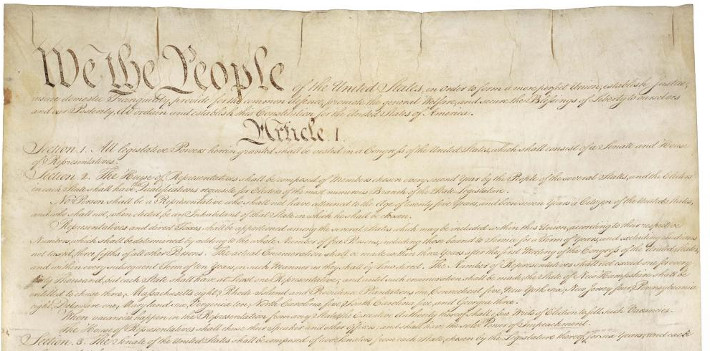
It’s the ultimate NFT, the Constitution of the United States. On November 18th, Sotheby’s will auction off one of the only thirteen surviving copies of the United States Constitution, an opportunity the public hasn’t had since 1988.
But a private collector hoping to pocket the national treasure will have some competition, the crypto mob on twitter. On November 11th, at least two individuals launched @ConstitutionDAO, a twitter account dedicated to crowdfunding crypto with the intent of raising enough money to be the winning bid.
The buyer would technically be a DAO, a Decentralized Autonomous Organization, a community-led entity with no central authority that is governed by a smart contract.
It’s predicted that if the DAO can raise significant cash before the auction that Sotheby’s will allow it to place legitimate bids. Sotheby’s put the estimated winning bid price at $15 million – $20 million.
It might not be out of reach, the DAO raised nearly $2 million in just the few hours since it began crowdfunding the money through a platform called juicebox.
If the DAO wins, theoretically “ownership” of the constitution would be fractionalized into shares based upon each member’s contribution. With a DAO, no one need even disclose who they are. Only a crypto address is required.
We have coordinated a DAO to acquire The Constitution of the United States.
I give you: @ConstitutionDAO
Ping me if interested in being a part of a monumental moment. https://t.co/VHkCTrq4fa
— Austin Cain (📜,📜) (@j_austincain) November 12, 2021
Members contributing to the pool of funds have the option of including a public message.
“To secure the blessings of liberty”
“Another first generation immigrant hoping to be the proud owner of the US constitution.”
“American Dream!!!”
“cant wait to explain this at Thanksgiving”
“in satoshi we trust”
The official website of the ConstitutionDAO is here.
For the sake of following the success or failure of this project accurately, AltFinanceDaily contributed a very small amount to the DAO so that it could participate in the possible ownership and community of the Constitution. Weird, I know.
Mississippi Fintech is Innovating Small Business Lending with Brokers in Mind
November 3, 2021
Vergent, a loan management software, is creating a space where brokers and lenders alike can manage all aspects of a deal in one place. Based in Ridgefield, Mississippi, Vergent is trying to innovate the industry with brokers in mind, pairing the small town values of interpersonal engagement and getting to know your customer with the big city ideas of fintech and automation.
“Really what we provide is the technology infrastructure for lenders to reach their end user,” said Bradley Tompkins, Chief Information Officer at Vergent. “Whether that be a small business looking for a loan, we facilitate that acquisition, the origination of that loan, and the servicing of that loan. That could mean recurring payment setups, based upon the lender’s requirements, communication with that customer via email, text, however that is facilitated, and all the different payment options.”
Tompkins talked about how his software is one of the few that brokers in his area are already utilizing to start making deals smoother. With access to all aspects of the deal, Vergent provides an all-in-one suite of options that can turn the process of analyzing a deal or checking out a deal post-funding into a couple of clicks.
“We actually have brokers who use our software to accept applications, originate loans, and then we can either transfer that to a separate portfolio that the lender then manages for servicing, or sometimes we have brokers that service the loans themselves,” Tompkins said. “So there are really a lot of options on how to set that up in the platform, so the lender can have a separate site where they accept applications from multiple brokers, or really any combination of those things.”
The value of a direct relationship with the customer is top-tier according to Tompkins, as he spoke about the next great innovations in fintech not being how to weed the human interaction out, but finding its role that will find the balance between human touch and AI power. “Once you know your customer, you can give them the option to pay you back in the easiest way possible. Understanding how they get paid, their pay cycles, when they have money and being flexible to accept that money when they have it, and giving them those repayment options is the next great innovation.”
When talking about the ability to market his product to a wide audience, Tompkins acknowledged the difficulty due to the size of the industry itself, but touched on the value of networking events like Money 20/20, where Tompkins was pitching Vergent to an international audience.
“We’ve been pleasantly surprised by the amount of lenders we’ve seen, and the amount of opportunities that have come our way from [Money 20/20]. We came here pretty open minded, maybe talk to some payment processors and other vendors that may be able to integrate to us and kind of help expand our network, but really it’s just getting our name out, seeing a little bit of a different segment than what we normally see, and looking at other market opportunities.”
IOU Financial Inc Surpasses $US 1 Billion in Loan Originations and Establishes All-time Record in Quarterly Loan Originations
November 2, 2021in its 12-year history of funding small business growth in North America
Atlanta, November 2, 2021 – IOU FINANCIAL INC. (“IOU” or “the Company”) (TSX-V: IOU), a leading online lender to small businesses (IOUFinancial.com), announced today that it has surpassed US$1B in total loan originations.
“This is a major milestone for all IOU team members, partners and stakeholders,” said Robert Gloer, President and CEO. “In 12 years, the company has grown but our values have not changed: now more than ever we are committed to exceeding the expectations of our broker partners and the small business owners across North America who rely on our funding solutions to drive their growth plans.”
In addition, IOU announced today that its loan originations for the quarter ended September 30, 2021 surpassed all previous records. The company originated over US$52 million in small business loans in Q3, a new high-water mark in the 12-year history of the company, representing a sequential growth of 51.5% vs. Q2 2021, and 183.1% over Q3 2020.
“We are thrilled to surpass pre-pandemic loan origination numbers and start setting new all-time records for IOU Financial,” said Robert Gloer, President and CEO. “We remain cautiously optimistic that the economic recovery will continue despite the lingering potential macroeconomic and public health risks.”
IOU Financial originated its first loan in December 2009 and quickly positioned itself as a trusted alternative to banks by helping small business owners get fast and easy access to funding visa its proprietary IOU360 technology platform. The Company continued funding small businesses throughout the Covid-19 pandemic and has subsequently introduced the industry-first IOU Financial Cash Back Loan and announced an-all-time record in monthly loan originations.
“We faced the challenges of the COVID-19 pandemic with the same entrepreneurial spirit that drove us to launch IOU Financial on the heels of the 2008 financial crisis – and both experiences have reinforced the importance of helping small businesses adapt to new challenges and grow” added Gloer. “Here’s to the next 12 years of small business growth!”
The Company is due to share its Q3 Financial Results in the coming weeks.
About IOU Financial Inc.
IOU Financial Inc. is a wholesale lender that provides quick and easy access to growth capital to small businesses through a network of preferred brokers across the US and Canada. Built on its proprietary IOU360 technology platform that connects underwriters, merchants and brokers in real time, IOU Financial has become a trusted alternative to banks by underwriting over $984 million as of September 20,2021 in loans to fund small business growth since 2009. IOU trades on the TSX Venture Exchange under the symbol IOU (TSXV: IOU), and on the US OTC markets as IOUFF. To learn more about IOU Financial’s corporate history, financial products, or to join our broker network please visit www.IOUFinancial.com.
Forward Looking Statements
Certain information set forth in this news release may contain forward-looking statements that involve substantial known and unknown risks and uncertainties. These forward-looking statements are subject to numerous risks and uncertainties, certain of which are beyond the control of IOU including, but not limited to, the impact of general economic conditions, industry conditions, dependence upon regulatory and shareholder approvals, the execution of definitive documentation and the uncertainty of obtaining additional financing. Readers are cautioned that the assumptions used in the preparation of such information, although considered reasonable at the time of preparation, may prove to be imprecise and, as such, undue reliance should not be placed on forward-looking statements. IOU does not assume any obligation to update or revise its forward-looking statements, whether as a result of new information, future events, or otherwise.
Neither TSX Venture Exchange nor its Regulation Services Provider (as that term is defined in policies of the TSX Venture Exchange) accepts responsibility for the adequacy or accuracy of this release.
For more information, please contact:
Robert Gloer, Chief Executive Officer, 866-217-8564 ext.308
David Kennedy, Chief Financial Officer, 514-789-0694 ext. 278
Carl Brabander, EVP of Strategy, 866-217-8564 ext. 4378
Appalachian Crowdfunder Gives Take on Business Lending
November 2, 2021 View from outside of Pittsburgh, PA
George Cook, whose family has been running a small community bank in rural Appalachia for over 130 years, has grown up in a world surrounded by banking in some of the most rural parts of America. Now the CEO of Honeycomb Credit, Cook has taken to a crowdfunding platform to start lending to businesses in his area. Cook shared his thoughts with AltFinanceDaily about the state of lending, and how his product competes with ones already available on the lending market.
Cook spoke about how when he growing up, he always had a fascination with the relationship between the consumer and their banks combined with the difficulties for those consumers to get access to capital. “I spent a lot of time thinking about community banking, especially local capital,” said Cook.
When discussing competing products in the lending space, Cook thinks that his product will innovate his area with a style of lending that benefits both the borrower and investor. It appears that he thinks products like MCAs have become partially antiquated.
“I think the downside of [MCA] is inherently when your value proposition is fast money, you’re going to have a negative selection,” said Cook, when asked about fintech’s role in innovating small business lending. “You’re going to have a lot of desperate businesses who need money fast, which means you inherently have to charge a high interest rate and that has [deterred] a lot of business owners.”
 George Cook, CEO, Honeycomb Credit
Cook referenced how the complexity of some MCA deals prevent small businesses from using them. “We talk to a lot of business owners who really don’t understand what a merchant cash advance is, they get caught in a debt trap, and it’s not a good situation. For me, I think the next evolution is, not saying merchant cash advances are going away, but I think they’ve been over extended. I think they’ve been overapplied in places where they don’t make sense.”
Cook hinted at new fintech loan products that have elements of MCA popping up in the lending world, as fintech innovates the industry.
“I think now we’re going to see the fintech space start to right the issue, come up with other capital solutions that make sense for small businesses for longer term capital. I think we’re going to see a lot of term loan products that act with different data and different attributes coming to bear, [thus] being able to bank these businesses.”
After working in fintech building big data credit analytics products prior to starting Honeycomb, Cook claims he saw a major issue with small businesses having access to capital long ago. He saw that the qualifications needed for business loans were the same as ones needed for consumer loans, and many small businesses just didn’t qualify for the capital they needed.
“[The system] didn’t work as well for small business lending because you know, small businesses don’t have as much operating history, they don’t have clean data sets, they’re not keeping their books really well, there’s not really a good data aggregator of small business data.”
Cook continued to speak about the issues with banks evaluating a small businesses’ credit and how this was causing a low approval rating. “A coffee shop looks a lot different than a fitness studio and those look a lot different than a manufacturing plant,” he said. “We were actually seeing a really large decrease in small business lending across the country.”
According to Cook, his company allows investors to take their money and put it right back into the community. He also claims that each one of his customers can expect returns ranging from six to twelve percent on an investment.
Honeycomb makes money on success fees, which are the closing costs on the loan. There’s also an investor fee to get a foot in the door.
“One of the things we’ve found is whenever you have retail investors, you have local people in the community voting with their wallets on these small business loans,” said Cook. “So we’re able to do small business loans in a way that no one else has been able to.”