
UK Banks Will No Longer Be Allowed to Decline Small Businesses For Loans as Alt Lending Wins
October 10, 2016UK Banks better have a strong reason to turn down loan applicants, and if not, turn them over to another lender.
In an attempt to break the might of the big banks and back the thriving alternative finance industry, the UK Treasury will make it obligatory for banks to refer rejected small businesses to other lenders. Nine of the country’s largest banks including Royal Bank of Scotland, Lloyds, Barclays and HSBC will be legally obligated to do so when the plan goes into effect in the next three months, The Times reported.
The applicants will be referred to three loan marketplaces — Funding Options, Funding Xchange and Bizfitech that will make referral fees for loans funded on their platforms.
Online lending across the pond operates differently. The UK online alternative finance sector grew 84 percent in 2015, with support from the government and was one of the first countries to establish a regulatory framework where The Financial Conduct Authority (FCA) defines and categorizes crowdfunding, P2P lending and online lending. The UK is home to many early starters in the industry like Zopa and RateSetter.
Entire Industries Still Unbankable Despite Big Data Boom
September 28, 2016
The use of data and technology for assessing risk shows promise for new borrowers, safer bets and fewer delinquencies. Big data has been credited for overhauling traditional lending models and ushering in a new crop of lenders that do not shy away from risky businesses and low credit scores. But has it been successful in narrowing the list of industries previously ineligible to even be considered? And perhaps there’s a bigger story, that some lenders still maintain a list of industries they cannot or will not lend to despite the boom in data. AltFinanceDaily checked the temperature on restricted lending practices today with three lenders and here’s what we found.
Jersey City-based World Business Lenders whose average loan size is $150,000 does not lend to startups. According to chief revenue officer, Alex Gemici, startups usually don’t have revenues to justify payments. “Startups fail the ‘ability to pay’ test,” he said.
The restricted industries for WBL are the usual-suspects that fall in the federal legality grey areas like Marijuana related businesses and adult entertainment websites and weapon manufacturers that the company takes a moral stance against. Gemici said that the company has never lent to these industries and will evaluate the policy only if the need arises.
Apart from these WBL also classifies certain establishments as ‘high risk,’ either prone to defaults or without a steady cash flow like car dealers, childcare services, gas stations, real estate speculators, stock brokers, insurance brokers etc. which the company lends to with increased scrutiny and tighter checks.
 Often, the risk appetite of a company depends on how long it has been in business and its funding track record. For instance, San Diego-based National Funding is 17 years old but is gun shy when it comes to lending to auto dealerships, thanks to sustained losses. “We don’t lend to auto dealerships because they already have enough MCA plans out there,” said CEO Dave Gilbert. “It’s too risky to be in that environment without being tied to actual assets, we have had too many losses.”
Government agencies, membership organizations (usually, non profit), insurance brokers, online dating services, weapon manufacturers, credit repair services, gambling and ticket sales websites are also industries the company does not lend to.
However, construction companies, oil companies, transportation and industries with high subsidies like solar businesses are what National Funding considers high risk and will finance cautiously, by tightening the credit window, advancing smaller amounts, demanding higher FICO scores and increasing scrutiny on cash flows.
Irrespective of whether a company automates underwriting, few contest the need for rich and varied data for calculating risk and approving a loan. Kennesaw, Georgia-based IOU Financial, which recently started lending in Canada, has a proprietary ‘Risk Logic’ score for underwriting which includes credit data, financial and non-financial accounts, public records, transactional data and a business owner’s personal credit information.
Despite this, it restricts lending to businesses with seasonal cash flow like tax prep services, industries that invoice out for larger orders including manufacturing, and marijuana dispensaries. IOU also does not lend to industries where it has faced high delinquencies in the past, like oil refinery service related industries and supply chain service providers that are subject to fluctuations in commodity prices.
And if OnDeck, the touted leader in deploying big data for underwriting prohibits 60 industries in five different categories including blood and organ banks, payroll companies and its own kind — non-bank financial companies, has big data really changed underwriting?
Commercial Finance Coalition Tells MCA Industry Story on Capitol Hill
September 23, 2016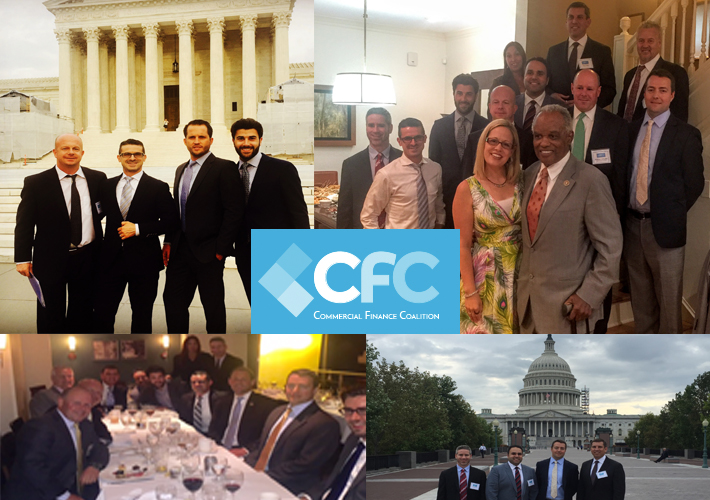
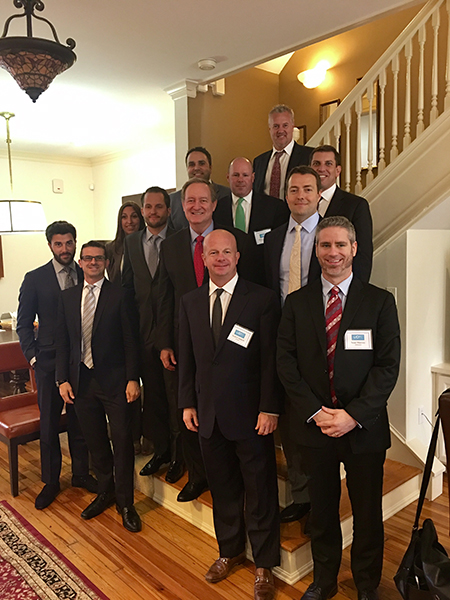
Earlier this week, executives and representatives from the merchant cash advance industry met with dozens of policymakers on Capitol Hill. The Fly-In was hosted by the Commercial Finance Coalition, whose members make up a sizable chunk of the industry’s overall transaction volume. It was their second such event this year.

The opportunity allowed industry representatives to get face time with Republicans and Democrats from both the House and the Senate. One message of great importance was in communicating the challenges that small businesses face in trying to access less than $250,000 in working capital. Another was in distinguishing purchase transactions from loans.
“Our members are engaged and committed to educating and advocating the interests of the merchant cash advance industry in Washington DC and state capitals around the country,” said Isaac Stern, President of the CFC and Fundry. “I would strongly encourage my industry colleagues and competitors to get involved in the organization and help us grow the CFC.”
While banks have been accused of being too big to fail, the CFC noted that many businesses have become too small to survive as a consequence of banks moving upstream. Regulations have made it too burdensome and expensive for a bank to underwrite a $25,000 loan, plus they may not be able to stomach the risk or be properly incentivized to approve or decline a loan in the first place. The CFC’s members do not securitize their transactions or sell them off, lending credence to the position that their livelihood depends on small businesses succeeding and performing.
“In less than 9 months the CFC has become the gold standard of alternative small business finance trade groups in Washington,” said Dan Gans, Executive Director of the CFC. “In a short time we have been able to conduct over 50 meetings with key policymakers and assemble a world class regulatory and lobbying team. I would encourage anyone involved in the merchant cash advance or alternative small business finance space to join the CFC and help us advocate for the thousands of small businesses across the country who benefit from the access to needed capital provided by the industry.”
The CFC has not been the only coalition from the broad genre of fintech to host a Fly-In, making it all the more imperative for the MCA industry to educate policymakers on the specifics of what they do and how they do it. For instance, a lot of the regulatory discussion as of late has focused on the partnerships between online lenders and chartered banks, the legitimacy of those partnerships and the sustainability of the algorithms being employed to make quick decisions. While there are several MCA-like products that rely on that model, there is also an entirely different methodology that relies on helping small businesses by purchasing their future receivables. The CFC is one major coalition communicating that distinction.
The CFC is also currently accepting new members to join their cause and participate in future events.

Funding The Great White North
September 13, 2016
As of last year, 98 percent of Canada’s employers were small businesses compared to 0.3 percent (2,933) large companies. Given this and what we know about Canada’s banking oligarchy, dominated by five large banks, it was inevitable that American alternative lenders would go looking for greener pastures in Canada.
When OnDeck set foot in the country two years ago, it accelerated the alternative lending movement by offering loans up to $150,000 CAD. But OnDeck wasn’t the first to discover the Canadian market. Merchant cash advance companies such as Principis Capital and AmeriMerchant (today Capify) have been there since 2010. Principis actually draws close to 15 percent of its business volume from Canada. But the credit that’s due to OnDeck is for expanding the horizons of small businesses who have been conditioned to think that lending begins and ends with banks. The crop of Canadian alternative lenders who do not otherwise have the resources for similar blitzkreig marketing are pleased with the industry’s promotion in general.
“We are happy that some of the bigger US players are coming up here and they are spending millions of dollars on advertising,” said Bruce Marshall, vice president of British Columbia-based Company Capital. “These companies raise awareness of the industry to a higher level and with us being a smaller company, we can ride on their coattails,” he said.
Company Capital has been operating as a balance sheet lender for five years and has provided term loans, working capital loans, merchant cash advances and ‘cash lines’ which are similar to lines of credit. For lenders such as Company Capital which makes loans in the range of $30K – $50K, the presence of bigger players like OnDeck saves them from consumer education-oriented marketing campaigns. “We cannot compete with the advertising of big companies but it works in our favor of creating awareness and becoming more mainstream,” Marshall noted.
And this not only helps the Canadian companies but also smaller US companies that feel comfortable entering a market with a leader. OnDeck’s presence nudged Chad Otar, founder and managing partner of New York-based commercial finance brokerage Excel Capital Management into considering Canada as a viable market. “We saw OnDeck go there and thought that there is some kind of money we can make,” he said.
 But for OnDeck, Canada might just as well be another large US state. Most American companies including OnDeck, Principis Capital and Excel Capital run their Canadian operations remotely, treating it much like an extension to their US business with similar products.
“Our range of business is virtually the same in Canada as in the US. We don’t need to have an operation center there,” said Jane Prokop, CEO of Principis Capital. The company approaches Canada just like the US with accounts and customer service being handled in a similar fashion. “It’s a very manageable extension of the US market,” Prokop said. “It’s a smaller market so someone who enters Canada cannot expect the same kinds of volume as in the US.”
It also certainly helps to be spread across the same time zones and in such close proximity where a majority of the country also speaks the same language. If it was that easy though, shouldn’t we have seen more companies doing this?
“The fundamentals of the Canadian market are different. Our banks are established and trusted and in general do quite a good job, so the opportunity for market expansion is different than in the US,” said Jeff Mitelman, CEO of Thinking Capital, one of the country’s first alternative lenders.
Prior to Thinking Capital, Mitelman founded and ran Cardex, Canada’s first ISO which offered lending products with payment services. And that competitive edge helped him recently to partner with payment solution company Everlink to expand its customer base and offer loans online. The company previously secured credit facilities worth $125 million from two of the biggest banks in the country, The Canadian Imperial Bank of Commerce and Nova Scotia.
Picking up the same strategy, some American companies decided to bank on these big banks (pun intended) for their success. For instance with Kabbage, it made sense to license its automated platform to Nova Scotia Bank and to rely on them to deploy capital while Kabbage provides the technology and customer experience. “We saw that Canada is ripe for technology but the differences in regulation among other things made us go the partner route,” said Peter Steger, head of business development at Kabbage.
The advantages of having an incumbent customer base, the brand equity and the supply of capital usually outweighs the costs and inconveniences of maneuvering in an unfamiliar business environment that only a few firms have the bandwidth for, some companies contended.
Secondly, there is a lack of reliable and robust data necessary for making lending decisions. Since only a handful of large financial institutions dominate the landscape, the data reported is limited to a small number of players and the outputs from credit bureaus may not be sufficient for making a credit decision. “The availability and access to government and financial data is scarce in Canada compared to other markets,” said Jeff Mitelman. “Most of the data relationships that fintech companies rely on, need to be developed on a one-to-one basis and is often proprietary information.”
Having the data presented in the right format can save a lot of underwriting time. Companies in Canada find the government and financial data available to be scanty and in less than ideal form. David Gens, CEO of Vancouver-based Merchant Advance Capital noted that Canadian merchants are slower to adopt technology which adds to the woes of online lenders. “Believe it or not, some Canadian merchants still use fax,” he said.
Even as the country plays catch up, Canadian lenders consider the market to be large enough for many players. “At this time, education is more important than competition,” said Mitelman.
 Canada’s geographical dispersion and regional differences however are peculiar. The four provinces of Quebec, Alberta, Ontario and British Columbia make up 86 percent of the population and the greater part of the economic activity. And Quebec is often avoided, in part because of the bilingual mandate that requires businesses to advertise and produce materials in French. OnDeck and Company Capital both do not operate there, for example.
The cultural differences can also determine how customer relationships are handled, and being a part of that culture has given Canadian companies an upper hand. “It does definitely help to have a home advantage in terms of understanding the local peculiarities,” said David Gens. “Marketing to Canadian merchants is also different — being aggressive might not work very well here and they like to know they are dealing with someone nearby.”
For financial brokers such as Otar, Canadian usury laws can appear restrictive. As per Canadian interest rate rules, Under Section 347 of the Criminal Code (Canada), interest rates exceeding 60 percent per annum are termed “criminal rates of interest” and “interest” in the Criminal Code is broadly defined as a broad range of fees, fines and expenses which includes legal expenses.
“US lenders have had to change their way of doing business. Since, APR is less here, if your product is a loan contract, you will be restricted and you will have to service low risk for low rates,” said David Gens.
Even so, the business emerging out of Canada may now be supplemental for American lenders and the potential for growth beneficial to diversification.
Sunshine and Deal Flow: Who’s Funding in Puerto Rico?
September 1, 2016
Lots of small businesses need capital in Puerto Rico and not many companies are trying to provide it. Combine that with the island’s tax incentives, tourist attractions and gaggle of ambitious entrepreneurs, and America’s largest unincorporated territory can seem like an archipelago of opportunity for the alternative small-business finance community – a virtual paradise.
But for alt funders, the sunshine, sandy beaches, swaying palms, picturesque rocky outcroppings, rich history and renowned cuisine can’t change two nagging facts about this tropical commonwealth that 3.4 million people call home. Alternative finance remains largely unknown on the island, and it’s difficult if not impossible to split credit card receipts there.
Let’s start with the good part. “If you call a restaurant in Los Angeles at 2 o’clock in the afternoon, you’re the 15th person to call them that day, but if you’re calling a business in Puerto Rico, you might be the only one,” says Andrew Roberts, director of partnership development for Merchant Cash Group, which funds some deals on the island. “So it’s not the same cutthroat competitiveness that we have here.”
But consumers in Puerto Rico’s tourist areas rely on PIN debit cards, which don’t qualify for split funding between merchants and finance providers because the cards don’t have Visa or MasterCard logos and thus merchants can’t run them as credit transactions, Roberts says. Besides, processors on the island don’t want to split the revenue from credit card transactions between funders and merchants, either, Roberts notes. “If there’s a processor in Puerto Rico that will split fund, I haven’t been unable to find them,” he says. “Believe me, I have looked.”
The two main processing platforms on the island, Global and First Data, require ISOs to carry 100 percent of the risk on a split, according to Elevate Funding CEO Heather Francis, who was involved in the island market at another company before taking her current job. That’s why split remittance “remains almost nil” in Puerto Rico, she says.
Splitting funds by using a “lockbox” – which works like an escrow account and distributes a certain percentage of receipts to the merchant and the rest to the funder – doesn’t provide a solution because banks in Puerto Rico decline to use the option, Roberts maintains. That’s why he advises that it’s easier to offer ACH-based products on the island.
Merchants on the island have to meet the same requirements for ACH that apply on the mainland, Roberts notes. That includes a reasonable number of checks returned for non-sufficient funds and a reasonable number of negative days. “The underwriting procedure on the island is pretty much the same as it is here,” he says.
Perhaps the difficulties of setting up the split in Puerto Rico shouldn’t cause any uneasiness about entering the market because the bulk of alternative funding on the island relies on daily debits—just as it does on the mainland, Roberts says. Still, he notes that some merchants in both places may qualify for split funding but fail to measure up for daily debit.
 Though merchants and funders have those commonalities, the banking systems differ on the mainland and on the island. Banco Popular, which has held sway in Puerto Rico for nearly 120 years, controls much of the island’s banking and inhibits the growth of alternative funding for small businesses there, Francis says. Still, Puerto Rican merchants should have some familiarity with alternative finance or high-fee products because of the island’s high concentration of title loan companies, she notes.
Similarities and and differences aside, the Puerto Rican market provides a little business to some mainland alternative finance companies. United Capital Source LLC, for example, has completed five deals for small businesses on the island, says CEO Jared Weitz. Companies can provide accounts receivable factoring there, he says.
Alternative funding has yet to post runaway growth in Puerto Rico, Weitz says, because it’s not marketed strongly there, only a few mainland funders are willing to do business in Puerto Rico, the range of products offered there is limited, and small business remains less prevalent there than on the mainland.
 But a handful of mainland-based companies have been willing to take on the uncertainties of the Puerto Rican market, and Connecticut-based Latin Financial LLC serves as an example of an ISO that has enthusiastically embraced the challenge. The company got its start in 2013 by offering funding to Hispanic business people on the mainland and began concentrating on Puerto Rico early in 2015, says Sonia Alvelo, company president.
Alvelo built a strong enough portfolio of business on the mainland that funders were willing to take a chance on her and her customers in Puerto Rico. Latin Financial now maintains a satellite office on the island, and the company generates 90 percent of its business there and 10 percent on the mainland.
Latin Financial has a sister company called Sharpe Capital LLC that operates on the mainland, says Brendan P. Lynch, Sharpe’s president. Alvelo describes Lynch as her business partner, and he says he’s started several successful ISOs. He credits her with helping Puerto Rican customers learn to qualify for credit by keeping daily balances high and avoiding negative days.
“It’s a small company with a big heart,” Alvelo says of Latin Financial. She was born in Puerto Rico and came to Connecticut at the age of 17. “For me it’s home,” she says of the island. She’s realizing a dream of bringing financial opportunity to business owners there.
To accomplish that goal, Alvelo spends much of her time teaching the details of alternative finance to Puerto Rico’s small-business owners, their families, their accountants and their attorneys. “You want to make sure they understand,” she says, adding that the hard work pays off. “My clientele is fantastic,” she says. “I get a lot of referrals.”
Latin Financial started small in Puerto Rico when a pharmacy there contacted them to seek financing, Alvelo says. It wasn’t easy to get underway, she recalls, noting that it required a lot of phone calls to find funding. Soon, however, one pharmacy became three pharmacies and the business kept growing, branching out to restaurants and gas stations. Already, some merchants there are renewing their deals.
 Growth is occurring because of the need for funding there. Puerto Rican merchants have had the same difficulties obtaining credit from banks as their peers on the mainland since the beginning of the Great Recession, Alvelo says. “It’s the same story in a different language,” she notes.
Speaking of language, Alvelo considers her fluency in Spanish essential to her company’s success in Puerto Rico. “You have to speak the language,” she insists. “They have to feel secure and know that you will be there for them,” she says of her clients. Roberts agrees that it’s sound business practice to conduct discussions in the language the customer prefers, and his company uses applications and contracts printed in Spanish. At the same time, he maintains that it’s perfectly acceptable to conduct business in English on the island because both languages are officially recognized.
People in Puerto Rico have been speaking Spanish since colonists arrived in the 15th Century, and English has had a place there since the American occupation that resulted from the Spanish-American War in 1898. Still, more than 70 percent of the residents of Puerto Rico speak English “less than well,” according to the 2000 Census, but that’s changing, Alvelo says.
Whatever the linguistic restraints, the products Latin Financial offers in Puerto Rico have been short-term, most with a minimum of six-month payback and a maximum of 12 months, but Alvelo hopes to begin offering longer duration funding. She also believes that split funding will come to Puerto Rico. “It’s in the works,” she asserts, noting that she is campaigning for it with the banks and processors.
At the same time, mainland alternative finance companies are learning that the threat of Puerto Rican government default does not mean merchants there don’t deserve credit, notes Lynch. “Just because the government is having trouble paying its bills,” he says, “doesn’t mean these merchants aren’t successful. The island is full of entrepreneurs.” In fact, many of Puerto Rico’s merchants use accountants and keep their business affairs in better order than their mainland counterparts do with their homemade bookkeeping.
Alvelo also knows many merchants there are worthy of time and investment. She strives to listen to her customers when they express their needs and then help them fill those needs. “I’m very, very proud to be doing this in Puerto Rico now,” she says.
Bizfi Originates $144 Million in Q2; CAN Capital, Entrepreneur Media Launch Funding Center
August 16, 2016 Online small business loan marketplace, Bizfi said that it originated over $144 million in Q2 this year, a 25 percent increase compared to $116 million in Q2 last year. The New York-based company has facilitated financing for more than 3,580 small businesses through its platform.
The company forged many partnerships to expand its customer base and access to small businesses. In March of this year, Bizfi announced a partnership with Western Independent Bankers (WIB), a trade association with community and regional banks across the Western United States and in July, it joined hands with the National Directory of Registered Tax Return Preparers & Professionals (PTIN).
Bizfi also secured a $20 million investment from New York-based investment manager Metropolitan Equity Partners in June this year, supplementing the $65 million infusion in December last year to expand and optimize its funding programs and develop an effective marketing campaign to advertise those better.
In other news, small business lender CAN Capital and Entrepreneur Media launched the funding center offering funding products that include term loans — available from $2,500 up to $150,000 for a single location with range of terms from 3 to 36 months. Trak loans which are working capital loans available from $2,500 up to $150,000 and installment Loans provide funding from $50,000 to $100,000 with 2, 3, and 4 year terms and have fixed monthly payments.
Lend Us An Ear: Women in the Industry Speak Their Mind
August 11, 2016
The majority (52.5 percent) of employees in the banking and insurance industries are women — if this sounds strange, that’s because it is, considering only 1.4 percent eventually go on to become CEOs. While the male dominance is not apparent at the mid-management executive level, the sex ratio is rather skewed on top. Needless to say?
AltFinanceDaily grabbed the opportunity to speak to three women in the alternative business financing industry, charting their journey, reliving their experience, knowledge and the lessons that got them to where they are. Here are excerpts from the interviews.
Back to Roots
For some, their careers are not a deliberate choice, but a serendipitous stumble.
Heather Francis, CEO of Florida-based Elevate Funding, who went to college to become a healthcare professional entered finance by happenstance. “I went to school for health promotion and education at the University of Florida and graduated in 2007,” said Francis, who comes from a family of entrepreneurs and is a fifth generation Floridian. “I found that the position I was looking for was not a necessity for companies, it was a luxury like setting up gyms, that people were not willing to pay for at that time.”
Francis landed her first job in finance with a private equity firm called Strategic Funding in Gainesville, Florida where she set up the firm’s merchant cash advance business. After spending seven years there, in 2014, she set up Elevate Funding which in a short span of 16 months has made over 1,000 advances to businesses.
For Kabbage Loans cofounder Kathryn Petralia too, fintech was a far cry from wanting to be an English professor. A graduate from Furman University, Petralia’s tryst with finance was when she got roped into a project, valuing companies using data compression tools. Riding on building her tech expertise, she founded her first company at 25 which made store catalogues digital. “I was a kid and did not know anything about marketing or sales, so I ended up selling the startup to the company which helped me build it.” The venture however gave her an in into finance and she went on to work for Revolution Money and eventually built Kabbage Loans.
But for Danille Rivelli, VP of Sales at United Capital Source, however, the jump wasn’t as big or unusual. Although finance was not originally on her mind as an art major, it was a natural path from what she began doing to acquire real-world work experience during school, selling mortgages. Rivelli changed her academic focus and went on to get a business degree from Briarcliff College, where she also played on the softball team.
“A year or two into college, I started doing mortgages, making 5 percent commissions. It was natural and it just kinda flowed,” said Rivelli whose first job out of college was on the sales floor at Merchant Cash Capital, now Bizfi. “I wanted to get out of mortgages and I was hooked when I saw the sales floor, it was fun and upbeat.” She was also one of the company’s youngest salespeople at the time.
Women Can Do No Wrong. Or Can They?
When we asked what women need to do differently at workplaces? The answer was quick, resounding and not surprisingly – be more assertive.
“Women think from the heart more than the mind,” said Rivelli. “I find myself in situations sometimes where I know that I should be ‘leaving the emotions out of it’ so that I’m not second-guessing myself as much.” But it’s what helps her build lasting relationships with clients. “I think most effective sales people will agree that the most important part of our job is listening. You want to really know and understand who your client is and what they’re looking for before you try to sell to them.”
According to Petralia, who thinks of herself as ‘one-of-the-guys,’ the problem lies in overplaying the differences between men and women. “I think we perpetuate the stereotype that men are supposed to behave a certain way and women aren’t. I notice that when men crack a joke or use a curse word, they immediately apologize to the women in the room. We are making that happen,” she said. Petralia’s strategy in such scenarios is to swing to the other side and initiate banter. “I am very comfortable with dirty jokes and f-bombs.”
“Men are really good at faking it ’til they make it. They position themselves as experts when they are not but women are unsure of jumping into the deep end when they are not sure they can swim and that’s a big part of what we have to overcome,” Petralia said.
Francis is on the same page, “Men have no problem tooting their horn, but women don’t do that. We cannot expect anyone to stand up for us. If you think you’re getting looked over for a promotion, walk up to your boss and say it,” she said. Francis talks about most of the struggle being personal rather than operational. “I will admit to us having a need to be right… right about decisions, right in arguments and right about where the furniture goes,” she says jokingly. “A lot of what led me to start Elevate was my belief in that you could service the risky credit market without taking advantage or putting insane demands on the performance of the portfolio and still be successful… having that theory validated and accepted and in the end, being right.”
What’s the hurdle, what’s the race?
And the assertiveness comes from one’s belief in their struggle and the value of that struggle. Petralia reminisces of a time when as a scrimping 25-year-old entrepreneur, she pitched a tent and stayed on a campsite in San Francisco while raising money for her startup. Two decades later, she runs a billion dollar lending company. Petralia recognizes that not all women have the same opportunities.
“When I was raising money for Kabbage, I realized that I had only been in one or two meetings where a woman wasn’t bringing me water,” said Petralia who believes that bringing diversity requires work and companies should set targets and find qualified diverse candidates.
Kabbage allows for 12 weeks of maternity leave but that pales in comparison with other countries, says Petralia. “The problem with women is, we have the babies. Women have to choose between their careers and personal life and we are not even close to making that situation better. The key time in their 30s when they are having kids, they come back to compete with younger people who are cheaper.”
The movement to make it better, according to her should begin with creating a system of incentives like better child care, easy commute to work etc. where women don’t have to choose between advancing their career and having a child.
And her other gripe is limp handshakes from men. “Shake women’s hands better. Men give this limp, deadfish like handshake at conferences to women and it’s the worst.”
According to Francis, equal footing comes from striving for professional equality and representation. She says being a woman opens many doors but that’s where it stops. “People will talk to you nicely if you’re a woman but they don’t think you are the person making the decision. You have the ability to start the conversation but no one thinks that you can finish it.”
And for Rivelli, that means giving it your all. “The point is to keep being so good that no one can ignore you,” she said.
National Funding Deploys $1.5B, Beefs up Automated Underwriting
July 26, 2016California-based small business lender National Funding said that it has deployed $1.5 billion in capital, funding small businesses with short-term working capital loans.
The 17-year-old company funded $152 million in loans in the half of 2016, up 45 percent from the same period last year. The company’s customers include general contractors, medical services and trucking companies that average about $1 million in sales annually.
While 80 percent of the loans are for working capital, the company has seen demand for equipment leasing slowly resurge after the financial crisis. “After 2008, the market turned negative in LA and we had to shrink our company,” said CEO Dave Gilbert.
The company is also preparing for a technology overhaul, trying to get access to data pools to automate underwriting. “We need to be tech driven,” he said. “As deals get smaller, we need to automate them to make it affordable.”
National Funding generates 25 percent of its loan volume through brokers. “Given everything that’s happening in the industry, a lot of lenders will be forced to become balance sheet lenders,” he said.
The company hired Geoff Howard from Intuit to lead its technology efforts and aims to automate underwriting for 40 percent of its deals, doubling up from its present rate of 20 percent.
The average size of its loans is $50,000 and the company also plans to launch its first long-term loan product later this year.