
Virginia Disclosure Law Quietly Goes Into Effect
July 6, 2022 On July 1st, Virginia’s “sales-based financing” disclosure law quietly went into effect. The Delegate from Virginia that introduced it in the first place, Kathy Tran, marked the occasion by retweeting a caucus announcement that it was live. Elsewhere, it was hardly mentioned. It was even absent from the Official Code of Virginia where it was supposed to be ceremoniously entered on July 1st. The State insists that its omission is just a glitch.
“There have been significant technical difficulties during the 2022 code upload process,” reads a notice on the Virginia State Law Portal. “Due to these difficulties, the portal does not currently reflect the changes to enacted law. The Division of Legislative Automated Systems and the publisher are working diligently to resolve these issues as quickly as possible. Once the data is obtained from the publisher in the correct format, the standard quality check of the entire body of law that went into effect July 1 will be conducted.”
The law focuses primarily on disclosures. Sounds simple enough, but in the preceding weeks the draft disclosure form was met with some resistance by potentially covered parties because of how little time there was to integrate it into their systems and processes. Regardless, at least one small business funding company told AltFinanceDaily off the record that ambiguous language and terms in the law had led to the decision to cease doing business in the State of Virginia, at least for now. Their focus is shifting toward compliance with the upcoming California and New York disclosure laws where the population pools are larger and the soon-to-be enacted requirements are seemingly more complex. Utah too will soon implement its own version of a disclosure law.
For commercial finance brokers, the defining elements of the Virginia law are that commissions earned will have to be disclosed to customers and that they’ll have to register their businesses with the State to even continue doing business there.
Small Business Finance Industry Ponders Inflation, Changing Economic Conditions Ahead
July 1, 2022 “I think what’s really important is just the same for our businesses and any business, is being able to make sure that as things change, you’re updating and changing what you’re doing,” said Seth Broman, Chief Revenue Officer at Yardline.
With the constant changes in the economy, inflation being on the rise, and a rumored recession, businesses providing financing are analyzing whether or not their customers will be able to withstand challenging times ahead.
“For us a big factor is the increased costs of being able to source goods from overseas, for example, the challenges around getting those goods in a timely fashion,” said Broman. “That’s the first thing we saw. And then similarly, in the e-commerce space, you’re seeing brands that aren’t able to sell at the same level as they were beforehand.”
Like Broman, John Celifarco, a Managing Partner at Horizon Funding Group, acknowledges that inflation is directly affecting his customers.
“It’s definitely going to have an effect on the industry as a whole in terms of our clients, I’d say it’s going to affect certain ones more than others, depending upon how their business is structured, and what type of relationship they have with their customers,” said Celifarco.
And with recent concerns for a recession, Celifarco believes this won’t affect a client’s willingness to borrow but rather the ability to get them approved.
“Having seen this in the past, there have been times where the economy has slowed or there’s been a recession, and the customers still want money, but because of the trouble the businesses are having it’s a lot harder to get people approved on the lending side,” said Celifarco.
Not being able to access credit for customers is also an area of concern for Luis Hernandez, CEO of CapLadder.
“There are going to be more cash constraints in a recession. Obviously, funding companies won’t want to take on certain risks so they’ll obviously be more careful on how they disperse those funds just to make sure they’re getting paid back,” said Hernandez.
Hernandez suggests companies should limit hiring and expenses to better weather the storm.
“With the recession looming, and pretty much it is going in this direction, the best practices right now are what’s always been tried, which is, hold on to your reserves. Cash is definitely better in your pocket than out there,” he said.
Deal Gone Bad? Next Stop Arbitration
June 20, 2022 When a funder is unable to resolve a breach of contract with a customer on its own, litigation may seem like the only option left. But there may be an alternative, a process known as arbitration.
“Arbitration is a creature of contract,” said Zachary Meyer, a partner at a law firm. Meyer is also the co-founder and Chief Administrator of RapidRuling, an arbitration forum that has recently experienced an uptick in cases from the small business finance space. An arbitration forum is an alternative to the courthouse, where disputes are adjudicated by an arbitrator instead of a judge. It’s binding. The prevailing party, for example, can take an arbitrator’s award to the Court and turn it into a judgment.
Meyer told AltFinanceDaily that part of the original vision for RapidRuling was an entirely online system that would prevent one or both parties from having to incur travel costs to participate. The overall cost of arbitration for a respondent in Montana, for example, would go up if they had to pay for a flight to New York City just to appear for it. “It’s beneficial for the [respondent],” Meyer said.
But in 2019 when RapidRuling first launched, the industry was already well accustomed to relying on AAA, the acronym for the American Arbitration Association. AAA, which was founded in 1926, resolved more than 300,000 total cases in 2019 alone. But then, Covid hit.
“It was like a perfect storm,” Meyer said. As the court system ground to a halt and struggled to move online, an all-online arbitration forum like RapidRuling suddenly had significant appeal. Meyer explained that the forum’s low filing fee compared to alternatives also grabbed attention. It understandably took off.
But the path to arbitration, including which forum to rely upon, may all hinge on the original contract itself, which a funding company’s attorney should carefully draft. Copying and pasting a random contract off the internet, for example, carries great risk, Meyer explained, because one may later discover a boilerplate arbitration clause to be limiting or disadvantageous.
RapidRuling’s website describes its arbitration process in four steps:
1. Submit Your Dispute
2. Wait For Opposing Party To Respond
3. Arbitrator Reviews Submissions
4. Receive An Arbitration Award
Contrast that value proposition to litigation, which depending on the circumstances could be drawn out for years.
RapidRuling seeks out arbitrators that are well-qualified, fair-minded, and diverse. “We have a panel of six arbitrators right now,” Meyer said, “and we’re looking to add more.”
Grand Opening of Latin Financial’s New Office Joined by Public Officials, Family, and Friends
June 4, 2022 Just a few miles outside of Hartford, cars exited the highway and advanced towards a quieter part of Connecticut. The aptly named “Beaver Road” is home to Wethersfield’s US Postal Service building on one side and the Connecticut Farm Bureau building on the other. Drivers veered towards the latter and pulled into a parking lot situated behind a literal babbling brook. There are other tenants besides the Farm Bureau in the expansive brown-bricked commercial-use building as indicated by a sign outside, but the business that people had come to celebrate hadn’t even been added to it yet.
Nevertheless, the blue and white balloons waving in the wind outside the back entrance were a clue that this was the right place. Inside, on the first floor, a line of people found the large plated logo of Latin Financial, a small business that helps other small businesses obtain working capital.
Already personally acquainted with the firm led by Sonia Alvelo, she led myself and others on a tour of the company’s new space. Latin Financial employees were easily identifiable by their blue company shirts, but others wore green to signal that they were part of a sister company named Sharpe Capital. Sharpe is spearheaded by Brendan P. Lynch.
Both brands previously operated in nearby Newington but outgrew what they had. When the ceremony officially kicked off with some impromptu speeches, the prominence of those assembled became evident. It included, among others, the Better Business Bureau, the local Chamber of Commerce, and the Connecticut Children’s Hospital.
Wethersfield’s mayor, Michael Rell, was also there. Rell welcomed Latin Financial to the neighborhood, echoing the note sang by other government officials.
Connecticut State Senator Matthew Lesser shared his appreciation for Alvelo and her company’s mission to provide capital to underserved small businesses both in the state and across the nation. Lesser explained that the state legislature had recently decided to delay a proposed commercial financing bill (Senate Bill 272) so that it could further assess the input from companies like Latin Financial and the potential impact it would have before moving forward. A version of the bill will be reintroduced next year.
Meanwhile, Joseph Rodriguez, Deputy State Director for US Senator Richard Blumenthal’s office, said that he was impressed by the company’s accomplishiments and contributions to the community. He presented Alvelo with a Certificate of Special Recognition signed by Blumenthal in honor of her new office and for her service to Connecticut Small Businesses.
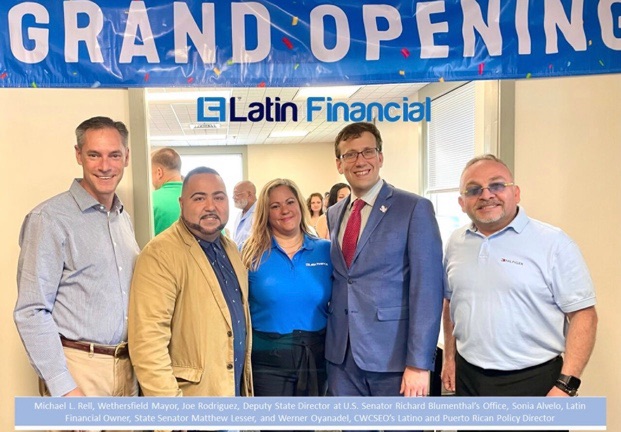
Werner Oyanadel, Latino and Puerto Rican Policy Director at the Connecticut General Assembly’s Commission on Women, Children, Seniors, Equity & Opportunity, said that Alvelo had “been a good partner of [their] work at the Capitol” and that “Latin Financial is filling a big void assisting new businesses and Latino entrepreneurs’ access to needed reources.”
Employees of both Latin Financial and Sharpe appeared excited by all the fanfare while friends and family members were proud to share in the moment. Alvelo ceremoniously cut a blue ribbon for the cameras and in conversations that followed it became known that they were hiring.
Alvelo has previously spoken at Broker Fair in New York and AltFinanceDaily CONNECT Miami. She has been a primary source of information for AltFinanceDaily since 2016 on matters regarding small business financing in Puerto Rico.
Economic Hurricane? Timeless Advice For Your Small Business Finance Company
June 2, 2022 “You know, I said there’s storm clouds but I’m going to change it … it’s a hurricane,” said JPMorgan CEO Jamie Dimon about the current economic situation. “JPMorgan is bracing ourselves and we’re going to be very conservative with our balance sheet.”
At the very least, Dimon is predicting that a recession may be just around the corner. And if that’s the case, we dug up some timeless advice about how a small business finance company can brace itself for such a scenario. These quotes are from 2016 when economic experts were already beginning to wonder if the economy had already overheated, if you can imagine that.
“If the market moves sideways and you rely only on a single source of funding, you are at risk. It’s an incredibly obvious statement, but it becomes more acute when the economic environment comes under pressure.” – Glenn Goldman
“Liquidity is king. The more that participants in this market are able to diversify their capital structure, diversify their funding sources and work with multiple providers, the better off they will be.” – David Snitkof
“[Funders will have to decide] to tighten and pivot while the rest of the players in the space are going full steam ahead. That’s where you have to have some conviction and trust your data and do the right thing.” – Stephen Sheinbaum.
“Just because someone paid you back yesterday doesn’t mean he’s going to pay you back tomorrow. You have to be right more often in a recessionary environment.” – Andrew Reiser
“A small recession could lead to big failures if you don’t take the right steps.” – Yoel Wagschal
In April 2016, when recession predictions were making the rounds, the S&P 500 was ~2,000, Bitcoin was $450, Ethereum was $8, gas was ~$2.20/gallon, and few, if any people, believed that Donald Trump would ever become President.
Who Needs The Merchant Cash Advance Keyword Anyway?
May 31, 2022 Almost five years since Google banned its search engine from displaying ads when queries contain the phrase “cash advance,” the loss of business attributed to that has probably been nil to the small business finance space.
According to Google, despite there being between 100,000 to 1 million searches for “cash advance” each month on average, only 1,000 to 10,000 searches per month are specifically for “merchant cash advance.”
People are ~10x more likely to search for business line of credit, business loan, working capital, or business credit card, according to Google’s estimates.
This is somewhat in line with findings from the Federal Reserve, whose recent study determined that 7x more business owners seek out a loan or line of credit than they do a merchant cash advance.
But putting that aside, the ban on paid advertising for all things cash advance has had an upside for some lucky companies. Without ads, Google has inadvertently (or maybe intentionally) elevated funding providers that are local to the searcher to the top of the organic results. That means listings on Google Maps that contain keywords matching the search queries are reaping the benefits of being prominently placed at the top of the page and are potentially capturing all the clicks along with it. The end result is an old-fashioned SEO war to win what few searches there are.
Compare that to a search for sba loan where paid advertising is fair game. In the era of PPP and EIDL, it’s perhaps no surprise that there are between 100,000 to 1 million searches per month for that keyword on average. Many of those searchers will probably not be eligible for an SBA loan so perhaps the next best fit would be equipment leasing or invoice factoring, two queries that are on par with merchant cash advance in average monthly searches, meaning volume is relatively low.
But how does low search volume turn into the large volume of funding originated? Well, another factor has changed since Google implemented the cash advance advertising restriction in 2017, and that is that Google is not as relevant as it used to be. Business owners are more likely to discover a potential capital source from social media or a fintech platform they already have a relationship with than ever before. According to a recent study, 25% of people claimed they had actually used either Alexa, Siri, or another voice assistant to find information about financial services, signaling a major departure from how traditional searching used to be conducted.
All of which means that the paid advertising restriction on a niche keyword on Google is unlikely to make any kind of difference in the big picture. Odds are you might not have known this restriction even existed. Bing, on the other hand, has no qualms with cash advances and allows paid advertising on it.
DoorDash Capital Warrants No Mention in Latest Report
May 23, 2022Readers interested in hearing the results of DoorDash’s foray in to MCA funding were keenly disappointed by the last earnings call. It didn’t even come up. The product was formally announced by DoorDash on February 9th. At the time, the company said that it was offering DoorDash merchants MCAs through a partner company named Parafin. The offers would be visible right in the DoorDash portal.
DoorDash reported Q1 revenue of $1.5B and a net loss of $167M. The material impact of DoorDash Capital, only in its infancy, was likely minimal then.
IOU Financial Was Profitable in Q1
May 19, 2022 IOU Financial may have originated $59.6M in small business loans in Q1, but the company also managed to do it profitably. Specifically, IOU recorded net earnings of $1.1M in Q1 2022 compared to a $100,000 net loss over the same period the year prior.
“IOU Financial continues to deliver on its promise to stakeholders by growing loan originations and increasing profitability while continuing to invest the scalability of its operations and technology,” said Robert Gloer, President and CEO in a public statement.
IOU’s Q1 revenue totaled $3.9M, earned mostly from servicing and fee revenue that is generated by its marketplace model. $500,000 of it was attributed to referral fee revenue earned by IOU’s direct-to-merchant retail operation called ZING Funding.