
David Goldin is BACK – The Scoop Behind His Return
November 7, 2019 “When I started, the term merchant cash advance didn’t even exist. There really were no business loans back then, the word ‘fintech’ didn’t exist, ‘alternative lender’ didn’t exist … Back in the day it was all about getting a credit facility, and that was like the iPhone 5, and now we’re the iPhone 11. There’s more ways to be a lot less stressful, a lot more productive, and a lot less time consuming. There’s other financial instruments to really help companies excel.”
This is how David Goldin speaks of the difference between the early days of the alternative funding industry, a marketplace which he helped form in the pre-crash years of the noughties, and now, a moment which sees the CEO’s return to the market after years abroad.
Having founded Capify, an alternative finance company, in 2002, Goldin had worked in the space for over a decade before he exited the US market in January of 2017, choosing to instead focus his efforts on the UK and Australia.
Over two years later, Goldin is back in the States with Lender Capital Partners, offering capital to commercial finance companies, with a priority given to those who deal in MCAs and business loans. “It’s very exciting, I’m coming in from a different perspective,” noted Goldin. “It’s still a great industry. I’m just coming at it from a different angle which I think could be a lot more productive and scale a lot faster.”
And as well as funding the funders, this new angle includes forward flow programs, a commitment to participate in deals up to $1 million, credit facilities in the range of $20-100 million, a system by which point of sale providers are able to provide merchant financing via their software, and the Broker Graduate Program. The last of these being LCP’s in-house channel open to brokers who originate a minimum of $500,000 a month, and who want to receive capital and advice from LCP in order to become a direct funder.
When asked why he chose to return via this more top-down approach to the industry, Goldin explained that “there’s enough good players here that are trying to originate on the merchant side, so rather than try to reinvent the wheel I thought I’d come in with my years of experience running a MCA alternative lending platform in the US, knowing what the pain points are.”
Made possible through a partnership with Basepoint Capital, LCP is there to help MCA and business loans companies through both the good times and the bad, according to its founder, saying that what was a lesson for him partly informs LCP’s model.
“The time to raise money is when you don’t need it. If you run into trouble where your lender gets spooked or either has their own financial issues, or it’s a regulatory or macroeconomic condition, you just can’t bring in a new lender within 30 or 60 days, and if you do it’s not going to be on favorable economic terms. It’s really going to be a desperate attempt to get it … It’s almost like having more than one internet connection in your office, if one goes down you have a backup with no downtime.”
Merchant Cash Advance Industry Pioneer David Goldin Launches Lender Capital Partners To Provide Financing To Merchant Cash Advance / Alternative Business Loan Providers
November 5, 2019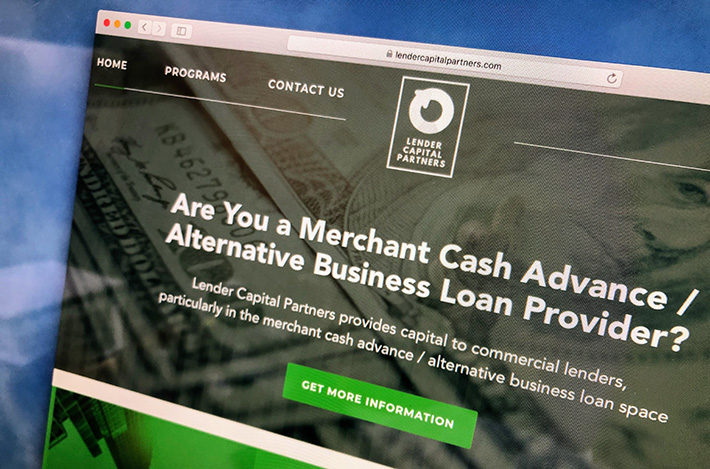 White Plains, NY – November 5, 2019 – David Goldin, one of the merchant cash advance industry pioneers who founded one of the first US merchant cash advance providers in 2002, Capify (formerly known as AmeriMerchant), that later expanded to the UK and Australia has partnered with a subsidiary of Basepoint Capital, a seasoned specialty finance group, to form Lender Capital Partners (http://www.lendercapitalpartners.com). Basepoint has provided over $300 million in committed financings / forward flow purchases in the merchant cash advance / alternative business loan industry.
Lender Capital Partners (LCP) provides MCA and alternative business lending platforms with strategic capital including:
- Forward flow programs – LCP funds 100% of the amounts disbursed by the platform in connection with their funding of advances / business loans including sales commissions to their customers to free up cash and avoid the burden of equity requirements or “hair cut” money associated with traditional asset-based credit lines.
- Participations / Syndication – by having LCP purchase a participation in larger deals, the platform is able to offer larger size approvals to their customers and brokers / referral partners without taking on concentration risk. LCP can participate up to $1 million in each deal and provide strategic capital by offering our many years of industry experience underwriting larger size deals.
- Credit facilities – LCP provide credit facilities for MCA and alternative business loan providers that begin at a minimum of $20 million and can go up to $100 million+. Our credit facilities typically offer a higher advance rate than a bank and less stringent concentration limits.
- Broker Graduation Program – LCP will allow brokers to take the next step of becoming a direct lender by providing the capital and know-how needed to fund deals on their own. Designed for brokers that can originate a minimum of $500k/month, LCP can provide the capital needed and set up brokers with one of our partners to provide a back office if needed for underwriting / servicing without having to make the investment on their own.
- Point of Sales / Credit Card Processor Merchant Cash Advance / Merchant Financing Program – LCP can provide a turnkey solution for POS / Credit Card Processing companies to offer a merchant financing program to their merchants to compete with some of the larger POS providers / credit card processors that are now offering these programs in-house and have had great success. LCP can provide the capital needed for a merchant financing / merchant cash advance program as well as introduce one of our underwriting/servicing partners if needed.
“After exiting the US MCA business in 2017, I have decided the time is right to offer my 17+ years of global MCA / business lending experience to the industry by partnering with Basepoint to supply capital to the MCA / business loan industry. I believe the various programs we offer at Lender Capital Partners are tailored for just about any company in the industry – for both current lenders as well as larger brokers/ISOs that are looking to graduate to the next step of becoming a lender as well as to POS providers / merchant acquirers looking to offer an in-house program to their merchants. And my 17+ years industry experience is a great value-added benefit that very few lenders, if any can bring to the table”, says David Goldin, a principal of Lender Capital Partners.”
About LENDER CAPITAL PARTNERS
Lender Capital Partners provides capital to commercial lenders, particularly in the merchant cash advance / alternative business loan industry. One of the founders of Lender Capital Partners is David Goldin. David is the Founder of Capify, one of the first merchant cash advance providers in the US founded in 2002. David scaled Capify to 225 employees operating in 4 countries and sold the US business to a competitor in 2017 and secured a $95 million credit facility with Goldman Sachs to fund Capify UK and Capify Australia which has over 125 employees total today operating in each of those markets. David has over 17 years experience in the merchant cash advance / alternative business finance industry and is considered a pioneer in the industry. David’s extensive expertise allows Lender Capital Partners to bring strategic value to our relationships, not just capital. For more information on Lender Capital Partners, visit http://www.lendercapitalpartners.com
AltFinanceDaily Around The World
September 28, 2019 Members of the AltFinanceDaily editorial team returned from Ireland this week. The Republic of Ireland will be the latest in our international series on nonbank finance. Stay tuned for our stories on that.
In the meantime, be sure to check out our international coverage of:
Canada
- Canada story series
- Magazine Feature: Canada’s Alternative Financing Market Is Taking Off
- Canadian Funder Directory
Australia
- Australia story series
- Magazine Feature: Snapshot on Australia: Growth in the making
- Australia Funder Directory
Hong Kong
Mexico
Fox Corp / Credible Deal – What’s Online Lending Got To Do With TV Broadcasting?
August 5, 2019 On Sunday Fox Corp announced it had agreed a deal to buy a majority share of 67% in Credible, a San Francisco-based online lending platform that is publicly traded in Australia.
Credible, which was valued at $397 million by Fox, provides credit checks for mortgages, personal loans, and student loans; gathers the information yielded; and presents prequalified rates and refinancing options to customers, which they can click-through to. In addition to an investment of $265 million for their stake, Fox Corp will allocate an additional $75 million to cover Credible’s operating costs for the next two years.
The news may come as odd to many familiar with some of the media company’s biggest subsidiaries, such as Fox News, 21st Century Fox, and Fox Sports, but it is the second such investment to be made since Fox Corp sold the majority of its television and film assets to Disney for $71 billion in 2017. May saw Fox acquire 4.99% of Stars Group, an online sports betting site, for $236 million.
 The move could be viewed as an attempt to enhance how current financial content is delivered through Fox Corp’s channels. With access to a pool of data that covers information relating to large swathes of credit ratings, loan approval speed, and financing priorities, Fox Business Network would be better positioned to deliver analysis. The Wall Street Journal, which shares a parent company with Fox Corp, News Corp, noted that Fox executives will be able to use Credible’s data in the digital avenues of its local television stations.
Lachlan Murdoch, who was made Chairman and CEO of Fox Corp when his father Rupert stood down earlier this year, said in a statement that “The acquisition of Credible underscores Fox Corporation’s innovative digital strategy that emphasizes direct interactions with our consumers to provide services they want and expand their engagement with us across platforms.” While in return, Credible will “benefit from our audience reach and scale, will drive strategic growth, further develop our brand verticals and deepen consumer relationships.”
A fate that Credible founder and CEO Stephen Dash appears to be content with, stating that “Fox Corporation’s record of innovation and focus on audience engagement will further enhance Credible’s position as a leading consumer finance marketplace in the United States, creating opportunities for organic growth and the expansion of the Credible platform. Credible’s industry-leading user experience, combined with FOX, will provide greater impact and scale for consumers.”
But not everyone with a stake in Credible is convinced by the decision, as Bell Potter analyst Damian Williamson has claimed. “Premature is the word to describe how some minority shareholders see the transaction … This company is operating in a very large market and has the potential to do really well.”
Regardless, the deal comes after months of negotiations, which were initially secured in May, only to go through an on-again-off-again phase until recently. While signed off by both Credible and Fox Corp, the sale won’t be confirmed until the Australian Securities Exchange approves the transaction.
Representing the first of its kind in acquisitions, the Fox Corp-Credible deal is an anomaly within the industry, being the pioneer case of a broadcasting company foraying into alternative finance – a field notedly uncovered by vast portions of the media.
OnDeck Taps Bank Veteran to Lead ODX Sales and Strategy
July 23, 2019 NEW YORK – OnDeck® (NYSE: ONDK), the leader in online lending for small business, today announced the appointment of Lonnie Hayes as the Head of Sales and Strategy for ODX, a wholly owned subsidiary of OnDeck that assists banks with streamlining and digitizing small business credit origination.
Mr. Hayes brings more than thirty years of experience to his new role. He most recently served as Executive Vice President of Small Business for BBVA USA, where he established the organization’s U.S. strategy to serve businesses with less than $10 million in annual revenues. At BBVA USA, Mr. Hayes oversaw product development, digital and sales operations, as well as leading the bank’s nationally recognized Small Business Administration (SBA) lending unit.
“Lonnie’s proven track record building and managing high-growth sales organizations and programs will be crucial as we continue to address the market from banks seeking enhanced digital lending capabilities,” said Brian Geary, President, ODX. “Lonnie will be a tremendous asset to our team as we engage financial institutions to help them accelerate their ability to serve small businesses.”
“I am excited to join ODX, the pioneer in digitizing and speeding the online lending experience for banks,” said Lonnie Hayes, Head of Sales and Strategy, ODX. “I hope to bring a banker’s perspective to our partnership efforts and look forward to collaborating with bank colleagues old and new, to strengthen the economics of small business lending while dramatically improving the customer experience for borrowers.”
ODX operates as a subsidiary of OnDeck and offers a combination of software, analytic insights, and professional services to help banks reinvent their small business lending process. At the core of the ODX solution is a modular, scalable, and reliable SaaS platform that allows banks to either create a fully end-to-end digital experience for their customers or to select certain components for specific product functions. An ODX-powered bank platform experience can enable a small business customer to apply for financing from their bank online, receive immediate decisions, and obtain funding in as fast as 24 hours.
About OnDeck
OnDeck (NYSE: ONDK) is the proven leader in transparent and responsible online lending to small business. Founded in 2006, the company pioneered the use of data analytics and digital technology to make real-time lending decisions and deliver capital rapidly to small businesses online. Today, OnDeck offers a wide range of term loans and lines of credit customized for the needs of small business owners. The company also offers bank clients a comprehensive technology and services platform that facilitates online lending to small business customers through ODX, a wholly-owned subsidiary. OnDeck has provided over $11 billion in loans to customers in 700 different industries across the United States, Canada and Australia. The company has an A+ rating with the Better Business Bureau and is rated 5 stars by Trustpilot. For more information, visit www.ondeck.com.
Media Contact:
Jim Larkin
OnDeck
jlarkin@ondeck.com
P: 203-526-7457
Investor Contact:
Stephen Klimas
OnDeck
sklimas@ondeck.com
P: (646) 668-3582
OnDeck, the OnDeck logo, OnDeck Score and OnDeck Marketplace are trademarks of On Deck Capital, Inc.
Become: The Who, What, and Why of a Rebrand
July 23, 2019Last week Lending Express rebranded to Become. Founded in 2016, the company, which educates businesses looking for loans on how to appear more attractive to funders, was spearheaded by CEO Eden Amirav in Australia originally, with an eventual expansion to the US. Three years in, the company has over 50 lending partners across its two markets, a record of having facilitated over $150 million in funding, and more than 150,000 members on their platforms. As indicators of progress go, these are far from undesirable. So, when things were going so well, what led Amirav to decide to rebrand?
In short, the company had evolved into something different from what it was in 2016, and its name, logo, and stylized website fonts had to reflect that. Thus, Lending Express became Become.
 Gone are many of the aesthetic features of Lending Express, replaced with fresher counterparts, but beyond the brand, much of the company has remained. Amirav, the ex-pro gamer who was national champion of Israel in Warcraft 3 when he was a teenager, is still around; their AI-powered funding odds calculator, LendingScore, continues to be used; and their offices in both the US and Israel remain open.
Rather than being hoarded remnants of times past, what Become has brought with it from Lending Express were deemed necessary by Amirav when discussing what was required to execute the rebrand. Explaining that before planning for the future of the rebrand even begun, Lending Express worked for months to comprehensively take stock of itself, and Amirav noted that all hands were needed and the entire company pitched in. Whether it was ensuring that URL links which once directed people to Lending Express now went to Become, or the drafting up of the new name, much of the work that went into the business’s metamorphosis came from within the company. Of course, Become specializes is helping small businesses get approved for loans, so not everything could be done by themselves, which is where a marketing firm came in to aid them with the crafting of the company’s new image.
As to the motives of the rebrand, the brief explanation given above doesn’t cut it. A blog post on Become’s website explains the origins of both names. With Lending Express having a ‘do-what-it-say-on-the-tin’ aspect to it, Become is much more abstract in how it reflects the company. Noting that Become originates from both within the company and without, Amirav explains the name owes itself to Lending Express’s development into a “no human-touch, all-tech based” company, following LendingScore’s creation; as well as the business’s ability to help its customers achieve their goals, enabling them to become what they wish.
Rebranding comes at a massive financial cost, with no guarantee of an immediate large payout upon launch, but as Amirav asserted, the switch to Become was necessary in his long-term plan for the company, as the “stress [of the rebrand] is offset by the goal of where they want to go.” “We’re well equipped with people, resources, and vision,” Amirav went on to say, and as well as this, he believes in the importance of a strong brand, regardless of industry, claiming that it “becomes a power to work with.”
And with their new logo and four-tone color palette sure to catch eyes, perhaps Amirav’s gamble will pay off. For now, he’s content with his rebrand going public, the continued business of Become, and the “shareholders [being] happy.”
Lending Express Rebrands to Become
July 16, 2019Lending Express, a company whose CEO was once a master gamer, has rebranded to Become.
“This transition comes at a pivotal point in the company’s growth and highlights its dedication to providing businesses with opportunities to improve fundability, secure funding, and ultimately become more,” a company spokesperson wrote.
According to the company, their online loan marketplace grew from just one lending partner in Australia to over 50 lending partners, operating in both Australia and the US. They’ve facilitated more than $150 million in funding and have over 150K members on their platform to date. Their journey is documented on a blog post published this week.
Are The Bankers Taking Over Fintech?
June 27, 2019
For Rochelle Gorey, the chief executive and co-founder of SpringFour, a “social impact” fintech company, mingling with industry movers and shakers at this year’s LendIt Fintech Conference was just what the doctor ordered. “I went mainly for the networking opportunities,” Gorey told AltFinanceDaily.
SpringFour, which is headquartered in Chicago, works with banks and financial institutions in the 50 states to get distressed borrowers back on track with their debt payments. It does this by digitally linking debtors with governmental and nonprofit agencies that promote “financial wellness.
The indebted parties—more than a million of whom had referrals that were arranged by Gorey’s tech-savvy company last year—constitute not only household consumers but also commercial borrowers. “Small businesses face the same issues of cash flow as consumers, and their business and personal income are often combined,” she says. “If their financial situation is precarious, it’s super-hard to get credit, a line of credit, or a business loan.”
 Although Gorey felt “overwhelmed” at first by the throng of 4,000 conference-goers at Moscone Center West in San Francisco—roughly the same number as attended last year, conference organizers assert— her trepidation was short-lived. It wasn’t too long before she was in circulation and having chance encounters and serendipitous interactions, she says, with “all the right people at the workshops and at the tables in the Expo Hall.”
Armed, moreover, with a “networking app” on her mobile phone, Gorey was able to arrange targeted meetings, scoring roughly a dozen, 15-minute tete-a-tetes during the two-day breakout sessions. These included audiences with community bankers, financial technology companies, and “small-dollar” lenders. “And it went both ways,” she says. “I had people reaching out to me”—just about everyone, it seemed, appeared receptive to “finding ways to boost their customers’ financial health.”
Gorey’s success at networking was precisely the experience that the event’s planners had envisioned, says Peter Renton, chairman and co-founder of the LendIt Fintech Conference. Organizers took pains to make schmoozing one of the key features of this year’s gathering. Not only did LendIt provide attendees with a bespoke networking app, but planners scheduled extra time for meet-ups. “We had around 10,000 meetings set up by the app,” Renton says, “about double the number of last year.”
AltFinanceDaily did not attend the LendIt USA conference on the West Coast this year. But the publication sought out more than a half-dozen attendees—including several financial technology executives, a leading venture capitalist, a regulatory law expert, and the conference’s top administrators—to gather their impressions. While informal and manifestly unscientific, their responses nonetheless yielded up several salient themes.
The popularity—and effectiveness—of networking was a key takeaway. Most seized the opportunity to rub elbows with influential industry players, learn about the hottest startups, compare notes, and catch up on the state of the industry. Most importantly, the event presented a golden opportunity to make the introductions and connections that could generate dealmaking.
“My goal this year was to strike more partnerships with lenders and fintech companies,” says Levi King, chief executive and co-founder at Utah-based Nav, an online, credit-data aggregator and financial matchmaker for small businesses. “We had great meetings with Fiserv, Amazon, Clover Network (a division of First Data), and MasterCard,” he reports, rattling off the names of prominent financial services companies and fintech platforms.
James Garvey, co-founder and chief executive at Self Lender, an Austin-based fintech that builds creditworthiness for “thin file” consumers who have little or no credit history, said his goal at the conference was both to serve on a panel and “meet as many people as I could.”
Self Lender is in its growth stage following a $10 million, series B round of financing in late 2018 from Altos Ventures and Silverton Partners. Garvey reports having meetings with Bank of America and venture capitalist FTV Capital “over coffee” as well as F-Prime Capital, another venture capitalist. “It’s just about building a relationship,” he said of making connections, “so that at some point, if I’m raising money or want to partner, I can make a deal.”
There was a concerted effort to recognize women, as evidenced by a packed “Women in Fintech” (WIF) luncheon that drew roughly 250 persons, 95% of whom were women. (“Many men are big supporters of women in fintech and we didn’t want to exclude them,” Renton says). The luncheon was preceded by a novel event—a 30-minute, ladies-only “speed-networking” session—which attracted 160 participants, reports Joy Schwartz, president of LendIt Fintech and manager of the women’s programs.
At the luncheon, SpringFour’s Gorey says, “it was empowering just to see lot of women who are senior leaders working in financial services, banks and fintechs.” The keynote speech by Valerie Kay, chief capital officer at Lending Club, was another highlight. “She (Kay) talked about taking risks and going to a fintech startup after 23 years at Morgan Stanley,” Gorey reports, adding: “It was inspiring.”
The women’s luncheon also marked the launch of LendIt’s Women In Fintech mentor program, and presentation of a “Fintech Woman of the Year” award. The recipient was Luvleen Sidhu, president, co-founder and chief strategy officer at BankMobile, a digital division of Customers Bank, based near Philadelphia, which employs 250 persons and boasts two million checking account customers.
I am honored to be the 2019 Fintech Women of the Year and thrilled that @BankMobile won Most Innovative Bank. It’s very exciting to be recognized by @LendIt Fintech with this prestigious award and I congratulate the finalists in all the categories. https://t.co/qjADuKEMrB pic.twitter.com/hFJVFw1fLS
— Luvleen Sidhu (@LuvleenSidhu) April 11, 2019
BankMobile, which also won LendIt’s “Most Innovative Bank” award, has an alliance with Upstart to do consumer lending and a partnership with telecommunications company T-Mobile. Known as T-Mobile Money, the latter service provides T-Mobile customers with access to checking accounts with no minimum balance, no monthly or overdraft fees, and access to 55,000 automated teller machines, also with no fees. (At its website, T-Mobile Money describes itself as a bank and uses the slogan: “Not another bank, a better one.”)
The impressive salute to women notwithstanding, their ranks remained fairly thin: just 733 attendees identified themselves as “female” on their registration forms, LendIt’s Schwartz says, a little more than 18% of total participants. Seventy-five of the 350 total speakers and panelists—or 21%—were female. (Schwartz also reports that another 157 registrants selected “prefer not to say” as their sexual orientation, while 22 checked the box describing themselves as “non-conforming.”)
In LendIt’s defense, AltFinanceDaily, who caters to a similar audience, regularly reviews its readership demographics using several tools. They have consistently indicated that women make up 18% – 23% of the total, in line with what LendIt experienced at its most recent event.
By all accounts, many panels were informative, jampacked and attendees were engaged. King, who moderated a panel on regulatory changes in small business lending, which dealt with such topics as California’s commercial “truth-in-lending” law and controversial “confessions of judgment” laws, says: “They didn’t have to lock the door but the room was pretty full and people seemed to be paying attention. I didn’t see people studying their cellphones.”
The Expo Hall was teeming with budding fintech entrepreneurs, financial services companies and multiple vendors hawking their wares. But as numerous fintechs were angling to forge lucrative symbiotic relationships with banks, some participants—even those who were hailing the conference for its networking and deal-making opportunities—lamented the heavy presence of the establishment.
The banks’ ubiquitousness especially vexed Matthew Burton, a partner at QED Investors, an Arlington, (Va.)-based, venture capital firm and a veteran fintech entrepreneur. Before signing on with QED last year, Burton had been the co-founder of Orchard Platform, an online technology and analytics vendor for fintech and financial services companies which was purchased by fintech lender Kabbage.
Not only did bankers seem to playing a more prominent role at the LendIt conference, Burton notes, but “big four” accounting firm Deloitte had signed on as a major sponsor. “The energy level seemed a bit lower than in past years,” Burton told AltFinanceDaily. “It’s not like people were depressed but it wasn’t bubbling with excitement. A couple of years ago we thought all these new fintechs would replace the banks,” he explains. “Now the discussion is over how to partner and collaborate with banks. It’s not as exciting as when everyone thought banks were dinosaurs.
“I couldn’t really tell if there were more bankers attending this year,” Burton adds, “but it sure felt like it.”
King, the Nav executive, told AltFinanceDaily: “It was a little bit subdued. I don’t know if it was nervousness about the economy or politics, but the subject of risk came up more often in side conversations with venture-backed businesses and banks and alternative fintech lenders. One large bank we deal with,” he adds, “told me it’s spending most of its time working on risk.”
Cornelius Hurley, a Boston University law professor and executive director of the Online Lending Policy Institute who participated in a standing-room-only session on state and federal fintech regulation, declares: “I’ve been to three of their conferences, including one in New York, and I would say that this one did not have as much pizzazz. It may be that the industry is maturing.”
For his part—when asked whether there was a palpable absence of passion this year—LendIt’s Renton told AltFinanceDaily: “I would say that it felt more businesslike. Fintech has had a lot of hype and we have had conferences that were ridiculously over-hyped in 2015 and 2016. And in 2017 (the mood) was much more somber. This one felt optimistic and businesslike.”
There were 750 bankers in attendance, almost one in five participants. “The number of bankers was not up significantly” over last year, Renton says, “but the seniority of the bankers was higher. We worked very hard to get senior bankers to attend this year.”
Renton was bullish on the closer ties developing between nonbank online lenders and banks. That was reflected as well in the several panels exploring ways to develop partnerships between the two sides. He noted that a session called “How Banks are Matching Fintechs on Speed of Funding and User Experience” drew a heavy crowd. “It brought more bankers than we’ve ever had before,” Renton says.
Moderated by Brock Blake, founder and chief executive at the fintech Lendio, the panel was composed of three bankers: Ben Oltman, the Philadelphia-area head of digital lending and partnerships at Citizens Bank; Gina Taylor Cotter, a senior vice-president at American Express (the highest-ranking woman at the company); and Thomas Ferro, a senior marketing manager at Bank of America. “The banks came to LendIt not just to learn but to decide whom they’re going to partner with,” Renton says. “Fintechs need banks and banks need fintechs. That is the narrative you hear on both sides.”
(Asked whether any banks sponsored this year’s conference, Renton replied: “They are not sponsoring yet in any number but we are working on that.”)
OnDeck, a top-tier fintech lender to small-businesses in the U.S., which has been making forays abroad to Australian and Canadian markets, is an enthusiastic champion of the fintech-bank union. So much so that it claimed LendIt’s “Most Promising Partnership” award for the cooperative relationship it struck with Pittsburgh-based PNC Bank, which uses OnDeck’s platform to make small business loans. (Among the partnerships that OnDeck-PNC beat out: Gorey’s SpringFour, which was named a finalist in the competition for its association with BMO Harris Bank.)
“We were the first fintech lender to strike a true platform relationship with a bank,” Jim Larkin, head of corporate communications at OnDeck says, noting that the PNC deal follows on the New York-based fintech’s similar, innovative arrangement with J.P. Morgan Chase. “Others may do referrals,” he explains. “What we do is actually provide the underlying platform to accelerate a bank’s online lending capabilities. We deliver the software and expertise to construct the right type of online lending engine.”
Meanwhile, there was avid interest about the stock performance of publicly traded fintechs—for example, Square and GreenSky—both of which had seen their share prices tumble and then recover.
Burton noted that, among venture-backed firms, the most excitement seemed to be coming from Latin America. “Everyone was very bullish on a Mexican company, Credijusto, an alternative small business lender that was written up the in the Wall Street Journal,” he says. “It’s not going public yet but it had a large debt-and-equity raise of $100 million from Goldman Sachs. And SoftBank Group announced a $5 billion Latin American tech fund.
“There was a lot of talk,” he adds, “about how money was flowing into Mexico and Brazil.”