

What’s a Broker To Do? Industry Execs Offer Their Insight
March 12, 2018
Below are excerpts from separate interviews with four industry executives when asked for tips or advice for brokers:
“I would just say to be in it for the long haul. Play the long game. Be the kind of quality partner that you would want in return. There are some brokers and referral sources in this space who see merchants only as a commission check, not as the going concern and business entities that they are. Some brokers are playing the short game, which is unfortunate, because brokers can be in a very powerful position with their clients (merchants) – they need to use that power wisely. If one were to carefully look at a business and its working capital challenges, and then tried to do what was in the best interest of that business in the long run, a broker could be creating a revenue stream for a longer period of time – on a healthier business – and in return creating a more sustainable brokerage platform for themselves. Be open and transparent – sometimes losing a deal due to full transparency can lead to many multiples of that volume with a loyal funding partner.”
– Bill Gallagher, President and Managing Partner, CFG Merchant Solutions | Read full interview
“Choose industries that you excel in—and own them.
Concentrate your marketing efforts on your core customers and target those that meet a lender’s criteria. It’s not the quantity of leads you deliver, it’s the quality—and that will save you time and money. Look for customers in growth stages, not those that are desperate for funds to stay afloat. This will also result in more renewals.
And find a lending partner with a strong brand, as this opens doors to new customers.”
– Michael Marrache, CEO, BFS Capital | Read full interview
“It is not an easy business and not for everyone. It takes quite some time – years – to either build an organization or to become a seasoned pro that truly understands the space. It is also very fast paced and ever changing, so you have to really commit and take the space seriously if you want to be successful.”
– James Webster, CEO, National Business Capital | Read full interview
“Brokering is a tough marketplace right now. I don’t want to say [it’s] saturated, but it’s getting pretty close…Everyone’s getting a million phone calls and mailings and the marketing is going crazy, and the expense is going up. So you really have to find a way to differentiate yourself.
That’s really the biggest thing about being a broker, besides quality service. It’s more: What kind of niche can I get into? How can I break into the market without having to spend like a million dollars a month on marketing? The biggest thing is: What can you do differently?”
– Evan Marmott, CEO, CanaCap | Read full interview
Princeton Alternative Funding Files Chapter 11
March 9, 2018Princeton Alternative Funding LLC filed for chapter 11 on Friday, court records reveal. A related entity, Princeton Alternative Income Fund, LP, also filed for Chapter 11.
Princeton Alternative Funding provides capital for businesses that make consumer loans in the non-prime market.
The Princeton Alternative Income Fund was previously reported to be a woe affecting Ranger Direct Lending after the blowup of online consumer lender Argon Credit.
AltFi reported in November that Ranger had written to Princeton to urgently seek information about Argon-related financial reporting prior to the commencement of arbitration proceedings.
Minority-Owned Businesses Present Opportunities for Online Lenders
February 27, 2018
Research consistently shows that minority-owned businesses have a harder time accessing capital than other businesses. Online financing has the potential to change this.
Most of the online funding process is based on objective factors such as your business type and revenue. When you apply for funds online, it’s harder to discern things like the color of your skin or your ethnicity—factors which research shows can sometimes play into the face-to-face lending process, even though it’s illegal and immoral. What’s more, applying for funds online eliminates the stigma that keeps many minority-owned businesses from walking into a bank to apply for a loan, according to industry participants.
“Many minorities are hesitant to go into a bank,” says Louis Green, interim president of The National Minority Supplier Development Council, which provides business development opportunities for certified minority-owned businesses. He says the growth of online lending platforms will potentially open more doors for minority-owned businesses to get much-needed capital to operate and expand.
“The beauty of things on the Internet is that it has the ability to take away discriminatory issues,” says Green, who is also the chief executive of Supplier Success LLC, a Detroit-based business that offers online business financing solutions.
Certainly, minority-owned small businesses are a large and growing market. There were 8 million minority-owned firms in the U.S. as of 2012, according to U.S. Census Bureau data. Minority-owned firms represented 28.8% of all U.S. firms in 2012.
Historically, however, minority-owned businesses have had trouble getting access to credit for a host of reasons, and recent research suggests the problems persist.
 A report published in November by the Federal Reserve Banks of Cleveland and Atlanta examines the results of an annual survey of small business owners. The report found that while many minority small businesses were profitable, a significant majority faced financial challenges, experienced funding gaps and relied on personal finances.
Some of the trouble obtaining financing may have discriminatory underpinnings. For instance, a recent working paper by researchers at Utah State University, Brigham Young University and Rutgers University, among others, suggests that minorities were more highly scrutinized for loans than other applicants. For instance, African American “mystery shoppers” underwent a higher level of scrutiny and received a lower level of assistance than their less-creditworthy Caucasian counterparts, according to the study.
Also, African American testers were asked significantly more often about their marital status and their spouse’s employment. This “marks another and even illegal differential experience for these minority entrepreneurial consumers compared with the Caucasian shoppers,” the study finds.
To be sure, other factors are also likely to blame. For instance, the average credit score of a minority small-business owner is 707, which is 15 points lower than the overall average for small-business owners in the U.S., according to a 2016 study by credit bureau Experian.
Even so, the bias issue remains a stark possibility in at least some cases. A 2010 report by the Minority Business Development Agency (MBDA) offers data to show that minority-owned firms are less likely to receive bank loans than non-minority-owned firms. Among all minority firms, 7.2 percent received a business loan from a bank compared with 12.0 percent of non-minority firms, according to the report. High sales minority-owned firms were more likely to receive bank loans with 23.3 percent receiving this source of startup capital. By contrast, 29.2 percent of high sales non-minority firms received bank loans, the data shows.
To be sure, it’s very difficult to prove discrimination when a bank loan is denied. A few years ago, a mortgage banker who asked not to be named, says he suspected discrimination when an Asian couple he worked with was denied a small bank loan. While he didn’t have rock solid proof, he felt the bank’s stated reasoning for turning down the loan was unjustified and he tried going to bat for the couple. His efforts were rebuffed, however, and the loan was denied.
Based on the size of the loan and the couple’s finances, the banker says the loan would have easily been approved by an online provider that was looking only at objective factors. “They see the numbers they’ve been given and calculate risk and make decisions based purely on numbers,” he says.
Indeed, this is where online lending has already shown significant potential. Alicia Robb, a research fellow at the Atlanta Federal Reserve who co-authored the November report by the Cleveland and Atlanta Federal Reserves, says when controlling for credit score and other business-related factors, the data shows that minority businesses have a better shot at getting loans approved online than they do at a large or small bank.
Industry participants say the online funding process can be a boon for minority business owners because it strips subjective reasoning out of the decision-making process. Instead of presenting themselves, applicants are presenting what their business looks like financially, and funders are making highly automated decisions based on the information provided.
“Humans make terrible decisions. The more you can eliminate human bias in the process the better,” says Kathryn Petralia, co-founder and president of Kabbage. She says 95 percent of the online lender’s customers have an entirely automated experience, which includes validating their identity using digital processes. “We never see a picture of them or know anything about their ethnicity or demography,” she says.
 Even funders who do ask for photo identification say that doesn’t happen until after applicants have been approved. And even then, it’s just to “make sure that the person you are funding is actually the person you are funding and no one is trying to defraud you,” says Isaac D. Stern, chief executive of Yellowstone Capital LLC, a MCA funder in Jersey City, N.J. “Online financing is colorblind. It doesn’t matter if [you’re] white or Hispanic or black,” he says.
Dean Sioukas, chief executive of Magilla Loans, an online search engine that matches prospective borrowers and lenders, has hope that the anonymity of the online funding process could eventually make the off-line process more equitable for all applicants. After accepting a number of solid proposals from viable lending opportunities—without knowing any personal information about the applicant—his hope is that whatever biases a loan officer may previously have had will dissipate, he says. Funding decisions should only be made on objective criteria, he says. “The rest has no place in the process.”
While in theory online lending should improve access to funds for minority-owned businesses, several industry observers say barriers remain.
One major challenge is getting the news out to minority business owners, many of whom don’t know about the online funding opportunities that exist, says Lyneir Richardson, executive director of The Center for Urban Entrepreneurship and Economic Development, a research and practitioner-oriented center at Rutgers Business School in Newark, N.J.
He suggests online lenders and funders need to do a better job of connecting with minority-owned businesses and explaining what they have to offer. He works with about 300 entrepreneurs, 70 percent of whom are minority-owned businesses. He’s held this position for 10 years, but says he’s never been approached by an online lending company to market its services, speak at one of his events, provide funding advice to business owners or in any other capacity.
 “There is an opportunity for online small business lenders to market and make known, particularly to minority business owners, that they have viable, market rate lending products that can help them grow,” he says.
One caveat is that rates online are often higher than traditional bank loans, so there is a trade-off for minority-owned businesses, says Brett Barkley, a senior research analyst in the community development department at the Federal Reserve Bank of Cleveland, who co-authored the November report.
Other research from the Federal Reserve shows that satisfaction levels were lowest at nonbank online lenders for both minority- and nonminority-owned firms compared with borrower satisfaction levels at small banks and large banks, he says. The satisfaction levels seem to be related to higher interest rates and “lack of transparency,” he adds. While the study doesn’t define the latter term, the findings could “point to confusion regarding the actual terms of the loan,” Barkley says.
Some online firms have taken steps to make pricing more transparent by using the SMART Box disclosure agreement, a comparison tool developed by the online lending industry to help small businesses more fully understand their financing options. There are currently three different versions of the SMART Box disclosure –for term loans, lines of credit, and merchant cash advances.
This “is a really important metric,” says Petralia of Kabbage, which offers the tool to customers.
Green, the interim president of NMSDC, says that helping its 12,000 minority-owned business members gain access to capital is a major goal for the organization. While online financing is still a largely “untapped resource” for minority businesses, it makes borrowing money easier and more appealing. “It holds great promise for minority-owned businesses, but I think the reality hasn’t met that promise yet,” he says.
Banks, Alt Funders Continue to Compete for Small Business
February 13, 2018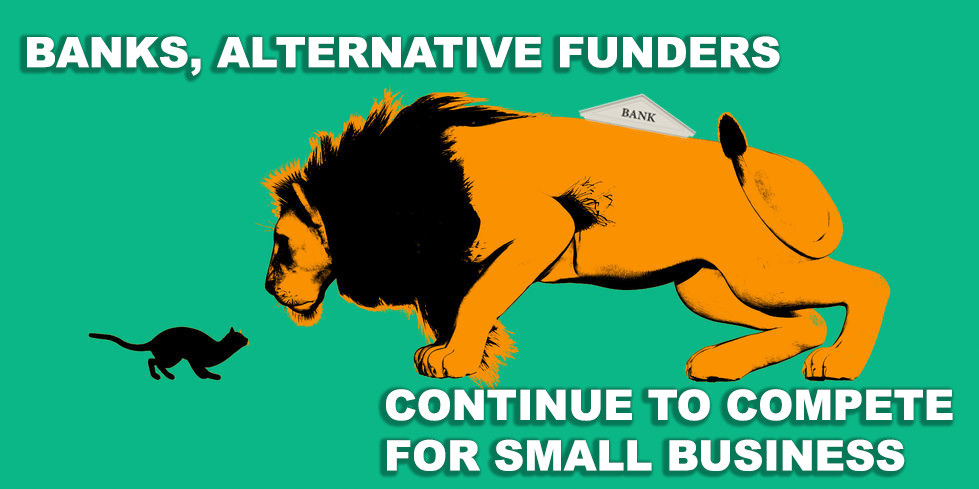
The alternative small-business finance industry owes its very existence to banks’ reluctance to lend money to mom-and-pop shopkeepers, tradespeople and restauranteurs, but bankers’ tight fists may be loosening. Small-business owners are reporting better results when they apply for bank loans.
In fact, small entrepreneurs succeeded in landing bank loans 37 percent of the time in the fourth quarter of 2017, up from 29 percent a year earlier, according to the 1,341 merchants surveyed for the most recent quarterly Private Capital Access Index report provided by Dun & Bradstreet and Pepperdine University’s Graziadio School of Business and Management.
“That’s a big change. It’s outside the margin of error and outside normal statistical variation,” Craig R. Everett, assistant professor of finance at Pepperdine and director of the Graziadio and Dun & Bradstreet Private Capital Markets Project, tells AltFinanceDaily. He’s comparing the shift to patterns established in the nearly six years the quarterly index has pegged small-business trends.
 But the effects of bankers’ increased willingness to lend to small businesses may prove a bit muted in the alternative funding industry. That’s partly because Pepperdine and Dun & Bradstreet define small businesses as having up to $5 million in annual revenue. Alt funders often deal with much smaller enterprises that could still fail to capture the attention of bank loan officers, says Noah Grayson, managing director of South End Capital in Encino, Calif. “If you’re making $5 million in gross revenue, that’s a pretty robust business,” he says of his clients.
Then there are the borrowers whose companies seem small in that they employ just a few people but might rake in $5 million on a single contract – like contractors who specialize in heavy construction equipment or have a presence in the aviation business – but aren’t profitable enough to qualify for bank loans, says Gene Ayzenberg, CEO of PledgeCap, a company with offices on Long Island and in Manhattan that specializes in business and personal loans secured by collateral.
Besides, lots of alternative lenders don’t regard gross revenue as the measure of a business. “I would look at what kind of resources and infrastructure the business has to define what is small and medium-sized,” says David Obstfeld, CEO of New York-based SOS Capital. Many alt lenders cite the importance of net over gross.
The size of prospective borrowers aside, banks are probably lending to small merchants more often these days because small businesses are becoming more profitable in today’s relatively healthy business climate and thus stand a better chance of qualifying for credit, Everett says. The recent reduction in corporate taxes will also improve profits and make small businesses more credit-worthy, he says.
The change in bank lending volume seems tied to those financial gains and doesn’t appear to be linked to any shift in policy among bankers, Everett notes. But new policies at the Small Business Administration could prompt the banking community to view small-business loans more favorably, according to Grayson. The SBA is increasing the percentage it guarantees for some loans and reducing the amount required for a down payment on some loans, he notes. That could make life more difficult for some alternative lenders because most of the small-business loans made by major banks, like Wells Fargo and Chase, are SBA loans, he says. The SBA did not provide details regarding the changes by press time.
 Regardless of what’s making banks loosen their grip on the purse strings, merchants are feeling more optimistic – or at least less gloomy – about obtaining bank loans in the near term, the study by Pepperdine and Dunn & Bradstreet indicates. In the fourth quarter of last year, 55 percent of small-business owners predicted difficulty in raising financing in the next six months, down from 61 percent a year earlier, the survey shows.
“That’s an improvement, but I still think it’s an alarmingly high number,” Ayzenberg says of those findings. “Before they even start worrying about how their operations are going and how good their product is, one in two businesses is already worrying that their bank is not going to be able to fulfill their needs. They shouldn’t have to have those fears.”
So, banks are becoming a bit more likely to loan to small businesses but still aren’t throwing open the flood gates to create a flood of funding. That’s true of banks that qualify as large and those classified as small.
American banks tend to be either small community institutions or huge national concerns that are swallowing up the remaining mid-sized regional banks, observers agree. Between 80 and 90 banks control assets of $10 billion or more and thus qualify as large, while thousands of small banks have more limited resources, says David O’Connell, an Aite Group senior analyst.
Large and small banks exhibit about the same degree of ambivalence toward small-business loans. Banks can mitigate the downside of the loans because they have funds to hire staffs and buy technology to analyze risk, O’Connell says. Executives at small banks can avoid potential problems with small-business loans because they’re often dealing with prospective borrowers who were their high school or college classmates, he notes.
Whether banks are large or small, they have their reasons to deny loans to small businesses. Perhaps foremost among the rationales for denying loans to small businesses is the cost of underwriting, says O’Connell. Banks simply can’t make enough money on the loans to pay the cost of processing them, he says, adding that, “It’s a long-standing problem.” For example, a bank can make a profit by loaning $2 million at prime plus 2 percent, but can’t cover the underwriting costs of an $80,000 loan that also earns prime plus 2 percent. The underwriting costs would be the same in both cases, he notes.
Banks became even more ambivalent about loaning to small businesses after the Great Recession struck in 2008, O-Connell continues. They didn’t want to repeat the mistakes of the freewheeling period that preceded the economic catastrophe. About the same time, private equity and hedge funds began madding more capital available to alternative lenders, he says. Meanwhile, technology and alternative data sets helped the alternative industry understand risk and reduce underwriting costs, he maintains.
Banks also find it more expensive to loan to small businesses these days because the Dodd-Frank Act has increased compliance costs, Everett points out. “Red tape and reserve requirements for the banks have all increased under Dodd-Frank, so making loans to small businesses is less cost-effective than it was before.” Banks now need upwards of $1 billion in assets under management to remain viable, and they feel compelled to expand their staffs to follow all the new rules for lending, he says.
What’s more, bankers still exercise extreme caution when it comes to extending credit to small businesses because stores or restaurants often fail and then the business or the owner defaults on the loan, Everett says. That’s why banks often require business-loan applicants to demonstrate two years of profitability to qualify for credit, he notes. Higher interest that can mitigate that risk, but state usury laws often capping rates at 36 percent or less, Everett notes. New York, for example, limits banks to 16 percent, he says.
State usury laws don’t apply to factoring or merchant cash advances, and that enables alternative funders to charge more for the use of funds, Everett says. “If it’s not called a loan and what the customer is paying is not called interest, then it’s not subject to state usury laws,” he says.
Obstfeld puts it this way: “In would be great to be in a business where nobody defaults. The rates we charge at SOS Capital are necessary to cover our losses and be profitable at the same time.”
The high cost of obtaining funds in the alternative market could eventually prompt the federal government to intervene with regulation but that probably won’t happen anytime soon, Everett predicts. O’Connell agrees, noting that in the current political climate the government has little appetite for new restrictions on a major source of capital for thousands of small businesses.
Because alternative funders have greater flexibility than banks in how much they can charge for access to credit, banks have sometimes formed referral relationships with alt funders to hand off small-business borrowers. “That looks good on paper and makes great headlines, but it’s harder to do in real life,” O’Connell maintains, because the bank loses control of the customer experience. If the alt funder doesn’t manage customers’ expectations effectively, the bank might have to take the blame – at least in some consumers’ minds, he contends. He’s surveyed bankers and found them feeling “really mixed” about such partnerships.
 The impact of such partnerships hasn’t been as great as some anticipated. “We were quite nervous when we heard that JPMorgan would be using OnDeck’s platform,” recalls Obstfeld. “However, it’s been quite some time that they’ve been doing that and it hasn’t seemed to make a dent – at all – in alternative lending.”
But alternative funders can provide borrowers with advantages that banks can’t match. Some alternative lenders can approve a client’s application in a few hours and wire funds to the recipient the same day, Grayson says. Steve Hauptman, chief operating officer at SOS Capital, notes that banks can require weeks or even months to respond to an application.
 That’s why SOS Capital customers sometimes obtains funding from the company as a bridge to keep operating while they’re waiting for an SBA bank loan or to take advantage of an opportunity that requires a quick response, Obstfeld says.
The advantages of the alternative funding industry don’t end there. SBA bank loans require more paperwork than is needed for a merchant cash advance, which can slow the process even further as the client assembles the documentation, Obstfeld notes.
In addition, banks can simply seem slow to respond to the needs of the market. “Banks are banks – they’re never going to be able to do the things we can do,” says Obstfeld. “If one product becomes an issue, we can pivot and create new product tomorrow. It takes banks years to get approval for something new.”
Then there are cards. Besides an increase in banks’ willingness to lend to small businesses, merchants are finding it easier to obtain business credit cards, the index provided by Pepperdine and Dun & Bradstreet finds. In the fourth quarter of last year, 65 percent of survey respondents applied successfully for cards, compared with 51 percent in the corresponding period a year earlier.
 Easier access to credit cards might not make merchants less likely to apply for loans, Everett says. “Usually, credit cards are a backup plan,” he notes. “They’re the poor man’s line of credit. It’s a very high interest rate.” Most businesses would prefer to open a line of credit from a bank with a lower interest rate. Many cardholders use cards only for travel expenses or to ease short-term cash-flow issues, he says.
Finding the right credit card poses a challenge, even for those who are adept at online searches, says Grayson of South End Capital. In addition, many business credit cards carry a low spending limit. A business might qualify for a $5,000 credit limit on the card but could receive a $50,000 loan, he adds. “A card generally doesn’t fill their needs,” he declares.
Others have a slightly different view of business cards. “Once you get approved, it’s easy money,” Obstfeld says of business credit cards. However, cards can’t finance some of the actions that cash from merchant cash advances can cover, such as buying out a partner or opening a second location, he notes.
Moreover, the fact that competitors exist – whether they’re banks, card issuers or other alternative lenders – doesn’t necessarily threaten existing alt funders, according to Hauptman. Remember that banks and alternative lenders aren’t offering the same products, he says. Those products, such as bank loans, factoring and merchant cash advances, each have advantages and disadvantages, which prompt merchants to pursue the vehicles that are right for them, he says.
Having banks and nonbanks in the mix can even prove complementary, too. Pumping more funds into the small-business economy from any source can result in a healthier environment that offers more opportunities for all, Ayzenberg says.
The real danger resides not so much from direct competition but rather from failing to keep pace with the alternative lending industry’s introduction of new products, falling behind in the quest to speed up the decision-making process granting funding or neglecting to obtain technology that eases the application process, Grayson says.
In one recent development, some alternative lenders aren’t reviewing credit histories, he notes. Instead they look just at deposits and can extend credit based just on that, Grayson notes. That’s somewhat like a merchant cash advance, but it’s offered at single-digit rates and on favorable terms, he says. “A lot of lenders are making it very simple for borrowers to get money now,” he continues, concluding that alt funding firms that can’t afford to make such improvements probably can’t remain in business.
Though some players will inevitably disappear, the alternative small-business funding industry in general seems likely to survive so long as banks remain reticent about lending to small businesses – the situation that gave rise to the alternative industry in the first place.
Sorodo’s Co-Founder: Alternative Financing Options ‘Unknown’ Amongst the U.K.’s Small Business Community
January 25, 2018Are small businesses across the pond aware of their alternative financing options? Manchester’s Sorodo Limited, a merchant cash advance company, feels that the word has far from spread.
“We still have some way to go, as the product is still fairly unknown to the wider business community,” co-founder Rich Wilcock said via release earlier this month while discussing merchant cash advance alongside other non-traditional avenues. “We spoke to a lot of business owners in 2012 and 2013, and they were understandably frustrated by their situation. Many who were declined for traditional forms of finance by their banks didn’t look any further, which is why it’s so important we get the message out about alternative funding options, such as peer-to-peer lending, cash advances, crowdfunding, unsecured borrowing and so on.”
Wilcock labeled awareness of the merchant cash advance option and other alternatives at the dawn of 2018 as “disappointingly low.”
Typical Sorodo Limited customers include owners of hotels, restaurants, cafes, pubs, clubs, bars, independent shops (including e-commerce stores), convenience stores, beauty salons and garages.
“In 2014, the average independent retailer was struggling to stay open, let alone turn a profit,” said Wilcock. “Many shops, hotels, restaurants and leisure outlets closed down, but we knew this product had the ability to not only keep businesses trading but also to help them grow.”
After promoting the lending alternative and seeing growth in Sorodo’s business, Wilcock believes that there is still significant amount of campaigning left to do. Thus, Sorodo Limited is expanding it’s offerings with a new platform called Capalona.
The newcomer is designed to help U.K. business owners find alternative solutions besides merchant cash advance that may serve their individual needs better.
“The term ‘alternative business finance’ covers a variety of new funding models that allow businesses to access funds that are not readily offered by traditional lenders,” said Wilcock. “These include products such as asset-based lending, invoice finance, venture capital, pension-led funding and many more.”
Capalona, which is currently up and running, is also based in Manchester.
MCA Helpline, A Debt Settlement Company, is Sued For Tortious Interference
January 25, 2018
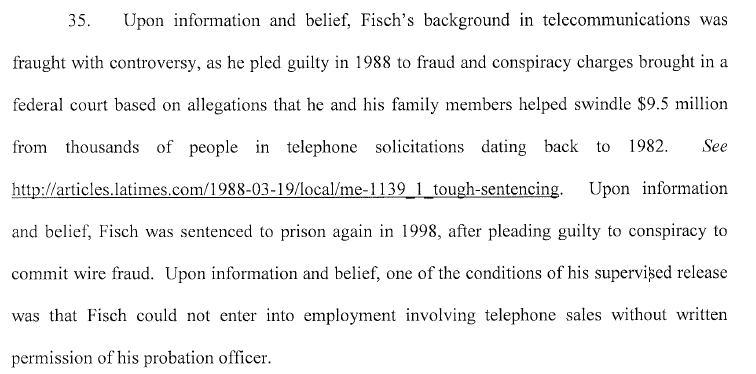
Debt settlement is under fire again. This time it’s a trio of defendants, namely MCA Helpline, LLC, Decision One Debt Relief, LLC and Todd Fisch individually, according to a complaint filed by plaintiff Everest Business Funding on Wednesday in Broward County, Florida.
Everest is seeking damages for Defendants’ tortious interference with at least a dozen of its merchant contracts.
“Defendants have engaged and continue to engage in the business practice of making misleading representations to Everest’s customers; namely, promising to save the merchants money on their existing contracts with Everest when they have no intention or ability to uphold such a promise,” the complaint states. “In so doing, Defendants tortiously interfere with Everest’s merchant agreements by inducing the merchants to breach their contractual obligations to Everest in favor of entering a new payment relationship with the debt relief company.”
Fisch is alleged to be the mastermind behind both MCA Helpline and Decision One Debt Relief.
Complicit ISOs were also put on notice. “To the extent any specific ISOs or their affiliates who have ISO Agreements with Everest have leaked information about Everest’s merchants to Defendants, or to any other third party, such conduct constitutes both a breach of the ISO Agreement and tortious interference with Everest’s merchant contracts,” it reads. “Through the course of discovery in this lawsuit, Everest plans to add as additional Defendants, as yet unidentified ISOs, which have been working with Defendants to target Everest’s merchant accounts in violation of their contractual agreements.”
Everest has been vigorously pursuing debt settlement companies. In September, they, along with Yellowstone Capital, filed a lawsuit against eight defendants (later amended to include 1 more) in New York.
Another lawsuit examining similar issues was also filed last year in New York. In Pearl Gamma Funding and Pearl Beta Funding v Creditors Relief, Pearl tacked on a defamation claim in addition to tortious interference. That case is still pending.
Fundbox Launches Fuse, A Funding Express Lane Designed to Increase SaaS ‘Stickiness’
January 22, 2018Fundbox announced the launch of Fuse, a new credit-integration service, on Monday morning. Via Fuse, SaaS business providers can now access Fundbox from within their workflows with just three lines of code.
“For small business owners, the process of applying for financing continues to be an arduous and demotivating journey that for many, does not end well,” the company stated in a release. “Since 2008 when the economic bubble burst, most banks made their small business underwriting processes more stringent in an attempt to mitigate potential risks from defaults.”
According to the Biz2Credit Small Business Lending Index, in December 2017 only 25.3% of small business loan applicants are being approved for funding, leaving the other 74.4% struggling to find alternative avenues through which to pay vendors and stay afloat.
Thus, not only are small business owners hampered, but SaaS providers that cater to these budding enterprises take a blow as well.
Citing a 2016 survey developed by the SaaS growth marketing agency, Cobloom, the average SaaS provider serving small businesses faces between 5-7% customer churn on an annual basis. A significant factor for this volatility is strains on customer’s cash flow.
Fundbox believes that they can alleviate this situation by offering easy access to its lending products via the SaaS services themselves.
“For our SaaS partners, we intentionally created a solution that was easy to integrate, increases service value and customer stickiness with just a few lines of code,” said Sebastian Rymarz, chief business officer at Fundbox via statement. “And for small business owners, we’ve ‘democratized’ access to credit and the underwriting process right from within your favorite business app or platform.”
“We’re excited to partner with Fundbox and to add Fuse to our service,” said Ryan Jackson, founder and CEO of Paid, via release. “Anyone who works closely with small business owners knows that time and cash flow are their two most important assets. With Fundbox Fuse, our customers get the convenience of accessing credit without having to leave our workflow and we get the additional service value and retention stickiness.”
Trial in Murder of Universal Merchant Funding Execs to Begin Feb 5th
January 7, 2018Nearly one year ago, Michael Genovese, the owner of Universal Merchant Funding, and Carl Clark, an employee, were found dead inside the businesses’s office in Staten Island. Former employee Ricky Dennis was arrested soon after for the double-murder. His trial is slated to begin on February 5th, according to SI Live.
Dennis had previously served time in prison for using a gun during a violent crime.
Genovese was a known operator in the small business finance community. Clark was a regular on the Daily Funder forum, and for a time was one of its most active users.


























.JPG)