
OnDeck Funded $591M to Small Businesses in Q1
May 8, 2018 OnDeck’s originations were $591 million in Q1 of this year, according to their earnings report, up 3% year-over-year. 29% of that was generated by funding advisors, OnDeck’s term for brokers.
They reported a total net loss of $1.9 million.
Compared to the same quarter last year, OnDeck’s Cost of Funds Rate increased from 5.9% to 6.8%, the 15+ Day Delinquency Ratio decreased from 7.8% to 6.7%, the Net Charge-off Rate decreased from 14.9% to 10.9%, and their average APR increased from 44% to 46%.
During the Q&A, OnDeck CEO Noah Breslow said that they had a strong quarter with Chase originations and that their second major bank is on track to be announced later this year.
Shopify’s Funding Automation Key to Its Growth
May 2, 2018 Canadian e-commerce company Shopify (NYSE:SHOP) has a business funding arm called Shopify Capital that issued $60.4 million in merchant cash advances in Q1 this year, according to the company’s earnings report yesterday.
The funding operation offers an MCA product exclusively to merchants that are customers of Shopify. The company helps small business owners create online stores, with products ranging from web design to marketing and analytics. Currently, Shopify supports more than 600,000 small businesses worldwide.
Shopify Capital was launched in April 2016, but a company representative said it wasn’t until April 2017 that it started using algorithms 100 percent to automate offers of capital to merchants.
“What Shopify can see is a lot of patterns in a merchant’s [online] store,” a company spokesperson told AltFinanceDaily. “How engaged is that merchant? What has their GMV (Gross Merchant Volume) been? How spotty is their GMV? How often do they sell? There’s a bunch of different factors that help us predict GMV going forward. And as [our] algorithm gets better and smarter, we are able to get more granular in our offers.”
Many of Shopify Capital’s small business owner clients are new business owners who would not qualify for loans from banks, but need money to expand their businesses.
“Business owners typically spend copious hours putting an application together and funds typically take two to three weeks to receive,” a different Shopify spokesperson said. “Shopify Capital is designed to provide our merchants with timely access to Capital without putting them through additional financial stress…[And] merchants receive financing based on our predictive technology to determine what makes sense for their business in their trajectory.”
Shopify was founded in 2004 and is headquartered in Ottawa, Canada.
Lendr Launches New Business Debit Card
April 9, 2018 Chicago-based Lendr is launching a new business debit card program, according to an announcement the company made at LenditFintech.
This will give them the ability to fund business owners in real-time via an instant access virtual Mastercard followed up with a traditional plastic card. This system is different than pushing funds to a merchant’s existing bank debit card, which fellow online lenders Kabbage and LendingPoint announced at LendIt.
“The idea is to offer a product that makes access to capital as easy as ‘1-2-3,’” CEO Tim Roach told AltFinanceDaily. “We will have the ability to deposit funds on the Mastercard in real time, making the process seamless for our clients.”
Kabbage, LendingPoint to Offer Real Time Funding Via Push Payments
April 9, 2018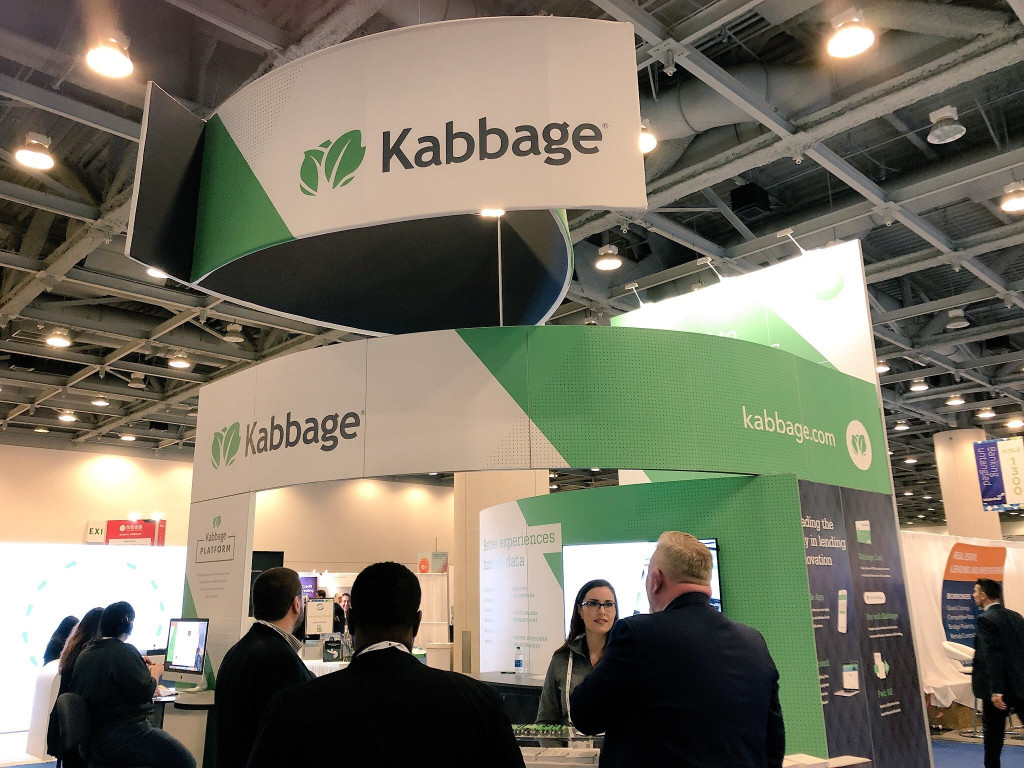 Kabbage and LendingPoint each separately announced today that they will soon be able to get funds into their customers’ business accounts instantly and 24/7 via their pre-existing bank debit card. Hopes for this are not brand new. Last October, OnDeck announced a partnership with Ingo and Visa that would provide this convenience to borrowers, although this has not yet come to fruition, according to an OnDeck spokesperson. This is also not Kabbage’s first foray into real-time loan funding.
“We launched [a real-time loan product] through the debit network three years ago and we were really excited about the results,” said Kabbage co-founder Kathryn Petralia . “Our customers really liked it, [but] our challenge was that we couldn’t get broad enough coverage. Only a small percentage of our customers were able to use it…so we’re excited about our partnership with Ingo because it gives us the ability to broaden this to about 90 percent of our customers.”
Kabbage has entered into a relationship with Ingo and has plans to make this service available to customers this summer. One might wonder why, on a weekend, a merchant needs money and can’t wait until Monday?
 “Our customers are always looking to expedite the process,” Petralia said, “not because they’re desperate for cash, but because they really are desperate for time, and they don’t want to spend a bunch of time reconciling their bank accounts [and] making sure the funds have arrived. This is a much cleaner way for them to get access to capital.”
Meanwhile, as part of an announcement by LendingPoint today, the company said that later this year it will be able to “instantly disburse loans to approved borrower accounts through their debit cards, 24/7/365.” This will be facilitated through the TabaPay platform, which also enables LendingPoint borrowers to use their debit card to make loan payments.
Strategic Funding Builds Executive Team
April 2, 2018
New York-based Strategic Funding has announced the expansion of its executive team with the appointment of a new CFO and the addition of two new roles, Chief Risk Officer and Chief Product Officer.
“It’s a very competitive world and you have to be able to offer more capabilities and have the right players on the field,” Strategic Funding CEO Andrew Reiser told AltFinanceDaily regarding the creation of these new positions.
Jeffrey Newman will take on the new role of Chief Risk Officer and his responsibilities will be to enhance Strategic Funding’s credit, risk, and fraud management models.
“We’re rolling out 3.0 of our credit risk modeling,” Reiser said.

As Chief Risk Officer, Newman will also play a key role in managing the company’s portfolio to ensure that it meets profitability goals. Newman is not new to this role. Since 2010, he was Chief Risk Officer of Consumer & Small Business for Citigroup.
The role of Chief Product Officer will be filled Arun Narayan, who has been with Strategic Funding since 2014, most recently as Senior VP of Risk and Analytics. Raiser said that this role is very data oriented and deals a lot with the customer experience, for both brokers and merchants. The role will be about “keeping the process smooth, fast and predictable,” Reiser said.

The Chief Financial Officer, not a new role, will be filled by Anthony Rose. Rose developed strategic and financial initiatives at JPMorgan Chase, Credit Suisse and, most recently, at Dime Community Bancshares, a publicly traded finance company.
Founded in 2006, Strategic Funding primarily offers MCA financing and business loans, but also does some equipment financing and factoring as well. The company has 240 employees spread across four offices in New York, NY, Williamsburg, VA, Rockwall, TX, and Boca Raton, FL.
Pearl Beta Funding Decision a Boon to MCAs, as Long as They’re True to Their True-ups
March 26, 2018While the recent Champion Auto Sales, LLC et al. v Pearl Beta Funding, LLC decision was a win for MCA companies because it determined at the appellate level that an MCA contract issued by Pearl Beta Funding to Champion Auto Sales “was not a usurious transaction,” many lawyers are saying that, more than anything, this decision has demonstrated the importance of having strong contracts with merchants.
So what made Pearl Beta Funding’s contract so strong in the eyes the judges?
“I would say that there were a variety of factors,” said Steven Berkovitch, who represented Pearl Beta Funding in this case along with lawyers from DLA Piper. “The first thing that the judges look for is if there’s a way for the merchant to modify their payments.”
This, in essence, is what is known as the “true-up” in an MCA contract. More specifically, Berkovitch said that the true-up is a contractual obligation on the part of an MCA funder to adjust the daily payment it receives from a merchant to more accurately reflect the percentage of receivables it is owed.

Pearl Beta Funding CEO Sol Lax takes this seriously. He told AltFinanceDaily: “Our front line servicing guys are well trained to respond when a merchant says ‘My deposits are down, my business is down, can I do something?’ They’re trained to know that the answer is ‘Yes. Send us some bank statements, we’ll look at it and we’ll adjust accordingly.’”
In this case, Berkovitch said that Champion Auto Sales did not use the true-up clause and did not request a payment modification when it was available to them.
“We have, literally, dozens upon dozens of cases where we’ve done the true-up,” Lax said. “So, it’s not just a contract. If [an MCA company] violates the true-up in practice and a merchant calls you and you say ‘hell no,’ that would be, not just a contractual violation, that would put a hole in your true-up clause.”
Many have remarked on how the decision of this case has already impacted the MCA industry. Berkovitch can see that himself. After the case was decided, he said that opposing attorneys have contacted him to withdraw their cases against his other MCA company clients.
Lax acknowledges, with modesty, what this decision means for the MCA industry at large: “You have a safe harbor now for the first time where, if you have a well-drafted contract, then you have active compliance [and] you’re pretty well off. Until this was settled in court, it was still up in the air.”
But Lax doesn’t take this victory for granted.
“You may still see challenges on specific [fact] patterns where a client can show that they had called, they asked for a true-up, and they were told ‘No true-up is available. You got to pay or we’re going to take all of your stuff,’” Lax said. “If they can show a pattern like that, then the MCA company is in trouble. They’ll have a hole blown right through their contract.”
2017 Small Business Financing Leaderboard
March 14, 2018Thanks to several companies filing their annual earnings statements and Funding Circle disclosing their USA origination figures for 2017, we’ve been able to put together a leaderboard in the small business financing space. This list is not comprehensive and omits key players like PayPal Working Capital and Amazon Lending.
| Company Name | 2017 Originations | 2016 | 2015 | 2014 |
| OnDeck | $2,114,663,000 | $2,400,000,000 | $1,900,000,000 | $1,200,000,000 |
| Kabbage | $1,500,000,000 | $1,220,000,000 | $900,000,000 | $350,000,000 |
| Square Capital | $1,177,000,000 | $798,000,000 | $400,000,000 | $100,000,000 |
| Yellowstone Capital | $553,000,000 | $460,000,000 | $422,000,000 | $290,000,000 |
| Funding Circle (USA only) | $500,000,000 | |||
| BlueVine | $500,000,000* | $200,000,000* | ||
| National Funding | $427,000,000 | $350,000,000 | $293,000,000 | |
| Strategic Funding | $393,000,000 | $375,000,000 | $375,000,000 | $280,000,000 |
| BFS Capital | $300,000,000 | $300,000,000 | ||
| RapidAdvance | $260,000,000 | $280,000,000 | $195,000,000 | |
| Credibly | $180,000,000 | $150,000,000 | $95,000,000 | $55,000,000 |
| Shopify | $140,000,000 | |||
| Forward Financing | $125,000,000 | |||
| IOU Financial | $91,300,000 | $107,600,000 | $146,400,000 | $100,000,000 |
*Asterisks signify that the figure is the editor’s estimate
The Underwriters – How A Small Team Is Turning Underwriting Into Big Business
March 13, 2018
A keen eye can spot a good deal. And for New York-based Central Diligence Group, an underwriting-focused company founded in 2015 by four partners, it has been a boon for business. The company has lately been providing its underwriting expertise to a wider variety of clients, including some outside the MCA space.
“We started to gear towards a more underwriting-centric model [where] a deal would come in, we underwrite it once, we assess the risk, we determine what box it would fall under and where it would qualify, and depending on what that pedigree of information [was], we would essentially [fulfill] the full underwriting [job,]” said Nick Gregory, one of the founding partners at Central Diligence.
Initially, the company provided underwriting services mostly to smaller funders, syndication brokers and ISO clients that service MCA merchants in the construction and trucking businesses, among others. But close to three years later, its roster of clients is far more diverse.
Over the past six to eight months, Central Diligence has been working with a west coast-based credit card processing company with a portfolio of over 100,000 clients, according to Andrew Hernandez, another Central Diligence partner. The credit card processing company has just built out its own MCA product, but they don’t have an underwriting team, which is where Central Diligence comes in. Hernandez said that this company, the identity of whom he could not disclose, just renewed its contract with them.
 Another unique client is an institutional investor, with offices in New York and Dallas, that just formalized a new working relationship with Central Diligence over the last week to go beyond just underwriting and into the realm of funding and servicing. According to Hernandez, this client is looking to make investments in MCA at the higher end of the market.
“In our space, $50,000 to $250,000 is pretty easy to come by, but $250,000 to $1 million, not so much,” Hernandez said. “So they see that there’s a gap with small businesses…and they’re using us to do [due] diligence [on companies.]”
Finally, Central Diligence is finishing an agreement with another unconventional client, an overseas mortgage company with interest in MCA. According to Hernandez, it is looking to execute a kind of beta test in the U.S. and then take the business model to Europe if it works.
In addition to the four founding partners, who work as underwriters, there are four additional underwriters and two junior underwriters for a total of ten on staff.
Hernandez attributes these new opportunities to the reputation they have built in the MCA space, including the 10+ years of experience that each of the founding partners have.
“Because of our experience and history in the space, a lot of our relationships have been built because of our credibility,” Hernandez said. “That’s the most important.”