Split Funding is Here to Stay
August 21, 2013 I’ll say it for the hundredth¹ time, the advantage of split-funding is the ability to collect payments back from a small business that has traditionally had average, weak, or poor cash flow. Let’s put that into perspective. There is a distinct difference between a working business with poor cash flow and a failing business. A failing business is typically not a candidate for merchant cash advance or similar loan alternatives.
Poor cash flow could be the result of paying cash up front for inventory that will take a while to turn over. A hardware store with a healthy 50% profit margin may be able to turn $10,000 worth of inventory into $15,000 in revenue over the course of the next 90 days. The only problem is that the full $10,000 must be paid in full to the supplier on delivery.
Enter the merchant cash advance provider of old that discovers the hardware store has had a fair share of bounced checks in the past, mainly because of the timing of payments going in and out. Cash on hand is tight, the credit score is average, but the profit margin is there. Most lenders would take a pass on financing a transaction that carries legitimate risk such as this one does, that is until the ability to split-fund a payment stream became possible.
Advocates of the ACH method tout that it’s just so much easier to set up a daily debit and scratch their heads and wonder, “man, why didn’t we think of just doing ACH in the first place?”
The thing is, people did think of it and they concluded that for a large share of the merchants out there that needed capital, it didn’t make financial sense to try and debit out payments every day with the hope that there would always be cash available to cover them. Banks have had a hard enough time collecting just one payment a month, so what makes 22 payments in a month so much more likely to work?
I’m not inferring that there is something wrong with the daily ACH system that has taken the alternative business lending industry by storm. There’s plenty of situations for which that may be the best solution, especially for businesses that take little or no credit card payments. My point is that the split-funding method isn’t going to shrivel up and die. It’s here to stay. So long as businesses have electronic payment streams, they will be able to leverage them to obtain working capital.
When it comes to splitting card payments however, it’s important for a business to have faith in the payment processor. Reputation, compatibility with payment technology, and the assurance that the business will be able to conduct sales just as it always has are important. If you’re a funder, ISO, or account rep, it’s your responsibility to make sure that those three factors are addressed. A lot of processors are willing to split payments but they haven’t all made a name for themselves in the industry. Integrity Payment Systems (IPS) comes to mind as one that almost everyone works with and I’ve been in touch with Matt Pohl, the Director of Merchant Acquisition of IPS for some time. He’s been nice enough to share a little bit about what makes a split partner special, and what has made them particularly stand out in the merchant cash advance industry.
Clearly, the role of the credit card processor has diminished over the last couple years when it comes to merchant funding. ACH/Lockbox models have become more prevalent which created a sales mindset that switching a merchant account was more of a hindrance than a necessity. Some argue the decline in profit margin on residuals, due to price compression, made it no longer worth the time and effort to make an aggressive pitch to switch the merchants processing. ISOs also argue that too often merchants have reservations to switch processors because of previous bad experiences, cancellation fees, or because they simply know its not necessary in order to be funded. This is where it’s important to have the RIGHT split partner, not just any split partner
What makes Integrity Payment Systems a “special” split partner is the fact we control the settlement of the merchants funds, in house. IPS is partnered with First Savings Bank (FSB), which allows us a unique way of moving money. Because of our state-of-the-art settlement system and direct access to FSB’s Federal Reserve window, we eliminate the necessity of having layers of financial institutions behind the scenes that merchants funds typically filter through. This is a HUGE benefit to cash advance companies for several reasons. First, we implement the fixed split % when we receive the request, in real time. This allows the deal to be funded quicker. Secondly, since we handle the settlement process we have access to the raw authorization data which allows us to provide comprehensive reporting on a daily basis from the previous days activity. But also we can do true next day deposits, including Friday, Saturday, and Sunday funds available for the merchant on Monday morning. This is especially valuable when selling to restaurants/bars, or any other industry with a lot of weekend volume. Lastly, IPS makes outbound calls to merchants, on behalf of the sales agent and cash company, to download and train the merchant on their terminal. A confirmation email is sent to the agent which includes any batch activity so the deal can fund.
As an added example of this, on the last week of every month, the merchant boarding and sales support team fully understands that our MCA partners have monthly funding goals they need to reach. The IPS team goes above and beyond to ensure merchants get setup properly in time so those accounts can be funded before the month is over. We have a motto at IPS that the sales force are our #1 customers, and nowhere is that more apparent than by the way we take over all the heavy lifting once the agent gets the signatures on our contract. We firmly believe that by helping the agent by taking over the boarding process, that this will allow them to do what they do best, sell more deals!! A lot of competitors expect the agent to be involved in the boarding process, and that’s valuable time that takes them away from selling.
IPS has opened their doors to every MCA company that wishes to have an exceptional split funding partner/processor. We have all the necessary tools to provide this service the right way, and we want the opportunity to earn the business of every working capital provider out there. You don’t have to listen to a sales pitch from me, because I strongly believe that our reputation in the cash advance space speaks for itself. We would love the opportunity to talk to any MCA provider about a few additional services we offer utilizing our settlement system that will allow ISOs to fund more deals.
– Matt Pohl
(847) 720-1129
Integrity Payment Systems
One thing I can personally attest to about Integrity is their human factor. You can actually meet some of their team and see inside their office in the fun youtube video below:
Getting deals done
Ultimately, the financing business is about getting deals done and there are countless small businesses that just won’t ever be a candidate for ACH repayment. Heck, for many years the merchant cash advance industry wasn’t even a financing industry of its own, but rather it was one of many acquisition tools for merchant account reps. (See: Before it Was Mainstream). Technically it still is. You don’t want to sign up a merchant for processing and then have to move the account because the processor doesn’t split or because there is no dedicated customer service. I’ve been in that situation before personally and it’s a nightmare.
There’s a reason this website which is dedicated mainly to merchant cash advance is called the Merchant Processing Resource. You can’t know everything about cash advance without knowing about merchant processing. Get acquainted!
If you’d like to read the lighter side of Merchant Cash Advance History, you just might want to check out MCA History in Honor of Thanksgiving. 😉
¹ I said it for the 99th time on the Electronic Transactions Association’s Blog in Preserving the Marriage Between Merchant Cash Advance and Payment Processing
Funding Restaurants is Risky Business
April 22, 2013 Perhaps as a fitting follow up to our recent post on Merchant Cash Advance Default Rates, an article in the Dispatch reveals that of all the businesses getting SBA loans, restaurant franchises are the worst performers. WHAT?! You read that right, but many of us have been saying this all along. Retail and restaurants are inherently high risk and that’s partially why they’ve been the bread and butter of the Merchant Cash Advance industry for so long. A friend of mine works in the commercial lending department of a major bank and he’s told me bluntly many times that their POLICY when it comes to restaurant loan applications is to decline 100% of the time. They don’t care if they have 800 credit, 40 years in business and 50 locations, the default rate is just too damn high and not worth the risk. Now the bank doesn’t come out and market this publicly and that’s why I haven’t identified my friend or the name of the bank, but when you see the numbers, it makes sense.
The SBA states that 20% of their guaranteed loans default
- Of the loans that defaulted, more than 50% of them defaulted before they were 20% paid in
- Of the loans that defaulted, more than 33% of them defaulted before they were 10% paid in
- Of the loans that defaulted, more than 7% of them defaulted before making a single payment towards the principle
The Dispatch points out that the SBA guarantees higher risk loans, as if that somehow justifies these statistics. The maximum allowable interest rate on a 7(a) loan with a maturity under 7 years is prime + 2.25%. Right now prime is 3.25%. Think about this… the interest rate is 5.5% and the default rate is 20%. Most businesses default without hardly paying anything. The taxpayers eat the billion dollar losses that result and Main Street America goes on believing that an interest rate below 6% is reasonable.
In the private sector, there is no government body sweeping billions of dollars in losses under the rug. Alternative lenders like Merchant Cash Advance providers are on their own to price deals efficiently and rationally. As you might guess, that price is usually MUCH higher than 5.5%. Many funders charging in excess of 40% barely break even at the end of the year, and some go out of business. Think about it… many businesses they support don’t even qualify for an SBA loan and the default rate on those is 20%. To operate in such a risky market, many try to hedge those risks by setting daily payments as opposed to monthly, and setting the loan term to 1 year or less. Even then, economic swings and competition have a way of making sustainability difficult.
On another note, here we have the SBA stating that 20% of their loans default, many before making even a dent in the principle and we have some alternative business lenders targeting an even riskier market that is claiming default rates of 2-5%. Something doesn’t add up here. Just saying…
Funding for Startups – An Ongoing Struggle
March 6, 2013Startup. Some people like the term and some people hate it. It doesn’t even mean the same thing to everyone. To some, the mega giant Groupon is a startup and they’ve been in business for almost 4 years and earned $638 million in revenue last quarter. To others, a startup is simply an idea for a business that hasn’t gotten off the ground yet. And to the Merchant Cash Advance industry, startups are people who don’t qualify for funding but manage to come storming through the front gates demanding loans while waving around business plans. There’s a real dilemma in this country. Millions of people aspire to go into business for themselves and very few have any idea what to do. I get exhausted just thinking about this because for many years, I’ve been trying to tackle what you’d think would be a simpler problem, funding people that ALREADY have a business.
 It’s finally gotten much easier for existing businesses to obtain capital, so much so that I started to warn the lenders in a recent article about getting too aggressive with their programs. But all that aside, these lenders have been plagued with an ongoing problem for years, a problem that has caused marketing costs to skyrocket, and have made loans for everyone more expensive. That problem is startups. It’s not that startups aren’t appreciated, it’s just that imagine opening a hair salon and seeing there’s a line of a thousand people waiting outside the door to get in. At first, you’d probably think “wow! we’re going to need to hire 50 more stylists to satisfy all this demand,” but then you find out that 900 of the people waiting were men that were completely bald. It’s awesome that they were interested to come out and get a perm, but without hair, there’s nothing for the stylists to do. The business ends up spending a lot of time and money telling folks with no hair that a mohawk will not be possible, causing the price of haircuts to go up for everyone else.
 Some lenders are so inundated with startups that they stop marketing altogether. Others try to board up their pay-per-click ads with specific instructions for startups to STAY AWAY. It doesn’t reflect very well on the brand to do this, but if bald guys were overrunning a hair salon, the poor stylists would have to do something so they weren’t driven out of business. I’m not making fun of startups per se, I’ve been a part of 3 startups, including my own. I’ve been in the position where I was unsure of what to do first, especially since I never knew anyone that funded people whose businesses weren’t already up and running. Yes, I was the guy who knew tons about business lending and I had no idea how to raise capital for a business that hadn’t yet started.
Oh I knew how to set the gears in motion: perform market research, talk to potential customers about what they want, draw up a plan, incorporate, get the necessary permits, draw up an operating agreement, pay for legal advice, and set aside a large enough cash cushion to pay for at least 3 months expenses in case nothing went as planned. I had enough experience to know what I needed to be ready, but I guess I was still shocked the day I went to a bank to finally open a business account. With my account, the bank granted me a substantial unsecured line of credit. I’m fortunate to have an excellent credit score and that definitely played a role, but try to understand that I walked into the bank with no job and no income. I told them I was starting a business, wanted to open a bank account, and had all my business document ducks in a row and within 2 minutes I was approved for a line. This is after I’ve been hearing for years that no banks were lending, businesses with excellent credit couldn’t get money, and startups had no place to go.
Keep in mind though that I didn’t just walk into the bank and tell them all my good ideas and sum it up by asking for money. Heck, I didn’t even ask for money at all, though it was really nice to have it. I went in showing I meant business and walked out with something that everyone said is impossible to get in this country. I’ll admit there’s a few caveats. I live in New York City, have a decent net worth, have great credit, and have a background in business financing. So I’m not going to pretend that what worked for me is what’s going to work for everyone else.
I’ve always wanted to help the people I couldn’t. So I’ve been wracking my brain for some time as to what to do if a hair salon had 900 bald customers waiting on line. Do you help them regrow their hair first?
 I totally believe in the old fashioned way of raising money, which means making sure you have enough of your own money saved up and taking every measure possible to be ready to launch before looking elsewhere for help. I realized though that many people don’t have the capital to get them as far as opening day, some don’t have strong enough credit to be confident that a bank line would ever be possible, and others just have a dream of something they want to do but have no money to even put their idea to the test. I’d say they were out of luck, but new friends of mine were telling me that’s not exactly right.
Crowdfunding – Get familiar
I recently spoke with Rachael Alford, a crowdfunding consultant who told me that you didn’t need to approach startup capital the old fashioned way. A bank? What’s that? The exact conversation between us is available online and I learned that folks with a serious idea can actually raise money just on the IDEA alone. Crowdfunding means raising money from other people so a lot of effort is required to make it work for you. When you go to a bank, the bank is forced to acknowledge that you applied and then decide to either approve or reject your application. With crowdfunding, your campaign to raise money can be outright ignored. It’s not a “hi, please approve me, bye” experience. Rachael said, “the problem is, people think it is as easy as making a page (on Kickstarter, GoFundMe etc.) and then they can just tweet or share the funding request and that is it.”
Driving interest to your crowdfunding campaign to raise money is kind of like a test to sell your product on opening day. If you can’t get anyone interested in your campaign, how in the heck are you going to get them interested to buy your product once it’s done? It should be mentioned that crowdfunding doesn’t necessarily require you pay back the money raised with interest like a loan. Some campaigns can be donation based. Others can be in return for a prototype of the product. Rachael shared this example with me to better explain: “Say Joe has an idea that may or may not cure XYZ disease but he needs to buy a super xyz widget before he can prove his hypothesis. No one will loan him the $10,000 he needs to see if it can work. With crowdfunding, he can’t offer (as a reward) to cure backers who pledge $1,000 or more. He should offer what he has: limited edition t-shirts that read: I’m a hero, I helped Joe Smith try to cure XYZ. Get the point? If it’s a food start up don’t offer to cater a wedding, offer to name a brick, booth etc.”
 So having the idea is a starting point but you have to sell that dream HARD to get people to invest in it. Fortunately, it’s easier than making appointments with scary Silicon Valley venture capitalists and having to sweat out a presentation and then being told at the end that your idea is terrible.
Rachael teaches classes specifically to help people approach crowdfunding in the most efficient manner. If you’d like to know more about crowdfunding, I highly suggest you connect with her.
P2P Lending – Have you really not tried this yet?
On the flip side of raising capital is peer to peer lending. This type of financing has been around for quite some time. Websites like Prosper.com allow people to post loan requests so that individuals can collectively contribute to the amount wanted. Unlike crowdfunding, peer to peer lending is… lending. You can’t offer to name bricks after your peers instead of paying them back. In the case of Prosper.com, they act as the loan servicer but they also determine based on your credit rating the interest rate that your peers will have to charge. Prosper.com works for personal loans and for startup loans, but the key again here is that you can’t post a request and walk away. Instead you to have to rally people to your cause. Prosper.com sums it up with this tip on their website: “Asking your friends and family to invest in your listing and give you a recommendation will increase your chances of having your listing fully funded.”

Selling on Ebay or Amazon makes you official already
A third option for startups is Kabbage. Though they are technically a Merchant Cash Advance financing provider for established businesses, they specifically fund people with ebay and Amazon stores. I find that many people that want a shot at starting their own retail business have already tested out their skills on ebay or Amazon. What they may not know is that Kabbage sees these sellers as businesses already and that they need not feel like a startup at all!
There is no sleep-while-you-get-funded method of raising capital
Alas, raising money for a startup means work. Whether that work means being ready to cut the tape at the grand opening before applying for a loan or furiously banging the social media drum to mobilize people to your cause to invest. To the entrepreneurs that read this, I hope you’re a little bit more informed about where to start. To the lenders, the good news is that startup financing does exist, we just need to guide these people to the right places.
Perhaps there is an opportunity for lenders to set up peer to peer lending or crowdfunding campaigns on behalf of all the serious startups that call in. They could top it off by contributing the first 10% of capital needed to help them generate buzz to raise the rest. Let the market decide if the business plans are viable. If successful, then you can consult them through their grand opening and up through the point that they become eligible for a merchant loan. I would think a fee for this service would be reasonable. Everybody wins.
We need not struggle!
– Merchant Processing Resource
../../
MPR.mobi on iPhone, iPad, and Android
Funding Down to a Science
December 21, 2012Account rep: Congratulations, you’ve been approved for $27,000!
Merchant: How did you come up with these figures?
Account rep: It was science. Science did this.
Funny? Maybe not, especially since an underwriting super algorithm may be on its way to the United States. In the days after we posted Made for Each other?, friends, acquaintances, and strangers have been telling us to keep an eye on Wonga’s potential acquisition of On Deck Capital. “It’s not just a european company’s gateway to the US. They’re going to change everything,” a few have said. Aside from their background of being a payday lender, having prestigious VC backing, and the resources to throw a quarter billion dollars at a main street lender in a takeover bid a lot of people didn’t see coming, apparently there is much more to be seen.
Just like MCA in years past, Wonga has worked hard to repel a negative image. Not easy stuff, especially considering they embrace their hefty costs wholeheartedly. Sure, it’s easy to calculate an APR equivalent of a very short term loan and spin whatever number you come up with as the symbol of something evil. If I let a stranger borrow $100 today with the stipulation that they pay me the whole thing back tomorrow plus 1 dollar extra to make it worth my while, would I be evil? That’s an APR of 365%. If I did the same thing with 100 strangers, what are the real odds that all 100 would actually pay me back? Somewhere along the line because of a borrower’s circumstances, bad decisions, or even malicious intent, I’m going to lose the entire $100 I lent out. Others might need more time to pay me back. If one person out of those hundred doesn’t pay back, I break even. If two people don’t pay back, I lose money. If one person doesn’t pay back and another can’t come up with the whole thing, I lose money. You can lend money at 365% APR and lose BIG.
So how do banks manage to charge 4, 7, and 10% APR? Is it just because they’re smarter? No. They don’t make money off loans at these rates either. In the US, interest rates are distorted by government guarantees. Politicians have decided that certain interest rates sound “fair,” then push big banks to lend money at these low unsustainable rates. But of course it doesn’t work and so government agencies sweeten the deal by reimbursing banks for up to 90% of the losses on the borrowers that default. Banks make money on the loan closing fees and other services they sell to the businesses. The loan is the doorbuster offer the bank puts in the storefront window. Once you come inside, they try to sell you on other things so that you don’t walk away with just the loan, otherwise they’re losing money.
So when you hear “banks aren’t lending,” don’t be so surprised. Lending money means giving it away to someone that might not pay it back. That’s a really tough business to be in, no matter how qualified the borrowers are or how good the underwriters are supposed to be.
But somewhere in between the opinions of the Merchant Processing Resource staff and government bureaucrats over what is fair, is a special recipe that determines once and for all what works best. It’s science. Wonga’s lending success is rooted in science and propelled by an advanced algorithm that can systematically calculate risk better than any bank in the world, or so they say.
 One of Wonga’s major investors, Mark Wellport, is a knighted renowned immunologist and rheumatologist that has defended Wonga’s methods against regulation. He believes their data-based process and strong motivation to make their borrowers satisfied places them in an entirely different category than payday lenders.
Wonga takes a human-free approach, something no MCA provider in North America does regardless of how automated their process may seem. In the UK, their business loan application process takes only 12 minutes and the funds are wired 30 minutes later. That’s it. Their max loan is £10,000 but just think about how that compares to MCA in the US. How much time and overhead is being spent on printing documents, underwriters, conference room meetings to discuss deals, setting up the merchant interview, trying to reach the landlord, trying to get page 7 of a bank statement from 6 months ago and the signature page of the lease, etc. etc. Funders might have had the wrong approach all along.
Wonga’s founder, Errol Damelin believes in data. According to some quotes in The Guardian, Damelin believes interacting with the borrower actually impairs a lender’s judgement.
From the Guardian:
Asking for a loan from a financial institution had traditionally involved making a strong first impression – putting on a suit to see the bank manager – then rigorous questioning, checking your documents and references, before the institution made an evaluation of your trustworthiness. In a way, it was exactly the same as an interview, but instead of a job being at stake it was cash.Damelin found this system old-fashioned and flawed. “The idea of doing peer-to-peer lending is insane,” he says. “We are quite poor at judging other people and ourselves – you get to know that in your life, both with personal relationships and in business. You realise that we’re not as good as we think we are at that stuff, and that goes for almost everybody. I certainly thought I was much better at it.
The 42-year-old entrepreneur grew up in apartheid South Africa, and he believes the experience of living in that country in the 80s has had a significant impact on his outlook. He was active in student politics at the University of Cape Town and marched in civil disobedience protests. So, when it came to deciding who should be lent money, Damelin says he wanted to strip away some of the prejudice – decisions would be taken without a face-to-face meeting; you wouldn’t even speak to an adviser on the phone, because people subconsciously judge accents too. The final call on whether to hand out cash would be based on “the belief that data could be more predictive than emotion”.
According to Wired, Damelin and his team created a system to approve or decline applicants all on its own. They tested it on a site called SameDayCash by using Google Adwords and within ten minutes of their ad going live, their system had already approved its first customer. In its early forms, it wasn’t very profitable from a lending standpoint but it did allow them to collect a massive amount of data.
From Wired
its strategy over this period wasn’t just to disburse money — it was to accumulate facts. For every loan, good or bad, SameDayCash gathered data about the borrowers — and about their behaviour. Who were they? What was their online profile? Did they repay the money on time? The site was feeding an algorithm that would form the basis of Wonga, launched a year after the beta experiment that was SameDayCash.
MCA has utilized Adwords for lead generation for years with mixed success, but few have used it for the purpose of accumulating facts. This isn’t to say that the firms collecting information for the purpose of leads aren’t sitting on treasure troves of data, it’s just that none of it to date has led to 100% computerized underwriting. The MCA industry is quite possibly about to undergo a major shift in how they promote their product on Adwords as a result of Google’s ominous warning a couple weeks ago. New disclosure requirements may change the way consumers respond and apply, ultimately impacting the data collected.
So will european science work in the good ‘ol US of A? If Wonga acquires On Deck Capital, you can bet they’ll try to replicate their success. There is a gigantic market of really small businesses that aren’t getting funded, and even the ones that are, they’re waiting 3-7 days to deal with the paperwork, handle the phone calls, fax documents, complete a landlord verification, and in some cases, deal with a credit card processing equipment change. If On Deck Capital becomes a household name as Wonga is in the UK, a lot of smaller funders are going to get squeezed.
Wonga claims to have a net-promoter score above 90%, a customer satisfaction metric that beats most banks and even Apple Computer. It’s a company that seems to be winning on every front.
Critics will say that the American lending market is big enough for everyone, that the loans Wonga has done traditionally are really small and therefore not in the same league as MCA, or that their own company has something similar or better. We believe however, that if this deal goes through that it’s a bad idea to get comfortable. There are Wonga-like companies in the US already, data fortresses that will soon revolutionize how loans are issued and determine what makes a successful business. New York based Biz2Credit is one such example.
We’ve been right about a lot of things in the last couple years and wrong about some. But we believe it is inevitable that any lender ignoring the automation revolution on the horizon is not going to last very long. Go ahead, brush it aside and convince yourself that this whole Automation thing is just hype as BusinessWeek did in 1995 about the Internet. “Automation? Bah!”
As Damelin told Wired in June, 2011, “For me the epiphany was right there. People were online, looking for a solution to a problem.” Ask any funder using Adwords or pouring work into SEO and they’ll tell you the same thing. People are looking online for money. What happens after they fill out the form on the website is what makes the USA MCA/alternative lending industry different from Wonga.
 But will a perfected european algorithm work in the US? Americans approach debt and money differently than the rest of the world and small businesses operate in a much more open manner. You never know, the european lab coat wearing scientists could come here and get their butts handed to them. Plenty of smart companies have jumped headfirst into MCA and left after disastrous results. Some veterans that have been in this business a long time will you tell that an impressive resumé, big investors, and a fancy algorithm will help you make it through the first six months. After that, you better know what the hell you’re doing, if you can continue to do it at all.
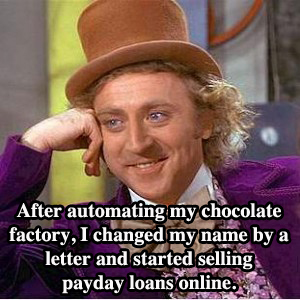
If in three years the average small business owner thinks Wonga is the last name of a guy that owns a chocolate factory, we promise to write a jingle that admits we were wrong about them. But On Deck Capital has been around the block and knows the business. They would allow Wonga to skip the learning curve and together could quite possibly nail lending down to a science.
Oompa Loompa do-ba-dee-doo, I’ve got another algorithm for you.
– Merchant Processing Resource
../../
There is great feedback to this article in a LinkedIn Group HERE
Strategic Funding Secures $12 Million Equity Round and $15 Million Senior Credit Facility
June 27, 2012For Release on MPR / New York (June 26, 2012) – New York City based Strategic Funding (www.sfscapital.com) has announced it has completed a $12 million equity round with an investor group led by Three Layer Capital of Los Angeles, California and simultaneously closed on a new $15 million revolving Senior Credit Facility with Capital One Bank. The new equity and credit facility will be used for ongoing capital needs and to fund the future growth of company.
Strategic Funding is recognized as one of the most innovative companies in the alternative finance industry, providing unique working capital solutions such as merchant cash advance, revenue based factoring (ACH programs) and commercial loans for small businesses. The company’s business model combines sophisticated underwriting incorporating qualitative and quantitative risk analysis with the most advanced enterprise technology available.
“Strategic Funding finances the small to mid-sized businesses of Main Street America” said Andrew Reiser, Chairman and CEO of Strategic Funding. “Since 2006, we have provided thousands of small businesses with the working capital they need to grow and sustain themselves through challenging times. Today’s entrepreneurs have very limited access to bank financing, a void filled by our company and the alternative finance industry – so one might say that we are stimulating the economy, one small business at a time.”
In seeking high yield investment opportunities, Thomas Scoville, a partner at Three Layer Capital stated that, “We were looking for best-of-breed players in the alternative finance space. A lot of companies are currently operating in this arena but few have the disciplines and technology of Strategic. A number of these companies are also beginning to venture into big-data risk analytics, but Strategic has been quietly doing this for years – they’ve got a big head start.” Dan Scholefield, partner in Three Layer Capital added, “Their business model demonstrates remarkably high yields and low default rates while providing financing to traditionally under-banked entrepreneurs. Strategic is very responsive to the needs of the market and economic conditions and provided an outstanding investment opportunity.”
Reiser continued, “We pride ourselves on integrity and responsiveness to the ever changing market and are pleased to welcome our new investors at Three Layer Capital and the team at Capital One Bank.
The Capital One Bank Senior Credit facility replaces the facility provided by Paul Frontier Holdings, which has been a shareholder in Strategic since 2007. Rahul Vaid a managing director of Frontier Capital Advisors, which manages the Paul Frontier Holdings portfolio. He will remain a member of the Board of Directors and his firm will continue their support as a major shareholder of Strategic.
About Strategic Funding
Strategic Funding ( www.sfscapital.com ) is a leading provider of specialty financing to small businesses throughout the United States. Strategic is recognized as the technology leader in servicing the factoring and loan transactions of thousands of merchant accounts for themselves and over one hundred funding partners. The Strategic enterprise technology is at the backbone of the “Strategic Partner” program which promotes syndication among numerous cash advance companies and private investors. Established in 2006, Strategic has its headquarters in New York City and maintains regional offices in Williamsburg, Virginia; Chicago, Illinois and Seattle, Washington, serving thousands of active small business clients in all 50 states.
About Capital One
Capital One Financial Corporation ( www.capitalone.com ) is a financial holding company whose subsidiaries, which include Capital One, N.A., Capital One Bank (USA), N. A., and ING Bank, fsb, had $216.5 billion in deposits and $294.5 billion in total assets outstanding as of March 31, 2012. Headquartered in McLean, Virginia, Capital One and ING Direct offer a broad spectrum of financial products and services to consumers, small businesses and commercial clients through a variety of channels. Capital One, N.A. has approximately 1,000 branch locations primarily in New York, New Jersey, Texas, Louisiana, Maryland, Virginia and the District of Columbia. A Fortune 500 company, Capital One trades on the New York Stock Exchange under the symbol “COF” and is included in the S&P 100 index.
About Three Layer Capital
Three Layer Capital ( www.threelayercapital.com ) is a privately held multidisciplinary fund with focused interests in biotechnology, energy and alternative finance, located in Los Angeles, California.
Contact:
David C. Sederholt, Chief Operating Officer
Strategic Funding
Phone: 212-354-1400
DSederholt@sfscapital.com
Funding Floodgates Reopen
September 20, 2011If you’re a business owner, it’s time to get ’em while they’re ~HOT! Small business funding is BACK and more available than they’ve been in years. And guess what? Because we’re just a news site, we’ve got no reason to douse you with a cheesy sales pitch. There’s a lot of money out there right now and that’s the truth.
Merchant Cash Advance (MCA) continues to dominate the alternative financing market but a few new options are changing the landscape. You might call them ‘alternatives to the alternatives’, deals that are based on MCA but have all the bells and whistles of a loan; Fixed time frame, a payment schedule, and even personal guarantees! The underwriting criteria generally requires a set of recent healthy bank statements and semi decent credit credit (yes, your credit still matters) to qualify. Beyond that, it’s up to the individual lender to present their respective checklist of closing documentation. This usually includes some combination of a business property lease, applicant ID card, business permit, and a recent tax return. That’s it. Oh, and the wait time? Expect a week long process if you’re quick on the draw with paperwork.
Two years ago, there wasn’t much variety in the MCA space. Business owners could shop all they wanted but the underwriting and cost structures were essentially identical everywhere. Now there are factor rates that range from from 1.20 to 1.65. It’s more merit based than it used to be. The higher credit rating, stronger cash flow businesses can earn something better than the one-size-fits-all 1.35 factor rate of yesterday. On the same token, the complete credit averse can grab a shot at financing too, but at a steep price.
But there’s more to it than just cost, there’s also the setup:
Don’t want to switch your merchant account?
Stay where you are: There’s a significant chance your merchant processor already has a contract with the MCA provider you’ve chosen. Often times your sales representative may encourage you to open a new merchant account for the lower discount fees and to have a higher degree of control if problems arise. Ultimately, a new merchant account is not essential if you want a MCA.
Leverage your strong cash flow history: If you’ve managed to keep a large positive balance in your bank account for the last few months, your MCA provider could simply extract the agreed percentage from there, rather than directly through the merchant account.
Lock it up: A Lockbox provides the MCA provider with peace of mind by obtaining their payments without the risk of Non-Sufficient Funds from the debit method but also allows you to keep your merchant account. It’s frequently used as a compromise for businesses that are legally prevented from changing their merchant account(i.e. franchisees), but are too cash flow weak to qualify for direct debit payments.
But the buck doesn’t stop at the many ways you can do MCA. You’ve got options!
Merchant Loan: An actual loan based on your credit card sales history. A percentage may still be withheld from each card sale but a periodic or an end-of-term lump sum payment will be applied as needed to ensure the loan is completed within the time frame allotted.
E-Bay/Amazon Loan: Get a loan based on your sales history on Ebay.com or Amazon.com. The largest lender of this type is Kabbage.
Cash flow loans: We described these in the 2nd paragraph. Expect cost ratios from 1.12 to 1.55 and term lengths between 4 and 24 months.
How can you find the floodgates?
You can refer to the directory of direct MCA providers but can check out alternative lenders such On Deck Capital, ForwardLine, Kabbage, and Sure Payment Solutions if you want to diversify your options.
Kennesaw based funding provider, AdvanceMe expects to fund $1 Billion in the next two years. That’s nearly as much as the entire MCA industry did in the last two years combined.
2009 was a year full of “I should’ves” as in “I should’ve obtained financing before the financial crisis.” Cash is finally available to small businesses again and although it is more expensive than it used to be at the local bank, there may never be a time where the process is this quick, approval is this easy, or where your credit score is weighted this lightly. We’re not the salesman here, just the messenger. If there was any project you were remotely considering, now is the time to make a move… Don’t wait until the funding levees have been restored.
– AltFinanceDaily
../../