MCA Company Files Suit Against Debt Settlement Company
January 16, 2017Plaintiffs Pearl Gamma Funding, LLC and Pearl Beta Funding, LLC (Pearl) aren’t happy with what a debt settlement firm is allegedly telling their customers, according to a complaint filed in the New York County Supreme Court in November.
“Creditors Relief LLC researches customers who have entered into Merchant Agreements with Pearl, solicits them throughout the country, and advises them to breach their contracts with Pearl,” plaintiffs allege. They also cite an example in which an employee of defendant allegedly told a customer “that Pearl was engaging in illegal activity and its Merchant Agreements were unenforceable.”
Pearl’s causes of action against the defendant include tortious interference with contract, defamation and permanent injunction.
Creditors Relief, based in Englewood Cliffs, NJ, denied the allegations in their response but has asked the court to declare Pearl’s contracts with its customers unenforceable nonetheless.
Due to the nature of pending litigation, neither party was asked to comment.
A GIANT BUFFALO ‘BILL’: Fake Debt Settlement Company Allegedly Defrauded Merchants, Business Lenders and MCA Companies Out of Lots of Cash
November 2, 2016
Several companies controlled by an alleged fraudster run out of western New York, promised merchants they could settle MCA agreements and alternative business loans for cheap.
Sergiy Bezrukov AKA John Butler AKA Thomas Paris AKA Christopher Riley was arrested last week after being charged with mail fraud. A joint investigation between the Department of Homeland Security, the IRS and the US Postal Inspection Service concluded that he scammed more than 100 victims and caused damages in excess of over $500,000.
“The victims and losses are the direct result of Bezrukov’s scheme involving the mailing of thousands of fraudulent solicitations to vulnerable small business owners, luring them into paying him for a service he never intended to provide, and resulting in hundreds of defaulted loans, worth hundreds of thousands of dollars,” an affidavit signed by Postal Inspector Clinton E. Homer states.

$400,000 in hidden cash was seized by investigators. The prosecution argued he was a great flight risk after it was discovered Bezrukov has dual Ukranian citizenship and that an identical copy of his US passport exists which he claims is missing and cannot forfeit. That combined with his propensity to use fake aliases resulted in his bail being denied and his being detained pending trial.
 Bezrukov is currently being charged with mail fraud.
Records, surveillance and witness interviews confirmed that he paid to have 75,000 mailings sent out to advertise his service just between the first week of August and the first week of October 2016. Those services allegedly included an offer to reduce a small business owner’s short term debt by as much as 75% in just 6 to 12 hours.
One small business owner said that after signing up, they were directed to send an initial $1,250 to Corporate Restructure, Inc. via wire transfer. It was suspicious bank activity like this that would ultimately play a role in the scheme unraveling.
“The Postal Inspection Service received a referral from a fraud investigator for Citizens Banks related to multiple accounts with suspicious activity,” Federal Agent Homer wrote in his affidavit.
Bezrukov is alleged to have used over 30 different company names, numerous banks, post office boxes, UPS Store boxes, and employees in an effort to ensure the success of his scheme, and in an effort to hide his true identity and location of operations. Most of the locations were in upstate New York, specifically in Salamanca, Jamestown, Irving, West Seneca, Cheektowaga, Buffalo and Sanborn.
Two other individuals were also charged in connection with the activity, Mark Farnham of Buffalo and Dustin Walker of Salamanca. Farnham is referred to as the Vice President of Bezrukov’s company, Corporate Restructure, Inc., while Walker was the Chief of Security. They are alleged to have committed bank fraud. More than $125,000 was deposited in their accounts just between June 21st and August 12th of this year.

Bezrukov himself was no stranger to alternative business finance. Numerous complaints online date back to his role in a company known as SBC Telecom Consulting, a purported business funding company that was also referenced in the affidavit attached to the criminal complaint against him.
Even in that business, Bezrukov who went by alias John Butler at the time, was known for being outrageous. Last year, shortly before he ventured into the alleged debt settlement scheme, his company filed a $45 million lawsuit against a former sales rep for among other similar claims, allegedly violating a non-compete agreement.
The Buffalo News reports that Bezrukov is being represented in his criminal case by Scott F. Riordan, who declined to comment on the allegations.
Debt Settlement: A Partner to Alternative Lenders?
August 23, 2015 Call it the flip side of the coin, the part of the universe that helps consumers get out of debt, rather than take more on. Debt settlement, as it’s called, has a bit of a murky reputation thanks to a number of unscrupulous players that operated prior to the implementation of the Telemarketing Sales Rule in 2010.
On October 27th, five years ago, for-profit companies that sold debt relief services over the phone could no longer charge a fee before they settled or reduced a customer’s unsecured debt.
“That law forever changed the industry for the better,” said a company representative at National Debt Relief (NDR), a New York City-based debt settlement firm.
Located right in front of the Bull at 11 Broadway, NDR occupies two floors and employs over four hundred people. And while it may seem that their business model is at odds with the dozens of loan brokers that operate in the neighborhood, they’re actually finding ways to work together.
“We’re monetizing their declines,” said a company representative. Indeed, alternative lenders like to talk about the amount of loans they can issue, but thousands of consumers are ultimately declined.
What those consumers do next and where they go is a storyline that doesn’t get much attention. NDR offers to the consumer an alternative route to become debt free in 36 months.
 “NDR is enrolling thousands of consumers per month,” said a company representative. The A+ BBB rating and firm regulatory compliance has enabled them to land several strategic partnerships in this industry ranging from merchant cash advance com- panies to peer-to-peer lenders.
“We’ve found that 36% of declines from alternative lenders fit our criteria,” said a company representative. Too much debt is one obvious reason that applicants are getting declined from some of these companies in the first place. And to that end, NDR strives to provide them relief. One condition however is that the client not use credit while in the program.
NDR operates in 42 states and requires a minimum of $10,000 of unsecured debt to be eligible. They are also an accredited member of the American Fair Credit Council, a consumer credit advocacy association that touts the strictest code of conduct in the industry.
At the 2015 LendIt Conference in NYC, NDR stood out as a Gold Sponsor.
“Everybody wanted to know what we did,” said Michael Drehwing who was there as the company’s representative. “I told them we want to monetize your declines. How simple is that?”

Got an Offer to Settle Your Debts? Be Careful!
May 25, 2023 “Imagine a small business owner who is getting calls and demand letters and lawsuits from their creditors,” said Steven Zakharyayev, Managing Attorney at Law Offices of Steven Zakharyayev, PLLC, “then this debt relief company comes along and claims they can help. Desperation makes them an easy target.”
Unlawful debt settlement schemes can take many forms but a common one is a third party enticing a merchant into believing that they can resolve their debts at a discounted price when there is no basis for that to be true.
“[The scammers’] marketing preys on small business owners who may be in tough financial situations with ‘pie in the sky’ promises,” Zakharyayev said.
Common red flags indicating a potential fraudulent marketing pitch include requests for upfront payments, down payments, or monthly installments. Third party assistance in and of itself is not necessarily unlawful but the debtors should conduct thorough due diligence on any proposal they receive.
“Consumers can look up the debt negotiation companies and find out if they are legit and how they work by looking up reviews and searching up the company,” said Manny Yosipov, CEO at Advanced Recovery Group.
Debtors should also take care to understand whom it is they are even speaking with. Sometimes the identity of the person calling to address a debt is not clear. Is it a creditor? A collections firm acting on behalf of a creditor? Or a third party with no relationship to the creditor at all? This can become all the more confusing when more than one communcations channel is being used.
“The amended FDCPA allows debt collectors to use newer technologies, such as email and text messages, to communicate with consumers regarding their debts, subject to certain limitations, which protect consumers against harassment or abuse,” said Yosipov.
Meanwhile, Zakharyayev emphasizes the importance of creditors informing clients about the types of communications they might receive from third-party scammers and the unrealistic promises these scammers may make to settle their debt. Merchants should be aware that debt settlement companies often charge significant fees to settle debts that merchants could likely handle themselves.
“Businesses and their customers are usually better off in the long run if they communicate and are transparent with their financial records,” said Zakharyayev. “Once the debt settlement companies get involved, the situation gets more complicated and ironically less likely to settle.”
How Raising The Debt Limit Affects MCA
May 22, 2023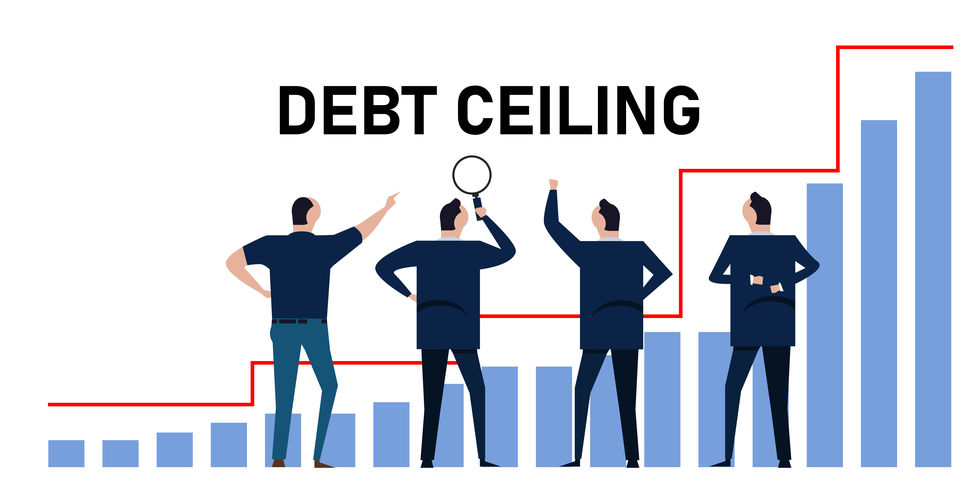 Every few years, particularly during the administration of a divided government, the threat of a default on raising the debt limit of the United States rears up in the political and economic spheres. While both sides tend to play chicken before ultimately settling on a negotiated outcome that they can sell to their bases, the current debt limit crisis feels more serious as the X date of June 1 looms with no settlement in site.
This crisis has a significant effect on various industries, and amongst them is the merchant cash advance business. MCA companies are heavily relied upon by small businesses for immediate financial needs, and understanding what this crisis means for the industry is crucial for getting through it unscathed.
Let’s compare the current landscape to running a business:
When a company opts to increase its debt limit, it essentially seeks to borrow more money, trading liability for an asset. For example, if the company’s equity is worth 100 billion dollars, borrowing doesn’t change this figure as long as the borrowed amount is an idle asset in their account.
The U.S. government should theoretically operate similarly to a regular company, borrowing only what it can pay back, but with the only growing expenses, when the government borrows money and raises the debt ceiling, it doesn’t always have enough funds for repayment.
In addressing its fiscal shortfall, the government operates distinctly from a conventional business. Unlike a company compelled to confront its financial mismanagement head-on, the government possesses the ability to print additional U.S. dollars. However, this course of action inherently devalues the currency.
For the sake of illustration, consider the worth of the dollar as a fixed entity. Suppose every thousand dollars equates to one bar of gold. If we slice this bar of gold into a thousand pieces, each piece represents $1. When the government initiates the printing of more money, it is essentially the government carving that same bar of gold into tinier segments. Meaning, if sliced in 2,000 pieces, the same bar of that once held the value of $1,000 is now $2,000. The total quantity of gold remains constant, regardless of whether it’s divided into 1,000 or 2,000 slices. However, with increased currency in circulation, each dollar—like every slice—holds less value, thereby shrinking everyone’s piece of the proverbial gold bar.
Now that we’ve explained the dangers of wantonly raising the debt limit, how does this affect MCA companies?
The debt limit crisis’s impact on MCAs is pronounced due to the time-value factor of money.
Suppose a mortgage of $100,000, repaid with interest over 30 years, amounts to $300,000. If the value of the dollar reduces significantly over this period – say by 50% – the bank, despite appearing to make a profit, loses money. That’s because the money they receive later has less purchasing power than the same amount ten years prior.
This reality can be acutely felt in periods of high inflation, such as in 2021 and 2022, where inflation neared 9%, and many felt it was closer to 20%. We all feel it during our grocery shops, the prices of experiences, and in other areas of our lives. Here, $100 can only buy what $80 could a couple of years ago, eroding the value of the interest charged.
At Better Accounting Solutions, a number of the MCA businesses we’re working with are concerned with this rapid devaluation of the money they’re funding.
The key factor to consider is the duration for which the capital will be deployed and how it will be recouped. For instance, if you advance $1 million at a 24% factor rate over 24 months and the debt ceiling is raised causing the dollar value to drop, your returns in the second year might be significantly less valuable despite the factor rate. This depreciation means that even though you’re receiving the agreed-upon returns, the funds’ purchasing power is considerably less, translating into a net loss of what would have been 13.5% over the past two years.
However, if you’re giving out (after careful consideration) riskier short-term advances with higher factor rates, daily repayments, and shorter durations, the situation would be different. Here, you’re receiving your return within, say, six months. Even if the dollar’s value decreases by 20% over a year, you’re less affected because your returns are realized in a shorter time and at higher rates, leaving you with a net gain.
Therefore, the debt limit affects MCA providers significantly, whether it’s being covered in the news or not. The devaluation of the dollar, high inflation rates, and other economic consequences of a debt limit crisis can dramatically impact the returns on cash advance businesses, especially those with longer repayment periods. As a player in the finance industry, it’s crucial to consider these elements when making advances or lending money. By factoring in these variables, providers can better protect their interests, minimize risks, and ensure the stability of their operations even during times of economic uncertainty.
Navigating Debt in A Post-COVID World: How Collections Agencies and Individuals Must Adapt
March 14, 2023 It’s been a hectic few years on the economic front.
From the shaky first days of the COVID-19 pandemic and the havoc in the economic system still ongoing, to the supply chain shocks and Russia’s war in Ukraine, it has been a time of deep economic uncertainty.
These crises had–and continue to have–a significant impact on individuals and businesses around the world. As many lost their jobs and saw their income reduced, it is likely that a large percentage accumulated debt during this time, furthering the financial struggles up the chain as more and more businesses had to contort themselves to stay afloat, despite their outstanding receivables.
As economies begin to recover and adapt to the current moment, businesses will be looking to collect what they are owed, but it’s important to consider how debt collection practices may evolve in a post-COVID world and how individuals and businesses can manage their debt.
Debt collection practices have traditionally been viewed as harsh and unforgiving, but as the world adapts to the new normal, the collection industry will need to evolve to be more compassionate and flexible.
As collections agencies, our job is to represent the interests of our clients who are looking to collect what is owed to them and recover as much of it as possible.
Collection agencies will need to take into account the fact that many people and businesses have been hit hard by the pandemic, and may not be in a position to repay their debts in full or at the pace creditors are used to.
One way in which collection agencies can evolve is by offering some form of a settlement that would involve a more flexible repayment plan. Rather than insisting on a fixed repayment schedule, collection agencies may need to consider allowing debtors to make smaller, more manageable payments over a longer period of time. This could involve negotiating a lower interest rate or waiving fees.
Another way in which collection agencies can adapt to the current moment is by offering debtors a reduction in the overall debt if the full balance is paid in lump. This involves the debtor agreeing to pay a lump sum amount that is less than the total amount owed. In some cases, this may be the only viable option for debtors who are struggling to make payments, and the only way a business can expect to see any of their money back. Collection agencies can be the conduit and work with both sides to negotiate a settlement that is reasonable and manageable for all parties involved.
Communication is also key, and never more important than it is right now. It’s crucial for collection agencies to be transparent and open in their communications with debtors. This means providing clear information about the amount owed, the payment schedule, and any fees or penalties that may be incurred. It also means being open to questions and concerns from debtors and providing them with accurate and timely information about their debt.
For individuals and businesses struggling with debt, there are several steps that can be taken to manage their debt effectively. Proactively communicating and working with your creditors offers the best chance at a reconciliatory solution.
The first step is to assess the situation and determine the total amount owed. This can be done by reviewing credit reports and contacting creditors to obtain a full picture of the debt.
Once the amount owed has been determined, the next step is to create a budget that takes into account all income and expenses. This will help to identify areas where expenses can be reduced and savings can be made. It may also be necessary to consider increasing income by taking on additional work or selling assets.
Once a budget has been established, it is important to prioritize debt repayment. This may involve negotiating a repayment plan with creditors or seeking the assistance of a credit counseling service. In some cases, it may be necessary to consider a debt consolidation loan or a balance transfer credit card to simplify payments and reduce interest rates.
Finally, it is important to maintain a positive attitude and stay focused on the goal of becoming debt-free. This may require making difficult decisions and sacrifices in the short term, but the long-term benefits of debt freedom are well worth the effort.
With a good-faith-first approach from creditors, debtors and collection agencies, it is possible to manage and clear debt effectively, even in an uncertain economic climate, and achieve financial security for all parties.
Why the Human Connection is Still Important in Debt Recovery
February 10, 2019 The CEOs and lawyers for debt recovery companies, particularly those in the commercial space, say that speaking to merchants over the phone is the best way to collect money for their clients. At New York-based Empire Recovery, Managing Attorney Steven Zakharyayev told AltFinanceDaily that they call this “soft collection.”
“Soft collection is probably the most effective way of collecting,” Zakharyayev said. “You can tie up [the merchant’s] business and freeze their accounts. That’ll bring them to the table. But the human interaction – negotiating with them – that’s where the deals are made and that’s how these accounts are ultimately repaid.”
Most of of the debt collection companies we spoke to have an in-house lawyer that can file a lawsuit against the merchant while also using “soft collection” to get to a settlement. But Dedicated Commercial Recovery, a Minnesota-based recovery firm led by Shawn Smith, who is not an attorney, sees itself as the step before attorneys get involved.
“We use a rapport-based collections approach,” Smith said. “We try to get to the real reasons why the customers are ignoring our client and come up with a viable solution for repayment.”
Merchants in default are usually not doing very well if they’re on a collections list.
“These [merchants] get pretty beat up by the time they get to us, so the more you can connect with [them] on a personal level, the better.”
Doug Robinson, the attorney at New York-based RTR Recovery, echoed this.
“There’s a story behind every default,” Robinson said. “Most of the merchants want to pay, so they appreciate someone reaching out and saying ‘What’s the matter?’”
Robinson said that he personally calls and emails every merchant and that they have a pretty high response rate with this simple technique. He said that the voicemails of the merchants are often full, but that they will usually respond to his email, where he explains that ignoring him will only escalate the problem.
If the merchant responds and engages with him, Robinson said he can create a payment plan with them, together with his client, that can reduce the merchant’s payments, stop payments temporarily, or change payments from daily to weekly.
Meanwhile, Houston, Texas-based AMA Recovery is often brought on after a collections agency has already unsuccessfully tried to get a merchant to pay. AMA Recovery’s Vice President of Legal Operations Kimberly Raphaeli said that a demand letter is always sent to the merchant, in addition to the use of secret shoppers or contacting neighboring stores to determine if a store is really out of business if the merchant says it is.
Even with these more aggressive tactics, Raphaeli said that calling is still critical. She said that they will move files around the office, noting that merchants respond differently to different personality types. Raphaeli said that by the time a file gets to AMA Recovery, the majority of the merchants have simply decided to stop paying and about 30% are legitimately no longer in business.
Having a merchant go out of business is never a good outcome for a collector.
“You want to keep them in business,” Zakharyayev said. “[…] You want to make a relationship with them where you leave them enough to stay in business but you collect enough that your client is satisfied and they get paid in full.”
While these collection companies all agreed that communicating – one human being to another – is the best way to approach recovery, that doesn’t mean that technology is thrown out the window. None of the companies AltFinanceDaily spoke to said they use autodialing, but Smith said he uses texting and email technology to make contacting merchants more efficient.
Mark LeFevre, CEO of Kearns, Brinen & Monaghan, a collections firm with offices in Delaware and South Carolina, agreed that technology makes the collections process more efficient.
“It’s important that you combine technology with the [human touch] to be most effective,” LeFevre said. “The technology will allow us to get the client to show what we can do, how we do it and so forth. But once that relationship is gained…we must talk with their customers.”
Details Emerge in Florida Lawsuit Against Corporate Debt Advisors
August 9, 2018 A debt settlement company being sued by Itria Ventures in Miami-Dade County, FL was asked to prove its claim that it has managed over $1.5 billion in total debt, court records show. That company, Corporate Debt Advisors (CDA), advertises that it provides debt relief for small business owners.
CDA responded to Itria’s request on June 29th with information relating to just two employees, Tony Shea and John Philbin, who combined through their previous experience have purportedly managed $1,584,000,000 of debt.
Not mentioned in their response is that each individual is prohibited from engaging in debt settlement services with Florida consumers where Corporate Debt Advisors is located.
According to the Office of the Attorney General, both Shea and Philbin previously and independently settled with the State after being investigated for running questionable debt settlement businesses. (See here and here)
In the lawsuit filed against CDA by Itria, it’s alleged that CDA is advising merchants to commit fraud by moving money owed to Itria to a new secret hidden bank account at a local bank in Florida where it will be out of reach from Itria.
This is not the first time Corporate Debt Advisors has been sued. In early July, a competitor to Itria, High Speed Capital, petitioned a New York court to turn over funds it believes CDA has in its possession for unlawful budget planning services rendered to a Florida-based business.