
Trade Group Sues CFPB Over Small Business Loan Data Collection Rules
January 4, 2024 The RBFC has filed a lawsuit against the CFPB over its data collection rules that are scheduled to go into effect this year.
As readers may recall, the federal regulator created 888 pages of rules governing how small business lenders (including MCA companies) will be required to collect and submit data for federal analysis.
At first, it appeared that the CFPB had way overstepped its bounds when Congress, on a bi-partisan basis, passed a resolution to scrap the rules. President Biden, however, then took the unprecedented step of vetoing their resolution on his belief that the rules were necessary to “conduct oversight of abusive and predatory lenders.”
One week after the veto the RBFC filed its lawsuit.
Although the CFPB is required by law to collect small business loan data pursuant to Section 1071 of the Wall Street Reform and Consumer Protection Act, the plaintiff took umbrage with the CFPB’s allegedly deliberate misinterpretation of the words “credit” and “loan” as they’re written in that statute. That’s because the CFPB unilaterally decided those terms also apply to MCAs/Sales-Based-Financing agreements. The RBFC contests that the CFPB has the legal authority to include products outside the scope of the federal statute and asks the Court to declare the rules invalid as they apply to sales-based financing.
Federal Regulator Enacts New 888-Page Law Covering Small Business Finance
March 30, 2023 This is NOT an April Fool’s joke. On Thursday, the CFPB released the final rules that govern how small business finance companies will have to collect and report data to the federal government. Such rules had been anticipated since the Dodd-Frank Act, passed in 2010, mandated that they be put in place. Thirteen long years later, the only part that may come as unexpected is the sheer magnitude of the language, 888 pages of fine print.
Transactions within the scope of the rule include loans, lines of credit, credit cards, merchant cash advances, and credit products used for agricultural purposes.
According to the CFPB’s executive summary, compliance appears to start next year.
- A financial institution must begin collecting data and otherwise complying with the final rule on October 1, 2024 if it originated at least 2,500 covered originations in both 2022 and 2023.
- A financial institution must begin collecting data and otherwise complying with the final rule on April 1, 2025 if it: Originated at least 500 covered originations in both 2022 and 2023; Did not originate 2,500 or more covered originations in both 2022 and 2023; and Originated at least 100 covered originations in 2024.
- A financial institution must begin collecting data and otherwise complying with the final rule on January 1, 2026 if it originated at least 100 covered originations in both 2024 and 2025.
Call your lawyer.
CFPB Publishes Long Awaited Proposed Rule on Small Business Loan Data Collection
September 1, 2021 A 918-page proposed rule published by the Consumer Financial Protection Bureau (if you don’t know what this bureau is, now is a good time to read up), is finally out.
Its application is broad, extending to “loans, lines of credit, credit cards, and merchant cash advances,” the CFPB said today. Initially, the Bureau’s intent was to exclude merchant cash advances, but that has apparently changed. (side note: I predicted this could happen as early as 2014.) Meanwhile, “factoring, leases, consumer-designated credit used for business purposes, and credit secured by certain investment properties” are exempt from the rule.
The rule is designed to assess whether there are disparities in sex, race, and ethnicity, when it comes to small businesses being able to access credit.
Covered financing providers would have to request that applicants disclose these things, which applicants can refuse to answer if they so choose. It could get a bit awkward from there because “if an applicant does not provide any ethnicity, race, or sex information for at least one principal owner, the Bureau is proposing that the financial institution must collect at least one principal owner’s race and ethnicity (but not sex) via visual observation and/or surname if the financial institution meets in person with any principal owners (including meeting via electronic media with an enabled video component).
BUT “minority-owned business status and women-owned business status would only be reported on the basis of information the applicant provides specifically for Section 1071 purposes, and financial institutions would not be permitted or required to report these data points based on visual observation, surname, or any other basis.”
Further, no one involved in the underwriting of the loan or advance would be allowed to know or access the ethnicity, race, or sex of the applicant. However, this would not apply if it isn’t “feasible” to do so.
All of the nuances, which seem to contradict themselves on the surface level, are specified in greater detail in the 918 page document.
When the proposed rule becomes final, lenders and MCA providers would have 18 months before they would be required by law to not only collect this data in the properly established manner, but also be prepared to submit it annually to the CFPB.
This rule will become a standard operating part of the business for companies both large and small whether one agrees with it or not. This law was passed in 2010 and it has taken this long to get to this point. This is a link to the CFPB’s official summary.
CFPB’s Reach May Extend to PPP Lending
February 16, 2021The CFPB’s Winter 2021 Supervisory Highlights Report that was published late last month, covered a section on small business lending. And it’s not related to the Bureau’s work on Section 1071.
The foray into non-consumer finance was instead driven by PPP lending.
“Consistent with its authority to ensure compliance with the Equal Credit Opportunity Act (ECOA), the Bureau conducted [Prioritized Assessments] to assess potential fair lending risks attendant to the institutions’ participation in the [PPP] program,” the report said.
Accordingly, the CFPB determined that small business lenders that restricted or limited eligibility such as banks who only permitted applications from existing customers, for example, “may have a disproportionate negative impact on a prohibited basis and run a risk of violating the ECOA and Regulation B.”
The CFPB conceded that it had not actually investigated if violations occurred and noted that the majority of institutions had argued that such limitations were either in place to comply with Know Your Customer legal requirements, to prevent fraud, or both.
The CFPB did not say that it had supervisory authority over non-banks that participated in PPP, but it did signal that its purview was larger than just consumers when it came to the institutions it supervised.
The report can be viewed here.
The CFPB is expected to have more proactive involvement in small business finance under its new incoming director, Rohit Chopra. Chopra’s nomination was formally submitted on February 13th. Dave Uejio, the Bureau’s Chief Strategy Officer, has been serving as Acting Director since President Biden took office.
Official Who Wants to “Wipe Out” Merchant Cash Advance Will Be Next CFPB Head
January 18, 2021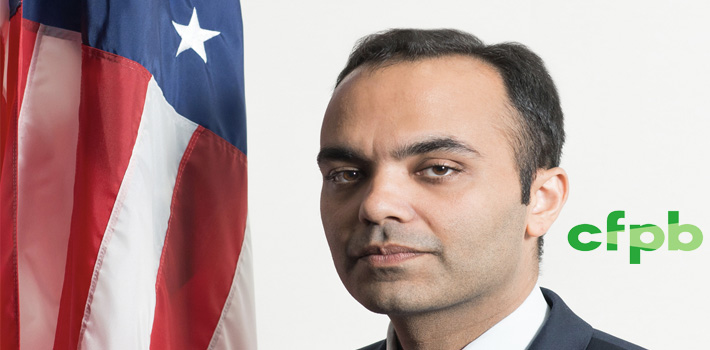 Rohit Chopra, an FTC Commissioner, will take over as head of the Consumer Financial Protection Bureau under incoming President Joe Biden, sources say.
Chopra’s name made the rounds in 2020 when he told NBC News that he was looking for a “systemic solution” that can “wipe out” all merchant cash advance companies.
His candid comments aligned with an official statement he put out in August in which he opined that the structure of MCAs “may be a sham since many of these products require fixed daily payments…”
He further added that there were “serious questions as to whether these merchant cash advance products are actually closed-end installment loans, subject to federal and state protections including anti-discrimination laws, such as the Equal Credit Opportunity Act, and usury caps.”
His transfer to the CFPB could be viewed as unwelcome news for the MCA industry as the agency is currently in the process of finalizing the types of financial institutions it believes it should maintain some jurisdiction over. Originally, MCA companies were poised to be excluded from the data reporting requirement set forth by Section 1071 of Dodd-Frank but that could very well soon change.
Greenbox Capital® Advocates For Fair Lending to Women- and Minority-owned Businesses in CFPB Panel
October 19, 2020Miami, FL: Greenbox Capital® announced it is serving as a Small Entity Representative (SER) to the Consumer Financial Protection Bureau (CFPB) that is responsible for amending the Equal Credit Opportunity Act (ECOA) protecting women-owned, minority-owned, and small businesses looking for financial assistance. Section 1071 of the Dodd-Frank Act amends the ECOA by requiring certain data be collected and submitted to the Bureau to protect these types of businesses.
“It’s an honor to be selected to the industry panel providing feedback on section 1071 of the Dodd-Frank Act ensuring fair lending laws to women- and minority-owned businesses”, said Greenbox Capital CEO Jordan Fein. “Over 2 million businesses across the U.S. are either women or minority owned and it’s vital they can secure funding as easily as non-minority owned businesses.”
Greenbox Capital, an alternative lender, serves small businesses in all industries across the United States, Puerto Rico, and Canada with the working capital needed to grow. Greenbox Capital is committed to supporting clear, secure, and fair financing solutions and is an active member of the Small Business Financial Association (SBFA).
For more information visit, www.greenboxcapital.com.
Dodd-Frank’s Small Business Lending Data Collection Rule Could Still Take Years to Implement
January 12, 2020 Small business lenders: Are you ready to regularly submit loan application data to the Consumer Financial Protection Bureau? No? Good, because almost ten years after Dodd-Frank passed, the provision that requires the CFPB to collect small business lending data still hasn’t been implemented.
And apparently we’re still years away.
Section 1071, as it’s known, modified the Equal Credit Opportunity Act and defined a small business lender as any company that engages in any financial activity. So if you’re wondering if this thing even applies to whatever you do in your corner of small business finance, it probably does.
The rule has taken so long to implement that consumer advocacy groups have actually sued the CFPB over the delay. The CFPB took note followed by initiative and hosted a symposium late last year to discuss how it might go forward. The next steps from here are to convene a panel of small business lenders, have that panel issue a report, propose what the rules on collection will be, collect feedback on the proposal, formulate a final rule, issue a rule, and then set a time for when it will go into effect. That process could mean that the earliest that data collection takes place is in 2023, possibly even longer as the entire financial services industry may need time to develop the infrastructure and human resources to comply.
Beyond that, advocates and critics of Section 1071 do not even entirely agree on what purpose data collection will even serve. Some believe the intent is merely for the government to have access to data it otherwise might not have while others believe that the CFPB could use statistics it deems discriminatory to bring enforcement actions against financial institutions. Sounds like we could use a few more years to get on the same page…
A recording of the 2019 Symposium is below:
CFC on the Front Lines of the MCA Regulation Battle
November 6, 2017
As the US Senate attempts to reach a bipartisan agreement on relaxing some of the rules in the Dodd Frank legislation of 2010 that would treat banks more favorably, the MCA industry is having to fend off legislation and regulation of its own at the state and federal levels that could position funders in a similarly crippling position.
MCA regulation has been thrust into the spotlight for a number of reasons, not the least of which has been the Consumer Financial Production Bureau (CFPB). The CFPB is moving forward with the Dodd-Frank Section 1071 rulemaking process for data collection regarding small business lending, a sector of the market for which they do not have jurisdiction, sources say.
Front and center in the policy discussions has been the Commercial Finance Coalition (CFC), a merchant cash advance trade association that is coming up on its two-year anniversary in December. While federal policymakers appear to be listening, state legislatures have been a more difficult nut to crack.
The CFC’s Influence
In its short two-year history, the CFC has been one of the most vocal if not the most influential trade organization lobbying on behalf of the MCA industry, having attended 70 congressional meetings and having led advocacy efforts for the industry in the halls of Albany, Sacramento, Illinois and Washington, D.C.

Dan Gans, executive director of the CFC, has been the voice of the MCA industry on Capitol Hill and has been invited to testify in key congressional hearings. “For whatever reason, the CFC has really become the voice and has taken an active part in the so far successful advocacy efforts to educate and mitigate potential harm to our members’ ability to deploy capital to small businesses that need access,” Gans told AltFinanceDaily.
Most recently the CFC participated in a fly-in, one of two such events this year, to Washington, D.C. in which the association’s counsel Katherine Fisher of Hudson Cook, LLP testified.
In her testimony Fisher said: “The MCA and commercial lending spaces are sufficiently regulated by existing federal and state laws and regulations. Both MCA companies and commercial lenders must comply with laws and regulations affecting nearly every aspect of their transactions, from marketing and underwriting through servicing and collection.”

She went on to explain: “Even if they comply with every applicable law and regulation, small business financers must also be wary of the Federal Trade Commission’s powerful authority to prevent unfair or deceptive acts or practices.”
Fisher told AltFinanceDaily she received a “positive” response to her testimony from funders but has not heard anything from lawmakers.
Gans said Fisher did a fantastic job in articulating the needs and status of the industry.
“She presented a very good case as to why the industry is currently adequately regulated. We don’t feel there is a need for federal regulation. In some cases, less regulation would allow our members to deploy more capital and help more small businesses,” Gans said.
The sweet spot for MCAs, Gans explained, are transactions under $100,000 and probably in the $24,000 – $40,000 range. He said the industry does a fantastic job of being able to deploy financial resources to small businesses in a timely manner that neither banks nor SBA lenders can match. He’s not suggesting MCA is for everybody but for some businesses it’s an essential product that can help. There have been many success stories.
“Competition is all over the place. But that’s great for the merchant. The more options that merchants have, the more we can enforce best practices and more competitive rates. And the more we can keep the government from impeding people from getting into this space, the better off small businesses are going to be,” said Gans.
Setting the Record Straight
The CFC was formed with the mindset that the organization, which is currently comprised of CEOs of small- and medium-sized funders, would take a proactive rather than a reactive approach to industry regulation. In its two-year history the CFC has tasked itself not only with educating policymakers on the role of MCA funders for small businesses but also with undoing the misinformation and misconception surrounding the anatomy of an MCA.
“Unfortunately, because MCA uses the term cash advance in its product name, uninformed people will often confuse MCA as some form of payday lending. And so that has been one of our biggest challenges, educating members of congress and committees that there is absolutely no correlation between MCA products and what their views of consumer payday loans is,” said Gans, adding that the CFC has had to communicate that MCA is a version of factoring has been around for more than 1,000 years.
A common thread that the CFC has been able to weave with lawmakers has been the diverse geographical representation of both the trade group and the House and Senate.
“Most venture capital is deployed in a few spots – New York, California and Texas – and it’s a cliff to get to those three states. So, one nice thing that I take pride in is my members are looking all around the country regardless of the geographic location. That helps us with policymakers, most of whom are not from the New York City metropolitan area or Silicon Valley. It’s nice being able to look at them in the eye and tell them we care just as much about your district as you do,” he said.
The Road Ahead
The CFC has an ambitious long-term agenda, one that includes raising their profile in the industry and participating in events.
“I think one of the ambitions we have is to have an organization where funders and brokers can be at the same table and work though some of the issues impacting the industry and try to make sure people are doing things in the right and best way.”
The trade group is planning to partner up with AltFinanceDaily for Broker Fair 2018 and they’re looking to bolster membership.
“The industry has had a lot of free riders that are benefiting from our advocacy efforts but not supporting it. So, from my perspective, if you’re in this industry, particularly in the MCA space, we’d like to expand membership. If we grow our membership, we can do more things, engage more states and expand our lobbying team,” said Gans. “The more members we have, the more we can do to advance the ball and protect the interests of the industry.”
The CFC will need all the help it can muster given the fight ahead to fend off regulation particularly in Washington, Albany and Sacramento. “I think we could see some harmful regulations and potentially legislation over time. Some of those bad ideas that emanate in states have a tendency to percolate into Washington. If at some point there is a less business-friendly administration in the future, we could see all those ideas get some traction at the federal level,” Gans warned.