Fintech Company Launching Money Managing App with Big Incentives
September 29, 2021 The fintech company Enzo is set to launch a money managing app within the end of the year and is handing out tremendous incentives to draw customers. The company is offering 10% cash back on Uber rides, 5% cashback on Doordash, 1.5% cashback on rent payments, and 1.25% cashback on everything else. Checking accounts offered by Enzo will also get a 0.50% interest rate.
Enzo’s cashback program has its limits. Annual cashback bonuses are capped at $500, and monthly cashback bonuses are capped at $65. According to their site, if a user spends $2,000 on rent, $150 on Uber, and $400 on DoorDash in one month, they would be credited $65 at the end of the month into their Enzo checking account. Once the monthly and/or annual cap has been triggered, an account will continue to earn 1.25% cashback on all other purchases.
“We started Enzo because we kept seeing our friends make the same money mistakes over and over,” said Jeremy Shoykhet, CEO of Enzo. “We saw people who excelled at every aspect of their lives struggling to get their finances in order [and] we felt there had to be a better way.”
Enzo will also be offering their first batch of account holders equity in the company.
“We feel very strongly about helping our members build and steward wealth,” said Shoykhet when asked about the company’s equity offer. “In connection with that mission, we are launching a first of its kind equity program where we will be giving equity to early evangelists of the Enzo brand, more information about the specific mechanics of the program will be available toward year-end,” he said. “The program does not require opening an Enzo account and is subject to terms and conditions.”
The company also has a stock trading interface within its mobile app, so customers can manage liquid cash and investments in the same place. According to Enzo’s website, customers can automatically track gains, dollar cost average over time, customize portfolios, and manage checking accounts all in the Enzo app.
“At our core, we want to help the millennial generation build the financial foundations that help them live the lives they desire,” Shoykhet said.
The company’s banking services will be FDIC insured through Blue Ridge Bank, who will hold all the money and process the transactions. They are also partnered with Unit for the backend technology in the software. Customers will have access to funds in their checking accounts with an Enzo debit card, which will be uniquely designed by artists for the first ten thousand account holders.
Enzo’s webpage claims that their inaugural staff is a “diverse team of veteran Wall Street investors, engineers, operations, and product folks.” They claim to have gathered top level employees from some of the top financial institutions around the globe.
Enzo’s accessibility and seemingly user-friendly software combined with their incentives for account holders portrays a very interesting notion in non-bank finance. Customers are looking for an easy to use, easy to understand, and easy to access multi-platform money management system with perks and incentives.
Enzo has a waiting list approaching 14,000 potential account holders as of Wednesday. As of now, according to Shoykhet, the program will launch as invite-only. They will add new customers into the program on a rolling basis.
This may not be the end of new financial services for Enzo, according to Shoykhet. He hinted to the company’s future plans in his explanation of the product. “We are also planning to launch innovative financial planning features through a mix of human advice [and] technology-powered advice.”
Marqeta Goes Public on The NASDAQ
June 9, 2021 Marqeta went public on the Nasdaq this afternoon, raising $1.2 billion and pricing higher than expectations. The firm priced 45.5 million shares at $27, and prices rose to over $30 a share.
Marqeta sells payment tech designed to detect fraud by issuing physical cards to independent contractor firms like DoorDash and Instacart. Contractors use Marqeta cards at point-of-sale in restaurants and supermarkets. Marqeta also enables Square’s Cash App debit card and Buy Now Pay Later fintech firms Affirm and Klarna to move money.
The firm applied for a public offering on May 15th, posting an annualized first quarter 2021 revenue growth of 123% to $108 million and a 2020 annual revenue that had doubled to $290.3 million.
From Sales to Founder: Craig J. Lewis Talks Gig Wage’s $7.5 Million Funding Round
November 27, 2020 Coming to you from the heart of Dallas, Texas is a digital payroll startup, Gig Wage, that received a $7.5 million Series A funding round just last month. The founder, CEO, and writer of The Sport of Sales, Craig J. Lewis, talked about his goal to make it easier for 1099 gig workers to get paid.
Lewis made $10 million in payroll tech sales before going on to lead a firm that has seen 30% month-to-month growth this year, during a pandemic no less.
“We help businesses pay independent contractors, but because we’re so tech-centric, it’s evolved beyond just payroll,” Lewis said. “What we ended up building was financial infrastructure for the modern workforce. We help businesses get money from their customers to their contractors as fast and as flexibly as possible.”
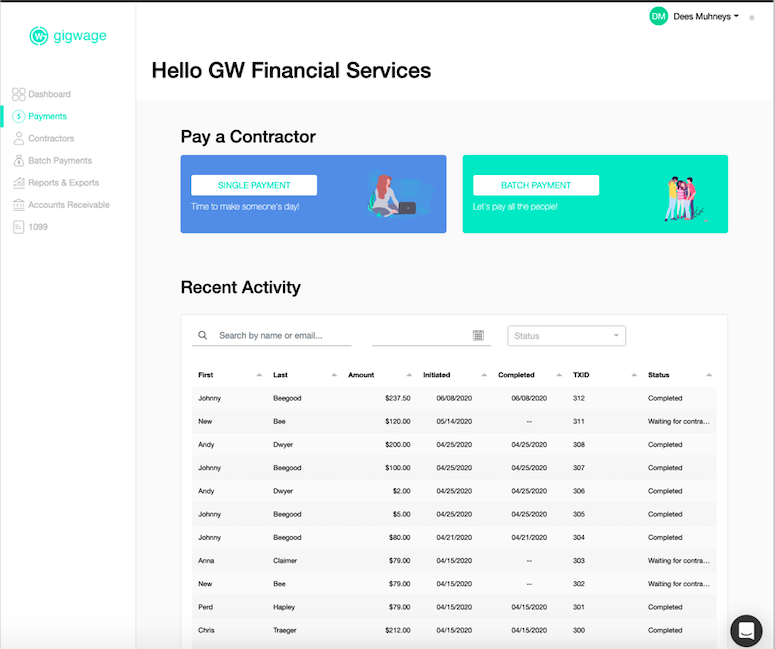
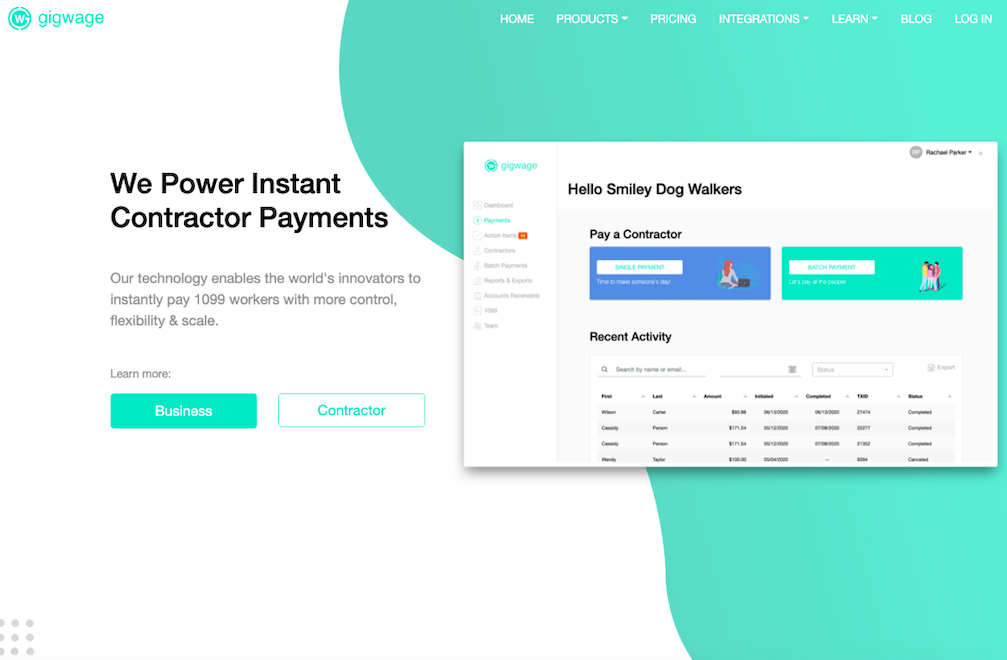
The way Gig Wage does this, Lewis said, is by offering an online platform for the hybridization of payroll, payments, and banking from a single login. Businesses can manage their payroll needs for 1099 workers, then shift to payment needs quickly, through direct to debit, all major cards, bank transfers, and accounts receivables.
“One of the only- the only platform in the world actually that has embedded banking into payroll and payments, which is what kind of allows for this speed and flexibility that we offer,” Lewis said. “We’re like B to B to C: We help the businesses with technology and operational excellence, and because independent contractors are separate from the workplace, we provide tools for them.”
Lewis has years of experience in the payroll space- starting as a salesman for ADP small business payroll products back in 2008. Realizing he had a passion for payroll tech and getting customers the best services possible, Lewis went on to learn anything he could about the industry. Selling $10 million in software while moving across the country, Lewis landed in Silicon Valley, where he studied what it took to start a company.
“I was just awed how they thought about technology and products and company building,” Lewis said. “And I vowed to bring that to the payroll industry.”
Lews joined a startup, learned the Silicon Valley way of creating a company through an African American tech acceleration program. In 2014, Lewis founded Gig Wage to do something disruptive in the payroll space.
 As Gig Wage attests, disruption is what the 1099 gig industry needs at the very least. Lewis believed the gig economy was going to keep growing when Gig Wage started. As he watched, the gig economy ballooned into a $2 trillion industry with an estimated 65-75 million person workforce. These workers suffer from an outdated payroll system, losing an estimated 2-20% of their income to flaws in the payments system Gig Wage found.
“With the maturation of Uber, Lyft, Postmates, Doordash, Grubhub, Upwork, all of these kinds of gig economy freelancer companies, we had great growth going into 2020,” Lewis said. “In Q1, we were set up to raise our series A, and then March happened, and the terms got pulled off the table.”
 But when the dust settled after those first shutdown weeks, Gig Wage looked at the damage and found the skyrocketing unemployment rates and furloughs had only accelerated their growth as a company.
“The gig economy was right there waiting on the workforce to provide opportunities to earn, and we were positioned perfectly to help people compete for that talent and pay people in a modern way,” Lewis said. “The pandemic has been a huge growth accelerant for us, and we think those tailwinds will only continue.”
Those winds of success came during a time of protest. Amplified in the pandemic’s backdrop, the country was waking up to the unequal disenfranchisement black people faced. Only 1% of black founder entrepreneurs ever receive VC funding, and Lewis said he is proud to have raised a significant round, given that unfair stat.
“With so much controversy and negative energy around black people in general,” Lewis said. “I think putting this positive story out there and showing this black excellence, black tech, I think it’s super important, and it’s been something that I’ve embraced. We’ve been able to be a part of putting something extremely powerful and positive into the market.”
America is finally waking up to realize something Lewis said was obvious, that black people matter, even though it can be controversial to say so. He hopes his success can help others but affirms the funding round was no charity drive.
“This is a great opportunity for us to be clear about the fact that like hey, we’ve been working on this, we’ve built a good business and a good technology,” Lewis said. “This is a big business opportunity for our investors and us. It wasn’t charity, right: This isn’t like, oh he’s black, give him some money.”
The successful funding round shows confidence in the Gig Wage platform from Green Dot, which will allow Gig Wage to offer bank accounts and debit services to independent contractors. Green Dot is one of the only fintechs with a national banking license, Lewis said, and Gig Wage is joining the Banking-as-a-Service direction that the fintech industry is headed.
Beyond payroll, Lewis can’t wait to offer other financial products to businesses as the company grows.
“When you think about the gig economy, it’s important that people get paid fast and flexibly: You’ve got to have the cash to be able to do that,” Lewis said. “We see some unique opportunities to get involved in the lending space down the line as well as we continue to build out our technologies.”
Fintech IPOs Are Back
November 18, 2020Fintech IPOs are back. Affirm, a fintech company whose platform offers “a point-of-sale payment solution for consumers, merchant commerce solutions, and a consumer-focused app,” is the latest company to file for an IPO.
Affirm’s S-1 was filed earlier today, revealing that they intend to raise $100 million. The company generated $509M in net revenue during its fiscal year ending June 30 and a net loss of $112 million.
| Fintech | Date Filed | Date Public | Amount Raised |
| Affirm | 11/18/20 | ||
| Upstart | 11/6/20 | ||
| Lufax | 10/8/20 | 10/30/20 | $2.36B |
| Ant Group | 8/25/20 | Delayed |
<>
Unrelated to fintech, but still “tech” are pending IPOs for DoorDash and Airbnb.