
Midland Funding Gets Mentioned in John Oliver’s HBO Show
June 6, 2016The infamous Midland Funding you might know from the Madden v Midland case, was mentioned on John Oliver’s Last Week Tonight and not in the best context. Midland is a subsidiary of Encore Capital Group, the largest publicly traded debt buyer in the United States and the episode was about the not-always-peachy world of debt buying and debt collection.
Oliver referenced Midland just to provide background on an industry as a whole, not to imply that they were involved in anything negative.
More background was added by Jake Halpern, the author of Bad Paper: Chasing Debt from Wall Street to the Underworld, who explained that the sale of debt from one party to another is not always done using the most sophisticated means, with it often being simply a list of fields on an Excel spreadsheet.
Oliver, who took his research to the extreme, actually set up his own debt collection company in Mississippi and purchased $15 million worth of debt that was aged beyond the statutory collections period for the bargain price of $60,000. Rather than try to collect on the debt, which he mentioned would not have been illegal, he decided to forgive the debt entirely and set the record for TV’s largest monetary giveaway in the process.
Oliver was careful to remind viewers throughout that while there are a few bad seeds and horror stories, the industry itself is regulated and is not illegal. You can watch the episode below:
In a first, Bizfi crosses $144 million in Q1 funding
May 17, 2016
Thanks to the partnership with Western Independent Bank, Bizfi had a record Q1 to date with $144 milion in loan originations.
The New York-based fintech company funded 3,605 small businesses, a 49 percent increase from $96 million funded in Q1 last year, Bizfi said.
The partnership with Western Independent Bank in March this year opened up several markets in the midwest and west coast Alaska, Arizona, California, Colorado, Hawaii, Idaho, Montana, Nevada New Mexico, Oregon, Utah, Washington and Wyoming can benefit from this partnership. Referring to the partnership, Bizfi founder Stephen Sheinbaum said, “These types of relationships not only help to fuel Bizfi’s growth, they ensure the financial partner continues to maintain their customer relationships by providing their clients an alternative for the financing they need,”. “In 2016, we’re looking forward to further expanding our product set and partnering with more traditional financiers, enabling us to fund the growth of even more of America’s small businesses.”
Bizfi’s marketplace partners with lenders like OnDeck, Funding Circle and Kabbage and the company has so far funded 29,000 small businesses with $1.6 billion in capital since 2005.
OnDeck Disappoints: “Marketplace” in Jeopardy?
May 3, 2016
OnDeck finally bombed an earnings report and marketplace lending (at least their marketplace anyway) is being seriously questioned. The company is now predicting a full-year adjusted EBITDA loss of between $41 million and $49 million, down from the projection they made just three months ago of full-year positive EBITDA of $10 million to $14 million. They had a GAAP net loss in Q1 of $12.6 million.
Any positive details were disregarded by analysts who hammered away at the shifting dynamic of the OnDeck Marketplace. The premium earned on selling off loans to major investors through this channel shrank to a measly 5.7% Gain on Sale Rate during the first quarter. Bank of America’s Nat Schindler pointed out on the call that back when OnDeck was getting a 9% Gain on Sale Rate, that they believed even that number to be undervalued, but that they had said it was worth selling them at a discount to “seed the marketplace.” With the margins now compressed to a point where “seeding the marketplace” is no longer a rational excuse, he wondered why they still sold $123 million worth. “Why not just keep it all? What would happen if you just stopped the marketplace?” he asked.
Stop the marketplace
Stopping the marketplace quickly became the underlying theme of the Q&A session. Previously, 35-45% of their term loans were sold off through Marketplace but they now predict that only 15%-25% will be sold through it in 2016.
David Scharf with JMP Securities asked if and when the company could ever break even assuming there was no marketplace.
Vasu Govil with Morgan Stanley asked “if the risk premiums were to continue to rise, at what point does marketplace funding go to zero? At what point do you decide that it’s not worth doing it and that you want to keep all the risk on the balance sheet?”
OnDeck CFO Howard Katzenberg explained the decreasing margins as a retreat from one type of buyer. “Our marketplace buyers fall into two counts,” he said. “The first is those that buy and want to hold ’til maturity and the other segment buys with the plan on securitizing the loans and selling off the residual position of the portfolio. Given the inherent leverage in the securitization transactions, those buyers historically have been willing to pay higher premiums versus the kind of the more traditional hold ’til maturity investors.”
The appetite from those that plan to securitize the loans has dropped off, the ones that are typically willing to pay more.
Losses today instead of income
OnDeck did book more loans on their balance sheet than they had expected and as a result GAAP rules require them to book a provision expense for them. “So as our loan book grows, we will have a mismatch of the provision expense upfront versus earning interest income over the lifetime of the loan,” Katzenberg said. “Moreover, when we sell a loan through marketplace, we book a gain on sale upfront, which had the affect of accelerating the recognition of income.”
Translation: Booking a loan on balance sheet means recording a loss today while selling a loan through marketplace means booking income today. The first might be more profitable over time but transitioning from marketplace to balance sheet makes the books look worse in the short term.
Originations down
Actual originations grew by 37% year-over-year, missing the 40-50% range projected. OnDeck CEO Noah Breslow was unapologetic about that. “We’re not going to do anything unnatural because of those growth numbers,” he argued. “If we conclude that growing at a slower rate is best for our business then we will grow slower.”
The stock was down 3.82% on the day prior to the earnings release but plunged by nearly 30% in after hours trading.
From Small to Big: Why Funding Circle is Building its Intermediary Channel
April 21, 2016 If online lenders want to disrupt banking, they need bankers.
Small business marketplace lender Funding Circle hired an intermediary finance veteran Neil Mullane to expand the company’s reach among small merchants. Mullane comes with eight years of experience in commercial finance at Barclays, where he oversaw business and corporate banking working with small businesses with a £250,000 to £25 million turnover.
The London-based P2P lender has channeled more than $2 billion of loans from individual and institutional investors to businesses in the U.S., U.K. and Europe since 2010 and has said that it remains dedicated to two principles, “marketplace and small business.”
And its gaze is set on Europe. Last year, it acquired German marketplace lender Zencap for an immediate footprint in Germany, Spain and Netherlands. Additionally, its SME Income Fund that was listed on the London Stock Exchange in November 2015, raised £150 million from shareholders and started lending to small businesses in those markets last month.
Last week (April 14), the company also launched UK’s first P2P securitized ABS backed by loans worth £130 million.
Speaking at LendIt USA recently, the company’s US co-founder and managing director Sam Hodges envisioned the golden age for marketplace lending where it takes “seconds to issue credit,” from a broad network of global investors. “A loan should get funded by a network of investors all over the world — be it a pensioner in London, a hedge fund manager in Sydney or a family office in New York simultaneously putting money to work through a global platform,” he said.
He elaborated further to note that the industry will have to work on four key tenets to get there: Stable lending capital, taking controlled risks, maintaining operational discipline to make sure that unit economics favor scaling and lastly, maintaining integrity around infrastructure and transparency.
The company has noted its intention to move in this direction at least with hiring the right talent, whether through the former Executive Board Member of the European Central Bank (ECB), Jörg Asmussen Mullane to lead business development or beefing up its risk compliance and product engineering teams in San Francisco.
Direct Mail Still Very Effective, Says National Funding President Torrie Inouye
April 16, 2016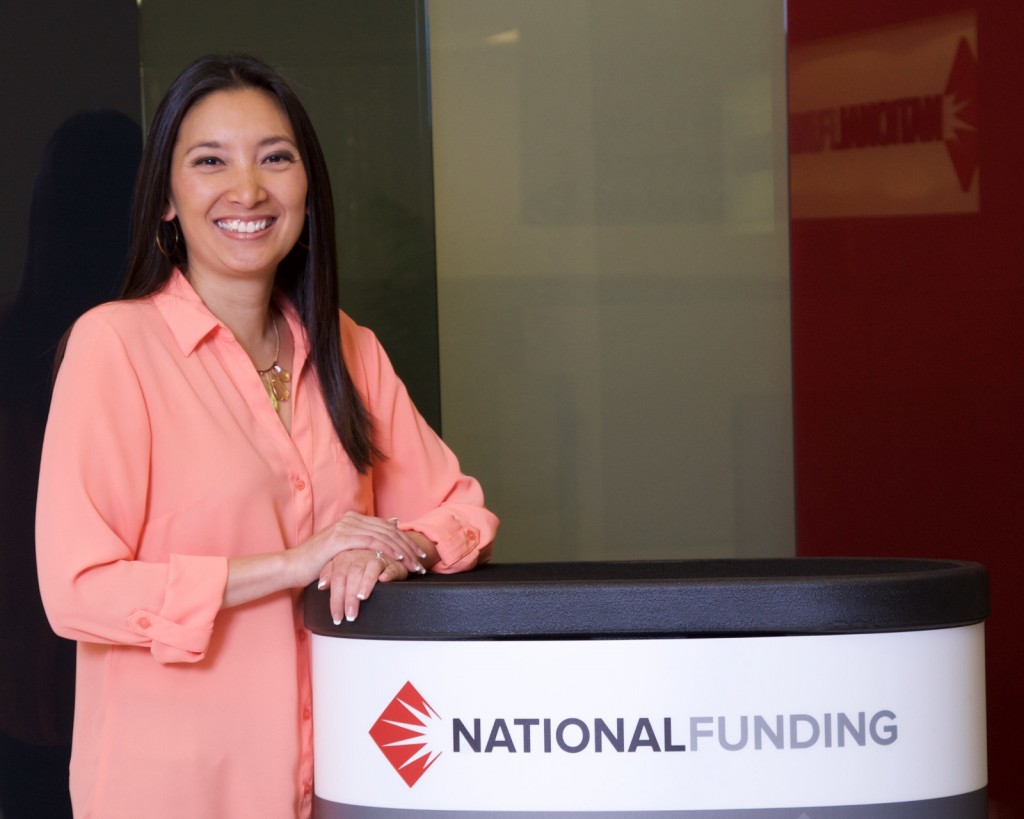 When I met with San Diego-based National Funding President Torrie Inouye at Lendit, I was surprised to learn that the company had quietly funded $293 million to small businesses in 2015, enough to earn them a spot on AltFinanceDaily’s top 10 alternative business funder list. The company isn’t new. They were founded in 1999, which puts them in the same category as CAN Capital, a 90s era relic that has not only survived but has continued to evolve and quite literally be a leader of the pack.
Inouye graduated from Stanford University in 2001 with a BA in Economics and started at National in 2004 where she worked as a Corporate Strategy Analyst. After 3 and a half years, she went on to play key roles at Union Bank and Intuit before returning back to National in the Fall of 2014. With a strong background in data analytics, Inouye took over as the company’s president just last week. Dave Gilbert, the company’s founder, has been the CEO since the beginning.
“Dave has always understood that data is valuable,” Inouye said, adding that she had been tasked with harvesting it.
“One of the trends that we’re seeing in our data is our direct mail response rates being much higher than what other people might expect,” she said. “We’re still surprising really good at direct mail.”
Others within the alternative lending space have made similar assertions, which ironically kind of undermines the concept of online lending itself. For Inouye, she says the online part is “the product.”
“You can control the message and you can control who you’re talking to with direct mail,” she explained. Though in a way the offline tactic is driving people to engage online. “A lot of our direct mail response comes through our website,” she said.
An expanded version of our interview will appear in AltFinanceDaily’s May/June 2016 edition scheduled to come out in early June. Subscribe FREE here.
CAN Capital Crosses $6 Billion in Small Business Funding
April 7, 2016
CAN Capital has surpassed the milestone of providing more than $6 billion in working capital to over 70,000 small businesses over 18 years.
Since they have a strong track record of repeat business, the company has actually made over 170,000 individual fundings across restaurants, medical offices, beauty salons and more. Last year, the company introduced two new special small business loans – TrakLoan, which adjusts daily payments with daily card sales and a monthly installment loan product offering a customer longer terms with higher transaction sizes.
The New York-based company was founded in 1998 and uses propriety data-driven models to underwrite loans and advances. CAN Capital is one of the early companies in the space that has seen much overhaul over the past few years with a slew of new companies offering a variety of working capital products distributed through a number of channels. “There has been an evolution both in product and distribution over the years,” said Daniel DeMeo, CEO of CAN Capital. “From a single type of loan and monolithic distribution, we have come to work with big changes in underwriting and decision making,” he said.
It helps to have a favorable economic environment for small businesses to thrive in. The Federal Reserve, in its part has kept borrowing rates unchanged in a decade with only a marginal hike. Small business borrowing also peaked in February touching 17 percent after hitting a two-year low the previous month.
Santander Cuts Branches, Partners with Kabbage
April 4, 2016
Santander is putting its money where its mouth is and launching Kabbage in UK.
The Spanish banking giant, an investor in Kabbage will use its technology to underwrite quick loans up to 100,000 pounds the same day for loans that typically take 2-12 weeks to process.
The service will roll out over the next two months and will be the bank’s second attempt at allying with an online partner. In 2014, it set up a referral program with UK-based Funding Circle for small business borrowers.
The announcement comes at a time when big banks are shedding weight and becoming leaner to adapt to the digital times. Last Friday (April 1st), Santander said that it will close up to 450 of its 3,467 (13 percent) branches to transition into “cheaper digital channels.”
The road to saving 3 billion euros by 2018 is paved in working with lean businesses like Kabbage. “The way we internalise and adapt to new technology in the coming years will determine our success,” Ana Botin, chairman of Santander said.
This isn’t a one off announcement by Santander. Through its venture arm, Innoventures set up in 2014, the bank dedicated $100 million to invest in fintech startups. The fund participated in Kabbage’s Series E funding last year along with Scotiabank, ING and Reverence Capital Partners.
The bank also set up what it called a “tech-focused international advisory board” led by former US Treasury Secretary Larry Summers with a panel consisting of Red Hat CEO Jim Whitehurst, former Oracle president Charles Phillips and Francisco D’Souza, CEO of software services company Cognizant.
As the alternative lending industry shapes itself into stability with regulation, reducing its dependency on Wall Street’s institutional money, there are doubts whether the industry will stand the test of time in tough credit markets. While venture dollars are increasing in these companies, investors demand more. Fintech upstarts raised $19 billion in 2015 and in the same time, bank staff has been slimming down as investors bet on automated finance to eventually overthrow banking. Already, 46 percent of private funding has gone to lending companies selling cheaper loans easily while the banks focus on the shift of a branch’s transactionary functions to a strategic, consultancy role.
Will we see more such debanking?
Bizfi Partners With West Coast Banking Group
March 17, 2016Bizfi will be the exclusive alternative finance solutions provider for small businesses that are members of the Western Independent Bankers, a trade association of community banks in the west coast.
Small businesses in the midwest and west coast in states including Alaska, Arizona, California, Colorado, Hawaii, Idaho, Montana, Nevada New Mexico, Oregon, Utah, Washington and Wyoming can benefit from this partnership. Bizfi’s marketplace partners with lenders like OnDeck, Funding Circle and Kabbage.
“WIB member banks are the leading funders of America’s small businesses,” said Michael Delucchi, President and Chief Executive Officer of WIB and WIB Service Corporation. “With Bizfi as a WIB Premier Solutions Provider we are able to offer their expertise in alternative financing and superior technology to our member banks and deliver a complete solution for small business funding.”
Earlier this month, Bizfi partnered with The New York State Restaurant Association to provide business financing for its 2,000 small businesses in the restaurant space.