
Merchant Cash Advance Accounting – A How To Guide
January 13, 2015This is the introduction and first question in an interview between AltFinanceDaily’s Sean Murray and accountants Yoel Wagschal, CPA and Christina Joy Tharp.
- 2. Do I Need a Special MCA Accountant?
- 3. and 4. Recording Merchant Cash Advance Transactions on the Books
- 5. Merchant Cash Advance Accounting Pitfalls
- 6. Revenue recognition for Merchant Cash Advance
- 7. Q&A – Real questions that MCA companies or syndicators have
Funding small businesses is the easy part of merchant cash advance. Anyone can fund. It’s what comes after that’s tricky and I don’t just mean capturing those receivables you’ve purchased, but also recording everything in such a way that you’re not scrambling around tax time.
I have a B.S. in Accounting but I asked the experts Yoel Wagschal, CPA and Christina Tharp his staff accountant for their insight on managing the books for a merchant cash advance company. We’re still a ways off from April 15th so now is your opportunity to fix whatever you might not have done in 2014 and start off on the right foot for this year. Thanks again to Yoel and Christina for answering these questions.
Q: As a funder, what systems should I have in place to make sure I can:
a. Prepare business tax filing
b. Be ready for an audit to raise capital
c. Know whether or not I am making money
A: First of all you have to understand that every type of business has this exact same question. The answer is that you need to have proper accounting entries and records which will then aid you in creating the financial statements (ie: balance sheet, income statement, statement of retained earnings, and statement of cash flows).
Whether it is a tax filing, a bank audit, or an internal inquiry, the solution is identical because all of those situations require the same financial material in order to answer them. In order to prepare a business tax filing a company must provide its profits and losses. That is the same information provided in an audit to raise capital and it is the same information a business owner needs to see how much money they are making (or losing!).
The exact system is obviously custom fit to your individual business model but it should follow these very basic steps:
i) Think the entire process through from cradle to grave
ii) Be sure to codify where funds are coming in from:
a. Investments from syndicators
b. Payments from merchants
c. Commissions
iii) Be sure to codify where funds are being sent to:
a. Funds to merchants
b. Funds to syndicators
c. Commissions
iv) Be sure there is a system of checks and balances which will alert you to the following common errors:
a. Funds not received from/sent to syndicator
b. Funds not received from/sent to merchant
c. Commissions not received
v) The bank account is the authority while the system is only a representation:
a. Your system balance should reconcile with your bank account
b. It is advisable to have a separate bank account for funding transactions
You will also want to pull up trial balances and earnings reports, which must be input correctly from the very beginning in order for these reports to be accurate and effectual.
What makes this industry different is that an accounting system can make or break an MCA company. For example, a supermarket usually has good POS software for inventory control. If an employee drops a “box of tomatoes” it’s not the end of the world. The loss is either immaterial or if it is material the accounting system will pick up the big monetary discrepancy.
In the MCA industry a “box of tomatoes” could be anything from a $0.05 loss to a $500,000 loss. Because the MCA industry deals with money as its product and is often processing transactions at breakneck speed, there needs to be safeguards in the system to catch any and all mistakes in real time.
Our accounting firm has seen where people built attractive systems which seemed good to the funder. However, if the funder lacks accounting knowledge when this “box of tomatoes” falls out they may not be able to place exactly where the loss occurred. Or even worse, they may not realize a loss has taken place until it is too late. For example, if you wait until the end of the tax year and then discover that merchant payments have been missed how do you recoup those funds? It’s the same situation if incorrect amounts are funded to merchants, if incorrect commissions are paid out, or if syndicators have not invested the funds they were expected to.
Phone (845) 875-6030
Fax (845) 678-3574
Email: cjt@ywcpa.com
http://ywcpa.com
Please consult with an accountant to assess your particular situation and needs.
Despite FinTech Disruptions, Many Thing Stay The Same
January 5, 2015 2014 was an unbelievable year!
I kicked off last year by opening an account with Lending Club so that I could understand their product. Today I have tens of thousands of dollars invested on their platform and picking up new loans has become part of my daily routine. You could say I’m not surprised they went public a few weeks ago.
I also launched the industry’s first trade publication and ran it as both publisher and chief editor. We produced 6 issues and distributed more than 20,000 print copies combined. Unfortunately the publication will not be continuing further. It is wild to think that it both started and concluded in 2014 as the magazine had a cult-like following.
7 conferences in 4 cities. Las Vegas (twice), San Francisco, New Orleans, and here in New York. I spoke at two of them. Hoping for at least 1 Miami conference this year. Please??? It’s so cold here right now.
OnDeck Capital took a lot of flak in 2014 from both industry insiders and the media. They shrugged it all off and went public on December 17th. Considering they’ve operated on the fringe of the merchant cash advance industry for so long, it was one of those things you had to see to believe. I didn’t get inside the building but I saw the IPO was real from the outside.

I started off 2014 not knowing what a Bitcoin was. Now I have a copy of the entire blockchain, operate a full node (don’t worry I have port 8333 open), have 10 dedicated mining devices running 24/7, have made purchases with bitcoin, conducted countless transfers, and just finished coding a working prototype application using Coinbase’s API. And when I realized that bitcointalk.org and my cryptography books weren’t enough to satisfy my appetite, I found myself talking about bitcoin on IRC; #bitcoin and #bitcoin-pricetalk on irc.freenode.net. I also know who Satoshi Nakamoto really is now too but he made me promise not to tell anyone.
I rebranded Merchant Processing Resource to AltFinanceDaily, retiring a name I’ve used for 4 years.
I interviewed former Congressman Barney Frank, one of the two architects of the Dodd-Frank Wall Street Reform and Consumer Protection Act (it was only a few questions).
I got asked by a credible movie producer if I would help him on a storyline for a script about Wall Street and the alternative business lending industry. Don’t worry I turned it down!
I jumped on the payment disruption bandwagon and used Square to process credit card transactions all year. You should know that I previously did merchant account sales. I could’ve boarded my own account and set my own fees but I went with Square anyway.
I finally got set up to syndicate on merchant cash advances.
I ran my first 5k in Central Park.
I moved to a different part of Manhattan.
Of course a whole lot more happened. It was a roller coaster year which leads me to believe that 2015 will be impossible to predict. There’s a lot more room to grow in FinTech but it might be time for fresh ideas. Everyone and their mom built an online lending marketplace platform in 2014.
Similarly, it’s also a tough time to become a loan broker or MCA ISO especially if you’re undercapitalized. The easy profit ship has sailed. Press 1s and UCCs aren’t winning business models, at least not ones that will invite outside capital or ensure survival long term.
2014 changed finance but in many ways it stayed the same.
It still takes 2-4 days to confirm an ACH didn’t reject! This is annoying all around. If I add funds to Lending Club on a Monday, it’s not accessible until Friday evening. If you debit a merchant on Monday, you won’t really know if you have it until a few days later. Believe it or not I actually mailed out more checks in 2014 than in any other year of my life. The ACH system appears to be fine until you use something that is far more advanced, something I will probably write about over the next month. Instantaneous payments, low transaction fees, no bank involvement. Yeah, it’s time for ACH to go away…
And with banks, well… I have opened business bank accounts over the last few years with 3 different banks. The one I opened in 2014 required a two hour in-person interview, a process that involved filling out forms by hand and being threatened that the government would shut everything down in a heartbeat if they found out that I so much as breathed wrong on an ATM. It was a repeat of prior account opening experiences. Although I’ve never had an account closed for doing anything wrong (because I’m not actually doing anything wrong), it is easy to see how much regulatory pressure banks are under. Swiping your debit card upside down could cause the entire bank to get an Operation Choke Point subpoena. They want your business but they’re scared to death of anything you might do with a bank account.
All the major peer-to-peer platforms of 2014 became centralized. Lending Club and Prosper don’t even fall in the p2p category anymore. The market trend has been to create a platform designed for the little guys and then hand it over to a bank or institutional money to do all the funding. In some ways it’s easier to deal with a handful of big players instead of thousands or millions of retail investors. But with the regulatory environment uncertain on so many new investment products, it’s probably also safer to deal with institutional investors, lest the regulators claim they violated a consumer protection law they thought up this morning.
Banks continue to be the biggest obstacle to innovation because at the end of the day, all payments flow through them. How can one deBank and truly disrupt?
Hopefully we’ll find out in 2015. Happy belated New Year.
With OnDeck IPO, Strangers Walk Among Us
December 18, 2014The future isn’t ours to make anymore. Not ours alone anyway. Last week the industry was a group of insiders. Today the outsiders walk among us.
$ONDK looking good, but surely this will fall by tomorrow.
— Nealio (@IpoBandwagonTagAlong) Dec. 17 at 11:07 AM
I don’t know who IpoBandWagonTagAlong is but he’s now an influencer in the industry. Almost 13 million shares of OnDeck Capital traded today, its very first day on the NYSE.

$ondk new ipo watching this..seems similar business to $lc
— kunal desai (@kunal00) Dec. 17 at 01:59 PM
It hurts to see “seems similar business to [Lending Club]” as the information being gleaned about OnDeck. I could spend an entire week contrasting the differences but it doesn’t matter anymore. Opinions about OnDeck and the industry they’re part of are about to be formed in tweet-sized pieces at rapid fire pace. Anything longer and the opportunity presenting itself on a trade might pass. Wild.
If you’re in the merchant cash advance business, you’re about to learn that describing the purchase of future sales in anything more than 140 characters is going to work against you. You will inevitably be asked if you do what OnDeck does and you better be concise.
Exactly 140:
“We provide working capital to small businesses by leveraging their future sales. It’s not a loan but it is in some ways similar to OnDeck :)”
Or you could simplify it further and just write:
“Seems similar”
Proud to have OnDeck join the NYSE’s community of the world’s leading, most-recognized companies (NYSE: $ONDK ) pic.twitter.com/ReozilWjbR
— NYSE (@nyse) December 17, 2014
The most striking thing I experienced on opening day was watching so many OnDeck bears transform into OnDeck bulls. Lots of buy orders were placed by those that have been chugging hater-ade for years.
I think that despite reservations with their business model, there was a desire to touch the company in some way, to feel like they were a part of the industry’s milestone. I totally get it. But that brings up an interesting question, how much of the stock can you touch until you start to hold some sway?
I mean shareholders are owners right?
Theoretically, could a terminated ISO buy up shares and then start making demands about re-establishing a partnership? What is the protocol here? Can OnDeck’s ISOs buy OnDeck? Or OnDeck’s competitors? I don’t mean a controlling stake but enough to make some noise. Imagine OnDeck being a funder for the ISOs by the ISOs! If a huge ISO is terminated, does that have to be announced to the public at the same time that the ISO community finds out?
This is a very gossipy industry and coincidentally, I run practically all the industry gossip websites so people like me want to know.
What if a merchant owns shares of the company it is applying to? Is that a positive underwriting data point?
With an office close to the New York Stock Exchange, I was able to at least snap off a few pics of the big banner displayed outside.

And if you’re wondering if I bought stock in OnDeck, I did not. I didn’t buy Lending Club either. It has nothing to do with how I feel about either company.
According to Crain’s, OnDeck’s “$1.32 billion market cap at its debut was the biggest for a venture capital-backed New York City tech company since 1999.” The stock exploded upward almost 40% from its open today. A lot of folks in the industry bought in and the rest is history.
Congratulations OnDeck Capital.
Getting in on the ONDK and LC IPO
December 4, 2014According to Investopedia, “Getting a piece of a hot IPO is very difficult, if not impossible.”
The Motley fool says:
If the bankers think a stock will soar, they earmark much of the shares for their favorite institutional clients (ones that bring in the most in commissions). In a sense, brokerages use lucrative IPOs to curry favor with big clients, to win and retain their business. When brokers aren’t so confident about the company’s prospects, they will try to sell the stock to less-favored institutional clients.
Admittedly these are generalities, not unyielding truths.
But when Lending Club mass e-mailed all their platform lenders on November 17th that they would be rewarded with a chance to get in on the IPO, people got excited. They wouldn’t just automatically get stock though, they’d be given the chance to buy it. An allocation was not guaranteed and a limit as to how much was not immediately disclosed, though it was recently revealed that platform lenders could buy up to a maximum of 350 shares.
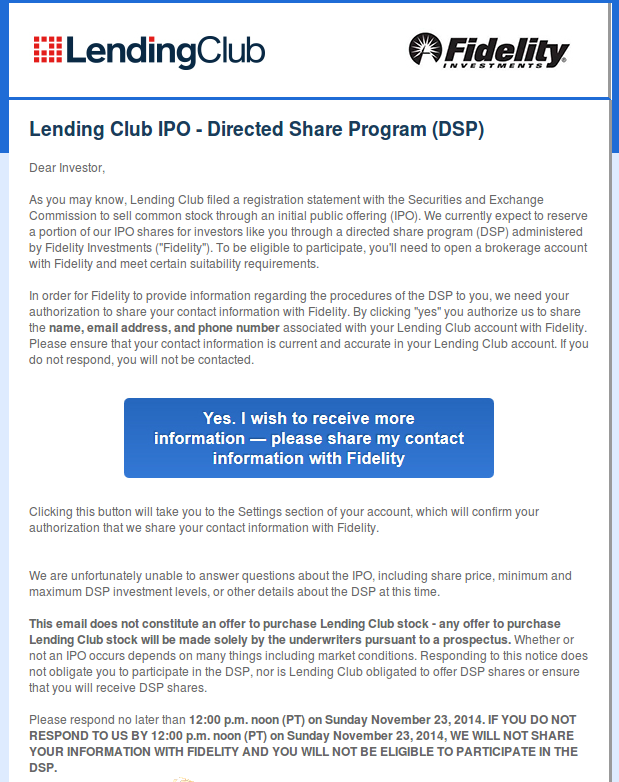
At $10-$12 a share, that’s an opportunity to spend a max of $3,500 to $4,200 on the IPO. Getting in won’t make you a millionaire but it’s a little way for Lending Club to say thank you to all those who invest on their platform.
I got the offer and turned it down. I’m very bullish on Lending Club stock but I feel like I’m already invested enough in them as a company through platform lending to need to get even more in. For those not sure how Lending Club really works, their system is not actually peer-to-peer. Investors buy Lending Club notes that are tied to the loans they issue. You are ultimately only investing in Lending Club with every note you buy. You have no relationship or claim to the borrower.
With that being the case, my tens of thousands invested in them is enough, especially from a retail investment standpoint. But I enjoyed the proposal nonetheless because it felt like a gift for getting in on the ground floor of something huge.
I also liked telling people over the last two weeks that I could get in on the Lending Club IPO.
“You hear about Lending Club going public?” I’d ask a friend. And then brag, “Yeah, well I have a chance to get in on the IPO if I want. I could talk to my guy to try to get you in but I don’t know if I can swing it. Maybe though.”
I was pretty damn important.
Until someone told me they could get in on the OnDeck IPO today. He apparently had an inside guy and that inside guy was E*Trade, as in he could apparently get in on OnDeck’s IPO just for having an E*Trade account.

One had to wonder why any schmo with a brokerage account was being asked to buy in. It didn’t sound good for OnDeck but I let my friend have his moment. His guy could try to get me in, etc.
The mass blanket invitation to get in might appear that brokers aren’t so confident about the company’s prospects. But actually back in January of this year E*Trade forged a “retail alliance” with middle-market investment bank Jefferies LLC. A Reuter’s story said that, “E*Trade is betting that it can score points with investors by guaranteeing access to IPOs that brokerage firms normally reserve for their best customers.”
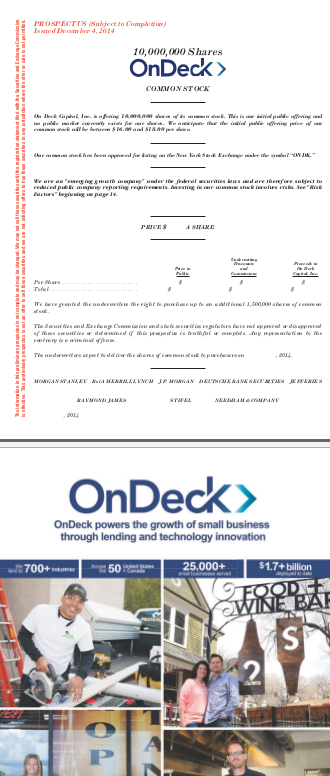 OnDeck’s underwriters include Morgan Stanley, Bank of America Merrill Lynch, JPMorgan Chase, Deutsche Bank and Jefferies. This is in line with “giving its customers access to initial public offerings and follow-on offerings underwritten by middle-market investment bank Jefferies LLC” though I haven’t confirmed the alliance is the cause of this.
Just as with Lending Club’s allocation offer, no one is guaranteed anything with OnDeck through E*Trade. There’s a required approval process which may ultimately yield nothing.
And yet it still feels a little weird, maybe because I’ve been hearing about an OnDeck IPO for years now and I just can’t grasp it’s actually happening. It’s one thing for a big banker to talk about it and another for an old college buddy, my doorman, and Jim who’s the cashier at the local hardware store ask me if I know anything about this OnDeck loan stock advance thing they heard about.
All I know is that sentiment on them is mixed but that ultimately insiders believe it’s great for the industry.
As for both of these the IPOs? I don’t know. I’m not getting in on either of them but it has nothing to do with how I feel about the companies. I can’t wait to watch this all unfold though.
Check out the 224 page OnDeck Prospectus!
OnDeck Already Filed Form S-1
September 27, 2014 Back on August 14th, the Wall Street Journal reported that OnDeck was preparing to file for an initial public offering. Since then, industry insiders have been bustling with anticipation to see the S-1 filing, the document that would reveal once and for all their true financial standing.
Update 11/18/14: Click to see OnDeck’s Public S-1 Filing
In between then and now, Lending Club, their rival in the business loan market, filed their S-1 on August 27th. The peer-to-peer lending world went nuts and merchant cash advance veterans such as AmeriMerchant’s David Goldin were asked to comment on BloombergTV.
And then… things quieted down. OnDeck went radio silent on August 14th, despite the SEC requiring such only after the S-1 form had actually been filed. Speculation began to build as to whether or not the WSJ report in August was a false alarm or misinformation. And with no word from the industry’s beloved charismatic superstar Noah Breslow, something seemed to be amiss.
And then the Financial Times dropped the bombshell that the registration documents had already been filed… last month… confidentially.
Admittedly, I didn’t even know a company could file confidentially, a process done offline so that it is not recorded electronically. Thanks to the JOBS Act, companies with less than a billion dollars in revenue can submit draft versions of their registration documents to the SEC, allowing the SEC to review, revise, and agree on a final version that will ultimately have to be made public. The takeaway here is that an OnDeck IPO is in the process and the registration documents will eventually be released. The law states that OnDeck must make the documents public at least 21 days prior to pitching investors.
The New Yorker walked readers through confidential registrations back when Twitter was planning their IPO, noting that it was not uncommon to choose this method, “Twitter is much like its peers: most small companies that have gone public since the passage of the JOBS Act have filed their S-1s confidentially,” the New Yorker said.
So why be secretive? The New Yorker continues to explain:
From the perspective of companies, the new rule has a couple of virtues. First, it allows companies that are thinking about going public to test the waters—they can gauge investor reaction, get feedback from the S.E.C. on their filings, and so on—before deciding if they want to go ahead with an I.P.O. If a company goes through that process publicly, and then decides to abandon the offering, its reputation gets damaged, even though it often makes sense for a company not to go public. Do it privately, and no one gets hurt.
-Source: http://www.newyorker.com/business/currency/the-virtues-of-twitters-confidential-i-p-o-filing
OnDeck’s biggest critics are their competitors, naysayers convinced that they are recklessly undercutting pricing to acquire market share. Indeed FT reported that OnDeck posted annual losses of $16.8m and $24.4m in 2012 and 2013, and losses of $14.4m in the first half of 2014.
 With $1.3 billion funded since 2006, an independent report cited in the registration by Oliver Wyman estimates the untapped market to be between $80 billion and $120 billion.
There’s plenty of runway left, but OnDeck has yet to turn a profit. In An Insider’s Perspective, I wrote, “What scares their competitors though, is that this strategy has been intentional. Very few if any players in the industry have had the luxury, guts, or the purse to lose money for seven years as part of a coup to conquer the market.”
If the IPO goes through, we can all place actual monetary bets on the company’s future. What a trip that will be. I expect the stadium of insiders to get loud once the public documents are released. Good luck OnDeck.
The Deal
May 25, 2014When times are tough, small businesses take chances. Last year, a family run business in Cohasset, MA made a snap decision and agreed to a $75,000 loan with infinity percent interest, literally. The principal was completely repaid in just 74 days but as per the contract, they still had to make fixed interest payments for as long as the business was open.
It wasn’t necessarily a good deal. Heck, some might think it was a really bad deal, but they got the cash when they needed it. The perpetual fixed payments kicked in after the principal was repaid because the lender structured them as royalty fees. A normal merchant cash advance will take a percentage of a merchant’s sales up until a predetermined amount has been satisfied, but this deal required a percentage forever. Is Wall Street running amok yet again? Shouldn’t people be monitoring stuff like this?
As it would turn out, about 6.5 million people were witness to this transaction. More than half of those people, most of whom are hard-working American families, cheered the business owner on. That’s because this deal had nothing to do with Wall Street and did not involve a commercial loan broker.
The business is named Wicked Good Cupcakes and it’s a deal they made on Shark Tank, a hit TV show on ABC. Kevin O’Leary loaned them $75,000 and took a percentage of every sale until he was repaid just 2.5 months later. Since then he is taking a permanent royalty of 45 cents per cupcake sold.
As quoted in the Boston Business Journal
“The royalty deal has worked great for us,” said Tracey Noonan, the CEO of the company.
Many people told her immediately following the deal that she was stupid. But today, Wicked Good Cupcakes is doing better than ever.
O’Leary, whom the business owners called an “angel in disguise” has referred to the deal as one of the most phenomenal ever made on the show. Wicked Good Cupcakes is actually on pace to do $3 million in revenue in 2014.
While it’s true that part of their success is due to the appearance on the show, nowhere does it say that entrepreneurs have to agree to take a deal if offered one. That means the owners could have walked away from O’Leary’s offer and still experienced the same post-show hysteria of celebrity. But they needed the money… and there was an offer on the table. It wasn’t the best deal, but it was A deal.
And that’s the nature of business. Everything is about circumstances. You could be flush with cash or in a pinch, growing fast or playing defense. All the while opportunities and obstacles approach from every turn.
 Unlike consumers who are afforded protections from making decisions that might not be in their best interest, small businesses are free to pursue whatever strategy they want. The best part about capitalism is that you’re the master of your own destiny.
The terms O’Leary offered to Wicked Good Cupcakes were not unique. Just recently in the 12th episode of Season 5, he offered a $100,000 loan to Tipsy Elves that once repaid, would still require payments in perpetuity in the form of a royalty fee for every sale. That’s an equivalent APR of infinity. In the end, they turned it down and went with Robert Herjavec’s equity offer instead.
Many viewers have taken to twitter to share their doubts about the viability of the Tipsy Elves business model, which is selling ugly Christmas sweaters. That healthy dose of skepticism is something alternative lenders are no strangers to, and as such they tend to price their deals accordingly.
Even deal making that is done on TV in front of millions of witnesses can go sour. Just ask Marcus Lemonis, the star of the TV show The Profit, who recently made a deal with a business in my own backyard, A. Stein Meat Products in Brooklyn, NY. After learning the business was on the brink of insolvency, Lemonis offered them a cash lifeline in exchange for buying their Brooklyn Burger brand at a bargain price of $190,000. In any other circumstances, that deal might not have happened.
Lemonis expeditiously wired them the cash, but never got what he paid for in return. Mora and Buxbaum, the owners, claim the funds were a loan but they have never made a payment. Defaults like these happen every day, especially in alternative business lending.
Hated to do it but here's the update on stein meats and Brooklyn burger. I tried not to but was ignored for 90 days. http://t.co/4oyYOiXK68
— Marcus Lemonis (@marcuslemonis) May 16, 2014
The entrepreneur applies for a business loan, the loan gets made, and the borrower quickly defaults. The result is that the price goes up for the next guy. That’s the risk part that lenders always talk about, the odds that they’re not going to get paid back. If every business repaid their loans, the average cost of financing in alternative business lending would probably be about 6% a year, around what an A rated personal loan costs on LendingClub, instead of the high double digit or triple digit rates that exist now.
Even Kevin O’Leary isn’t taking any chances, hence he protects himself by charging infinity percent interest, and America thanks him every Friday night for blessing entrepreneurs with an opportunity. It’s not the best deal, but it’s A deal.
Small business owners are sophisticated enough to make tough decisions all on their own. That’s the reason we can put them in the public eye, in front of more than 6 million people who either cheer for their success or literally cry out for their demise. These entrepreneurs don’t go on Rainbow & Unicorn Tank, they go on Shark Tank. Sometimes the entrepreneurs walk away with a partner, sometimes they get a loan with infinity percent interest. In the end, it’s their choice, a choice that 36,000 small businesses hoped they would have in 2012. That’s how many applied to be on the show that year.
Business is business and a deal’s a deal. The ball’s always in your court…
Quotes from Kevin O’Leary
Business is war. I go out there, I want to kill the competitors. I want to make their lives miserable. I want to steal their market share. I want them to fear me and I want everyone on my team thinking we’re going to win.
Here’s how I think of my money – as soldiers – I send them out to war everyday. I want them to take prisoners and come home, so there’s more of them.
You may lose your wife, you may lose your dog, your mother may hate you. None of those things matter. What matters is that you achieve success and become free. Then you can do whatever you like.
I’m not a tough guy. I’m just delivering the truth and only the truth and if you can’t deal with it, too bad.
Nobody forces you to work at Wal-Mart. Start your own business! Sell something to Wal-Mart!
Don’t cry about money, it never cries for you.
The only reason to do business is to make money; that’s the only reason for doing business.
Money has no grey areas. You either make it or you lose it.
Working 24 hours a day isn’t enough anymore. You have to be willing to sacrifice everything to be successful, including your personal life, your family life, maybe more. If people think it’s any less, they’re wrong, and they will fail.
I have met many entrepreneurs who have the passion and even the work ethic to succeed – but who are so obsessed with an idea that they don’t see its obvious flaws. Think about that. If you can’t even acknowledge your failures, how can you cut the rope and move on?
I don’t mind rude people. I want people that I can make money with, so if their executional abilities are good, and they’re arrogant and rude, I don’t care.
Can you handle it?
LendIt Conference: The State of Alternative Business Lending
May 6, 2014 Have you heard? Banks aren’t lending. Nobody at LendIt seems to mind though. Ron Suber, the President of Prosper Marketplace, said earlier today that banks are not the competition. That’s an interesting theory to digest when contemplating the future of alternative lending. If banks are not the competition, then who is everyone at LendIt competing against? I think the obvious answer is each other, but much deeper than that, the competition is the traditional mindset of borrowers.
The biggest challenge the wider alternative lending industry faces is awareness and understanding. Those happen to also be two of Suber’s three edicts for growth. The third is education. Just because alternatives are available today doesn’t mean that potential borrowers know about them or feel comfortable enough to use them. Today we are competing against the old way of thinking.
Revolution?
Other products in the new “share economy” have encountered a similar struggle. Several presenters today cited Uber as having revolutionized the way people use taxis. “A long time ago, people used to stand on corners and hold out their hand to get a cab, but that’s all changed,” was the oft-paraphrased proof that age-old industries were falling like dominoes. But as a New York City resident, I hadn’t quite noticed a change at all. Hailing cabs off the street is still very much the norm. It is only by sheer coincidence that I used Uber for the very first time to travel to JFK airport on my way to this conference.
I first encountered Uber a year ago when an acquaintance dazzled me with his ability to summon a car using an app on his phone. It was then that I became aware, but I did not understand how it worked. It took me 12 months to get comfortable enough to try it myself, and the experience was okay I guess if you discount the fact that my driver went through the E-ZPass lane without actually having an E-ZPass. Needless to say, that led to a major holdup that caused me to almost miss my flight.
If it took me a year to get past the confusion of hailing a cab from my phone, I can only imagine what potential borrowers must think when told they can raise money from their peers, the crowd, or a lender that requires payments to be made every single day.
Perhaps most telling about the awareness challenge, is that many people I’ve spoken to at LendIt had never heard of a 16 year old product known as merchant cash advance. That speaks volumes about how much more work merchant cash companies still have to do in order to gain mainstream awareness.
Even those fully aware were not entirely certain about how to define the product. In the Online Lending Institutional Investors Panel, merchant cash advance was briefly discussed as a topic but it was almost entirely spoken in the context of being something that OnDeck Capital does. That would come as disheartening news to OnDeck since they have spent considerable resources in positioning themselves as anything but a merchant cash advance company. Confusion over what somebody is or isn’t will probably increase especially as alternative lenders from different industries start to compete for the same clients.
Funding businesses instead of people
Brendan Ross, the President of Direct Lending Investments, and the moderator of the Short Term Business Lending panel pointed out that a dentist could pursue two different loan options and get completely different results. With excellent credit a dentist could expect to land a 3-5 year personal loan at 7-8% APR on a P2P platform. If he were to apply for the loan using his dental practice though, he could expect to incur costs over 25% and get nothing longer than 2 years.
Ross, who was a very active moderator, subscribes to the belief that businesses are overpaying for credit. Unlike the consumer loan space, there hasn’t been price compression. The cost of business capital remains high, perhaps higher than what is necessary to turn a reasonable profit. Ross argued that the padded cost serves as a hedge against defaults and economic downturns. “The asset class works even when the collection process doesn’t,” Ross said. “The model works with no legal recovery.”
Building on that premise, Ross asked the panelists if an increase in defaults were simply the cost of doing business towards automating the underwriting process.
Stephen Sheinbaum, the CEO of Merchant Cash and Capital argued that just the opposite had occurred, that automation had led to a decrease in defaults. Others on the panel confirmed a similar outcome, though Rob Frohwein of Kabbage admitted they could potentially weather higher defaults through automation by offsetting it against decreased infrastructure costs.
Noah Breslow of OnDeck echoed something similar to Frohwein in the Small Business Term Lending Panel. He asked this question, “Do underwriters add value or not?” and followed up by saying that 30% of their deals were still manually underwritten, usually the deals that are larger.

Is full automation right around the corner?
The debate between humans and computers in risk analysis is a featured segment in the third issue of DailyFunder that is being mailed out this week, but there is another angle that is seldom discussed, whether or not customers want automation. Breslow said today that, “if customers want full automation, we are prepared to deliver it.” They’ve learned over time that “many customers want someone to talk to at some point in the transaction.” Rohit Arora, the CEO of biz2credit expressed much of the same in a recent interview with DailyFunder’s Managing Editor Michael Giusti.
The only dissenting voice was Gary Chodes, the CEO of Raiseworks who seemed to be of the belief that human involvement in underwriting was nothing short of ridiculous. He stated that, “if you look back over the last 20 years, the loss rates on business loans under 24 months has been really low.” To him, that data seemed to be proof enough that complete automation could and should be achieved, though he admitted to performing back-end checks such as landlord verifications. They currently have no physical underwriters however.
Is there a transparency problem?
Tom Green, a VP of LendingClub shared an interesting tale. While trying to convince potential borrowers to ditch a merchant cash advance in favor of a LendingClub business loan, they get pushback on the cost of their money. The reason being? Some borrowers think they’ve already got a great deal or at least a better deal than what LendingClub is offering. The problem stems from the borrower’s belief that the holdback percentage set up in their future revenue sale (the most common way a merchant cash advance is set up) is the APR.
 Merchant Cash Advance Companies pay cash upfront in return for a specified amount of a businesses’s future sales. They collect these sales by withholding a percentage of each credit card transaction or bank account deposit until the agreement is satisfied in full. On a dollar for dollar basis, the cost of these programs typically range from 20%-49%, but on an APR basis, substantially higher. The holdback % is not even a factor in the APR. Green said they’ve learned that some small business owners are not sophisticated when it comes to finance.
Ethan Senturia, the co-founder of Dealstruck would probably agree. Earlier today he said, “you need to speak the borrower’s language.” Some understand APR, some don’t. “Dealstruck offers more than just APR comparisons to borrowers,” Senturia said. “Whatever helps them understand.”
When the OnDeck Capital model and merchant cash advance model were questioned as possibly being bad for borrowers, Tom Green was quick to clarify. “There are different capital needs that small businesses have,” he said. And “there is a trade-off between the length of the term and the risk.”
OnDeck Capital’s clients are not entrepreneurs born yesterday. “The typical customer has been in business for 10 years,” Breslow said. Their deals are “structured to protect through daily and weekly payments in addition to the interest rates we charge,” something he reminded everyone was “not single digits.”
Still, transparency issues remain in business lending. Sam Hodges, the Managing Director of Funding Circle explained that when he was previously a small business owner, there were hardly any lenders willing to provide him with an amortization schedule. Ashees Jain, a managing partner of Blue Elephant Capital Management admitted he would find it hard to justify the high rates of merchant cash advance if asked by a regulator, so he’d rather not invest in that market. When it comes to those types of transactions, they “don’t want to have to explain themselves” at some point in the future.
Scott Ryles, the managing member of Echelon Capital Strategies, LLC commented on OnDeck capital’s model as unbelievable. “The arbitrage is huge,” Ryles said. And Eric Thurber the managing director of Three Bridge Wealth Advisors believes that alternative business lenders are at odds with themselves. “They always talk about their risk management,” Thurber said, but he feels that players in that industry are concerned with how much market share they have. That conflicts with risk management in his opinion.
They pay or they don’t
At the end of the day Ashees Jain said as far as unsecured loans go, “borrowers pay or they don’t.” The recovery process on secured loans can be 12-18 months Jain said, a statistic cited by Brendan Ross earlier in the day.
It’s clear at LendIt that there are a lot of products available, but Ryles summed it up nicely. In the consumer space, all the volume is in the 36 month installment loans, he reckoned. For businesses it’s merchant cash advance. “It’s an awareness thing,” Ethan Senturia said in regards to getting businesses to use alternative lending sources.
It is indeed. Awareness, education, and understanding…