
Levo Funding Makes Debut
January 8, 2024January 8, 2024 — We are excited to present Levo Funding, a new addition to the financial industry. A dynamic and innovative fintech company, Levo Funding has launched with a team of industry veterans at the helm. With a wealth of experience and a reputation for excellence, this new venture is committed to reshaping the industry.
“We are thrilled to introduce Levo Funding,” said Christopher Ives, the company’s Co-Founder and CEO. “Our team comprises industry veterans who have successfully navigated the complexities of the finance sector for years. This includes learning from our successes and our failures. We’ve come together to create a fintech company that focuses on the simplicities of what we do; help businesses access capital, and ensure that entrepreneurs and companies have the resources they need to thrive. We are committed to doing business the right way, and are looking forward to working with those that share the same values.”
Levo Funding aims to fill an emerging gap in the market by providing flexible funding options, streamlined application processes, and personalized support, while not being anchored by covenants and the increasing costs of capital. Their approach is rooted in a deep understanding of the challenges faced by businesses of all sizes, and they are committed to delivering financing solutions that empower growth and success.
As a testament to their expertise and accelerated growth, Levo Funding has already secured significant investment backing from reputable partners and investors who share their vision for the future of finance. This substantial funding ensures that the company is well-prepared to meet the capital needs of businesses across various industries.
Christopher added, “Our team’s collective experience spans various sectors, including banking, venture capital, private equity, credit and underwriting. We understand that one size does not fit all when it comes to financing. We are dedicated to tailoring our solutions to the unique goals and challenges of each client. Our team was carefully selected to build a culture of trust and encourage open communication. When people are comfortable sharing ideas, everyone wins.”
For more information about Levo Funding, please visit levofunding.com. Stay updated on their latest developments and news by following them on Linkedin.
Contact
(619) 908-1372
info@levofunding.com
Expansion Capital Group Announces $1 Billion Funding Milestone — Supporting the Expansion of U.S. Small Businesses
December 13, 2023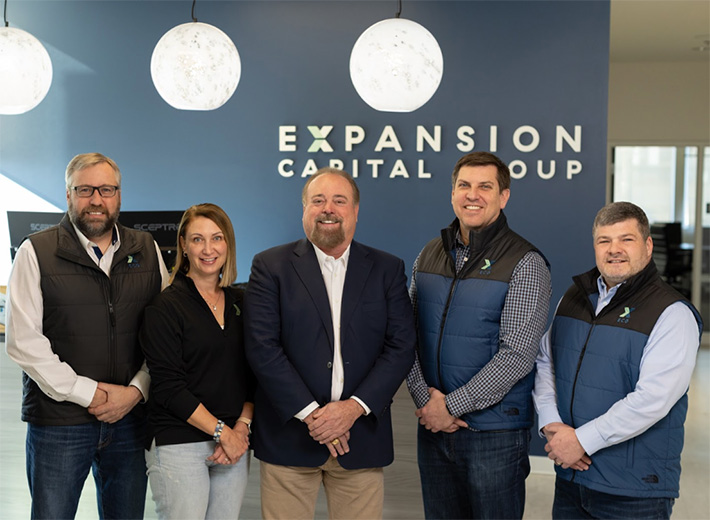
L-R: Herk Christie, Chief Operating Officer; Brittney Newell, Chief Financial Officer; Vincent Ney, Chief Executive Officer;
Tim Mages, Chief Strategy Officer; Mike Beattie, Chief Technology Officer
Photo Credit: Reistroffer Design
SIOUX FALLS, SOUTH DAKOTA—Expansion Capital Group, LLC (“ECG”) is pleased to announce its billionth dollar in funding, reinforcing its mission to support the “Expansion” of America’s Small Businesses with simple and efficient capital. Since inception in 2013, ECG has provided services to over 20,000 small businesses across multiple industries nationwide. ECG’s core solution, a six to 11 month working capital product, meets the needs of small business owners that are not in a position to wait for a traditional bank loan.
Tim Mages, Chief Strategy Officer of ECG said, “The ECG team is proud of its efforts to fulfill the capital needs of small business owners. Capital challenges have been magnified since COVID and the recent muted lending environment by regional and community banks. During the last three years, inflationary pressures have negatively impacted many hardworking small business owners. ECG has continued to be a reliable partner and a key resource as business owners navigate these headwinds.”
He continued, “In the last two years, we’ve seen accelerated growth of our platform. This growth is being driven by two key factors. First, our industry-leading Partner Portal is designed to create a transparent and seamless process for our referral partners. Second, investments in new technology and data sources have positioned ECG to provide underwritten approvals in less than an hour. These innovations would not have been possible without the trust of our valued customers and dedication of our 85+ team members.”
ECG’s Chief Operating Officer, Herk Christie, said, “Paramount to our success is the support from our referral partners. Since inception, we’ve also seen over one million applications from small business owners. Our financing alternatives provide business owners with more options and availability, so they can successfully execute their business objectives.”
As an on-balance sheet working capital provider, ECG is committed to providing customized solutions for small businesses. ECG works directly with small business owners and with hundreds of referral partners who are trying to meet their clients needs. ECG utilizes proprietary data, analytics, and systems to provide access and capital in a timely manner. Its robust underwriting models and flexible Partner Portal platform allows business owners to compare options and select a product that fits their needs.
Brittney Newell, ECG’s Chief Financial Officer added, “We hope to continue this growth in the coming years and appreciate the support of our long-time capital provider Bastion Management. As many market participants have tightened lending standards throughout 2023, ECG is committed to continuing to meet the increased demand for our services and offerings.”
PR Contact: tamara@tamaraedwards.co
###
Expansion Capital Group is headquartered in Sioux Falls, SD and operates as a technology-driven specialty lender harnessing data and analytics to offer tailor-made solutions for small business enterprises. The company primarily serves small businesses across the United States with annual revenues of less than $10 million. For more information, please visit www.ecg.com and follow us on LinkedIn and Twitter.
Recent ECG News
Sioux Falls Business Journal: Fast but careful money: Sioux Falls firm offers new kind of capital
Inc. 5000: Financial services firm partnering with small business owners to provide working capital solutions with speed, simplicity and service.
Mastering Taxes for Merchant Cash Advance Businesses – Cash Basis 101
December 7, 2023David Roitblat is the founder and CEO of Better Accounting Solutions, an accounting firm based in New York City, and a leading authority in specialized accounting for merchant cash advance companies. To connect with David or schedule a call about working with Better Accounting Solutions, email david@betteraccountingsolutions.com.
 For funders in the merchant cash advance industry, navigating through various funding scenarios is a common challenge. There are many different ways to fund your MCA business–including institutional money, using your own funds, partnering with syndicators, or involving outside investors– and understanding how to recognize income for reporting to your partner, syndicators, investors and the IRS is essential to avoid tax and compliance issues down the line.
When I started Better Accounting Solutions in 2011 and began working with clients in our industry, I found the accounting world wholly unprepared for the different funding streams MCA businesses worked with, and in the years since, we’ve managed to systematize and customize the income recognition process for the entire industry, particularly in the context of accrual basis reporting, as we’ve become more and more ingrained in the space..
Let’s explain how, starting by exploring the different funding scenarios your business might find itself in:
Using Company’s Own Funds: Some funders rely solely on their own company’s money to provide advances. In this scenario, the funding is entirely self-financed, and the company does not seek external investments.
Equity Partner of the Funding Company as Syndicators: Other funders collaborate with partners who contribute money as syndicators, in addition to using the company’s funds. This means that both the company and its partners are involved in funding the deals.
Outside Syndicators and Investments: Certain companies involve outside syndicators, who are not part of the company’s core team or partners, to provide additional funding. This setup allows the company to expand its funding capacity beyond internal resources and institutional investors.
Income Recognition for Reporting and Tax Purposes
Typically, for funders using their own company’s money, there are two primary ways to recognize income— one for reporting purposes and the other for tax purposes.
Cash Basis Reporting: Cash basis reporting recognizes income and expenses when actual cash is received or paid. In this method, income is recognized when the money hits the bank account, and expenses are recognized when the money leaves the credit card or bank account.
Accrual Basis Reporting (GAAP): Accrual basis reporting, also known as Generally Accepted Accounting Principles (GAAP) reporting, is used by Certified Public Accountants (CPAs) when auditing financial statements. Unlike cash basis reporting, accrual basis recognizes income when earned, regardless of when the cash is received, and expenses are recognized when they are accrued. (More about GAAP in a future article)
Challenges in Income Recognition for Merchant Cash Advance
Recognizing income in the merchant cash advance industry can be complex, especially when dealing with cash advances rather than traditional loans. Unlike loans, where regular payments consist of interest and principal, merchant cash advances involve the purchase of future receivables.
Consider this example: A merchant cash advance provider funds a merchant with $100,000 at a commission expense of 12% and a Junk Fee income of 10%. The bank fee income and RTR/Factor Rate is.5, while the merchant will pay back $150,000, $1,500 daily assuming a 100 day duration.
Cash Advance Income Recognition Approach in Cash Basis Accounting:
Because of this unique funding structure, here’s how my team at Better Accounting Solutions recommends reporting the income (BAS will typically use Accrual Basis reporting for business owners, and note-holder investors, and cash basis for tax reporting if the company’s revenue is less than $10 million annually):
Commission Expense and Junk Fee Income: The commission expense and junk fee income are recognized immediately (in most scenarios) on the day the advance is given, deducted from the funded amount.
Factor Income: Until the full contract funded amount of $100,000 is received in the funder’s bank account (not just the amount wired), no additional income is recognized. Once the contract amount is fully received on a cash basis, any payments received after that point constitute factor income or RTR income.
What’s the benefit of reporting this way?
By reporting on a cash basis you are deferring the recognized tax income. For example, if you have a deal that was funded in November over five months, you will have been only about forty percent in the payback by the time the tax calendar year is over. Since you would have not received the contract funded amount back yet , you would not recognize any of the factor income for tax purposes until the following year, thereby deferring your tax liability. This means you have more time to spend that money and grow your actual business.
It’s important to acknowledge that accounting practices can vary, and accountants may have differing opinions on income recognition. The approach outlined here is definitely an aggressive method, but one I continue advocating using for IRS and tax purposes, for the reasons listed above.
As we’ve said, navigating income recognition in the merchant cash advance industry can be challenging due to the unique nature of cash advances. Understanding the funding scenarios, recognizing income for reporting and tax purposes, and considering different accounting methods are crucial for funders and companies in this space, and will give you a leg up come Tax Season.
It’s essential to emphasize that this article is for informational purposes only and should not be construed as accounting or financial advice. It’s strongly recommended for funders and companies to seek guidance from qualified accountants or financial professionals to ensure compliance with accounting standards and tax regulations tailored to their specific circumstances.
Why I’m An Evangelist…. For Outside Accounting Firms in MCA
November 9, 2023David Roitblat is the founder and CEO of Better Accounting Solutions, an accounting firm based in New York City, and a leading authority in specialized accounting for merchant cash advance companies. To connect with David or schedule a call about working with Better Accounting Solutions, email david@betteraccountingsolutions.com.
 For over a decade, since the explosion of the merchant cash advance industry in the United States, my team and I at Better Accounting Solutions have been working with a growing number of people and businesses involved in the industry, including brokers, funders, syndicators and investors. We’ve spent time meeting and mingling with you at industry events like Broker Fair and spent more hours talking on the phone advising you than we can bill for.
All this experience has led me to one conclusion, one reinforced the longer we work together with many of you: to thrive and be successful in the merchant cash advance industry, you need a third-party independent financial expert embedded in your business and books.
To declare the obvious context and biases up front: yes, this benefits businesses like mine and yes, I know this from working with many of you. But people become knowledgeable and experts in their own field that they’ve spent years studying and developing, which is why I feel qualified to discuss this.
In the ever-evolving world of merchant cash advance and its challenging relationship with transparency and ethics, trust with your business partners is a must.
Having independent third-party financial experts that report to both parties-for example between a funder and their syndicators- is the only way to ensure complete transparency without bias or conflict. It eliminates the possibility of the funder misappropriating the syndicator’s investment and skimming off what the investors are owed. Firms like ours excel in tracking the numbers to see the deals that are working and the ones that aren’t, and can demonstrate what is trending down to stop a bad deal from spiraling into a company-killing problem.
People often choose to rely on a single in-house accountant to manage their books because they want exclusive focus, but there are plenty of downsides to that as well. Not only are accountants hired from another corporate job rarely equipped to accurately track deals in the complicated world of cash advance, but they are also incentivized to make their reports as favorable as they can to their own company, which may scare syndicators and investors whom they have no obligations to. By outsourcing these critical functions to a specialized firm, MCA funders send a clear message to investors and syndicators: they take financial accountability seriously and they are a trustworthy and transparent business to work with, with open books for their partners to peer in.
Industry scandals that bring our profession into disrepute- such as the collapses of MJ Capital Funding, LLC and 1 Global Capital– were able to happen because the investors pouring money into what they thought were legitimate MCA businesses weren’t given access to the companies books until it was too late and hundreds of millions of dollars were forever lost.
Obviously, you should be wise about people’s motives, even mine as the author of this article, but you should also take every piece of advice into consideration, particularly one that objectively suggests measures that fosters and promote trust and better business growth practices.
Remember, in the world of finance, trust is the most valuable asset of all.
Nice Yacht, Someone Financed It
October 26, 2023 Every sentence sounds better ending with the word “yacht.” Enjoying crackers and cheese on a yacht. Sipping champagne aboard a luxurious yacht. Even making money financing high-end yachts, the charm remains intact. Over the past six years, East Harbor Financial has been offering a range of financing solutions under their Luxury Assets category, which includes exotic cars, aircraft, and vessels. While the company has been in business for 11 years, President Bruno Raschio’s foray into the yacht industry provides a unique perspective from an outsider turned insider.
According to Yatco.com, there are currently 592,000 yachts in the United States and the global market size was valued at $8.91 billion in 2022, with expectations to expand 5.8% from 2023 to 2030. The most Raschio has ever financed on one unit was $2 million and he admits there is a lot of money to be made in this sector, but people must be willing to welcome the risk that comes with it.
“Lenders who embrace risk and identify a specialized market can consistently generate profits in a business,” said Raschio. “Nonetheless, market corrections often possess the capability to level out the gains amassed during prosperous years.”
Raschio emphasized that the industry has many brokers that do not necessarily need an in-depth knowledge on yachts. Nevertheless, the significance of understanding yachts itself is always advantageous. In the case of private lenders, like his own company, Raschio advised focusing on financing high-quality yachts that possess strong market appeal and retain their value.
With the increase in manufacturing costs, Raschio states that prices may not revert to pre-Covid rates, like when they initially joined the yacht industry. For instance, A-credit rates, which used to range from 4½ to 5% before the pandemic, have now risen to 8 to 9%. Similarly, rates for B, C, and D credit ratings, previously between 10 to 13%, have surged to 14 to 19%.”
 “Consider this scenario, if you were buying a million-dollar yacht before, you’d typically put down 30%, leaving you with a financing amount of $700,000,” he said. “However, in a post-Covid market, if the same yacht is selling for $1.5 million and you still put down 30%, you’d be looking at financing $1,050,000. That means you’re financing nearly $50,000 more than its pre-Covid value.”
East Harbor specializes in financing high-end yachts, brands like Sunseeker, Azimut, Ferretti, Pershing, and Princess. Transactions typically range from $600,000 to $1 million, covering yachts that fall within the 40 to 75-foot size range. Working with clients nationwide, the primary regions where the company provides financing are South Florida, which is the largest market, California’s Newport Beach, the second largest, and various areas along the east coast, the third-largest market. The company exclusively offers short-term loan options, typically lasting between 5 to 8 years, as opposed to the more common 15 to 20-year loan terms for yachts.
“We prefer to expedite our financing process since we rely on private funding,” Raschio explained. “Furthermore, this type of financing is generally costlier than traditional bank loans. Therefore, many individuals find it more sensible to present it as a short-term solution, where you secure your financing, achieve your objectives, and exit, or sell the boat.”
Upon entering the boat financing business, Raschio first’s client came to him with a million-dollar yacht with a $500,000 down payment. It seemed like a solid deal, but there was also a high likelihood that the yacht was going to need very expensive repairs. Its details like this that can change the entire dynamics of the deal and it was a teaching moment for him.
“As an example, a major repair on a used yacht that’s heavily depreciated could cost more than the entire used yacht price,” said Raschio.
ELFA Announces Leigh Lytle as New President and CEO
October 23, 2023 PHOENIX, ARIZONA, October 23, 2023 – The Equipment Leasing and Finance Association (ELFA) today announced the appointment of Leigh Lytle as President and CEO, effective Dec. 4, 2023. ELFA Board Chair Bob Neagle made the announcement this morning at the General Session of the 62nd ELFA Annual Convention in Phoenix, Arizona. Lytle will succeed Ralph Petta, who is retiring from the association at the end of the year.
“We are pleased to welcome Ms. Lytle to ELFA as our new President and CEO,” said Neagle. “Leigh is a dynamic leader whose experience, passion and vision make her uniquely qualified to guide our association into the future. Her experience in banking, operations, advocacy and education, and most recently with a fintech company and a fintech trade association, will add momentum to our current ELFA efforts in those same areas. After conducting a national search, we are delighted with this outcome and the opportunity it offers our organization. I would like to thank our search committee for their tremendous work throughout the process.”
As the Head of North American Policy at Plaid, Lytle led education and engagement efforts with regulators and financial institutions. In this role, she advocated for protecting consumers’ rights within the digital financial ecosystem and in Washington, D.C. She also served as the Chair of the Board of Directors of the Financial Technology Association (FTA), which represents innovative companies shaping the future of finance. The industry trade group champions the power of technology-centered financial services and advocates for the modernization of financial regulation to support inclusion and responsible innovation. Before joining Plaid, Lytle spent over 15 years in the Federal Reserve Bank system in various executive roles ranging from engagements in monetary and regulatory policy to operations and data analytics oversight.
“I am honored to be joining the Equipment Leasing and Finance Association as the organization moves into its next phase and navigates the digital landscape and abundant opportunities on behalf of our members,” said Lytle. “The association has an incredible board, members and team championing this critical sector that adds tremendous value to the American economy. I am proud to join the ELFA staff to build on the solid foundation established by Ralph Petta and the team, and look forward to meeting with and working with our members in the coming months.”
About ELFA
The Equipment Leasing and Finance Association (ELFA) is the trade association that represents companies in the $1 trillion equipment finance sector, which includes financial services companies and manufacturers engaged in financing capital goods. ELFA members are the driving force behind the growth in the commercial equipment finance market and contribute to capital formation in the U.S. and abroad. Its 575 members include independent and captive leasing and finance companies, banks, financial services corporations, broker/packagers and investment banks, as well as manufacturers and service providers. For more information, please visit www.elfaonline.org.
###
Media/Press Contact: Amy Vogt, Vice President, Communications and Marketing, ELFA, 202-238-3438 or avogt@elfaonline.org
Lending Industry Expert Joe Valeo Appointed President of SmallBusinessLoans.com
October 20, 2023NEW YORK SmallBusinessLoans.com (SBL) is pleased to announce the appointment of Joe Valeo as its new President. With over 35 years of experience in finance and sales, Valeo brings a breadth of knowledge to his executive leadership role at SBL, where he is committed to making the “right fit” lending solutions more accessible to small business owners.
In his previous positions, Valeo gained strategic development and consumer/business lending experience, serving financial services organizations such as LendingPoint, where he held the position of EVP/GM for POS merchant lending and direct-to-consumer loans. Before that, at Capital Access Network, he led sales strategy and management. His extensive background in payment services to merchants at First Data Corporation and Citicorp, managing e-commerce, ISOs, and franchises, as well as his experience managing acquirer and issuer relationships with key financial institutions at VISA, uniquely positions him to lead SBL to new heights.
Valeo’s vision for SmallBusinessLoans.com is straightforward and ambitious. His growth strategies include connecting with his deep finance industry network and implementing financial and business solutions to meet SMBs’ needs.
With his leadership, SmallBusinessLoans.com is positioned to:
- Be the preeminent destination for small businesses seeking financing and related business services digitally. The SBL platform cuts out time-consuming research and matches small businesses with trusted lenders who offer a variety of financing to suit every business need.
- Provide a simple, efficient application journey to help small businesses qualify for the right product and solution, ensuring easy access to financing and business services.
- Assist business owners in meeting immediate financing needs, helping them thrive in the long run. SBL serves various industries, including agriculture, commercial trucking, construction, landscaping, medical practices, and more.
Known for his problem-solving skills and quick thinking, Valeo is excited about leading a team of dedicated bridge-builders who will connect businesses and consumers to the funding they need to build their businesses and improve their lives. His commitment to customer-centric solutions makes him an ideal fit for SBL.
Valeo expressed his enthusiasm for his new role, “I strongly believe we’re doing something special, different, and market leading. Our mission is to provide a simple and easy way for businesses to access financing and business solutions.”
As passionate advocates for small businesses, Valeo and the SBL team are eager to converse with potential partners and business owners seeking small business financing and operations solutions.
For more information and to connect with us, please visit us at: www.SmallBusinessLoans.com.
About SmallBusinessLoans.com (SBL)
SmallBusinessLoans.com (SBL) helps small business owners connect with their best financing solution. With a commitment to simplifying the lending process and making it easy for business owners to find trusted, reliable lenders, the SBL platform matches business owners with lenders who offer fast funding, flexible terms, personalized options, and more to help small businesses thrive. SBL aims to become the go-to digital destination for small businesses seeking financing and business services. For more information, go to www.SmallBusinessLoans.com
Contact:
Susan Almon-Pesch
sue@speschialpr.com
858-205-0516
With Fraud on the Rise, AI Can Fill in the Gaps
October 19, 2023 In today’s dynamic world of fraud detection, technology, and artificial intelligence (AI) are allies. The insights of industry experts, Yinglian Xie, a technology veteran with a background at Microsoft Research and CEO at DataVisor, Sandip Nayak, President at Fundation, and Andrew Davies, Global Head of Regulatory Affairs at ComplyAdvantage, discuss the transformative role of AI in fraud prevention.
When DataVisor started, it primarily offered advanced machine learning solutions, through an unsupervised approach. In other words, their programs can spot fraud without needing a loss or training labels; they can automatically identify suspicious activities. Xie explains that AI’s ability to make rapid decisions during real-time transactions depends on the amount of data available for this process. To achieve a proactive response, it must be synchronized with real-time data, as opposed to a manual or “supervised machine learning” approach.
“We need to kind of switch the traditional approach looking at fraud being very much kind of an isolated case, like a manual approach, and into something we need technology for, said Xie. “And we need to essentially be able to make decisions instantaneously as well.”
In addition to unsupervised learning algorithms, Xie explains that generative AI falls into another category of fraud detection. This method describes the data and communicates information back in human-like responses. Xie gives an example that as customers, some may not understand why a transaction was rejected and that’s where generative AI comes to rationalize the reason behind the rejection.
Echoing Xie, Nayak described solutions where traditional techniques fail, one of them being unsupervised learning algorithms. These algorithms can use techniques like anomaly detection to actually hone in on “the needle in a haystack problem.”
“Number two, the automated and advanced nature of AI can really solve the shortcomings of rules based and human based approaches in detecting fraud and can also self-calibrate itself as the nature of fraud evolves with time,” said Nayak.
Meanwhile, Andrew Davies pointed out that one of the biggest challenges faced by banks and financial institutions is “they are constantly playing catch-up.” With the accelerated pace of money movement and real-time settlement, he emphasized that fraudsters capitalize on this by being swift and innovative, continuously seeking out new vulnerabilities to exploit.
“Banks must update their legacy technology which leaves too many weak points in the control environment,” said Davies. “Additionally, as money moves more quickly and is subject to finality, fraud detection must be done in real time.”
And as the digital landscape continues to evolve, Nayak envisions the adoption of these technologies will be beneficial to the lending industry. Embracing different strategies not only reduces fraud losses but also enhances capital efficiency, paving the way for increased profitability and security in lending, according to Nayak.
“I do expect the lending industry, especially the ones who adopt the latest technologies of fraud detection, will have a competitive advantage compared to those who don’t,” said Nayak. “And what that will do is it will help them preserve more of their capital in the current tough macro environment by helping the overall unit economics…”
Unsupervised machine learning and generative AI are strategies reshaping fraud prevention. The ability to make rapid, data-driven decisions, adapt to evolving fraud tactics, and provide human explanations behind alerts has become a cornerstone in modern fraud detection.