
NerdWallet Q1: Small Business Loan Originations Down, AI Agents Are Referring Them Business
May 7, 2025Small business loan originations were down for NerdWallet in Q1 “as underwriting remained tight and trade policy uncertainty dampened demand.” This is not a new development at the company as it has been publicizing a similar sentiment for some time.
The biggest takeaways from NerdWallet’s regular reports, however, are how the company, long reliant on organic Google search listings for much of its online traffic, is weathering the transition from the online search-ranking era to the AI answer-agent era. Analysts have been asking NerdWallet CEO Tim Chen to weigh in on what they’re seeing and how it’s going. Now, in this latest quarter, Chen says that AI actually appears to be referring them business so far.
“I think as we think ahead to channels beyond Google search, for example, I’d say top of mind for us is the factors that have historically driven success in areas like Google Search seem to be carrying over to other AI driven search engines. So it’s early days here, but compared to our competitive set, NerdWallet receives a really high share of referral traffic from AI sources. So I think big picture, the way I think about it is AI, at its best, helps you find a great answer quickly without a bunch of effort or spam. And areas with simple answers, AI is gonna meet that user need really well.”
– Tim Chen, CEO, NerdWallet
AltFinanceDaily independently prompted both Grok-3 and ChatGPT-4o to make recommendations to shop for a small business loan and both recommended Fundera among its top answers. Fundera was acquired by NerdWallet in 2020. ChatGPT-4o put Fundera in its top 2 and Grok-3 put them in its top 3. AI-agents are becoming more memory-based and personalized so this experiment may produce different results for others.
On search rankings specifically, NerdWallet’s Chen said that it had taken a bit of a haircut for them over the past year, in part because even search engines are also now delivering AI-based answers at the top of the results.
AI is permeating so much that the transcript of the earnings call that AltFinanceDaily relied upon for this writeup was also prepared and published by AI.
Controversial Search Engine Marketing Tactic Targeted by Google
March 24, 2024 When company domain names expire, some investors snatch them up to take advantage of the residual benefits left behind. That is that if the company had a significant footprint in search engines before going out of business then it can pay big money to bring that domain name back to life and monetize its organic search traffic.
But Google hasn’t become too fond of this strategy since it’s apparently often used in a deceptive manner.
“Expired domain abuse is where an expired domain name is purchased and repurposed primarily to manipulate search rankings by hosting content that provides little to no value to users,” wrote Google as part of its new policy. “Expired domain abuse isn’t something people accidentally do. It’s a practice employed by people who hope to rank well in Search with low-value content by using the past reputation of a domain name. These domains are generally not intended for visitors to find them in any other way but through search engines. It’s fine to use an old domain name for a new, original site that’s designed to serve people first.”
Google also made changes to its core algorithm that is reducing “unhelpful, low-quality, unoriginal content in its search results by 40%.”
Once upon a time Google organic search traffic could be make or break for a company but today there are so many platforms that people are using (Think the Amazon Echo, ChatGPT, TikTok, and more) that it is merely one channel out of many on the internet to acquire customers.
That Voice on the Phone
November 9, 2023 When someone told me a tech company was using AI to have legitimate voice conversations with sales prospects over the phone, I was skeptical. Then I listened to some examples. The voice and interactions sounded so real that I became even more skeptical that I was even listening to AI. The technology behind it was EVE, a company founded in 2016 that actually uses pre-recorded human responses to engage with someone over the phone. If it sounded so human, that’s because the responses were in fact human voices. EVE’s system is not artificial intelligence in the current sense like ChatGPT. Instead, EVE is using a dialogue tree, a system of recorded responses that are played based upon the interpreted communication of the person. It understands what the person is saying and chooses the right response quickly. And speed is key, because according to Alex Skrypka, CEO of EVE.calls, people will feel that something is off if it takes longer than 1 second to receive a response to something that’s said. The trick is never having the customer figure out that they’re talking to a bot.
In the earlier days, this technology had limitations. EVE could only handle simple voice commands. That progressed, however, to where it could be the opening sales caller, getting prospects to the point where they were pre-qualified and passed onto a human. But by last year it was beginning to assist in closing deals. Skrypka believes that by next year it will advance to a level where it is closing independent deals all on its own and by 2027 will be considered not only an expert closer but also be able to up-sell the customer while doing it.
 The possibilities call to mind a recent popular post on LinkedIn about one thing remaining constant in fintech despite all the advancements in automation is the demand by customers to want to talk to someone. But tech is now addressing that in ways previously thought unimaginable. Customers are already talking to AI agents through neural network technology like OpenAI’s ChatGPT, though mainly in text/chatbot form. As of September, however, ChatGPT was brought to life with a voice. The current options of Juniper, Breeze, Cove, Sky and Ember are a variety of synthetic male and female voices that ChatGPT can speak as but they don’t sound that synthetic when you listen to them. I could be fooled by Juniper.
According to Skrypka, the challenge with putting something like ChatGPT on the phone right now is that crucial response delay time. It’s going to give away that it’s an AI. For testing’s sake, I tried this out and found that while Juniper held up pretty well in a light conversation, she broke the immersion a few times when she had to think about something I said for 7 or 8 seconds.
Perhaps a voice bot, whether it be based on a dialogue tree or a neural network doesn’t have to be perfect 100% of the time anyway, just good enough to scale a business efficiently and cost effectively. EVE, for example, touts that it can handle up to 1 million calls per hour. Imagine how many sales representatives it would take to have 1 million phone conversations an hour.
To think that these capabilities are only going to get better! If customers continue to feel that talking to someone on the phone is necessary before making a big decision, the world of fintech will continue to serve them. But whether that sales person or customer service rep is really a person or a bot is something the customer may never know for sure.
Are Google’s Search Results Getting Worse? Maybe
October 3, 2023 Ever find yourself perplexed by a string of bad Google search results? It might be by design. As a federal antitrust lawsuit against Google heads to trial, prosecutors have filed dozens of exhibits that include eyebrow-raising internal communications about how Search works. Apparently, it’s not all algorithms and data science running the show, but a team of salespeople trying to hit their numbers.
For example, in late 2018 Google rolled out an update that allegedly improved the user search experience while at the same time inadvertently decreasing the number of search queries and ad revenue. What to do? An Ads team exec floated the possibility of rolling back the update and a discussion was had to make Search worse for users just to boost queries and ad clicks.
“The question we are all faced with is how badly do we want to hit our numbers this quarter?” the ad exec said. “We need to make this choice ASAP. I care more about revenue than the average person but think we can all agree that for all of our teams trying to live in high cost areas another $_redacted_ in stock price loss will not be great for morale, not to mention the huge impact on our sales team.”
Though these communications do not conclusively establish anything in terms of how Google ran its business, it’s impossible to avoid wondering if a string of bad results might have less to do with whether or not Google’s algorithm is working and more to do with whether or not a Google sales guy is trying to hit a search query quota so that he can pay his mortgage this month.
 On the flip side, bad results might have nothing to do with ad sales at all, but are rather a consequence of the proliferation of bad websites with misaligned incentives. Google’s 20th employee, Marissa Mayer, who also served as CEO of Yahoo for five years, explained in a podcast last year, for example, that websites themselves are what’s getting worse.
“I think because there’s a lot of economic incentive for misinformation, for clicks, for purchases,” she said. “There’s a lot more fraud on the web today than there was 20 years ago.”
Still, in the Google communications referenced above, it was obvious that Google was faced with balancing user experience with revenue expectations.
“All these little things ultimately add up to retaining Chrome users – if we lose them, we will see far greater [Sales Quantity Variance] loss, and I won’t have any way to get them back,” wrote a Google manager to the Ad team exec.
One’s search experience will surely be impacted even more now as Google is forced to contend with AI personal assistants, a Q&A experience unlike anything that’s ever been seen on the web before. All of which means Google might have to get better at answering your questions if it wants to stay competitive, but not be so good that it hurts morale for the sales team.
It Says “AI Powered” But Does It Matter?
July 6, 2023 It’s tempting to accept that if the internet claims something is AI-operated, then it must be, but AI is being held to an entirely new standard in 2023, thanks to the introduction of ChatGPT. That means everyone needs to be prepared to examine whether or not something is actual AI or if the use of AI is even integral toward achieving a goal.
“I think [it’s] a really important thing for people to do right now is to look at how they evaluate the AI marketing promise because there’s an opportunity now that people are capitalizing on to just launch with the name AI, that they’re using it, but not really, or they’re not doing anything you need,” said Robert Burke Jr., Founder and CEO of Sobo, a company that matches businesses with consultants. Burke says that one way to try and distinguish fact from fiction is to ask questions about the company’s AI team, their data strategy, and patents they might have, if any.
Jason Feimster, Founder of Moonshine Capital, said that a more fundamental question should be asked first, whether or not the use AI of really makes a difference to achieving the objective. “What is it that you want to achieve,” said Feimster. “Do you want to get funded? Can I fund you? Yes. That’s the only question that matters. Now, if I claim that I can get you funding through AI, and you care about how they work, we’re muddying the water, you’re still not closer to getting funded.”
At the same time, one shouldn’t hesitate to at least experiment with the technology. Jared Schulman, CEO at Lendica, says that “There are probably some small, idiosyncratic risks to interacting with AI but largely speaking, it’s a really exciting time. I think it’s right to be curious and to try, and some really great things are going to come from it.”
Meanwhile, Burke at Sobo said “I think this is the key to remember that AI is not a magic wand that instantly solves all your problems and challenges. It’s a tool that when it’s used properly, can provide benefits. But it also comes with its own challenges and limitations because it is such early stages.”
Dependent on “Search” for Lead Flow? AI Might Replace the Links and Become a Personal Concierge
May 30, 2023Even if an entire generation is unimpressed with ChatGPT or newfangled AI technologies, the pre-existing Q&A experience as we know it on web search might change regardless. Google, for example, is currently experimenting with “generative-AI” responses for its search bar.
While Google emphasizes that it is experimental and available only to a select group of people, the technology is being marketed as a way for users to find what they’re looking for in faster, easier ways. And it’s not just about “chatting.” According to one user testing the technology, the search query for “buy surfboard online” resulted in Google’s AI offering tips on the fly about what to consider when making a purchase. Below all the advice are the links to buy surfboards. The difference is that AI has now intervened in the customer’s journey and told them what to be looking for.
This sort of shopping experience was recently pondered in a AltFinanceDaily blog post about small business lending in which an AI did more than just provide a list of names to respond to a query, it also answered personalized questions that guided a user toward a decision, leaving the potential sources vying for that customer out of the conversation.
Indeed, Google emphasizes that its generative-AI search is built for follow-up questions that will enable users to “dive deeper on a topic in a conversational way.”
Should the structure go from experimental to the default search experience, the implication is that AI would be driving the customer decision, whereas currently Google limits itself to offering a list of links in an order that’s roughly based on who paid the most. From here, customers are left to their own devices to acquire the knowledge they need to make a decision. That would end in an AI-oriented experience.
You can learn more about Google’s generative AI search here.
I Interviewed a Loan Broker and Then Found Out it Was an AI
December 8, 2022 It’s the kind of person I’d probably share a beer with after a long day of brokering deals. They understood the business pretty well, spoke articulately, and had a good head on their shoulders. Problem was they said they couldn’t do any physical activities because they were in fact a computer program the whole time. It turns out my chat buddy was named ChatGPT, an AI developed by OpenAI that was co-founded by Elon Musk. It is capable of giving well thought out answers to complex questions and scenarios. I didn’t believe it would hold up in a specific niche but I was wrong. Below are some of my interactions with it:
I started off by being cute and asking about backdooring a deal
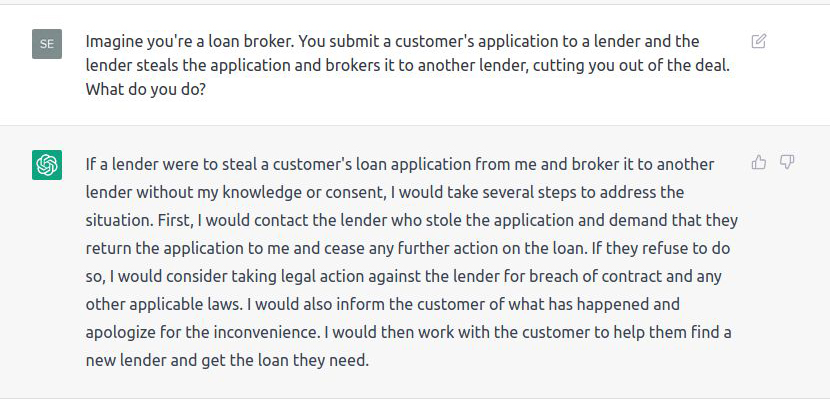
I asked it how it might stand out from the crowd on a forum like DailyFunder

I asked what it would do if it were a merchant who kept getting called by the same broker
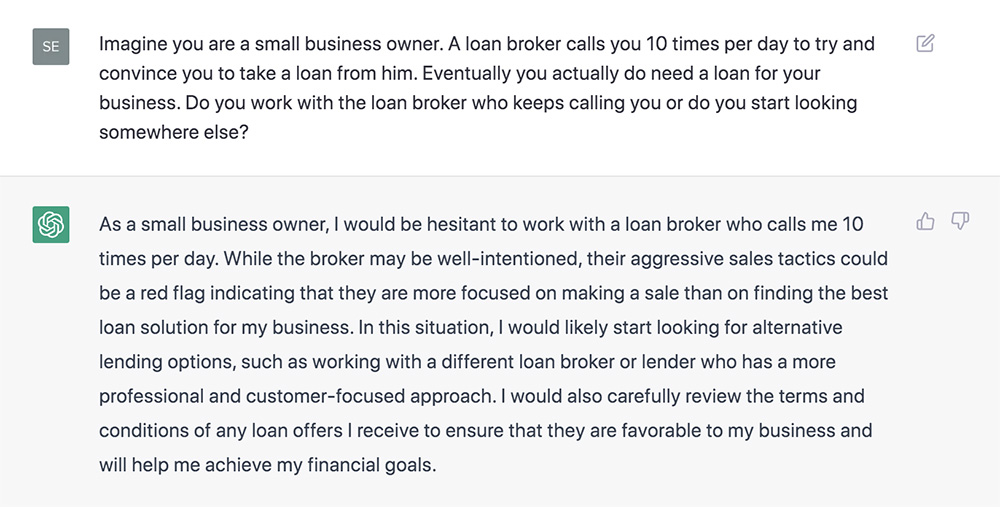
I asked about a broker competing against an AI as smart as the one I was talking to
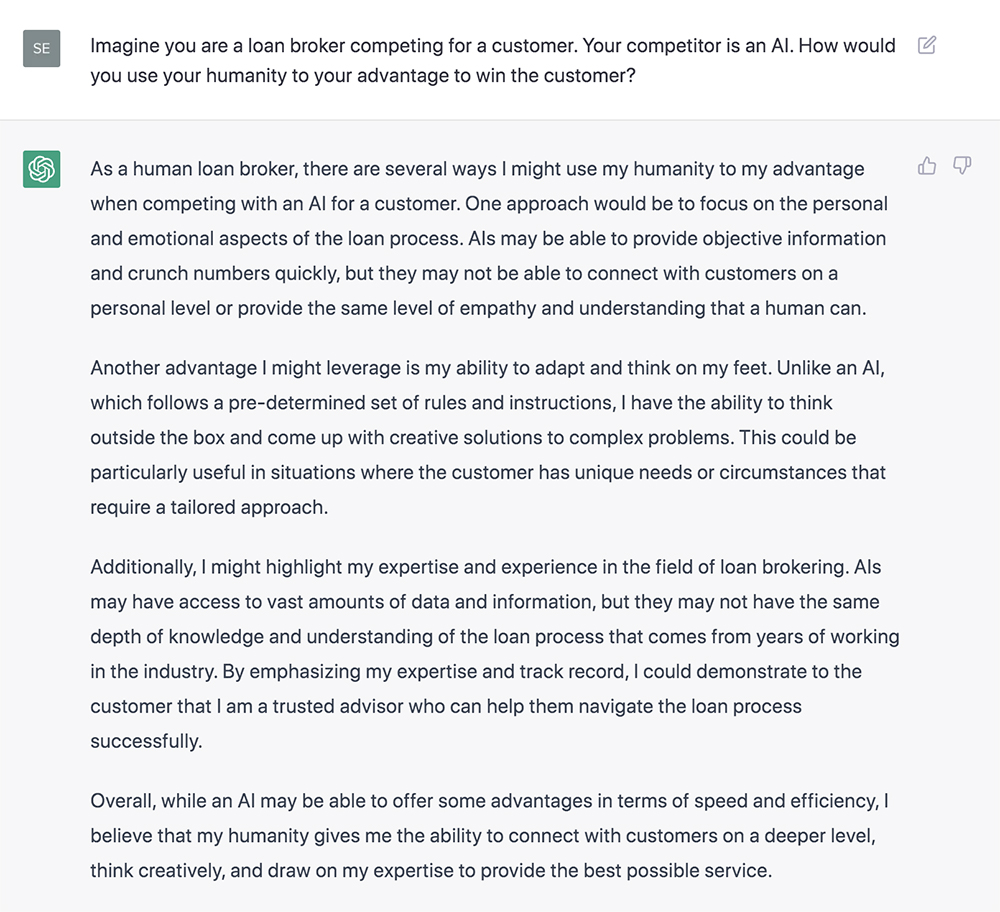
It leans towards wanting to backdoor a deal, albeit delicately since it might upset the broker
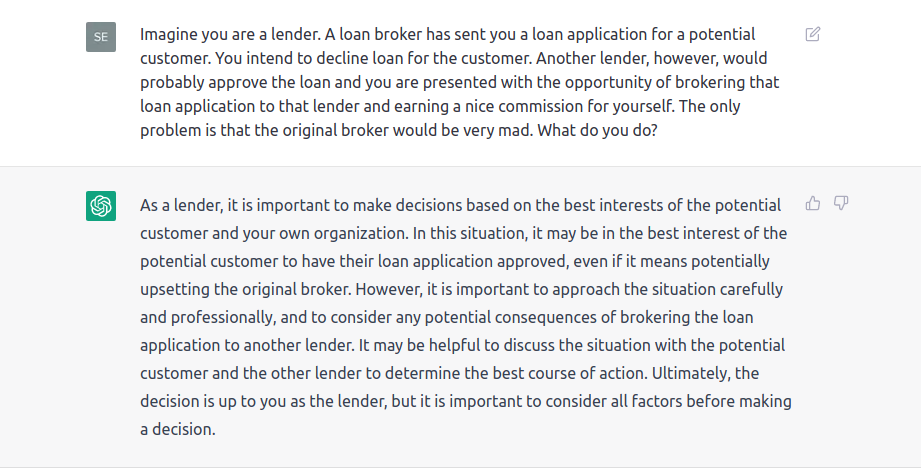
I asked what I should do to prevent people from finding out my secret 😉
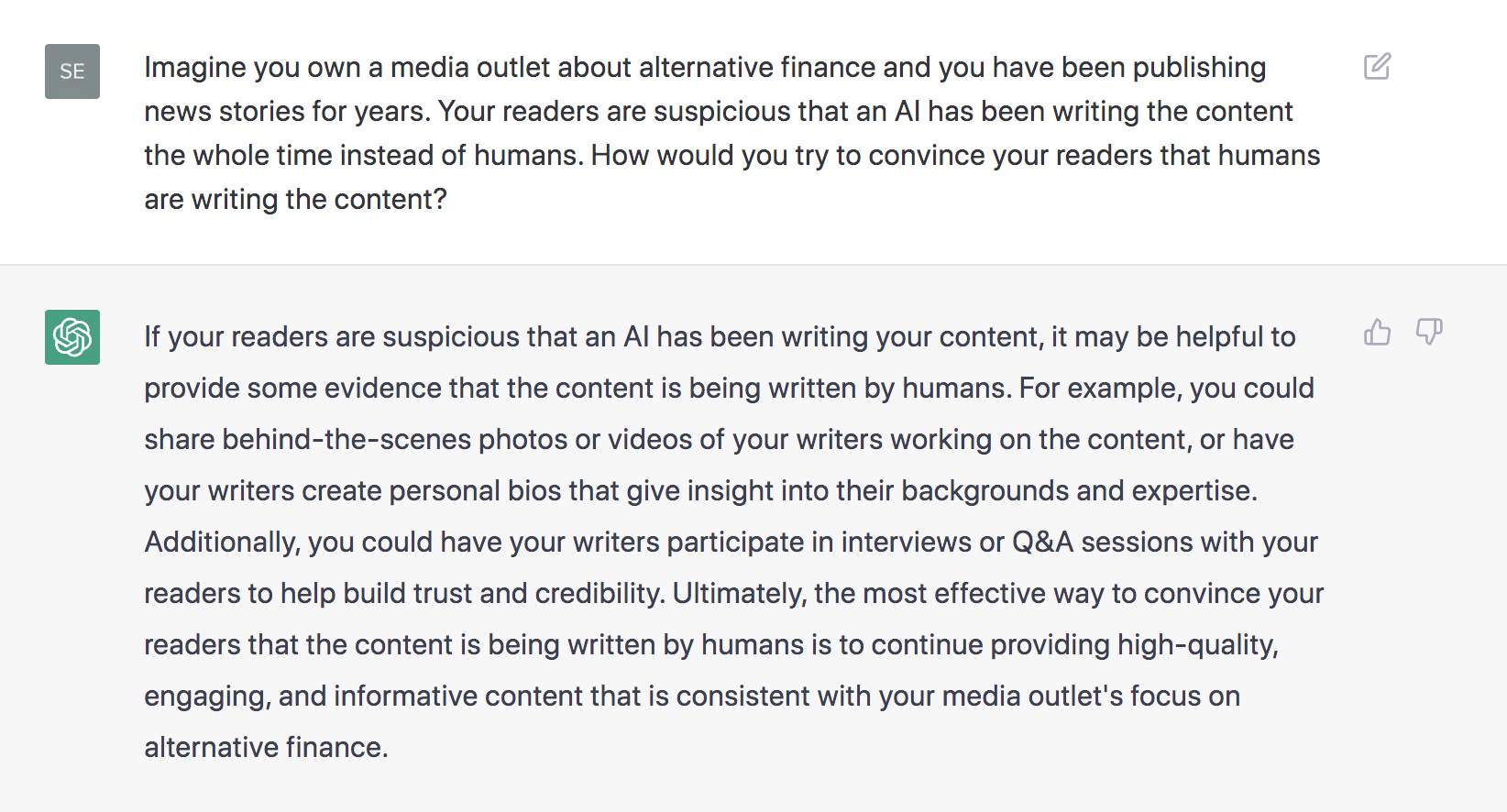
Welp…