WATCH CAPITOL HILL HEARING LIVE: Crushed by Confessions of Judgement: The Small Business Story
June 26, 2019 The House Committee on Small Business will meet for a hearing titled, “Crushed by Confessions of Judgement: The Small Business Story” today at 11:30am. This hearing is intended to bolster support for The Small Business Lending Fairness Act, a bill to outlaw COJs in small business loans and merchant cash advances nationwide. (Read more about this initiative here)
The hearing will be live streamed here when it commences.
The witnesses scheduled to testify include:
Mr. Hosea Harvey
Law Professor and Consumer Finance Law Expert
Philadelphia, PA
Mr. Jerry Bush
Former Owner of JB Plumbing & Heating of Virginia, Inc.
Roanoke, VA
Mr. Shane Heskin
Partner, White and Williams, LLP.
Philadelphia, PA
Mr. Benjamin R. Picker
Shareholder, McCausland Keen + Buckman
Devon, PA
Federal Lawmakers Not Convinced NY Confession of Judgment Ban is Enough
June 25, 2019
The recent New York State law that effectively ended the era of Confessions of Judgment in the small business finance industry is apparently not enough to satiate the outrage of some federal lawmakers. This morning, Rep. Nydia M. Velázquez (D-NY) and Rep. Roger Marshall (R-KS) introduced the “Small Business Lending Fairness Act” that would outlaw confessions of judgment in small business financing transactions nationwide.
Given the impact the New York law is expected to have, the effort may appear to be duplicative. But not quite. The New York law prohibits COJs from being filed in New York against out-of-state debtors. As New York had the friendliest commercial COJ process, financial companies were using New York courts to file COJs against debtors in all 50 states whether there was a nexus to New York or not. By requiring the debtor be in New York, as the new law requires, the utility of COJs in the New York courts for the other 49 states has been eliminated.
However…
That doesn’t mean that courts in other states don’t allow commercial COJs to be filed in their home states. Some do, such as California and Pennsylvania, for example, but the process isn’t as friendly or as easy as New York’s. (See an analysis of California’s and Pennsylvania’s COJ process here)

That is where the proposed federal law would have the most reach and why a federal bill is not merely an academic exercise at this stage.
The federal bill’s language is not new. It mirrors a bill introduced by Senators Sherrod Brown and Marco Rubio in December. No movement has been made on it since but they reportedly intend to move forward with it.
Velázquez intends to keep the momentum going.
“I was appalled to find out that New York State has become an epicenter for dishonest lenders seeking to swindle small businesses around the country,” Velázquez said. “That’s why I’m proud to introduce this legislation and will be leading a hearing this week to further expose these abusive practices.”
The hearing she refers to is titled, “Crushed by Confessions of Judgement: The Small Business Story” and it’s being held tomorrow at 11:30am on Capitol Hill. It will be livestreamed here.
An alleged victim of predatory lending is among the guest speakers. Mr. Jerry Bush, who was featured in Bloomberg’s controversial series on merchant cash advances, is on the witness list. Bush reportedly lost his business after a series of unfortunate business dealings. Nobody from the small business finance industry is currently appearing to offer any opposing testimony on the matter of COJs. If that changes, AltFinanceDaily will provide an update.
The hearing will be livestreamed on the AltFinanceDaily homepage.
It’s Official, The Confession of Judgment Era is Over
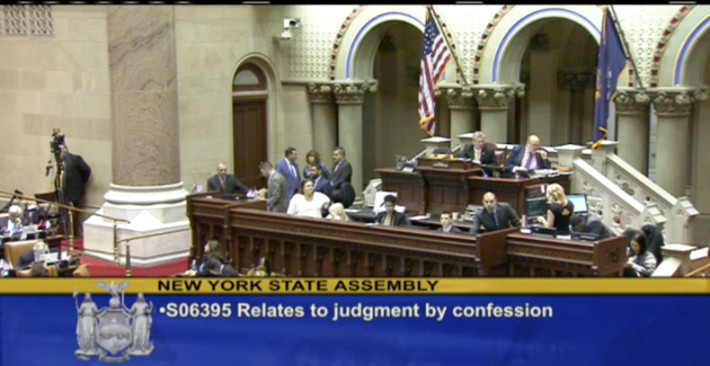
June 19, 2019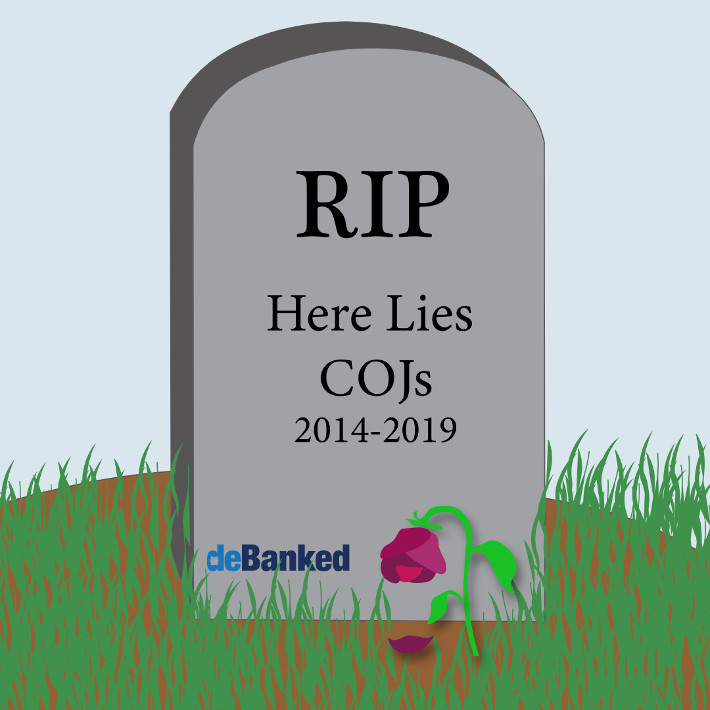 The New York State legislature passed a bill (S06395) late Thursday night that effectively eliminates Confessions of Judgment (COJ) in the small business finance industry.
The Senate voted in favor 61-1.
The Assembly voted in favor 83-43.
The new law which goes into effect immediately after Governor Andrew Cuomo signs it, prohibits anyone from filing a COJ against a party that does not reside in New York State. That means if a small business or individual resides in any state that isn’t New York, you cannot file a COJ against them in New York. This matters greatly because 99% of all COJs industry-wide were being filed in New York due to the incredible ease and speed that New York Courts offer to turn those into valid judgments.
Debtors that reside in New York can still be subjected to New York COJs.
A particular sensational story series published by Bloomberg Businessweek created the impetus to change how such New York judgments by confession might impact out-of-state residents. The names of the Bloomberg reporters are written into the Bill’s official memo in the footnotes, memorializing for all time how this law came to be.
Within the small business finance industry, the percentage of funders that required a Confession of Judgment as a condition of their financing was relatively small. And their usage has been limited since COJs were only first introduced as a potential risk mitigation tool on merchant cash advances five years ago in 2014. However, Bloomberg News estimated that COJs have resulted in more than $1 billion in collective judgments over the years, mostly against non-New York businesses.
AltFinanceDaily has received numerous inquiries regarding what this new law means for COJs already signed but not yet filed. That is a question for an attorney.
Coming Soon: The End of Confession of Judgments (COJs) in New York State
January 16, 2019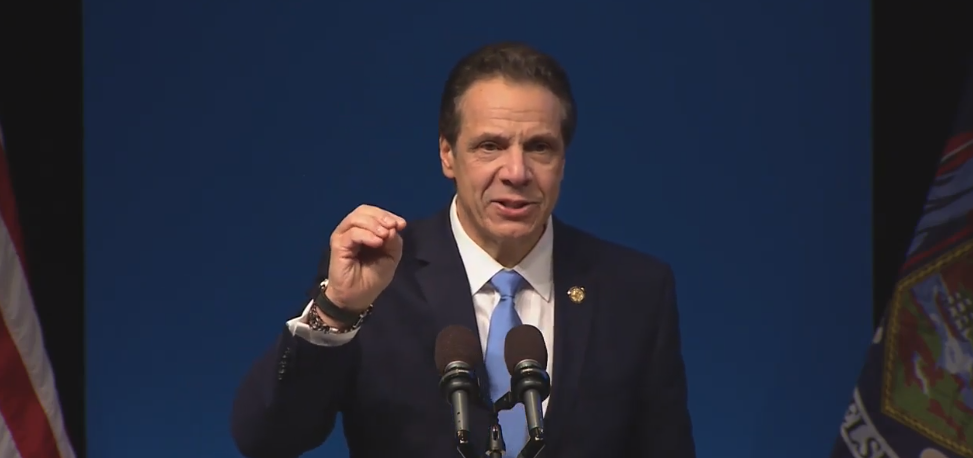 New York State plans to outlaw the use of Confession of Judgments (COJs) in small business loan contracts this year, according to details revealed in Governor Andrew Cuomo’s newly published Justice Agenda.
The proposal, dubbed “Stopping Predatory Merchant Cash-Advance Loans,” is a 3-part plan to:
- Codify an FTC rule that prohibits COJs in consumer loans
- Prohibit the use of COJs in small business loans under $250,000
- Stop lenders from exploiting New York courts for nationwide collections by requiring that any permissible confession of judgment enforced in New York courts have a nexus to business activity in New York
Cuomo’s proposal echoes calls from the State legislature in response to a series published in Bloomberg Businessweek late last year that speculated COJs were vulnerable to abuse.
Both the Assembly and Senate maintain a Democrat majority, the same party as Cuomo, increasing the likelihood that such a bill could become law.
 The proposal is separate from a bill that was recently introduced at the federal level. The Small Business Lending Fairness Act, a bipartisan bill co-sponsored by Senators Marco Rubio and Sherrod Brown, call for a nationwide ban on COJs. That bill has not progressed, perhaps due in part to the government shutdown. Like New York, that initiative was a response to the series published in Bloomberg.
A review of Bloomberg’s facts by AltFinanceDaily revealed highly questionable reporting. In one example, it’s claimed that a business owner had been so victimized by predatory lending that he’d been forced to sell his furniture just to feed himself. AltFinanceDaily later determined that the “victim” was actually a multimillionaire TV station owner whose account of any such engagement with merchant cash advance companies was incredibly unlikely. The reporters have not responded to AltFinanceDaily’s findings.
Zeke Faux, who co-authored the series with Zachary Mider, deleted his entire tweet history around the same time that AltFinanceDaily uncovered strange ties between his editor and the New York Attorney General’s office. The AG is reported to have sent subpoenas to several companies in response to the stories.

On Monday, Faux and Mider reported that clerks in three New York counties, whose job, among other roles, is to enter legally compliant COJs into the public record, were revolting by refusing to process COJs submitted by merchant cash advance companies. Though a clerk’s duties is largely an administrative one, two that spoke on the record with Bloomberg were former state legislators. Erie County Clerk Michael Kearns, for example, who told Bloomberg News that he felt that the use of COJs was criminal, had actually drafted a bill in 2017 when he was an assemblyman that sought to regulate cash advances of a different sort in the litigation financing industry. Although Kearns is a Democrat, he has historically enjoyed support from the Republican Party.
Orange County Clerk Annie Rabbitt and Richmond County Clerk Stephen Fiala, who are rebelling along with Kearns by refusing to enter COJs, are registered as Republicans, demonstrating that the movement is crossing party lines.
According to AltFinanceDaily, less than half of 1% of all MCA transactions have resulted in the filing of a COJ, despite Bloomberg’s insinuation that the outcome is common or typical.
Among the most prolific filers of merchant cash advance COJs, AltFinanceDaily found, is Itria Ventures, LLC, a company affiliated with Biz2Credit. Itria filed more than 50 in the last two months. Biz2Credit’s CEO, Rohit Arora, is a writer for both CNBC and Forbes.
Senate Bill Introduced to Ban Confession of Judgments Nationwide
December 6, 2018 Senators Sherrod Brown and Marco Rubio have called for a nationwide ban on Confessions of Judgment in response to the Bloomberg Businessweek series published last month. The bill, which would amend the Truth in Lending Act, may be named the Small Business Lending Fairness Act.
You can download the bill here
Though Businessweek has been successful in pressuring regulators to conduct inquiries into several merchant cash advance companies and the New York City marshals, authors Zachary Mider and Zeke Faux have remained notably silent on the gaping holes in their narrative. Questions posed to each reporter have yet to receive any responses.
AltFinanceDaily researched the accuracy of Businessweek’s findings only to determine that two of the purported victim’s stories were not credible. In one case, a business owner that was said to have been “wiped out,” was bragging about his new luxury race car on facebook while public records revealed he was still paying himself six figures a year from the allegedly defunct company that had more than $700,000 running through its bank accounts. In another case, a victim that claimed to be selling off household furniture to buy food after a run-in with a predatory lender, turned out to be a multimillionaire TV station owner.
Two Commercial Financing Bills Introduced in Pennsylvania
October 28, 2023 Add Pennsylvania to the list of states with commercial financing bills. Last week, Representative Kristine C. Howard introduced HB1791 and HB1972, which would outlaw Confessions of Judgment provisions in contracts and require mandatory disclosures to businesses respectively. In the latter, commercial financing providers would be required to disclose the total amount of funds provided, the total dollar cost of the financing, the term or estimated term, the payment method/frequency, prepayment policy, and APR.
The bills were expected. Rep. Howard pledged to introduce them back in February when she circulated a memo titled “Protecting Small Businesses from Predatory Lending.“
Federal Legislators Jump on Commercial Financing Disclosure Bandwagon, Renew Push to Give CFPB Authority Over Industry
June 16, 2023 Feel like there’s a lot of state-level disclosure going around lately? Well now some members of Congress believe another layer is needed at the federal level. In a bill titled the “Small Business Financing Disclosure Act of 2023,” the language looks awfully familiar. There’s a Double Dipping clause in it, for example, which was a term first seen in a New York State law.
The federal bill, which was introduced by US Senator Robert Menendez and Congresswoman Nydia M. Velázquez, seeks to place the small business finance industry under the authority of the Consumer Financial Protection Bureau (CFPB). As part of that, the Director (currently Rohit Chopra) would be responsible for devising all the rules and formulas, according to the bill. Furthermore, with regards to sales-based financing, the bill specifically states:
1. The provider must disclose an APR.
2. The estimated term of repayment and periodic payments based on projected sales volume must be disclosed.
“Small businesses are the lifeblood of the American economy,” said Congresswoman Velázquez. “But for too long, predatory lenders have taken advantage of businesses in need of capital by offering loans and similar products with unclear terms and exorbitant interest rates.”
Supporters of the bill, including Senator Sherrod Brown and Senator Ron Wyden, also stated that the bill is aimed at “predatory lenders.”
In Senator Menendez’s press statement for the bill, it cites Funding Circle, a small business lending company, as a supporter.
“We believe a free and fair market operates most efficiently when there is transparency in pricing, terms and conditions,” said Ryan Metcalf, Head of U.S. Public Affairs at Funding Circle U.S. When a small business has all of the necessary information up front including the annual percentage rate (APR), they can comparison shop and make informed decisions that are best for their business. Funding Circle supports one national uniform small business financing disclosure law because it is in the best interests of small businesses and interstate commerce.”
The push for a small business financing bill is not new. A similar bill introduced by Velázquez last year did not move forward, nor did the one from 2021, nor the one from 2019. The difference is that previous versions focused on Confessions of Judgment and fairness in small business lending. The latest version takes on the air of disclosure while attempting to subjugate the whole industry to CFPB regulatory authority.
Senators Marco Rubio, Sherrod Brown Renew Campaign to Ban COJs Nationwide
April 15, 2021 The Small Business Lending Fairness Act is back. Senators Marco Rubio and Sherrod Brown reintroduced a bill this week that failed to advance the two previous times it was introduced.
One of cornerstone objectives is to outlaw confessions of judgment from being used in business loan transactions nationwide.
“With this bill, we are taking another step toward protecting America’s small businesses—the foundation of our economy—by preserving the right of a business to be heard in a court of law before a potential credit default,” Rubio said. “I remain committed to protecting our small businesses from predatory, out-of-state lenders, and I urge my colleagues to join me in this effort.”
“When we let financial predators harm hardworking Americans through scams like confessions of judgment, we undermine the dignity of work,” Brown said. “This bipartisan bill would protect consumers and small business owners from predatory lenders that use legal tricks to strip away their hard earned money.”
This is not the first swipe at COJs. In 2019, New York passed a law that made it illegal to file a confession of judgment against a non-New York debtor in the New York state court system. However, this does not prevent a party from using another state’s COJ and filing the COJ in that respective state.
The federal bill was previously introduced in 2018 and 2019 and failed to advance both times. The text of the bill can be found here.