Federal Legislators Jump on Commercial Financing Disclosure Bandwagon, Renew Push to Give CFPB Authority Over Industry
June 16, 2023 Feel like there’s a lot of state-level disclosure going around lately? Well now some members of Congress believe another layer is needed at the federal level. In a bill titled the “Small Business Financing Disclosure Act of 2023,” the language looks awfully familiar. There’s a Double Dipping clause in it, for example, which was a term first seen in a New York State law.
The federal bill, which was introduced by US Senator Robert Menendez and Congresswoman Nydia M. Velázquez, seeks to place the small business finance industry under the authority of the Consumer Financial Protection Bureau (CFPB). As part of that, the Director (currently Rohit Chopra) would be responsible for devising all the rules and formulas, according to the bill. Furthermore, with regards to sales-based financing, the bill specifically states:
1. The provider must disclose an APR.
2. The estimated term of repayment and periodic payments based on projected sales volume must be disclosed.
“Small businesses are the lifeblood of the American economy,” said Congresswoman Velázquez. “But for too long, predatory lenders have taken advantage of businesses in need of capital by offering loans and similar products with unclear terms and exorbitant interest rates.”
Supporters of the bill, including Senator Sherrod Brown and Senator Ron Wyden, also stated that the bill is aimed at “predatory lenders.”
In Senator Menendez’s press statement for the bill, it cites Funding Circle, a small business lending company, as a supporter.
“We believe a free and fair market operates most efficiently when there is transparency in pricing, terms and conditions,” said Ryan Metcalf, Head of U.S. Public Affairs at Funding Circle U.S. When a small business has all of the necessary information up front including the annual percentage rate (APR), they can comparison shop and make informed decisions that are best for their business. Funding Circle supports one national uniform small business financing disclosure law because it is in the best interests of small businesses and interstate commerce.”
The push for a small business financing bill is not new. A similar bill introduced by Velázquez last year did not move forward, nor did the one from 2021, nor the one from 2019. The difference is that previous versions focused on Confessions of Judgment and fairness in small business lending. The latest version takes on the air of disclosure while attempting to subjugate the whole industry to CFPB regulatory authority.
Connecticut Passes Commercial Financing Disclosure Bill
June 7, 2023 Connecticut has passed a commercial financing disclosure bill. See: SB1032. The bill now just needs to be signed by the governor. The planned effective date is July 1, 2024.
Connecticut’s bill has several unique rules in addition to standard disclosures already seen in other states. They include:
1. A provider shall not revoke, withdraw or modify a specific offer until midnight of the third calendar day after the date of the specific offer.
2. Providers and brokers must register with the Banking Commissioner.
3. No commercial financing contract shall contain any provision waiving a recipient’s right to notice, judicial hearing or prior court order in connection with the provider obtaining any prejudgment remedy, including, but not limited to, attachment, execution, garnishment or replevin, upon commencing any litigation against the recipient.
The bill has been added to AltFinanceDaily’s state regulation map.
Connecticut Nears Passage of a Unique Commercial Financing Disclosure Bill
June 5, 2023 Connecticut’s General Assembly came one step closer to passing its own commercial financing disclosure bill when SB1032 passed the Senate on Monday. The State’s legislative session ends on June 7 so the House would have to also pass it by then in order to send it off to the governor.
Connecticut’s bill has several unique rules in addition to standard disclosures already seen in other states.
1. A provider shall not revoke, withdraw or modify a specific offer until midnight of the third calendar day after the date of the specific offer.
2. Providers and brokers must register with the Banking Commissioner.
3. No commercial financing contract shall contain any provision waiving a recipient’s right to notice, judicial hearing or prior court order in connection with the provider obtaining any prejudgment remedy, including, but not limited to, attachment, execution, garnishment or replevin, upon commencing any litigation against the recipient.
Given the likelihood this bill could pass, it has been added to AltFinanceDaily’s state regulation map.
Florida Set to Enact Commercial Financing Disclosure Law With Unique Broker Rule
May 15, 2023Update: the governor signed the bill into law on June 23.
 It’s a new state disclosure law but with a twist. Florida’s bill, which passed both chambers of the legislature on May 4th and now awaits the governor’s signature, has a specific code of conduct aimed directly at brokers.
Among these rules is that the broker cannot:
- Offer its services in any advertisement without disclosing the actual address and telephone number of the business of the broker and the address and telephone number of any forwarding service the broker may use, if any.
- Make or use any false or misleading representation or omit any material fact in the offer or sale of the services of a broker or engage, directly or indirectly, in any act that operates or would operate as fraud or deception upon any person in connection with the offer or sale of the services of a broker, notwithstanding the absence of reliance by the business.
- Make or use any false or deceptive representation in its business dealings.
- Assess, collect, or solicit an advance fee from a business to provide services as a broker. However, this subsection does not preclude a broker from soliciting a business to pay for, or preclude a business from paying for, actual services necessary to apply for a commercial financing transaction, including, but not limited to, a credit check or an appraisal of security, if such payment is made by check or money order payable to a party independent of the broker.
The bill, as written, says it is poised to go into effect on July 1, 2023 (assuming the governor signs it). AltFinanceDaily first reported on this bill on March 16th.
Georgia Governor Signs Commercial Financing Disclosure Law
May 9, 2023Georgia’s governor signed the state’s commercial financing disclosure bill into law as anticipated. The full text is available here. It is scheduled to go into effect on January 1, 2024. Georgia’s new law is merely the latest in a series aimed at the small business and commercial financing industries.
Others include:
- Virginia’s sales-based financing disclosure law – Went into effect July 1, 2022
- California’s commercial financing disclosures – Went into effect December 9, 2022.
- Utah’s commercial financing disclosures – Went into effect January 1, 2023.
- New York’s commercial financing disclosure law – Goes into effect August 1, 2023
- CFPB’s small business lending data collection law – Goes into effect October 1, 2024
Georgia’s Commercial Financing Disclosure Bill Now on the Governor’s Desk
April 10, 2023Georgia is on track to become the latest state to pass a commercial financing disclosure law. This state’s bill passed through both the House and Senate and was delivered to Governor Brian P. Kemp on April 5th to await his signature. When that happens, Georgia will join a list of mandatory disclosure states that includes California, New York, Virginia, and Utah.
Other states that currently have disclosure bills up for debate in their respective legislatures include: Connecticut, Missouri, North Carolina, Florida, New Jersey, Kansas, and Illinois.
Federal Judge: Legal Challenge to California’s Commercial Financing Disclosure Law Has Merit, Orders SBFA Case to Proceed
April 3, 2023 A federal judge has ordered the Small Business Finance Association’s (SBFA) case against Clothilde Hewlett in her capacity as Commissioner of the California Department of Financial Protection & Innovation (DFPI) to proceed. On March 30, The Honorable R. Gary Klausner denied defendant’s motion to dismiss the claims that the State’s commercial financing disclosure law is both unconstitutional and preempted by the federal Truth in Lending Act (TILA).
The case, originally filed on December 2, 2022, argued, broadly speaking:
- That the regulations violate the First Amendment on the premise that they compel the group’s members to make inaccurate disclosures to customers while at the same time prohibiting members from engaging in communications that could be used to clarify or correct the required false or misleading information to customers.
- That APR is defined and governed at the federal level by TILA and that California’s own customized spin on it would only serve to confuse customers.
The Court has now ruled that these claims have been sufficiently alleged, allowing the SBFA the opportunity to prove its case.
Steve Denis, the Executive Director of the SBFA, told AltFinanceDaily that the win at this juncture was validation for what the organization has been saying for the past few years.
“I think [this victory] is really good news. It’s a lawsuit that the entire industry should be behind,” he said.
The outcome of the case could have far reaching effects. New York, for example, has enacted similarly misleading APR rules that are soon slated to go into effect while other states have contemplated following in its footsteps.
“I think if we win this lawsuit the APR argument is over,” Denis said.
To that end, anyone in the industry that would like further information about what’s taking place can contact Denis at sdenis@sbfassociation.org.
Georgia on Verge of Passing a Commercial Financing Disclosure Law
March 27, 2023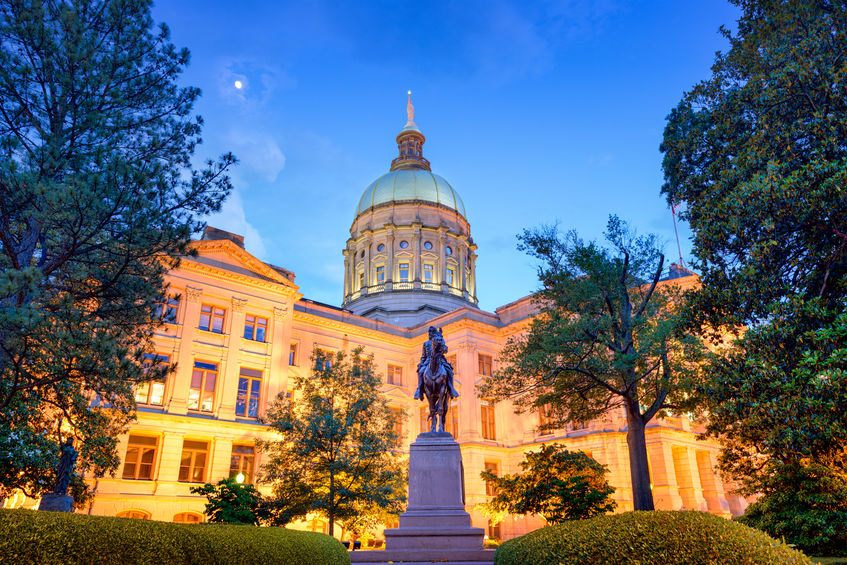 Georgia is on pace to become the next state to pass a commercial financing disclosure law. SB 90 has sailed through both the state’s House and Senate with strong bi-partisan support and is potentially heading for the governor’s desk. The text of the bill is similar to the disclosure law recently enacted in Utah. It also explicitly states that brokers may not make or use any false or misleading representations in the course of its business.