AltFinanceDaily Presents: The Broker NFT Collection
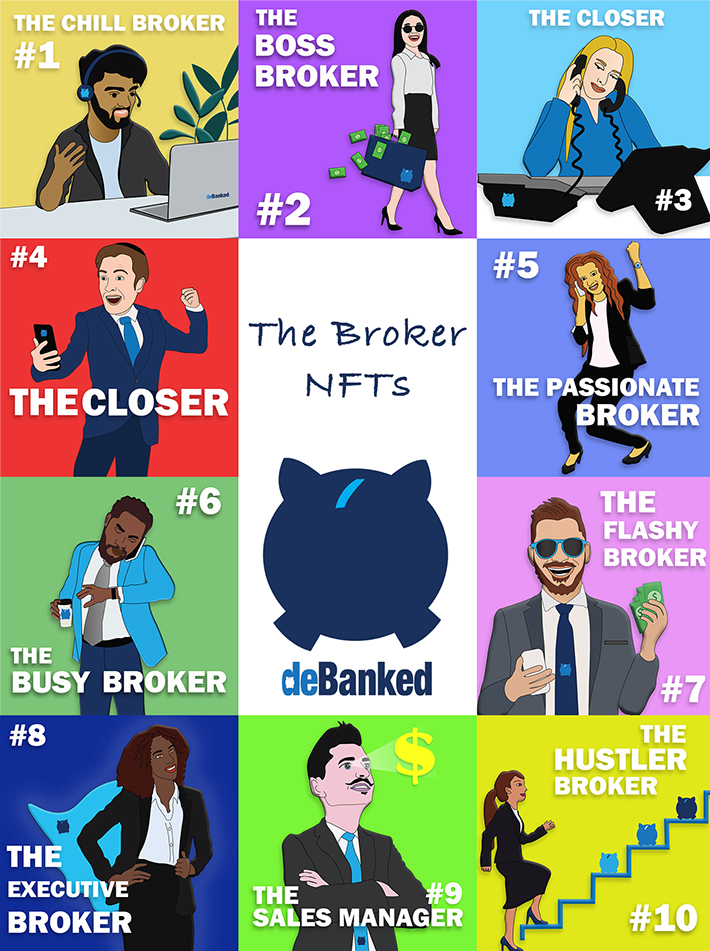
October 26, 2021Watch out CryptoPunks, AltFinanceDaily has minted a limited edition set of its own Broker NFTs.
Drawing from the animated style popular in the NFT community, this collection of ten “brokers” is a diverse light-hearted tribute to the professionals in the business finance industry. Each broker in the collection has been individually minted on the ethereum blockchain.
The artwork was drawn by Cindy Recile and the NFTs minted via AltFinanceDaily’s own ethereum smart contract. (See here on etherscan.)
The other news is that we’ll be giving some of these away for free. (stay tuned for those details!)
Today’s NFT market has things like pixelated punks and bored apes literally selling for millions of dollars.
A jpeg with no picture other than 4 words of text that say: “Fintech is Killing me,” is currently up for sale for more than $400, if that can be believed.
The act of minting an NFT cost Ethereum gas but if there is any particular thing you would like to see AltFinanceDaily turn into an NFT, let us know and maybe we’ll make it happen! Email info@debanked.com.
Small Business Finance Industry Mulls Crypto, NFTs
September 16, 2021 As the crypto craze roars on, NFTs are starting to stake a claim in the finance world as a legitimate option for those looking to invest or stash money in a virtual space. The sports world recently took their swing at NFTs, and here at AltFinanceDaily we minted NFTs of our own early this week. It seems that NFTs have sparked the interest of the media, athletes, and art enthusiasts— but in small business finance, the conversation is only in the early stages.
“I think of it more not so much as a currency, but from what I’ve been reading, more of an investment vehicle,” said Noah Grayson, President of South End Capital, when asked what he thinks an NFT represents. “It’s a way for people to put tangible items in a digital format to get ownership from.”
Grayson says those in his industry have brought up the topic around the office, but it hasn’t made its way into any type of business practices yet. “It’s tough to see how [NFTs] would affect the lending industry at this time, cryptocurrency is something a little more probable in the long term.”
Grayson stressed how difficult small business lending can already be with dollars, and it seems as though the industry just isn’t ready to start conducting business in other types of currencies. “When you consider that many small business owners have no credit score and a large portion of those still pay for things in cash, I think it’s going to be a long time before the industry as a whole considers [crypto] an option to make loans with or compensate partners [with] as a whole,” he said.
“I’d describe it as a digital asset that can be purchased, owned, and used by an individual, giving that individual exclusive rights to the asset,” said James Webster, CEO and founder of ROK Financial when asked how he would define an NFT. “Like any other asset, the price can go up or down over time.”
Although his company has never created an NFT themselves, Webster won’t eliminate the possibility for one in the future. With the interest of the industry and his employees being focused around crypto as of late, Webster can’t keep the crypto and NFT talk out of the office.
 “We have a [clever] and nimble-minded staff at ROK. NFTs and crypto like other tradable assets are always being discussed and invested in here,” said Webster. “The team has been buying crypto for years now and I don’t see that slowing down any time soon.”
Webster believes it’ll inevitably make its way into the business with positive effects. “I see it streamlining, as well as making lending and banking for that matter more efficient over time,” he said.
At Velocity Capital Group, crypto has already seeped into the business. The company began offering commission payments to brokers this past August with an immediate positive reception. Velocity Capital Group CEO Jay Avigdor attributes “speed” as the primary use-case of crypto in his business.
“The feedback has been fantastic!” Avigdor said.
With crypto on the minds of fintech gurus everywhere, it’s evident its interest comes from the ability to put the technology in practice. Until these types of things can be borrowed, used to buy goods, or seen as a means of collateral at a mainstream level, the small business finance community will continue to eye their development and evolve if necessary.
AltFinanceDaily Mints NFTs, Puts First Magazine Cover on the Ethereum Blockchain
September 12, 2021 deBanked has been forever etched into the Ethereum blockchain.
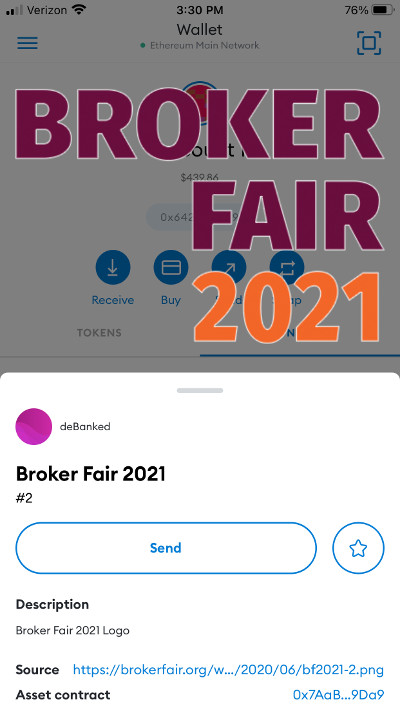
The first print magazine cover ever published by AltFinanceDaily has been turned into an NFT. Over the weekend, AltFinanceDaily deployed its own NFT smart contract on to Ethereum and minted several NFTs including the deBanked logo and the Broker Fair 2021 logo. The exercise was prompted by a AltFinanceDaily TV discussion about athletes selling “digitally-signed” memorabilia.
“I think it’s important that as we talk about this technology, that we fundamentally understand how it all works,” said AltFinanceDaily President Sean Murray. “There are some drag-and-drop style NFT ‘makers’ online, but I thought that would defeat the purpose, so I did it all through the Terminal. Once I got our NFT smart contract on the Ethereum mainnet, I minted a handful of NFTs with it.”
Murray, who started using and mining crypto in 2014, has offered Bitcoin as a AltFinanceDaily customer payment option for more than 6 years.
Although the NFT contract and token IDs are visible on etherscan.io, images themselves are not. Users need a particular wallet or app that is equipped to display NFTs.
 “It’s a somewhat strange system in which these tokens basically contain metadata with a URL to where the images are hosted somewhere else online. So you need something that’s interpreting the metadata,” Murray said.
Using a mobile wallet like MetaMask can accomplish this, but so can a quick web tool like AltFinanceDaily’s NFT Viewer.
Murray added that there’s actual costs involved too.
“A lot of people are joking about how someone paid $1.3 million for a picture of a rock,” he said, “but it does cost money by way of eth to mint an NFT. It could cost someone more than $100 just to put a single NFT on Ethereum so selling an NFT, even if it’s something silly, could fetch a significant price by virtue of the high transaction fees on the network.”
 Network fees are a known obstacle. NFTs on the sports star operated Autograph.io are minted on the Polygon blockchain where costs are lower, for example. Autograph boasts that anyone can buy “digitally signed autographs” from celebrities like Tom Brady, Derek Jeter, and Wayne Gretzky.
Minting an NFT or two or three, or as many as one wants, is as simple as pressing a button once a proper script is written. Interested collectors would have to establish just how genuinely or intimately signed an autograph is and how rare it is. Is it an agent executing a script? Is it the celebrity pressing a button? Or could it be that the image itself is unique and that the seller drew or signed it with their own hand in Adobe Photoshop or something similar? As the mysteriousness of the technology becomes more understood, the market may become more cost normalized.
Murray says that the smart contract is still accessible so that there is the potential to mint more AltFinanceDaily-originated NFTs in the future and that AltFinanceDaily NFTs can also be sent to others that have Ethereum-equipped wallets.
“I think 2021 is as good a year as ever for Broker Fair in particular to be memorialized into Ethereum,” Murray said. “What better way than to be on the forefront of technology in the commercial finance space?”
Derek Jeter Joins Athletes Looking to Cash in with NFTs
September 7, 2021 The trendiest merch in tech has made its way into the world of professional sports and entertainment, as professional athletes have begun selling NFTs. DraftKings Marketplace already offers several tiers of NFTs from Tom Brady, Simone Biles, and Wayne Gretzky—some of which are valued at over $167,000. Jeter’s NFT will be dropped Tuesday afternoon in two separate bids.
“We are excited to bring this special Derek Jeter offering exclusively to our DraftKings Marketplace customers, and believe it will have a place in history as our first digital baseball collectable drop,” said Matthew Kalish, co-founder and President of DraftKings North America to AltFinanceDaily. “There has been such a strong and positive response from our community around the iconic athlete drops so far, and Derek Jeter, the iconic Yankees superstar and soon-to-be Hall of Famer, will be no different. We look forward to seeing thousands of collectors add to their digital collections this week on DraftKings Marketplace.”
Alongside age requirements specific to the state in which the purchase takes place in, potential buyers must also have a verified DraftKings account with all of the terms and conditions agreed upon.
Hosted by the NFT platform Autograph, Jeter is one of the many athletes that sits on the board of the company. Co-Founded by Brady, all the athletes that have had NFTs sold through DraftKings thus far are the board of advisors for Autograph.
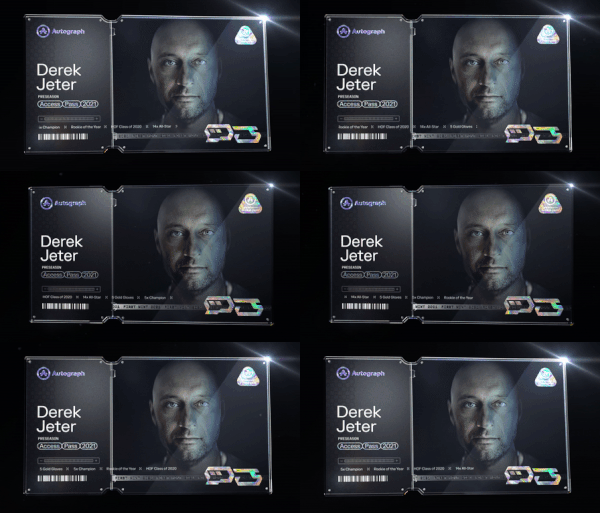 With a reliance on live events, merchandise, and sponsorships with brands to engage with millions of viewers, the NFT market is an interesting platform for athletes to take the trading card to the digital space, while also opening up another avenue of revenue outside the arena.
“As the world becomes more comfortable with digital ownership and collection, we see an incredible opportunity to bring users high-quality and personalized content from their favorite athletes, artists and franchises,” said Dillon Rosenblatt, Founder and CEO, Autograph. “NFTs are the perfect medium to connect users to both the things they love and those who share those interests, and we want to leverage today’s incredible partnerships to provide continued value to our community.”
Autograph has also teamed up with Lionsgate to develop NFTs with their most successful films, continuing their push to develop a marketplace of purely entertainment-based NFTs.
A source at DraftKings was able to confirm that more athletes are going to be releasing NFTs on the platform within the next couple of weeks.
Lenders, Brokers Doubtful That Merchants Would Use Their Domain Names as Collateral if They Could
September 12, 2024Only 26% of respondents said that merchants would use their business’s website domain name as collateral for a loan (presumably if they were given the option to). This according to an informal poll conducted on LinkedIn that asked that very question without any context or clarification. Forty eight percent of respondents straight up said that merchants would not use their domain name as collateral for a loan. Ironically, many secured loans with liens on all assets would already include domain names among those assets.
Back in April, AltFinanceDaily predicted that lending specifically against a domain as collateral was a product likely to happen in the near future. The following month a domain name registrar partnered up with a peer-to-peer lending site that touted the use of blockchain technology. The first ever domain name loan executed by smart contract actually happened in January of this year, however, by AltFinanceDaily.
Coming Soon: Domain Names as Loan Collateral
April 25, 2024 It’s called a DeFi Cash Advance, a collateralized loan with 1-30 day terms. It’s just one of many products created by Teller, a peer-to-peer lending platform that relies on smart contracts to facilitate the transactions. The key word is “collateralized” because the blockchain-tethered asset doesn’t necessarily have to be crypto-native per se anymore. Virtually any business owner with a website can offer up its online domain name as collateral for a loan thanks to rapidly developing blockchain technology.
“Essentially what Teller is at the core is basically like an OTC desk as a way to think about it because Teller doesn’t do any lending,” said Kieran Daniels, Growth at Teller.
Instead it’s done by peers which have historically used the platform to lend against very esoteric crypto assets that traditional commercial finance folks would probably roll their eyes at. But all that’s poised to change ever since a Silicon Valley-based startup called Namefi recently found a way to bridge regular old internet domain names to the ethereum blockchain. Namefi’s tech can turn any .com or similar internet domain into a real life NFT without any disruption to the underlying website it hosts. And once ownership of the domain name is governed by whomever owns the NFT, then voilà, it can be offered up as collateral for a loan on the blockchain.
The advantage of doing something this way is the efficiency in which it transforms a widely recognized digital asset, a domain name, into a liquid piece of collateral for a loan. For example, a loan can be made instantly just with a smart contract, it can be transferred to escrow (while still working the whole time) instantly, and also transferred to the lender in the instance of a default without any headache or hassle. The hard part, if one could even consider it hard, is that in order for the domain name to turn into an NFT, it has to be transferred from the owner’s current domain name registrar to the one operated by Namefi. This can be accomplished in less than an hour. It’s the exact same process as if one were to transfer a domain name from say Godaddy to Namecheap. Namefi does all the techy stuff that turns it into an NFT and the user can still manage their regular DNS settings via Namefi.
As mentioned previously, Teller is accustomed to other assets on its platform, things like “meme coins” and digital artwork, some of which use a technological token standard called ERC-721. That’s kind of where I ironically enter the story because I noticed that Namefi relied on the same standard when turning domain names into NFTs. And so without informing either Namefi or Teller of what I was up to, I turned a domain name that I owned into an NFT via Namefi and then used the Teller platform to set up and execute a loan transaction, resulting in a self-aggrandizing press release this past January about how smart I was for possibly doing the first domain name loan over ethereum in the world.
It was noticed. The outcome is that Namefi and Teller have been talking to each other since. On February 28, the two took to social media to announce a partnership.
Namefi is partnering with Teller (@useteller) to bring DeFi to your internet domains! Now lending with Namefi domains as collateral is made easy through this partnership.
As a result of the partnership, customers will be able to:
1. List DNS names gaslessly for liquidity: List… pic.twitter.com/nHJpkUKeXj
— Namefi.io 🍊 (@namefi_io) February 28, 2024
“We’re fully leaning into it,” said Daniels to AltFinanceDaily, “we did a spaces [on X] with Namefi.”
“I think we’re just really bridging that gap for a lot of people right now and actually making that connection to say that ‘hey, NFTs aren’t just JPEGs, they aren’t just digital identity, they can have other forms of utility,'” said Alexander Walker, Ambassador at Namefi. “And there’s millions of people out there with domain names already.”
And that’s sort of the point. Everyone already understands domain names as a digital asset. The tech has just finally caught up to do that much more with them.
The typical challenge of any upstart peer-to-peer lending platform, however, is liquidity. As some readers may recall in the very early years of LendingClub and Prosper, hopeful borrowers would languish on those platforms while they waited for individual retail investors to pool together enough money to actually fund the full value of the loans. Teller has already come up with a solution for other assets it understands well, standing liquidity pools funded by peers or investors that will automatically lend against assets it recognizes. There would be a similar goal with certain categories of domain names.
“When you go to Teller, you’ll see Pokemon on ENS or 999s or certain collections of NFTs,” said Daniels of Teller. “So those are the more popular NFTs and so what Teller has done is created standing offers for those. So again, Teller isn’t the LP, but LPs can come in and add to that pool. And anyone with one of those categories can instantly get a loan or instantly borrow against that.”
 Enter .coms into the fray.
“The bigger vision is right now when you go to Teller you see Tokens, NFTs, and ENS,” Daniels said. “We want to change that to Tokens, NFTs, and Domains. […] Once we integrate that and once we get set up, then we can really lean into it and grow it from there.”
The market is still mostly unaware that this technology is here. Early interest seems to be coming from domain name investors in particular, those that think about the standalone speculative or resale value of a domain name independent of any active business use. Valuations on that basis might be too small or risky for a commercial lender to get excited about. The real opportunity then perhaps is domain names that are actively in use where the corresponding website is driving revenue for a business or even generating it on site. In the digital era, it’d be reasonable to say that many businesses depend on their web traffic to generate hundreds of thousands or millions of dollars a year in annual sales. A domain name that is being used to make that all happen is theoretically worth much more than an unused clever sounding domain name. It’s also the sort of collateral that could be monetized by a lender familiar with the market of its borrower.
With 360 million domain names registered worldwide as of Q3 2023, there’s a large market at stake.
“Domains don’t have that liquidity as of yet,” said Walker of Namefi. “But we’re currently building out that infrastructure. And that’s what makes me really excited.”
Forget the Metaverse, I Bought Real Land
February 20, 2024 In 1958, developers purchased 82,000 acres of barren land that was situated a hundred miles north of Los Angeles with a plan to build a sprawling metropolis for 400,000 future residents. As it instantly became the third largest city in California by land area, they chose an appropriately symbolic name, California City. It was a flop from the start. Although powerful marketing led to the sale of 50,000 lots by the early 1970s, the city only had a population of 1,300 people by 1969. That was bad enough that the Federal Trade Commission intervened in 1972 and forced a settlement that allowed thousands of landowners to get refunds. California City held on, however, and it’s now home to nearly 15,000 residents. It even has its own airport. But still, what it has become is still remarkably short of the original vision.
All of this history was something I breezed through right before I impulsively clicked a button on my screen asking me to confirm my purchase for a lot there. One click. That’s apparently all it took to become the newest member of a potential future neighborhood in California City, one that might not ever come to fruition. But how I found it in the first place is the real story. It appears that in the modern era this sleepy desert outpost has become a bit of an experimental laboratory for something relatively new in the real estate world, converting properties into NFTs.
 Here’s how it’s done. A landowner places their property into an individual trust and ownership of that trust is governed by whomever owns the corresponding NFT on Ethereum. In effect, the owner of the trust would be defined by their ugly hex address, like this one for example: 0x64233eAa064ef0d54ff1A963933D0D2d46ab5829. It’s actually quite basic and it’s all made possible by a “proptech” company called Fabrica.
Founded in 2018 and backed by investors like Mark Cuban and Zain Jaffer, properties tokenized by Fabrica “can be traded instantly, used as collateral and are compatible with all NFT platforms,” the company states. “The product automates sales transactions, facilitating title transfer, payments and regulatory compliance.” Fabrica facilitates the on-ramping of your land into an NFT and even provides its own marketplace for buyers and sellers. That’s where I got mine. Interested parties can read up on a property’s on-chain history and even check the title. There’s also a cool little Google Earth-like animation that flies the user to their specific plot of land. The experience feels a lot like buying a plot of virtual land in a video game or the metaverse except this land is real. That means that sleek little NFT in your digital wallet comes with real responsibilities like property taxes, which Fabrica works to keep the owner informed about. It also means any and all liabilities of property ownership. The upside is that you can go and visit it in real life and even develop it. You can’t do that in a video game.

Although I’ve counted six properties in California City that are immediately identifiable as NFTs, it’s hardly the only place in the United States where this is being done. Properties available for sale as NFTs as of this writing include locations across Colorado, Arizona, New Mexico, San Bernardino-CA, and even Orange, New York. Some are very remote and speculative, while others are a part of normal civilization and priced accordingly. Buyer beware of course given the serious nature of these assets.
Perhaps one of the biggest obstacles to understanding how this is all possible is the widespread misconception of what NFTs are. Most of the American population lives under the mistaken impression that NFTs are cartoon art pictures like Bored Apes or CryptoPunks that were all the rage in 2021 and to some extent are still popular in niche circles, but almost anything can be tokenized. More recently, for example, domain names are being converted into NFTs to facilitate faster sales and quicker payouts. The same is true now here with land. Not only can land ownership change hands in the blink of an eye by transferring the NFT but one can also easily tap into the value by pledging it on a peer-to-peer NFT loan marketplace like NFTfi. Fabrica officially announced a partnership with NFTfi this past December, for example. The possibilities are endless
For the perpetual skeptics of all things blockchain that are convinced real business will only ever be done in the real world, a visualization of an NFT on a crypto wallet app might not be all that convincing, especially if the icon for it is situated right next to one of those expensive monkey pictures that kids wouldn’t shut up about years ago. The proof then is in the adventure. With a drive of less than two hours from Downtown Los Angeles, there’s a little plot of land on a quiet street known as Yerba Boulevard. It’s covered in weeds and reddish soil. Empty plains make up most of the backdrop but the suburbs are very slowly creeping their way there. In fact, I’ve since learned who my neighbor is across the street. It’s a 26,000 square foot cannabis facility that was just built in 2022. I bet the owners would be into NFTs (😂). Since that facility is up for sale, numerous 3D surrounding views exist of my plot. Turns out I can even walk to the airport. It’s not much but it’s home to me and all I could afford for the purpose of this story and learning what it was all about. Maybe those 400,000 planned residents will eventually want my land and it’ll make me a millionaire. Ah the allure of California City.
First Ever Domain Name Loan by Smart Contract Was Executed on Ethereum
January 27, 2024 History was made on Saturday when the first ever loan against a domain name was executed with a smart contract on the Ethereum blockchain. The significance is that the success marks the birth of a new asset class that can be leveraged to unlock capital for business owners or domain name investors in an expeditious and secure manner.
AltFinanceDaily founder Sean Murray was the executor of the transaction. The process involved tokenizing a domain name (domainfi.net) into an NFT and then offering that NFT as collateral on an NFT loan marketplace. When a loan was executed on the platform with a smart contract, the domain name was automatically placed into an ethereum address to be held as escrow. If the borrower were to default on the loan, the smart contract would automatically release the domain name to the lender, who would now have full control of it.
The process involved two parties, the tokenizing registrar and the NFT loan marketplace. The loan, which was consummated for proof of concept, carried a 10% APY and a 7-day term. It took less than 20 minutes combined to complete the tokenization and loan execution process.
“I was guessing that this capability might still be another year away and I had not even dreamed that I would be the very first one to execute this type of loan,” said Murray. “Following this space closely probably contributed to that stroke of luck. There is still time until this is ready to be a consumer-facing product in the marketplace, but the tech already exists and transactions of this nature are already viable. It will be fascinating to watch.”
About AltFinanceDaily
AltFinanceDaily was launched in 2010. For questions or inquiries email info@debanked.com and call 212-220-9084.