Take a Break From Funding This Thanksgiving
November 21, 2017This Thanksgiving…
Step back from the daily grind

Those merchants eager for your cold calls can wait

There’s no need to start worrying about next year just yet

It’s Thanksgiving

So hug an underwriter

Kiss a broker

Think about your favorite merchant

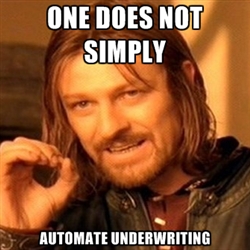
And pay no attention to the algorithms automating your job

Give thanks

Because nobody wants to hear you recap your holiday like this

Or this

Or this

Enjoy the Holiday!

You should also check out our 2016 Thanksgiving Day post and 2012 Thanksgiving Day post.
Jim Cramer Tweeted About OnDeck and Online Lenders
May 4, 2016Eighteen months ago and prior to OnDeck’s IPO, I joked about how an online business lender might be evaluated by the mainstream financial media, particularly through Jim Cramer memes.
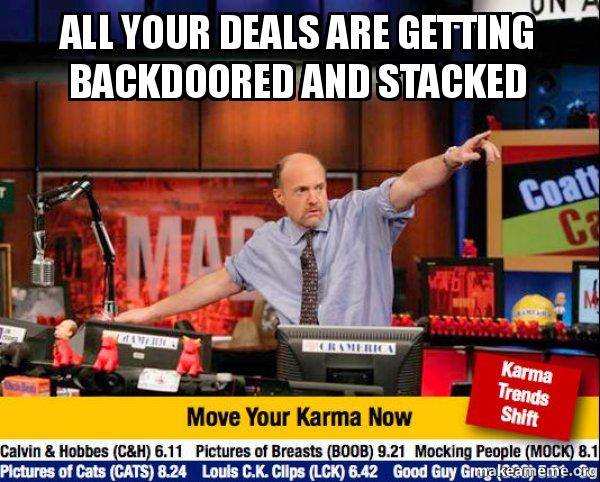
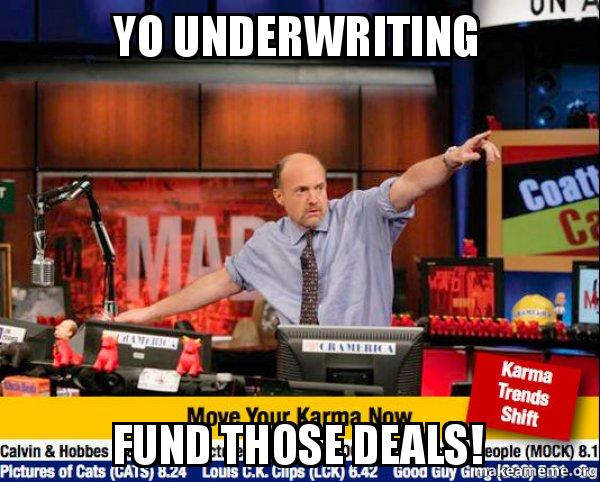
You can view all of the rest of those on the bottom of this page here.
In the meantime, the real Jim Cramer is not as entertained by these types of businesses. Here’s what he had to say about OnDeck and companies like them:
I do not like these new kinds of “banks” https://t.co/DO33G0cBCz
— Jim Cramer (@jimcramer) May 3, 2016
Meanwhile, below is a video of Jim Cramer talking to Lending Club CEO Renaud Laplanche just 1 year ago when he was more open to the idea:
Video not working? click here
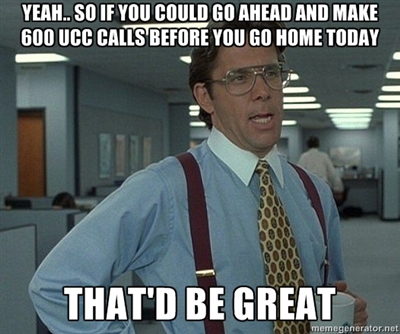
The UCC Boom Is Over
November 21, 2015 I spend a little bit of time scrolling through social media during my down times. There’s always an array of memes, GIFs, pictures, and random quotes that are posted either to spark laughter or to flat out troll a particular person or audience. I ran across a particular post that was interesting, it said: It’s called originality, you should try it sometime! This post got me thinking about our industry, the Merchant Cash Advance and Alternative Business Loan industry, and how over here on the broker side of things where we seem to as a whole, be lacking any type of originality.
- We for the most part, use the same sales pitches
- We for the most part, recruit using the same “rah rah” sales motivational speech
- We for the most part, resell the same product (the MCA or alternative business loan), even though we have access to reselling all types of alternative financing products such as asset based lines of credit, inventory loans, warehouse loans, hard money loans, bridge loans, SBA loans, credit cards, factoring, equipment leasing, purchase order financing, commercial mortgages, etc.
But nothing seems to be more common amongst broker houses (large, small and one man shops) than the fact that we all seem to rely on prospecting to, marketing to and calling on the same merchants over and over, using the system known as The Uniform Commercial Code (The UCC).
THE UCC AS STRATEGIC MARKETING – VERY LATE 90’s TO 2011
The UCC was published in 1952, by a host of legal professionals including Grant Gilmore and William Schnader, to name a few. The code establishes rules and governs certain types of commercial transactions including leases, bank deposits, secured transactions, investment securities and letters of credit, to name a few. The UCC had been utilized heavily by our industry since the early days in the late 90’s until around 2011 to perfect an interest in future assets.
Starting in and around 2007, the UCC became a very strategic marketing tool because the merchant already knew what the product was, how it worked, and would most times seek renewal once they were 50% paid down. However, this was during a time when a lot of the funders were still pricing A-paper like C-paper, or B-paper like D-paper, so if you could build a quality funder network and price said merchants within their correct paper grade, you could steal them from their old provider through better pricing.
THE UCC AS A STRATEGIC MARKETING TOOL DECREASES IN QUALITY – 2011 TO 2013
A lot of funders stopped filing UCCs on good accounts altogether or companies began using various fake/alias names starting around 2011 due to many new broker houses entering the space and solely using UCC filings as a way to market to merchants a “lower priced” merchant cash advance.
As funders grew tired of their merchants not renewing and instead switching to other providers, they responded by rolling out competitive pricing tiers and new renewal procedures.
- Proper Paper Grade Pricing: A lot of funders began to roll out more risk-based pricing tiers to properly price merchants based on their paper grade. No longer would funders price an A-paper merchant like a C-paper merchant, instead they were pricing A-paper merchants like A-paper merchants. That made it more difficult to woo merchants away as they were now receiving the proper pricing from their current provider.
- Better Renewal Policies: A lot of funders began to eliminate their renewal policy that required merchants to pay off the current balance from the first advance with a portion of the renewal approval monies, essentially having them pay for the same balance twice. Instead, funders rolled out add-on procedures that mirrored a lot of the positive aspects of a credit line. This strategy helped to keep their merchants from moving to other providers because it always kept their balances too high for other funders to pay off.
THE UCC AS A STRATEGIC MARKETING TOOL
The UCC remains to be a tool for newer funders and brokers looking to make their mark. But with more merchants already being accurately priced, they have less incentive to simply trade one company for another. That doesn’t mean they’re not interested in using both at the same time however and thus stacking has kept value of UCCs alive. But will it last?
THE UCC BOOM IS OVER
It’s called originality, you should try it sometime!
It’s time for brokers to innovate and find other ways to market. In addition to the stacking, merchants are receiving 20 – 40 calls a week from different funders and brokers based on historical UCC filings.
This is insane. Instead of us all chasing after the same merchant, it’s time to find other quality forms of data to transform into a sales pipeline.
Is Everyone Buying into the Technology Craze?
December 6, 2013 Following a wild 18 months of press releases and technology revolutions, I’m hearing that some ISOs are having technology fatigue. VCs and Private Equity want to invest in companies that are automating everything, but that doesn’t necessarily mean account reps are ready for it. The worst fear an account rep has is using an automated system to spit out numbers with a contract, get that contract signed by the merchant, and then have the figures revised or nullified during a later human review. Going back to the merchant with a 2nd contract with new numbers (often times worse) is a major credibility killer for them. It has bait and switch written all over it, even if they’ve made perfectly clear to the merchant that the terms they sign for are subject to a final underwriting review.
This problem has existed for years but that pressure has really been amplified by the recent tech race. Some funders are doing pretty good with it. Others aren’t. There are plenty of account reps that can’t function in a world where the answer is always 1 or 0 regardless. MCA came of age because of the shades of grey. I used to work for a company that was famous for listening to every merchant’s “story.” That factor can’t get baked into an algorithm.
As you might or might not suspect, there are funders thriving simply because they aren’t heavily tech oriented. ISOs get to talk to a human, negotiate the terms with an underwriter, and get exceptions that algorithms are programmed to disallow. When the algorithm says the deal is approved for a maximum of $10,000 and your merchant gets an offer from a competitor for $12,000, you’re going to need to get a human involved to match it. And if you’re a company that simply won’t bend your limits in situations like that, then that ISO isn’t going to send you deals in the first place.
Not everyone in the merchant cash advance business is convinced about automation. Then again, it’s not easy to convince people in this business about many things:
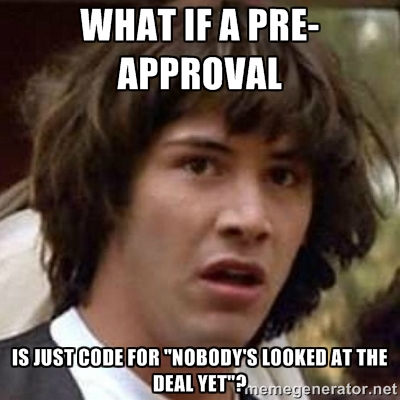
So what’s your criteria again???

We all know this guy
So it’s not actually approved then…

Oh really? What’s this ISO’s name?
As an account rep, I once had a funder make me get six re-signed contracts. Each time I got it re-signed, they decided they weren’t comfortable and revised the offer down. The final advance amount was more than 80% lower than the original approved amount. Streetz is rough.
More Merchant Cash Advance Memes on DailyFunder
10 Clues You’re Hardcore About Merchant Cash Advance
May 30, 2013You might eat and breathe funding small business, but unless you’ve got a set of pajamas like mine, you probably don’t sleep it too.

Yeah, Funding Just Got Serious…
1. You miss your train back to Westchester, Long Island, Brooklyn, or North Jersey because of something someone said on DailyFunder:


2. You yawn whenever you reference millions of dollars…

3. This is what you have for lunch every day…

4. You know at least three people that talk about starting their own ISO on a daily basis but never do it…
5. You’ve realized that the only reason the MCA industry has grown so much in recent years is because of account reps like this…
6. You’ve accidentally referred to your friends, relatives, or other non-business owners as merchants. “I mean hey, we’re all merchants here, right?“

7. You’ve gotten at least one trophy. Top Salesman, Hardest Working or…

8. You’ve worked for this guy before or you probably still do..
9. You’ve been on a totally great sales call and had a colleague walk in the room and do one of these to ruin it…

10. But most of all, if you help your clients in a timely manner and they look like this…

Then you’ll always be hardcore in their eyes!
View More Merchant Cash Advance Memes on DailyFunder
– Merchant Processing Resource
../../
MPR.mobi on iPhone, iPad, or Android
It Got Said – Merchant Cash Advance – Friday Fun
April 26, 2013In honor of Friday, we’re having some fun…

Caught on twitter
And Also
Business Financial Services landed an $82 million credit line
A third industry captain will be joining DailyFunder’s CEO Corner early next week at the ETA Expo. Stay tuned! Read articles put out by two other MCA CEOs.
Sean of Merchant Processing Resource and the DailyFunder co-founders will be on the trade show floor of the ETA Expo next week. Considerable time will be spent at Merchant Cash Group‘s exhibit at booth #751 and a guest appearance at Strategic Funding Source‘s booth at #916. We’d love to see you there. Make sure you download the DailyFunder iPhone app as we will try to maintain a live blog of the events.
Is Google Your Only Web Strategy?
December 31, 2012Every business wants to be found in search. To most, being found means top placement in Google’s search results for keywords or phrases that are most likely to convert into a lead, sale, or customer. That begs the question… how does one get that top placement?
While many are now accusing Google of monopolizing or manipulating the search results to promote pages and products that earn them revenue, they are still unique in the sense that one simply cannot buy top placement in organic rankings. The Google search system was originally designed to rank pages based on both how many other pages linked to a page and how important those linking pages were. It was a relational system called PageRank that theoretically gave little guys a chance of being ranked alongside or even ahead of major corporations.
When it came to being talked about or linked to from other sites (these incoming links are called backlinks), mega corporations with large sums of money had a tremendous advantage. Media outlets seemed to always be linking to them naturally and they could buy linking ads on websites that didn’t. They could even buy backlinks on irrelevant pages just to up the ante. In 2011, Overstock.com was penalized by Google after one such linking scheme was discovered. Overstock was offering discounts to students and faculty that placed a link to their website on a school web page ending with .edu. It was believed that .edu top level domains (TLDs) carried far more weight than .com, .net, and .org. Overstock tried to capitalize on that.
Where a company ranks in the result listings can mean the difference between success and failure. For the mega corporations, millions of dollars in revenue can be gained by being listed 1st as opposed to 4th. The reality is that searchers tend to click on top results more often, ultimately leading to more sales for the companies that rank well.
According to a study conducted by Slingshot SEO, the top search result is clicked 18.2% of the time, whereas the last result (#10 on the page) is selected 1% of the time. These statistics make a few things clear. If you’re not on the first page, you might as well be in outer space. Additionally, a ranking on the first page must be for a search term or phrase that is frequently searched. Sure, we’re happy to be listed 4th for the search phrase “greatest merchant cash advance company in the world,” since it links to our free directory of verified MCA providers, but since no one is using that search phrase, it really doesn’t matter.

A hypothetical business does research and determines that 100 people per month are entering this phrase into the Google search bar: “I want a merchant cash advance this minute.” It looks promising because it shows that the end user is in buying mode. One could make the case that they are more likely to apply for business financing than a user searching for “the history of merchant cash advance.” 100 searches for the initial phrase might seem like an opportunity, but you have to make an effort to achieve a listing for that keyword, at least that’s what Search Engine Optimization (SEO) gurus will tell you.
All Hail the King
Since Google is the omnipotent dictator that determines where every website falls, there is nothing that can 100% guarantee a website will be visible for the terms and phrases a webmaster wants. There is no shortage of tips, methods, and tricks to boost the odds but all of those things require time, money, or both. Neither will get the webmaster far unless the Search Engine Optimizer (SEOer) knows how to modify a website, analyze search phrases, and implement a strategy to increase rankings. If the SEOer isn’t tech savvy, stay away.
The SEOer’s strategy will likely fall into one of two categories, white hat or black hat, but it’s important to note that wearing any kind of hat is technically a violation of Google’s Terms of Use. It’s easy to label an SEOer that places thousands of irrelevant comments with a backlink on blogs all over the Internet as a black hatter. But contrast that technique with a white hatter that does nothing more than write interesting articles and get them published on other websites with a backlink.
The latter may seem innocuous, but both attempt to manipulate Google’s algorithm and can lead to serious ranking devaluation penalties. A penalty can be crippling for a business that depends on acquiring leads or customers online. Worse yet, the webmaster is not tried before a jury of his/her peers before being sentenced to page infinity for all search terms. This is the downside of the playing field Google creates. John Doe business owner can be listed alongside multi-million dollar corporations and can enjoy that visibility to grow into a million dollar business themselves. But if it is Google that brought him into this world, it is Google that can take him out.
 In late April, 2012 Google announced they were cracking down on “blog networks.” This algorithm update became known as Google Penguin and hit the web like a hammer. 3.1% of all english search queries were affected. Penalized webmasters that paid to have self-written articles published on other websites to get the link juice were left wondering how the practice could be a violation. Analogies were used to explain that paying to promote oneself is standard business practice. They likened article marketing to the basic trade of journalism. They argued it was their constitutional right to promote articles without fearing the total loss of business or retribution from Google.
Google’s position though is that it is perfectly okay to link to a friend’s website or to pay to have articles placed elsewhere. They respect that those decisions are not theirs to judge in respect to the global Internet. However, if the intent (or perceived intent!) of these practices is to achieve higher ranking in Google’s search results, then they reserve the right to protect the integrity of their ranking system accordingly. Essentially, anyone can do what they want, but it might affect how things are scored within their private system. So if you don’t care about your valuation in Google, you can use all the linking schemes in the world if you so choose. The problem is that most people do care about their score in Google and many people view Google as the global Internet. Google can argue that they are simply policing their own private system but to millions of web users around the world, they are viewed as policing the Internet.
The Revolution
It’s not their fault. Google’s system was so good and their interface so simple, that millions of people started using it and never went back. They became the Internet. Search engines existed previously but had many flaws. Back then, millions of websites that provided answers to questions or sold solutions for problems went undiscovered to the vast majority of humanity. Google found them, ranked them, and then went on to check them frequently to make sure users were still likely to find what they wanted.
They made the world a better place until the laws of their kingdom began to contradict common sense. For example, it would seem practical for a video game company to buy a banner ad on a video game enthusiast web forum. They could benefit from the targeted traffic and hopefully sell some video games. But at the same time, Google might view this banner link as an attempt to manipulate their algorithm.
 To resolve this dilemma, Google created a tagging system to allow their search crawlers to identify which links were paid for and then direct their algorithm to make sure the buyers did not benefit in search from them. This directive was controversial because it forced webmasters that cared about their rankings to worry about the nature of their outbound links. Could a website selling banner ads hurt both the buyer and the seller at the same time? They sure could. If buying and selling backlinks is forbidden, then both parties have something to worry about. Today, it is important to include the rel=”nofollow” attribute in html coded links that are paid for.
Since the majority of web users use Google in some way, the challenge and effort to achieve better placement has become a billion dollar industry. Prestigious advertising firms claim they can improve search placement using white hat guidelines Google itself created. The fact remains that there is no way to be safe, no matter how prestigious, knowledgeable, expensive, or innocuous the SEOer is. Having a page on a website that discusses a topic that another page on the same website already talks about can be grounds for a penalty. Interlinking your pages too much can be grounds for a penalty, discussing too many broad topics can be grounds for a penalty. Writing with imperfect english can be grounds for a penalty. Mentioning your product or service too many times in an article or throughout your website can be grounds for a penalty. Not using enough visual aids such as images or videos can be grounds for a penalty. Adding new content to the website too frequently can be grounds for a penalty.
Everybody’s Doing it
 Smart webmasters approach the web like their health. Do everything in moderation. It seems like every year there is a study that proves a correlation between a daily household food item with a certain untimely death. We’ve all heard something like this before: “The study determined that people that eat less than 2 carrots a day are more likely to die before the age of 70 than people that eat 2 or more carrots per day.” It’s the kind of fear mongering that causes someone to worry obsessively about meeting the 2 carrot daily minimum only to get hit by a bus as they cross the street three decades before they turn 70. Webmasters can spend their days worried about how Google will view them and ultimately never be found by their potential customers or they can do what everyone else does and work on getting backlinks and add content to their websites.
Is a compliant website that is never found by customers better than a website that has a good run, makes a lot of money, but takes the risk of getting penalized in the end? Some believe it is better to have loved and lost than to have never loved at all. Afterall, an online business that has no web visitors is not really a business is it?
 White hatters, the SEOers that wrongly believe they are immune from repercussions argue that their strategies take far longer to create results because they are in it for the long haul. Coincidentally, these long-haul strategies tend to have a high monthly price, do not guarantee results, and cannot predict what changes Google will make in the future. For example, if an SEOer says their slow and steady method will take 6-12 months, the webmaster should understand that the ranking algorithm could change in 5 months. All the work performed could be rendered obsolete in the blink of an eye or worse, devalue the ranking further from where it was originally.
In the quest for a quick fix or even as part of a long-term strategy, SEOers can’t help but notice that websites maintained by news media seem immune to all the rules. They republish countless amounts of duplicate news reports and they buy and sell exposure like its going out of style. In a way, they are a multiplied version of everything Google says not to do. But while they might get tons of traffic from search engines, they are not entirely dependent on them. Big news media has incredible brand name recognition. An individual seeking information about the Fiscal Cliff may simply type “CNN.com” in the browser address bar and bypass Google altogether.
Companies like Reuters, The Wall Street Journal, Fox, and CNN, etc. are highly authoritative and could be categorized as the holy grail of backlinks. If one of the major ranking factors is the importance of the website the link is on, then there is nothing more important than being mentioned by national mainstream news media. The media outlets know the perceived value of their links and are hungry to find new streams of revenue. Thus, an opportunity presented itself to them just as printed newspapers began going the way of the dinosaur. And so they began to peddle link juice.
The age of buying links is not dead and it is now much more difficult for Google to punish the parties involved. Webmasters can pay public relations firms to get a “company press release” published on big news media sites and get the backlink of course. This tactic has been around for years but it has become one of the last great bastions for white hat SEO. Others would argue that social media is the next frontier but for SEOers grinding it out in the trenches, traditional backlinks seem to work better above all else.
Many public relations firms have been warned by Google not to promote the backlinking aspect of their service, but all of them offer some kind of SEO package to target webmasters that are interested in using their service for the purpose of link juice. Searchengineland.com ran a great article that exposed what the press release as SEO tactic revolution has done to the news. (http://searchengineland.com/how-prweb-helps-distribute-crap-into-google-news-sites-140597)

There is now a surge in boring, irrelevant, and oftentimes non-sensical company announcements on big media sites across the Internet. It is a popular SEO method in many fields, making it difficult to find actual industry news amongst the clutter of backlink driven stories.
But if it works, then why stop? That of course implies that it works in the first place. Several days ago, Matt Cutts, the director of Webspam at Google informed inquisitive webmasters that links in these press release articles DON’T COUNT. Helpful SEOers explained to the original poster that most links in press releases have the no-follow attribute added to the links to make sure that they don’t pass juice. Upon our own examination however, we couldn’t find any news media or public relations firm that implements no-follow. It would probably hurt their bottom line if the junk releases they were peddling suddenly didn’t count for anything.
The debate rages on about whether or not the director of Webspam is to be trusted. Is the ranking algorithm as powerful as Google claims it is? Or are they spreading fear and misinformation to make up for their shortcomings? There is a lot of interesting feedback to consider in the comments section of seroundtable’s short article regarding press releases.
In the past, many webmasters have used obvious black hat techniques for favorable placement and gotten burned in the end. Many innocent websites have been caught in the crossfire. Success on the Internet is believed by many to be achieved only by being visible on Google.
The War
Individuals that have never managed a business website in their life have little idea how Google works. They know it will provide them with the answers they’re looking for and rank them in order from best to worst. To everyday users it is nothing short of magic. To an SEOer, being #1 for a search term may mean weeks, months, or years of trial, error, and patience. It requires time, money, or both. It is a tireless quest to become #1 or to die trying. It is the difference between getting 18.2% of visitors for a keyword searched 5,000,000 times a month or 1% of visitors for a keyword searched 100 times a month. It is a battle against not only Google, but against competitors in the same field that are using the same tricks to move up. It is a system that gives little guys a chance to be ranked alongside major corporations. It is way to be found in the sea of a trillion websites. But it is also a dictatorship. Google can sneak into your house in the middle of the night and banish you to page 50 with the accusation that you were buying backlinks. Google can lock the front door of your virtual store to prevent shoppers from getting in. Google can label non-native English speakers as spammmers and silence those that won’t stop writing about the same thing over and over again. This is the challenge with a single company being tasked with policing the entire Internet.
The Perks
 There are alternatives out there like Bing and Yahoo, but the problem is that when people go to those sites, they tend to type Bing or Yahoo into Google just to get there. Such is the habit these days for getting anywhere on the web. In 2008, blogger Marshall Kirkpatrick wrote about this phenomenon. He argued that mainstream users of the Internet do not even know how to navigate it. While tons of responders to the article seem to agree, there are plenty of folks that make a compelling case as to why using a search engine is superior to a browser’s address bar.
It isn’t easy typing ../../ perfectly if you’re a fast typer, which might explain why a significant portion of our visitors type this url into Google instead. They want to get to the right place the first time even if they type it in wrong. They might not even be exactly sure what our website is called or how to spell it. It’s not uncommon to see incorrect urls somehow end up in our traffic reports anyway.
- Merchant Processing Esource
- Merchant Processing Source
- Merchant Processing Resources
- Merchant Proccesing Resource (2 Cs or 1s)
- Merchant Processor Resource
The list of mistakes continues, but Google points them in the right direction anyway. If this didn’t happen, we might seriously consider rebranding the site with a much shorter domain name. Unfortunately, in mid-2010 when Merchant Processing Resource started, we didn’t give much thought to the difficulty in remembering a 7-syllable name, nor the likelihood of miskeying a single character in a 34 character address (www.merchantprocessingresource.com). This shove in the right direction is a benefit that an address bar can’t offer.
Not Evil?
The user oriented focus of Google arguably ended once and for all on May 19, 2010, the day they went public. While #6 on the list of Google’s official philosophy is that “You can make money without doing evil,” shareholders may have qualms with #1. It states, “Focus on the the user and all else will follow.” This motto doesn’t scream maximum profit. Besides, being public doesn’t allow Google to focus on the user, but instead tasks them with increasing the value of their stock. Of course they can’t earn a profit if they disregard the users altogether and so they are faced with the challenge of maximizing profit without alienating their users.
Adhering to their own philosophy is tricky, not to mention that many state and national governments believe that Google is manipulating the results to promote their own products. Products? one might ask; What possible products does Google have? Oh you mean you haven’t heard of Maps/Earth, Youtube, Zagat, Google Reviews, Google Plus, Gmail, Blogger, Picasa, Google Wallet, Translate, the Droid OS, driverless cars, the Chrome web browser, or the many other products they control?
Google isn’t content with just controlling search. They want to control the entire Internet experience. Companies like Facebook threaten that monopoly and as such Google has made social networking a top priority to counter them. Not evil?
The Google universe is exhausting. Webmasters must do more than just design great websites to continue enjoying the luxury of being found. Paid links must be marked as no-follow, backlinks on bad websites must be disavowed, private pages must be marked as no-index, similar or duplicate content must be avoided, URLs must be descriptive, title tags should be relevant, HTML should be used over Flash, and moved pages should be redirected if for no other reason than to retain the page value of the original URL.
Is There Life After Dea.err…Google?
As we draw near our conclusion, we argue that Google continues to play a large role in Internet Marketing, but advise that Google is not the Internet, no matter how much you’ve come to believe otherwise. There is LinkedIn, Facebook, Twitter, web forums, blogs, email newsletters, and a zillion other places to promote oneself and be found. Too many people fail to utilize the infinite other opportunities to market themselves online simply because they believe ranking in Google is the only way or because they’ve received a penalty and give up. “Getting ranked” has become an all consuming challenge that blinds webmasters from their true goal of attracting customers. People bought products and services online before Google came around. They might make things easier for the average user that believes search results are a product of magic, but in reality they are just one of many systems to find things. They are an imperfect ecosystem that has become tainted by their motivation for profit. And let’s not forget the millions of white hatters and black hatters that are driving the algorithm wild as they seek better placement for themselves or their clients.
Do we care about Google? Certainly, but only about half of our visitors originate from the search engine. People actually see us mentioned on LinkedIn, Facebook, and actual trade publications. And guess what? Those people visit us, bookmark us, and return. There may come a day when Google decides too many incoming links from Facebook is grounds for a penalty, causing outrage among webmasters, a move that might force many to give the social network up, and even disavow it officially. White hatters could end up having to eat their white hats down the road. The whole system of the Internet will no longer seem to make any sense. Maybe a reality check is okay. Perhaps too many hours and megabytes are wasted on trying to gain favor with Google. So much junk exists out there these days that isn’t even meant to be read or followed, but rather exists for the sole purpose of gaining link juice. If a poorly designed website in China links to a good website in the U.S., should the webmaster have to spend time tracking it down, identifying it, and disavowing it just to appease the king? Does this make any sense?
The next time you spend $300-$500 on a press release with carefully crafted link text, think about whether or not Google is really going to reward you with placement for a search term. Their director of Webspam says you’re not going to score any points, yet you may believe otherwise. Consider how else that money could be spent online outside the context of Google SEO. Are you looking to attract customers or simply gain favor with a king that MIGHT lead to customers? Imagine for a minute that Google, Bing, and Yahoo have banished you from being found forever. Would you close up shop or start to think outside the box?
White hatters that read this may be mumbling to themselves that they need not think this way because they have a surefire strategy that works, something along the lines of “Content is King.” This “Content” revolution involves publishing tons of articles to ones website to give the impression to Google that a website is constantly being updated with helpful information. An SEOer will tell you that Google “wants” this. In reality though, this has created a new phenomenon, the practice of webmasters spamming their own websites. The content may be informative, well written, and on-topic but if it’s being done to please Google instead of making sales or helping visitors, then it’s really nothing more than the black hat trick of the day. “Content is King,” that is until it’s not because 100 million websites are doing the same thing, leading to a vast pile of junk in cyberspace.
People forget that the word ‘marketing’ exists in Internet Marketing. They focus their time and effort on Internet Manipulation. They either have systems to make a quick buck or they slowly march onwards towards a promise that can’t be kept. As we approach 2013, it remains true that Google can’t be ignored, but the rest of the global Internet shouldn’t be either. There are billions of people out there that are looking for what you offer and you need to learn how to reach them. Coincidentally, there are 100 million articles on the web that claim they can teach this very trade. 99 million of them exist for the purpose of getting a backlink. That means the information is questionable at best. Take a marketing course, read a marketing book, or hire a marketing consultant. Go back to the basics if you must. Plan for the day where you won’t exist in search even though your business exists in real life. If the moment comes where Google replaces the search results with only paid advertisements or you get penalized because you told all of your friends to link to your website, you can shrug it off. If you want to be in Internet Marketing for the long haul, stop thinking about search. Google can’t be your only web strategy forever.
– Merchant Processing Resource
../../
Find tons of great Matt Cutts memes here

A Great Thread That Discusses Business Survival Without Google