
National Funding Acquires QuickBridge
October 2, 2018
National Funding announced today that it has purchased QuickBridge. The two companies will combine back-end resources, including advanced technology, innovation and product development, but they will continue to operate independently, as separate brands. Ben Gold, QuickBridge’s founding President, will remain in his current post and will work closely with National Funding founder and CEO Dave Gilbert.
“QuickBridge has an unbelievable front end system that knows how to underwrite small businesses extremely efficiently,” Gilbert told AltFinanceDaily.
Gilbert also said he was particularly interested in QuickBridge’s 10 year loan product.
National Funding was a minority interest owner in QuickBridge since the company’s founding in 2011, so this acquisition was essentially a buyout of five other partners.
In addition to the technology, Gilbert said QuickBridge’s people and its headquarters in Irvine, California were elements that made it very appealing.
“There’s a lot of great talent in Orange county and there are a lot of finance companies out there, so it’s going to be a great recruiting hub,” Gilbert said.
Given the high quality pool of talent, Gilbert said he believes he can scale QuickBridge quickly. Together, National Funding and QuickBridge have provided more than $3 billion in financing to small and mid-sized businesses and their combined overall financing volume will exceed $600 million this year, according to National Funding. QuickBridge has been recognized in recent years for its rapid rise, including year-over-year double or triple digit percentage growth.
The way that both companies get business is slightly different. Gilbert said that QuickBridge derives 75 percent of its business from ISOs and 25 percent from direct marketing, whereas National Funding’s ratio is the inverse, with a sizable direct sales team.
In addition to QuickBridge’s headquarters in Irvine, it also has a small satellite office in New York, which will remain. Of the company’s roughly 100 employees, Gilbert said that virtually all of them will stay on. Founded by Gilbert in 1999, National Funding is based in San Diego and employs roughly 230 people.
Funding Circle Stays Global; Goes Public in London
September 29, 2018 Funding Circle became a public company yesterday on the London Stock Exchange, listed as FCH. Founded in 2010, the peer-to-peer lending platform for small and medium-sized businesses, was initially priced at 440 pence (£4.40), which was on the low end of the 420-530 pence per share price range. But it opened at 460 pence, placing the value of the tech company at roughly £1.5 billion, or $2 billion, according to a Reuters report. In conjunction with the company’s IPO, it raised approximately £300.
The stock price dropped below the initial 440 pence per share on Friday to 435 pence, but went back up by the end of the day. The company was founded by Samir Desai, James Meekings and Andrew Mullinger, who all met at a pub in Oxford, England, according to a University of Oxford publication. Desai and Meekings were both studying Economics and Management at the university.
Among the company’s investors are Union Square Ventures, Blackrock and Index Ventures, in addition to a £150 million investment from Danish billionaire Anders Holch Povlsen.
According to the company’s September 2018 prospectus, Funding Circle’s total revenue has steadily increased over the past few years with $32 million in revenue in 2015 and $50.9 million and $94.5 million in 2016 and 2017, respectively. The company has facilitated £5 billion in loans its inception in 2010.
In August, Funding Circle rebranded with a new logo, and in June, the company expanded its partnership with Kansas-based INTRUST Bank, strengthening it presence in the U.S. market. Funding Circle offers small business financing from $25,000 to $500,000 with repayment options up to 5 years. While headquartered in the UK, the company also services customers the U.S., Germany and the Netherlands. Its headquarters is in London and it also has an office in San Francisco.
Yellowstone Capital Introduces a Smarter Box In Move Towards Transparency
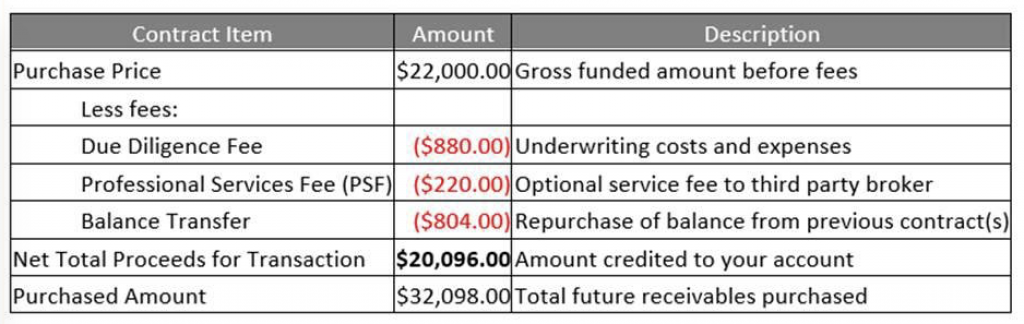
September 26, 2018Yellowstone Capital CEO Isaac Stern announced a “Smarter Box” through social media channels this morning. The itemized box will be provided to merchants through a post-funding email as part of a company effort to maximize transparency.
According to the announcement:
“[We are] very serious about maximum transparency and disclosure to our funding partners’ great merchant customers. In addition to our new Purchase and Sale Agreement we will be using with each of the funding partners on our platform, we are also implementing a transaction summary email to ensure that all applicable fees, costs, disbursements and hold-backs are clearly understood by all parties. Our new contract will increase disclosure while simplifying the product, while our summary confirmation ensures greater understanding and improved communication between our funding partners and their customers.”
Example of the box:
Based in Jersey City, NJ, Yellowstone Capital has originated more than $2 billion to small businesses since inception.
RDM Capital Funding Secures $7.5 Million Credit Facility from Charleston Capital
September 12, 2018Clifton, NJ – RDM Capital Funding, LLC, a technology enabled specialty finance company, announced that it has entered into a new $7.5 Million credit facility with Drift Credit Opportunities Fund, LP, an affiliate of Charleston Capital Management, LLC. This is the first institutional credit facility for RDM Capital Funding, which was launched in 2015 and focuses on financing for small businesses throughout the United States of America.
“This facility allows us to expand our ability to serve more small businesses and help them with their working capital needs. We are pleased to partner with Charleston Capital and take this major step toward our continued growth,” said Reuven Mirlis, Chief Executive Officer of RDM.
“RDM represents an attractive opportunity for Charleston Capital as they have quickly established themselves as a disciplined underwriter with substantial operating controls,” said McLean Wilson, the Chief Executive Officer of Charleston Capital, “We expect them to become a significant presence in the space over the next few years and look forward to their continued success.”
About RDM Capital Funding:
Founded in 2015, RDM Capital Funding is a technology enabled specialty finance company, which provides working capital to small businesses. The company provides small businesses easy-to-access capital, through a quick, efficient and transparent process. RDM is headquartered in Clifton, NJ and employs 11 personnel.
About Charleston Capital:
Charleston Capital Management is an alternative asset manager that seeks to generate attractive, absolute returns by opportunistically and tactically investing in areas where conventional sources of capital are disproportionately unavailable. Charleston Capital was formed to expand the spectrum of opportunities for investors seeking risk adjusted returns that are less correlated to other markets. Specifically, the firm seeks to exploit inefficiencies that are borne from transactions requiring significant amounts of intellectual as well as financial capital. The firm is headquartered in Charleston, South Carolina and is part of inFactor, a FinTech firm focused on liquidity solutions for businesses. The Drift Credit Opportunities Fund is a credit strategies fund focused on structured loans to FinTech enabled Non-Bank Financial Services companies, which underwrite loans to small and medium sized businesses in the United States of America.
Contacts:
RDM: info@rdmcapitalfunding.com (877) 667-4647
Charleston Capital: media@charlestoncm.com (843) 310-3528
Merchant Cash Advance Company Wins in Bankruptcy Court After Judge Rules It’s an Ordinary Part of Business
August 21, 2018 Last week, a bankruptcy judge in the Northern District of Illinois ruled that a merchant had used so many merchant cash advances that it had become a normal part of their business.
At issue was Network Salon Services, a business founded in 2004 that was brought back from the brink of insolvency in January 2013 by a merchant cash advance. That advance, coupled with dozens of advances from more than 14 MCA companies over the following 3 and a half years would keep Network Salon on life support until it finally failed for good.
At the end, Network Salon had just $200 to its name and nearly $4 million in outstanding future receivables due to MCA companies.
After the Chapter 7 proceedings commenced, the bankruptcy trustee came knocking on the doors of several MCA companies to give back the funds it believed had been fraudulently transferred and obtained through criminally usurious means.
One of those companies, NY-based LG Funding, pushed back hard, and on August 15th the judge ruled in LG’s favor. In a carefully considered decision, The Honorable Jacqueline Cox said that an exception applied to LG Funding. Unlike a normal creditor where certain property obtained leading up to a bankruptcy becomes returnable to the trustee, Network Salon relied on MCAs in its normal course of business for years and thus the transfers of funds to LG Funding was the ordinary course of business not subject to return.
So ordinary was it in fact that Network Salon used MCAs to make payments on other MCAs, going so far that at one point one of its bank accounts showed no deposit activity for a month except for deposits from MCA companies and online lenders.
Ultimately it didn’t matter if LG Funding was actually debiting the deposits made by rival companies rather than the actual proceeds of sales, Judge Cox opined, because this deviation from the contract was not fraudulent and both parties benefited from it.
The usury arguments, as usual, failed, because New York courts (The state governing LG Funding’s contracts) have already determined that MCA transactions are not loans and therefore can’t be usurious.
“The Trustee has failed to meet her burden to establish by a preponderance of the evidence that the transfers were preferential or constructively fraudulent and therefore subject to avoidance,” The judge ordered. “LG Funding has succeeded in establishing that the transfers were made in the ordinary course of business, defeating the Trustee’s 547(b) preference claim. The constructive fraudulent conveyance claim fails because Network Salon received reasonably equivalent value in the transactions in issue. Judgment will be entered in favor of Defendant LG Funding on all counts.”
This post is an oversimplified explanation. Download the 24-page decision HERE for the full facts and details.
Lengthy Investigation Leads to Arrest of Former Funding Company Employee
August 2, 2018 A former Yellowstone Capital employee was arrested yesterday in New York City, the culmination of what Yellowstone CEO Isaac Stern said was a nearly year-long investigation that involved law enforcement in New York, New Jersey and Florida.
The former employee was charged as a Fugitive of Justice in New York. And he is being charged with 3rd degree Theft by Deception and two computer related crimes in New Jersey, according to Stern. This person’s name is being withheld as he has not been convicted. According to Stern, the employee started working for Yellowstone last year as a rep at the company’s Jersey City office. He then left the company on his own volition to move to Florida. When Yellowstone opened a Florida office in May 2017, the man was rehired by Yellowstone to manage the data entry operation at the new office.
The man was terminated in September of 2017 for reasons unrelated to these charges. Following his termination, Stern said that the company noticed a trend where merchants were being solicited after submitting new deals. Simultaneously, the company saw an increase in concerns raised by its ISO partners regarding backdooring. (Backdooring is when a broker submits a potential deal to a funder and that file leaks out to third parties whom the broker did not authorize to handle the information.)
In response to this, the company created a task force comprised of cyber security professionals that ultimately traced the leak to this former employee. A number of people have been arrested for stealing information from Yellowstone, but Stern said that this was by far the largest and most sophisticated theft.
“Nothing has hurt us more than this leak,” Stern said, “and it would have been impossible to catch this guy if we didn’t have a full-time team.”
The team Stern refers to is what he says has now become a separate Yellowstone office at an undisclosed location that is devoted exclusively to security. He said Yellowstone spent about $250,000 developing this external office and upgrading the company’s security systems. Additionally, employees and others can now anonymously email: security@yellowstonecapllc.com with information related to potential theft.
Square Capital is Funding $130 Million a MONTH
August 1, 2018 Today Square released its Q2 2018 earnings, revealing that in the second quarter Square Capital facilitated over 60,000 business loans totaling $390 million. This is an increase of 22% year over year, and a 13% increase compared to last quarter’s loan volume of $339 million.
Square’s growth was also driven by its Instant Deposit, Caviar and Cash Card products. Additionally, second quarter growth came from Square’s acquisitions, including Weebly, which provides tools to help individuals and small businesses create websites or online stores.
In today’s earnings call with Square CEO Jack Dorsey and CFO Sarah Friar, an analyst asked about plans for development of Square Capital. In response, Friar said that they plan for Square Capital to grow as the Square customer base grows. But she said Square is also taking more proactive steps to acquire Square Capital customers, including partnerships. Just last week, Square partnered with eBay to make loans to eBay merchants.
“We’re looking to partner [with companies] where their customers look like Square sellers,” Friar said.
Founded by Jack Dorsey and Jim McKelvey in 2009, Square is headquartered in San Francisco, with offices also in Canada, Japan, Australia, Ireland, and the UK. Dorsey is also the CEO of Twitter.
Crowdfunding Legal Limit Too Low for Intended Beneficiaries
July 25, 2018 Regulation Crowdfunding (Reg CF), a regulation that grew out of the Jumpstart Our Business Startups (JOBS) Act of 2012, was designed to allow non-accredited investors to invest relatively small amounts in startups. But the regulation seems not to be serving its purpose, according to people in the fintech investment community.
Why is this? Because the maximum amount that can be raised in a single year under Reg CF is limited to $1,070,000.
“I’ve had clients consider [using] Reg CF, but when they see that they can only raise $1 million, they say it’s not worth the trouble,” said James P. Dowd, CEO of North Capital, a Salt Lake City-based broker-dealer that helps private companies raise money.
“I’m not anti-regulation at all, but if the reward is not there, people won’t go through the trouble,” Dowd said. “Let’s have regulations that are appropriate for the need.”
Dowd said that a small startup seeking funding for a series A round is typically looking to raise around $10 million. The $1.07 million cap for Reg CF is therefore inadequate. A startup’s other options for raising money under the JOBS Act include regulations D, S and A+. Dowd said that Reg D is the most common. It involves very little paperwork and is less expensive compared to other options. Reg S applies only to offshore investors and Reg A+ makes sense only if the startup is looking to raise $20 million or more because this option is costly to file.
All of these options require that investors be accredited, which translates to investors being wealthy. (Accredited investors must have a net worth of at least $1,000,000, excluding the value of one’s primary residence). On the other hand, if an entrepreneur opts to raise money through a Reg CF, investors need not be accredited, although there are still restrictions on how much they can invest, given their income.
Reg CF allows entrepreneurs to access a wider pool of investors. And Dowd, along with others in the investment community, believe that the current $1.07 million annual cap should be raised to as high as $20 million to satisfy the need of entrepreneurs who are looking to raise more money.
“The infrastructure for the crowdfunding industry has been tested and is ready to expand,” said Douglas S. Ellenoff, partner at Ellenoff Grossman & Schole who is an expert on crowdfunding.
Ellenoff said that there was much fear among regulators following the 2012 JOBS Act that crowdfunding would be ripe for fraud. But the fraud didn’t happen. He believes in raising the Reg CF cap to allow the crowdfunding industry to mature. And he believes that once the cap is raised, more substantial companies will start to use crowdfunding which further legitimate it as a valid way of raising money.
North Capital was founded by Dowd in 2008 and provides an array of financial advisory services to its clients. In addition to its Salt Lake City headquarters, it also has offices in Benicia, California and McAllen, Texas.