
Industry Takes ALS Ice Bucket Challenge
August 24, 2014Have you been nominated to take the ALS ice bucket challenge yet?
Kabbage below:
Their video made the local Atlanta news.
OnDeck in Times Square NYC:
Noah Breslow, their CEO also did it:
Funding Circle:
PayPal
Coincidentally, in the industry’s 2012 fantasy football competition for charity, league winner Sure Payment Solutions chose to donate all funds raises ($7,100) to the ALS Association.
Whether you get nominated or not, you can donate at http://www.alsa.org/.
Feel free to tweet @financeguy74 if you or your company accepted the challenge. 🙂
Is Awareness of Alternative Lending Still Low?
July 4, 2014 Prosper’s President Ron Suber and LendingClub’s CEO Renaud Laplanche have previously explained that there is still a large opportunity for growth because most people still don’t know non-bank lending options exist.
As cited on LendingMemo, Renaud Laplanche admitted the reason they are even considering an IPO is “to use it as an opportunity to raise awareness for the company.” He continued by saying that they don’t need capital so the purpose of their IPO aspirations “is a lot of free advertising.”
In casual conversations with business owners, friends, and new acquaintances I’ve asked if they’ve ever heard of merchant cash advance, p2p lending, or companies like OnDeck Capital and LendingClub. The answer is almost always ‘no’.
That means there is still a lot of work to do.
In this CNBC interview Funding Circle acknowledges that many business owners aren’t aware of alternatives and explains what makes them different.
Do Opportunities Abound?
June 8, 2014 Just recently I found myself in an office surrounded by some folks who had each worked in the merchant cash advance business for more than 10 years. The first generation of MCA pioneers are still out there of course but it’s rare to be in the presence of so many at one time. It was weird. Weirder still was the realization that no matter how much things have changed, some things continue to be exactly the same.
Me: You guys looking to recruit ISOs?
Them: Damn right
As far as the industry is concerned, these guys might as well have fought in ‘Nam. They’re from another generation where life was hard and men were still men. When businesses couldn’t get bank loans, these guys were splitting payments with their bare hands and reprogramming credit card machines with nothing more than a paper clip and a ball of twine. Funding a deal wasn’t a product of technology, it was one of sweat, tears, and blood. Have you ever bled for your deals?
This August I celebrate my 8th year in the industry. Next month marks the 4 year anniversary of this blog. I enjoy reading some of my posts from back then, particularly since most of them discuss the ordeals of credit card processing. A lot of what I’ve written no longer applies and some of what I’m writing these days will be outdated years from now. As I approach 600 articles and blog posts on this subject matter, I’ve had to stop and ask myself if everything has already been written. What more can possibly be said about this business? Perhaps the tale of the industry has already been told and I am on my way to retelling exaggerated stories to anyone who will listen. I don’t want to be that wrinkled up old man swaying back and forth in a rocking chair talking about how ISOs got it so easy these days.
 Sadly, even the name of the website is reflective of a previous era. This is the Merchant Processing Resource, not exactly what you’d expect a top destination to be called on the subject of alternative business lending.
But the story’s not finished. Every passing month is filled with events that inspire a dozen new chapters, which is more than one man can keep up with. Last month at the LendIt conference, I got a glimpse of just how many opportunities still lie ahead.
Some alternative business financing companies such as Funding Circle and DealStruck are diverging away from merchant cash advance and going back to the traditional roots of term lending. Funding Circle is doing it with a 21st century twist, by making their system peer-to-peer based.
Still other firms have sprung up around LendingClub’s and Prosper’s APIs and offer their users ways to make better loan investment decisions.
And even among the players we’re all familiar with, there is innovation, growth, and new ideas. Just recently CAN Capital launched CAN Connect, a software application that can be integrated with any other company’s software. According to CAN’s release,
Through CAN Connect™, merchants will be able to receive a CAN Instant Quote™ based solely on data provided by the partner. Once the merchant elects to proceed, they are taken through a simple online application process and can obtain access to working capital without ever leaving the partner’s platform.
Indeed technology has even allowed me to become a lender myself,

My LendingClub portfolio, which is still very young and made up by hundreds of $25 consumer loan contributions has a current Net Annualized Return of more than 10%. Contrast that against the average U.S. savings account that pays out less than 1%.
While it’s certainly not the 54% yield that OnDeck Capital enjoys, there are levels of risk and markets set up for just about anyone interested in alternative lending.
And what might come next may not all be broker/funder related. As the industry flies in a thousand different directions, entire new industries and services are going to grow up around them. That brings me back full circle. Has everything already been written? 4 years of blogging here and this might as well be my first day.
Some things haven’t changed a bit, but the rest of it, well… we must soldier on in this strange new world.
Do you see opportunities ahead? Discuss with industry insiders on DailyFunder.
LendIt Conference: The State of Alternative Business Lending
May 6, 2014 Have you heard? Banks aren’t lending. Nobody at LendIt seems to mind though. Ron Suber, the President of Prosper Marketplace, said earlier today that banks are not the competition. That’s an interesting theory to digest when contemplating the future of alternative lending. If banks are not the competition, then who is everyone at LendIt competing against? I think the obvious answer is each other, but much deeper than that, the competition is the traditional mindset of borrowers.
The biggest challenge the wider alternative lending industry faces is awareness and understanding. Those happen to also be two of Suber’s three edicts for growth. The third is education. Just because alternatives are available today doesn’t mean that potential borrowers know about them or feel comfortable enough to use them. Today we are competing against the old way of thinking.
Revolution?
Other products in the new “share economy” have encountered a similar struggle. Several presenters today cited Uber as having revolutionized the way people use taxis. “A long time ago, people used to stand on corners and hold out their hand to get a cab, but that’s all changed,” was the oft-paraphrased proof that age-old industries were falling like dominoes. But as a New York City resident, I hadn’t quite noticed a change at all. Hailing cabs off the street is still very much the norm. It is only by sheer coincidence that I used Uber for the very first time to travel to JFK airport on my way to this conference.
I first encountered Uber a year ago when an acquaintance dazzled me with his ability to summon a car using an app on his phone. It was then that I became aware, but I did not understand how it worked. It took me 12 months to get comfortable enough to try it myself, and the experience was okay I guess if you discount the fact that my driver went through the E-ZPass lane without actually having an E-ZPass. Needless to say, that led to a major holdup that caused me to almost miss my flight.
If it took me a year to get past the confusion of hailing a cab from my phone, I can only imagine what potential borrowers must think when told they can raise money from their peers, the crowd, or a lender that requires payments to be made every single day.
Perhaps most telling about the awareness challenge, is that many people I’ve spoken to at LendIt had never heard of a 16 year old product known as merchant cash advance. That speaks volumes about how much more work merchant cash companies still have to do in order to gain mainstream awareness.
Even those fully aware were not entirely certain about how to define the product. In the Online Lending Institutional Investors Panel, merchant cash advance was briefly discussed as a topic but it was almost entirely spoken in the context of being something that OnDeck Capital does. That would come as disheartening news to OnDeck since they have spent considerable resources in positioning themselves as anything but a merchant cash advance company. Confusion over what somebody is or isn’t will probably increase especially as alternative lenders from different industries start to compete for the same clients.
Funding businesses instead of people
Brendan Ross, the President of Direct Lending Investments, and the moderator of the Short Term Business Lending panel pointed out that a dentist could pursue two different loan options and get completely different results. With excellent credit a dentist could expect to land a 3-5 year personal loan at 7-8% APR on a P2P platform. If he were to apply for the loan using his dental practice though, he could expect to incur costs over 25% and get nothing longer than 2 years.
Ross, who was a very active moderator, subscribes to the belief that businesses are overpaying for credit. Unlike the consumer loan space, there hasn’t been price compression. The cost of business capital remains high, perhaps higher than what is necessary to turn a reasonable profit. Ross argued that the padded cost serves as a hedge against defaults and economic downturns. “The asset class works even when the collection process doesn’t,” Ross said. “The model works with no legal recovery.”
Building on that premise, Ross asked the panelists if an increase in defaults were simply the cost of doing business towards automating the underwriting process.
Stephen Sheinbaum, the CEO of Merchant Cash and Capital argued that just the opposite had occurred, that automation had led to a decrease in defaults. Others on the panel confirmed a similar outcome, though Rob Frohwein of Kabbage admitted they could potentially weather higher defaults through automation by offsetting it against decreased infrastructure costs.
Noah Breslow of OnDeck echoed something similar to Frohwein in the Small Business Term Lending Panel. He asked this question, “Do underwriters add value or not?” and followed up by saying that 30% of their deals were still manually underwritten, usually the deals that are larger.

Is full automation right around the corner?
The debate between humans and computers in risk analysis is a featured segment in the third issue of DailyFunder that is being mailed out this week, but there is another angle that is seldom discussed, whether or not customers want automation. Breslow said today that, “if customers want full automation, we are prepared to deliver it.” They’ve learned over time that “many customers want someone to talk to at some point in the transaction.” Rohit Arora, the CEO of biz2credit expressed much of the same in a recent interview with DailyFunder’s Managing Editor Michael Giusti.
The only dissenting voice was Gary Chodes, the CEO of Raiseworks who seemed to be of the belief that human involvement in underwriting was nothing short of ridiculous. He stated that, “if you look back over the last 20 years, the loss rates on business loans under 24 months has been really low.” To him, that data seemed to be proof enough that complete automation could and should be achieved, though he admitted to performing back-end checks such as landlord verifications. They currently have no physical underwriters however.
Is there a transparency problem?
Tom Green, a VP of LendingClub shared an interesting tale. While trying to convince potential borrowers to ditch a merchant cash advance in favor of a LendingClub business loan, they get pushback on the cost of their money. The reason being? Some borrowers think they’ve already got a great deal or at least a better deal than what LendingClub is offering. The problem stems from the borrower’s belief that the holdback percentage set up in their future revenue sale (the most common way a merchant cash advance is set up) is the APR.
 Merchant Cash Advance Companies pay cash upfront in return for a specified amount of a businesses’s future sales. They collect these sales by withholding a percentage of each credit card transaction or bank account deposit until the agreement is satisfied in full. On a dollar for dollar basis, the cost of these programs typically range from 20%-49%, but on an APR basis, substantially higher. The holdback % is not even a factor in the APR. Green said they’ve learned that some small business owners are not sophisticated when it comes to finance.
Ethan Senturia, the co-founder of Dealstruck would probably agree. Earlier today he said, “you need to speak the borrower’s language.” Some understand APR, some don’t. “Dealstruck offers more than just APR comparisons to borrowers,” Senturia said. “Whatever helps them understand.”
When the OnDeck Capital model and merchant cash advance model were questioned as possibly being bad for borrowers, Tom Green was quick to clarify. “There are different capital needs that small businesses have,” he said. And “there is a trade-off between the length of the term and the risk.”
OnDeck Capital’s clients are not entrepreneurs born yesterday. “The typical customer has been in business for 10 years,” Breslow said. Their deals are “structured to protect through daily and weekly payments in addition to the interest rates we charge,” something he reminded everyone was “not single digits.”
Still, transparency issues remain in business lending. Sam Hodges, the Managing Director of Funding Circle explained that when he was previously a small business owner, there were hardly any lenders willing to provide him with an amortization schedule. Ashees Jain, a managing partner of Blue Elephant Capital Management admitted he would find it hard to justify the high rates of merchant cash advance if asked by a regulator, so he’d rather not invest in that market. When it comes to those types of transactions, they “don’t want to have to explain themselves” at some point in the future.
Scott Ryles, the managing member of Echelon Capital Strategies, LLC commented on OnDeck capital’s model as unbelievable. “The arbitrage is huge,” Ryles said. And Eric Thurber the managing director of Three Bridge Wealth Advisors believes that alternative business lenders are at odds with themselves. “They always talk about their risk management,” Thurber said, but he feels that players in that industry are concerned with how much market share they have. That conflicts with risk management in his opinion.
They pay or they don’t
At the end of the day Ashees Jain said as far as unsecured loans go, “borrowers pay or they don’t.” The recovery process on secured loans can be 12-18 months Jain said, a statistic cited by Brendan Ross earlier in the day.
It’s clear at LendIt that there are a lot of products available, but Ryles summed it up nicely. In the consumer space, all the volume is in the 36 month installment loans, he reckoned. For businesses it’s merchant cash advance. “It’s an awareness thing,” Ethan Senturia said in regards to getting businesses to use alternative lending sources.
It is indeed. Awareness, education, and understanding…
Lending Club Threatens The Status Quo
March 20, 2014 In late 2013, consumer peer-to-peer lender Lending Club announced their plans to start offering small business loans. That caused a stir in the merchant cash advance world for a few weeks, but the hype died down. The general consensus was that there would be little to no overlap between the applicants each target.
To this day, I continue to doubt that the overlap will be anything less than substantial. Nik Milanovic of Funding Circle would probably disagree with me. The main argument has been that Lending Club will only target small business owners with good credit, which assumes that businesses with anything less are the only users of merchant cash advances. Not to give anyone’s figures away, but I have seen data to suggest that a large segment of merchant cash advance users have FICO scores in excess of 660. Somewhere along the line we convinced ourselves that merchant cash advances were for businesses with really bad credit. That was never the purpose it was intended for, though it’s true that many applicants have low scores.
Historically, merchant cash advances were for businesses that posed a cash flow risk to banks. Split-processing eliminated that risk by withholding a percentage of card sales automatically through the payment company processing the business’s transactions. Funders today that rely on bank debits for repayment don’t have that safeguard, but they make up for the risk they take by doing something banks don’t do, require payments to be made daily instead of monthly. This allows businesses to manage their cash flow throughout the month and enables the funder to compound their earnings daily. It’s a phenomenon I wrote about in the March/April issue of DailyFunder (Razzle Dazzle Debits & Splits: Daily is the Secret Sauce)
According to the Wall Street Journal, Lending Club will require a minimum of 2 years in business and participation will initially only be open to institutional investors.
Lending Club’s website states that they will recoup funds on a monthly basis via ACH and that interest rates range from 5.9% APR to 29.9% APR + an origination fee. Terms range from 1 to 5 years and there are no early payment penalties.
TechCrunch openly pegs CAN Capital and OnDeck Capital as chief rivals for Lending Club in the space. CAN has enjoyed frontrunner status in the industry since 1998 and while they have been tested in the last 2 years, they haven’t come up against something like this.
In the same Wall Street Journal story, Lending Club’s CEO, Renaud Laplanche lays out who his competitors are with his quote, “The rates provide an alternative to short-term lenders and cash-advance companies that sometimes charge more than the equivalent of 50% annually.”
But will the impact be felt right away? In Laplanche’s interview with Fortune, he claims that it’s very likely they’ll focus on the 750+ FICO segment first, where institutional investors will be comfortable. But make no mistake about it, that will change quick, especially with a probable IPO in the next 8 months.
Is Lending Club really all that big? To draw a comparison, RapidAdvance got a $100 million enterprise valuation when they got bought out by Rockbridge Growth Equity about 6 months ago. Lending Club on the other hand was valued at around $2.3 billion at that time. It took OnDeck Capital 7 years to fund $1 Billion in loans. Lending Club is funding a billion dollars in loans every 3 and a half months. Granted, they’ve all been consumer loans, but let’s not kid ourselves about their capabilities.
Lending Club is funding more consumer loans than the entire merchant cash advance industry is doing combined. Thanks to the peer-to-peer model, they have infinity capital at their disposal. We can pretend that no one with good credit ever applied for a merchant cash advance or we can acknowledge the 3 billion pound gorilla in the room.
Lending Club and other peer-to-peer lenders that follow them will disrupt the alternative business lending status quo.
—
Previous articles on this subject:
Will Peer-to-Peer Lending Burn the Alternative Lending Market?
Lending Club Business Loans are Here
Peer-to-Peer Lending will Meet MCA Financing
Peer-to-Peer Lending Will Meet MCA Financing
December 29, 2013 In 2014 the peer-to-peer lending industry will collide with merchant cash advance and the rest of alternative business lending. Get familiar with these names: Lending Club, Funding Circle, and Prosper. They are brothers and sisters in the business of non-bank financing. They’re also seasoned, tested, and much like the merchant cash advance industry, experiencing phenomenal growth.
The old guard of merchant cash advance companies should take notice. After losing significant ground to Kabbage and OnDeck Capital, a new breed of fighter is about to enter the ring. I hear this phrase too often in response to the threat of competition, “there’s enough opportunity out there for everyone.”
But is there? Aside from the ACH repayment boom, one of the biggest drivers of merchant cash advance industry growth has been stacking. Stacking is the process of issuing an additional advance or loan to a merchant without paying off their existing advances or loans. That puts merchants in the position of having 2, 3, 4, or even 5 daily withdrawals to remain in good standing with all of them.
While the legality and risks of stacking have long been debated, the deeper revelation here is that there may not be as much new opportunity as everyone thinks. There has been an ongoing turf war over land that had already been discovered. It’s caused overall annual funding volume to rise significantly, but there’s not much room for 400%, 500% or 1,000% growth.
Funders like Kabbage came in and conquered the online merchant cash advance space without anyone noticing. Some funders have taken 5 years to double output on a monthly basis. Impressive, yes, but Lending Club on the other hand has more than quadrupled monthly funding volume over just the last 18 months. Not only that, but they’re doing more than OnDeck and CAN Capital (formerly Capital Access Network) combined. That’s massive.
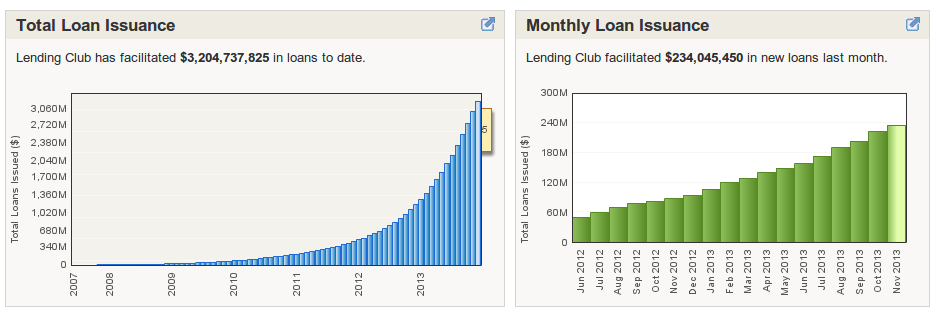
Backed by Google and recently valued at $2.3 Billion, Lending Club is expected to go public in the next 12 months. As they seek to extend their dominance from consumer lending to business lending, funders should seriously ask themselves, is there really enough opportunity out there for everyone?
The Achilles Heel for merchant cash advance companies is money. Regardless of how fast they turn it over, there’s no possible way to experience fast triple digit growth without outside capital. Some funders spend a lot of time and energy trying to raise it. Others are content without it and go chugging along at a moderate pace.
 Peer-to-peer lenders on the other hand have a unique advantage, unlimited access to cash. That’s because they source all the money from individuals. The money is crowdsourced from an infinite pool of investors and they just book the deals and service them. Combine this model with a sweet infusion from an IPO and alternative business lending will have its very own behemoth.
I’m not predicting the doom of merchant cash advance at the hands of Lending Club, but quite the opposite. Lending Club will legitimize non-bank business financing once and for all. Merchants will seek capital and investors will seek lucrative returns. Merchant cash advance companies offer a vastly better ROI than what 3-5 year loans can do with regulated interest rates. The top 10 Prosper investors are only earning 15-19%.
Lending Club will carpet bomb businesses across the nation with marketing and likely end up declining 90% of them. If they do indeed stick to their model of 3-5 year loans, they will undoubtedly leave a trail of interested but unfundable merchants. Alternative lenders and merchant cash advance companies will rush in to fill the void.
At the same time, that capital raising problem could fix itself. As everyone jumps on the peer-to-peer/crowdsourcing bandwagon, investors will be thrilled to learn that merchant cash advance is peer-to-peer based as well. Oh you didn’t know? Many funders already crowdsource capital from “syndicates”. Syndication in merchant cash advance is a simplified form of crowdsourcing. ISOs, investors, and account reps can pool funds collectively into deals just as someone could with Prosper or Lending Club.
I first raised this similarity in December 2010 (three years ago!) and even went so far as to make a mock version of Prosper’s site with MCA terminology plastered on it. Eerie isn’t it?
The difference between a company like Lending Club and say a company like RapidAdvance is whether or not funding is meant to be used as working capital or permanent capital.
The consumer lending model is not applicable when it comes to underwriting businesses. Renaud Laplanche, the CEO of Lending Club acknowledged that when he testified before congress a few weeks ago. But is he really ready to experience it for himself?
We shall see in 2014 when the line blurs once and for all. MCA, say hi to your family, P2P.
—————
Get familiar:
Centrex Software Announces New Relationship Building Technology at Broker Fair 2021
December 22, 2021Costa Mesa, CA— Finance technology (FinTech) in the traditional and alternative business finance industry is seeing a massive enhancement with the release of new technology from Centrex Software.
Centrex Software, a dedicated business lending CRM and loan/advance servicing software platform that brings multiple technologies all under one roof for direct funders, brokers, and investors, experienced 22% growth from 2019 to 2020 and 35% growth from 2020 to 2021, during a global pandemic. With that growth has come quite a bit of new thinking out of the Centrex Software management team.
When it comes to the business lending space, FinTech companies spend huge amounts of time focused on how to drive more users into their software. This strategy makes sense as it is what a large operating software company is required to focus on to generate revenue. “But what about our customers’ customers? What if we spent more time focused on driving our customers’ customers not to our software, but to our customers’ software? In our business, we fail if our customers can’t engage, retain, and sell to their customers. We want that relationship to thrive and grow so we have built technology to aid that,” says Trey Markel, Senior Software Specialist with Centrex.
In realizing there was a tech need for this new way of thinking, Centrex Software built a mobile app that is white labeled to Centrex Software customers so they can offer more relationship retaining and building solutions to their customers. Keith Nason, President at Velocity Funding Group, and a Centrex Software customer, explains, “Trey, Michael and the Centrex team are going to put my brand in the pockets of every single one of my customers. It was an entirely new strategy that you simply don’t see from other software companies, and it should create customer engagement like we have never seen before.” The new white labeled mobile app has a few features that will really put your marketing hat on. First, the white labeled app is fully integrated with Plaid so that pre- and post-funding, Centrex clients can actually link their banks accounts and manage their finances. On top of that, Centrex Software has an admin portal where Centrex clients can manage all their app users. One of the best parts is that, in the admin portal, Centrex clients will have the ability to send push notifications to smart watches and to mobile devices that can communicate to the end mobile app user. Plus, there are several other features that keep mobile app users engaged with Centrex clients and the broker partner via the mobile app.
In the same spirit of engaging more efficiently with customers, the Centrex team also built a WordPress plugin that allows its customers to build “Smart Applications” right on their website. Michael Lindsey, also a Senior Software Specialist with Centrex expressed, “Our clients need more tools that are forward facing to their customers to help make faster decisions and offer a better more automated experience.” Taking the automated application process a bit further, Centrex integrated the WordPress plugin with Universal Credit Services to pull and analyze credit data, and Plaid to pull and analyze financial data. This allows Centrex Software customers to automatically underwrite and create offers right on their website. The WordPress plugin will communicate all info and decisions into Centrex Software during each step of the process. Lastly, for those Centrex Software customers using both the WordPress plugin and the white labeled mobile app, once an application is completed by the business borrower on a Centrex Software customers website, it will automatically create a user for the mobile app in real-time. The end result is a completely seamless and streamlined business borrowing experience.
Perhaps the most impressive part of the two new technologies being released by Centrex Software on January 1st of 2022, is that in order to take advantage of the new tech, you don’t even need to be a Centrex Software CRM customer. “We understand that the Centrex CRM is only one option for funders and ISO’s out there. We also understand that there is much more than just CRM that is needed to build a successful finance business. Because of that, we built the WordPress plugin and the mobile app in an API based architecture so that any finance company using any CRM with an API can utilize the new Centrex technology. We wanted to capture more of the market with unique FinTech solutions, offering CRM alone can only get us a to a certain point.” says Trey Markel.
Needless to say, Centrex Software has really stepped it up as a full circle FinTech solution provider to the finance industry. Centrex Software will also be launching its new open REST API and amortization calculators in the new year to expand their tech offering. You can reach Centrex Software at www.centrexsoftware.com or email media@centrexsoftware.com