
The Challenges in Offering Financing to Latino Businesses
June 20, 2015 The number of minority-owned businesses jumped nearly 46% from 2002 to 2007, according to the Minority Business Development Agency. The growth rate is three times as much as for U.S. businesses as a whole. These businesses increased 55% in revenues over that five-year period. There are a number of minority groups within this category. Latino businesses are leading the way. Latinos are the fastest growing ethnic group in the United States today. Like it or not these numbers are likely to increase due to economic blocs. The U.S. has created a number of free trade agreements with Mexico, Central America and South America. Latinos are our next door neighbors.
The SBA is the largest guarantor in the U.S. and does not offer any specific minority business loan program to Latinos. The U.S. Hispanic Chamber of Commerce offers advice to Latino business owners, but does not offer any loans. Traditional banks continue to maintain stringent guidelines for all businesses. Alternative finance companies and online lenders have a long way to go to tap into this
niche market.
Alternative lenders, online lenders and peer-to-peer lenders can cater to this niche market, but it requires a lot of resources and knowledge. We can categorize Latino businesses into one broad category. However, as a Hispanic entrepreneur, my experience has been that the Latino business community is complex in nature.
Latino Businesses by Age Groups
There are two types of Latino entrepreneurs. The older generation tends to be within the age range of 45 to 70 years old. These business owners are not accustomed to doing business over the Internet, email, fax, or phone. Online lenders may have difficulties in retrieving information from these clients. This group has a high level of distrust in doing business via the Internet. The majority of our clients within this age group are accustomed to doing business face to face. This sales and marketing strategy can be very expensive for lenders, unless you have a team of field agents. The younger generation of this group is made up of Latino entrepreneurs in the age range of 25 to 45. This group is more accustomed to using online banking and online systems. Forbes recently reported that, “With a median age of 28 years old, the timing is ripe for organizations/brands to make a firm commitment to the Hispanic consumer.”
Family Decisions and Delayed Gratification
Despite the age category, many Latino businesses are family-based. Based on my experience, the decision making process is made among family members. You could offer a $50,000 loan at a cost of factor of 1.30 to the husband and he may need to consult with his wife and his children before he signs his John Hancock. This makes the decision-making
process challenging.
Manuel Cosme Jr., the chair of the National Federation of Independent Businesses (NFIB) Leadership Council in California and co-founder of Professional Small Business Services in Vacaville, California has said, “Family plays a big role in Hispanic culture, so naturally it plays a big role in Hispanic-run businesses.”
Trust Factors
Even if you have a Latino staff or bilingual staff, Latino business owners need to trust you in order to gain their business. You will need to build good rapport with these businesses to get them to fill out a loan application and send it via fax, email or online. Latinos are accustomed to traditional banking methods and brick and mortar businesses.
“When we looked at online US Hispanics in 2006, there were four main roadblocks to US Hispanic e-Commerce adoption: 48% of online Hispanics did not want to give out personal financial information; 46% wanted to be able to see things before buying; 26% had heard about bad experiences purchasing online; and 23% did not have access to a credit or debit card,” says Roxana Strohmenger, Director in charge of Data Insights Innovation at Forrester. These are some of the challenges that we face by conducting our business in a digital manner.
According to mediapost.com, only 32% of online Hispanics use the Internet for their banking needs. In order for online lenders to succeed with this marketplace, U.S. banks need to do more to market to Hispanics online. Alternative lenders need to understand that there are barriers to entry in this marketplace.
Social Media
The Pew Research Center conducted a study that clearly indicates the usage of social media by Hispanics. Accordingly, 80 percent of Hispanic adults in the U.S. use social media and the same study revealed that Latino Internet users admitted to using Facebook as the leading social platform. A lot of business owners love to show the storefront, their family working in their businesses, and other images. You should consider Facebook as part of your overall marketing strategy to tap into this marketplace.
 Going overseas
Another option to consider is going overseas. CAN Capital set up an operation in Costa Rica mostly for their business processing services. In fact, we at Lendinero decided to do something different that no one else is doing. We set up the majority of our operations in Central America, consisting of outbound agents, digital marketers, programmers and loan analysts. There are great benefits to having a full bilingual staff overseas and the cost of personnel is less expensive. At the same time, there are huge challenges. Since I am of Hispanic descent, it was easier to set up our operation in a Latin American country. However, there are cultural differences and you have to take into account the economic and political conditions of each country. Setting up a corporation can take 1 to 3 months and it is more expensive than the U.S.
The labor pool is huge, but finding the right people can be a challenge. In addition, training agents, processors, and support staff can be time consuming and you may run for a few months before you begin to see a profit. If your staff did not live in the U.S., you need to train them on U.S. culture, the economy, and other topics.
Furthermore, Internet speed and Internet services can be a challenge. Be prepared to pay a high cost for Internet. And labor laws are not like the U.S. If you fire an employee, you will be forced to pay unpaid vacation and a severance. In addition, you have to take other costs into consideration such as travel costs, lodging, auto leasing, and more.
Lastly, if you don’t know people in the country you plan on setting up in, an outsourced business processing service will charge you more money for rent and other services knowing that you are coming from the U.S. It is highly recommended you pair up with a native or someone who has done business in the countries you consider.
In summary, the Latino business community continues to lack financing. This niche market needs to be educated on the revolutionary paradigm shifts in business lending and online lending. If you can obtain these clients, they are clients for life. Once you obtain them as a client, they are loyal. They will not leave you.
Merchant Cash Advance Term Used Before Congress
December 18, 2013 I’d like to think that the term, merchant cash advance, is mainstream enough that a congressman would know what it was. I have no idea if that’s the case though. What I do know is that Renaud Laplanche, the CEO of Lending Club gave testimony before the Committee on Small Business of the United States House of Representatives on December 5, 2013.
Watch:
In it, he argued that small businesses have insufficient access to capital and that the situation is getting worse. We knew that already. However, he went on to explain that alternative sources such as merchant cash advance companies are the fastest growing segment of the SMB loan market, but issued caution that some of them are not as transparent about their costs as they could be.
The big takeaway here is that he didn’t say they are charging too much, but rather that some business owners may not understand the true cost. I often defend the high costs charged in the merchant cash advance industry, but I’ll acknowledge that historically there have been a few companies that have been weak in the disclosure department. That said, the industry as a whole has matured a lot and there is a lot less confusion about how these financial products work.
Typically in the context Laplanche used, transparency is code for “please put a big box on your contract that states the specific Annual Percentage Rate” of the deal. That’s good advice for a lender and in many cases the law, but for transactions that explicitly are not loans, filling in a number to make people feel good would be a mistake and probably jeopardize the sale transaction itself. If I went to Best Buy and paid $2,000 in advance for a $3,000 Sony big screen TV that would be shipped to me in 3 months when it comes out, should I have to disclose to Best Buy that the 50% discount for pre-ordering 3 months in advance is equivalent to them paying 200% APR?
This is what happened: I advanced them $2,000 in return for a $3,000 piece of merchandise at a later date.
I got a discount on my purchase and they got cash upfront to use as they see fit. Follow me?
Now instead of buying a TV, I give Best Buy $2,000 today and in return am buying $3,000 worth of future proceeds they make from selling TVs. That’s buying future proceeds at a discounted price and paying for them today. As people buy TVs from the store, I’ll get a small % of each sale until I get the $3,000 I purchased. If a TV buying frenzy occurs, it could take me 6 months to get the $3,000 that I bought. But if the Sony models are defective and hardly anyone is buying TVs, it could take me 18 months until i get the $3,000 back.
In the first situation, if the TV never ships I get my $2,000 back. In the second situation if the TV sales never happen, I don’t get the 3 grand or the 2 grand. I’ll just have to live with whatever I got back up until the point the TV sales stopped, even if that number is a big fat ZERO.
Best Buy is worse off in the first situation, but critics pounce on the 2nd situation. APR, it’s not fair! Transparency, high rate, etc.
Imagine if every retailer that ever had a 30% off sale or half price sale one day woke up and realized the sale they had was too expensive and not transparent enough for them to understand what they were doing. If only consumers had given the cashiers a receipt of their own that explained that they would actually only be getting half the money because of their 50% off sale, then perhaps the store owners would have reconsidered the whole thing. 50% off over the course of 1 day?! My God, that’s practically like paying 18,250% interest!!!
To argue that a business owner might not understand what it means to sell something for a discount is like saying that a food critic has no idea what a mouth is used for.
I will acknowledge that issues could potentially occur if an unscrupulous company marketed their purchase of future sales as if it were a loan. That could lead to confusion as to what the withholding % represents and why it was not reported to credit bureaus. I’m all in favor of increasing the transparency of purchases as purchases and loans as loans, but let’s not go calling purchases, loans. Americans should understand what it means to buy something or sell something. Macy’s knows what they’re doing when they have a Black Friday Sale. They do a lot of business at less than retail price. They are happy with the result or disappointed with it. They’re business people engaged in business. End of the story.
In recent years, the term, merchant cash advance, has become synonymous with short term business financing, whether by way of selling future revenues or lending. When testimony was entered that many merchant cash advance providers charge annual percentage rates in excess of 40%, I do hope that Laplanche was speaking only about transactions that are actually loans. As for any fees outside of the core transaction, those should be clear as day for both purchases and loans. I think many companies are doing a good job with disclosure on that end already.
Part 2
The other case that Laplanche made was brilliant. Underwriting businesses is more expensive than it is to underwrite consumers. Consumer loan? Easy, check the FICO score and call it a day. That methodology doesn’t even come close to working with businesses. He stated:
These figures show that absolute loan performance is not the main issue of declining SMB loan issuances; we believe a larger part of the issue lies in high underwriting costs. SMBs are a heterogeneous group and therefore the underwriting and processing of these loans is not as cost efficient as underwriting consumers, a more homogenous population. Business loan underwriting requires an understanding of the business plan and financials and interviews with management that result in higher underwriting costs, which make smaller loans (under $1M and especially under $250k) less attractive to lenders.
Read the full transcript:
LendingClub CEO Renaud Laplanche Testimony For House Committee On Small Business
Merchant Cash Advance just echoed through the halls of Capitol Hill. And so it’s become just a little bit more mainstream, perhaps too maninstream.
Thoughts?
No End in Sight for Alternative Lending
September 17, 2013 Which one of these three isn’t like the other two?
- Quicken Loans
- RapidAdvance
- Cleveland Cavaliers
It’s a trick question because as of September 16, 2013, All three are owned by Rockbridge Growth Equity, a Detroit-based private equity firm. RapidAdvance announced the acquisition over the news wire, shocking many people around the industry. The move opens RapidAdvance to the connections and prowess of Dan Gilbert, the 126th richest man in the United States. Gilbert is worth approximately $3.9 Billion, is the founder of Quicken Loans, and he owns 4 sports teams, including the NBA’s Cleveland Cavaliers.
Compare that to On Deck Capital board member Peter Thiel, who is worth $1.9 Billion and is the 309th richest person in the U.S. You may remember Thiel, the co-founder of PayPal and first investor in Facebook as participating in a series D round for On Deck Capital along with Google Ventures back in May.
These are truly some historic times. Two of the richest people on all of planet Earth have stock in the merchant cash advance industry. Does that tell you anything about the direction things are moving in? Think about that one again… Two of the richest men in the world have invested in the merchant cash advance industry.
Four years ago, an influential friend advised me that this industry would be eradicated by 2010. As told through The Bubble That Wasn’t, some people left the business prematurely fearing the best days of alternative lending were over. At present, it looks as if those best days are still yet to come.
The Rockbridge Growth Equity move comes less than a year after Steven Mandis bought into RapidAdvance. He will reportedly stay on as a shareholder.
On Deck Capital
In other news, On Deck Capital announced that they’ve raised another $130 million in debt financing, leveraging themselves out even further. ISOs in the industry report that they’re ON FIRE with approvals. Rumors about a possible IPO on the horizon are starting to pick up again but my sources tell me that isn’t likely to happen with On Deck for another 2-3 years.
Funding Down to a Science
December 21, 2012Account rep: Congratulations, you’ve been approved for $27,000!
Merchant: How did you come up with these figures?
Account rep: It was science. Science did this.
Funny? Maybe not, especially since an underwriting super algorithm may be on its way to the United States. In the days after we posted Made for Each other?, friends, acquaintances, and strangers have been telling us to keep an eye on Wonga’s potential acquisition of On Deck Capital. “It’s not just a european company’s gateway to the US. They’re going to change everything,” a few have said. Aside from their background of being a payday lender, having prestigious VC backing, and the resources to throw a quarter billion dollars at a main street lender in a takeover bid a lot of people didn’t see coming, apparently there is much more to be seen.
Just like MCA in years past, Wonga has worked hard to repel a negative image. Not easy stuff, especially considering they embrace their hefty costs wholeheartedly. Sure, it’s easy to calculate an APR equivalent of a very short term loan and spin whatever number you come up with as the symbol of something evil. If I let a stranger borrow $100 today with the stipulation that they pay me the whole thing back tomorrow plus 1 dollar extra to make it worth my while, would I be evil? That’s an APR of 365%. If I did the same thing with 100 strangers, what are the real odds that all 100 would actually pay me back? Somewhere along the line because of a borrower’s circumstances, bad decisions, or even malicious intent, I’m going to lose the entire $100 I lent out. Others might need more time to pay me back. If one person out of those hundred doesn’t pay back, I break even. If two people don’t pay back, I lose money. If one person doesn’t pay back and another can’t come up with the whole thing, I lose money. You can lend money at 365% APR and lose BIG.
So how do banks manage to charge 4, 7, and 10% APR? Is it just because they’re smarter? No. They don’t make money off loans at these rates either. In the US, interest rates are distorted by government guarantees. Politicians have decided that certain interest rates sound “fair,” then push big banks to lend money at these low unsustainable rates. But of course it doesn’t work and so government agencies sweeten the deal by reimbursing banks for up to 90% of the losses on the borrowers that default. Banks make money on the loan closing fees and other services they sell to the businesses. The loan is the doorbuster offer the bank puts in the storefront window. Once you come inside, they try to sell you on other things so that you don’t walk away with just the loan, otherwise they’re losing money.
So when you hear “banks aren’t lending,” don’t be so surprised. Lending money means giving it away to someone that might not pay it back. That’s a really tough business to be in, no matter how qualified the borrowers are or how good the underwriters are supposed to be.
But somewhere in between the opinions of the Merchant Processing Resource staff and government bureaucrats over what is fair, is a special recipe that determines once and for all what works best. It’s science. Wonga’s lending success is rooted in science and propelled by an advanced algorithm that can systematically calculate risk better than any bank in the world, or so they say.
 One of Wonga’s major investors, Mark Wellport, is a knighted renowned immunologist and rheumatologist that has defended Wonga’s methods against regulation. He believes their data-based process and strong motivation to make their borrowers satisfied places them in an entirely different category than payday lenders.
Wonga takes a human-free approach, something no MCA provider in North America does regardless of how automated their process may seem. In the UK, their business loan application process takes only 12 minutes and the funds are wired 30 minutes later. That’s it. Their max loan is £10,000 but just think about how that compares to MCA in the US. How much time and overhead is being spent on printing documents, underwriters, conference room meetings to discuss deals, setting up the merchant interview, trying to reach the landlord, trying to get page 7 of a bank statement from 6 months ago and the signature page of the lease, etc. etc. Funders might have had the wrong approach all along.
Wonga’s founder, Errol Damelin believes in data. According to some quotes in The Guardian, Damelin believes interacting with the borrower actually impairs a lender’s judgement.
From the Guardian:
Asking for a loan from a financial institution had traditionally involved making a strong first impression – putting on a suit to see the bank manager – then rigorous questioning, checking your documents and references, before the institution made an evaluation of your trustworthiness. In a way, it was exactly the same as an interview, but instead of a job being at stake it was cash.Damelin found this system old-fashioned and flawed. “The idea of doing peer-to-peer lending is insane,” he says. “We are quite poor at judging other people and ourselves – you get to know that in your life, both with personal relationships and in business. You realise that we’re not as good as we think we are at that stuff, and that goes for almost everybody. I certainly thought I was much better at it.
The 42-year-old entrepreneur grew up in apartheid South Africa, and he believes the experience of living in that country in the 80s has had a significant impact on his outlook. He was active in student politics at the University of Cape Town and marched in civil disobedience protests. So, when it came to deciding who should be lent money, Damelin says he wanted to strip away some of the prejudice – decisions would be taken without a face-to-face meeting; you wouldn’t even speak to an adviser on the phone, because people subconsciously judge accents too. The final call on whether to hand out cash would be based on “the belief that data could be more predictive than emotion”.
According to Wired, Damelin and his team created a system to approve or decline applicants all on its own. They tested it on a site called SameDayCash by using Google Adwords and within ten minutes of their ad going live, their system had already approved its first customer. In its early forms, it wasn’t very profitable from a lending standpoint but it did allow them to collect a massive amount of data.
From Wired
its strategy over this period wasn’t just to disburse money — it was to accumulate facts. For every loan, good or bad, SameDayCash gathered data about the borrowers — and about their behaviour. Who were they? What was their online profile? Did they repay the money on time? The site was feeding an algorithm that would form the basis of Wonga, launched a year after the beta experiment that was SameDayCash.
MCA has utilized Adwords for lead generation for years with mixed success, but few have used it for the purpose of accumulating facts. This isn’t to say that the firms collecting information for the purpose of leads aren’t sitting on treasure troves of data, it’s just that none of it to date has led to 100% computerized underwriting. The MCA industry is quite possibly about to undergo a major shift in how they promote their product on Adwords as a result of Google’s ominous warning a couple weeks ago. New disclosure requirements may change the way consumers respond and apply, ultimately impacting the data collected.
So will european science work in the good ‘ol US of A? If Wonga acquires On Deck Capital, you can bet they’ll try to replicate their success. There is a gigantic market of really small businesses that aren’t getting funded, and even the ones that are, they’re waiting 3-7 days to deal with the paperwork, handle the phone calls, fax documents, complete a landlord verification, and in some cases, deal with a credit card processing equipment change. If On Deck Capital becomes a household name as Wonga is in the UK, a lot of smaller funders are going to get squeezed.
Wonga claims to have a net-promoter score above 90%, a customer satisfaction metric that beats most banks and even Apple Computer. It’s a company that seems to be winning on every front.
Critics will say that the American lending market is big enough for everyone, that the loans Wonga has done traditionally are really small and therefore not in the same league as MCA, or that their own company has something similar or better. We believe however, that if this deal goes through that it’s a bad idea to get comfortable. There are Wonga-like companies in the US already, data fortresses that will soon revolutionize how loans are issued and determine what makes a successful business. New York based Biz2Credit is one such example.
We’ve been right about a lot of things in the last couple years and wrong about some. But we believe it is inevitable that any lender ignoring the automation revolution on the horizon is not going to last very long. Go ahead, brush it aside and convince yourself that this whole Automation thing is just hype as BusinessWeek did in 1995 about the Internet. “Automation? Bah!”
As Damelin told Wired in June, 2011, “For me the epiphany was right there. People were online, looking for a solution to a problem.” Ask any funder using Adwords or pouring work into SEO and they’ll tell you the same thing. People are looking online for money. What happens after they fill out the form on the website is what makes the USA MCA/alternative lending industry different from Wonga.
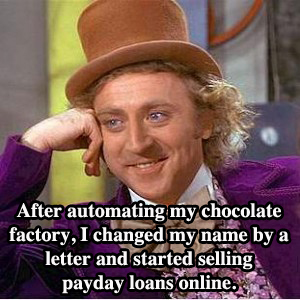 But will a perfected european algorithm work in the US? Americans approach debt and money differently than the rest of the world and small businesses operate in a much more open manner. You never know, the european lab coat wearing scientists could come here and get their butts handed to them. Plenty of smart companies have jumped headfirst into MCA and left after disastrous results. Some veterans that have been in this business a long time will you tell that an impressive resumé, big investors, and a fancy algorithm will help you make it through the first six months. After that, you better know what the hell you’re doing, if you can continue to do it at all.
If in three years the average small business owner thinks Wonga is the last name of a guy that owns a chocolate factory, we promise to write a jingle that admits we were wrong about them. But On Deck Capital has been around the block and knows the business. They would allow Wonga to skip the learning curve and together could quite possibly nail lending down to a science.
Oompa Loompa do-ba-dee-doo, I’ve got another algorithm for you.
– Merchant Processing Resource
../../
There is great feedback to this article in a LinkedIn Group HERE
More Companies Cheer For Charity
October 5, 2012The alternative business lending industry has raised even more money for charity thanks to four new companies. Through a fantasy football competition that started with the beginning of the NFL season, each of the twelve participants are representing individual non-profit organizations. At the end of the season, all of the money raised will be donated to the winning team’s charity. Though registration to compete ended five weeks ago, outside individuals and companies are free to add to the total. One of the following charities with be the lucky recipient of the prize:
- Network For Teaching Entrepreneurship
- Epilepsy Foundation
- Society of St. Vincent De Paul
- Kiva
- ALS Association
- 100 Urban Entrepreneurs
- Gift of Life Bone Marrow Foundation on behalf of the The Silver Project
- The Missionaries of Our Lady of Divine Mercy
- Smile Train
- Cystic Fibrosis Foundation
- American Heart Association
- Distressed Children & Infants International
Special thanks to the new contributions from:
Entrust Merchant Solutions
Based in New York City, Entrust has been helping small businesses get financing for more than five years.
Strategic Funding Source
From the flashy district of Times Square in New York City, Strategic is one of the oldest and most successful firms in the Merchant Cash Advance (MCA) industry. They can teach you how to become your own MCA company:

Capital Stack, LLC
Capital Stack is a Brooklyn, NY based financing provider that specializes in high risk deals structured via ACH. They’re also a co-founder of a new industry forum, DailyFunder.com.
Paramount Merchant Funding
Yet another New York City merchant financing company, Paramount is one of the fastest growing firms in the industry.
They’re also helping a separate cause at the same time. Help Paramount raise money for Noah’s Hope!

Dear Friends and Family,
Paramount Merchant Funding is hosting a bowling night on November 2nd to help raise money for Noah’s Hope.
About Noah’s Hope:
Noah’s Hope was started by Jennifer and Tracy VanHoutan, the parents of Noah and twin girls Laine and Emily. Noah and Laine are both battling LINCL-Batten Disease, a rare genetic illness. They have lost the ability to speak, as well as their balance and mobility. At this time, LINCL-Batten Disease is always fatal, usually between the ages of eight and 12.
Fewer than 450 children in the United States have LINCL-Batten Disease, so it doesn’t receive the attention it should. Paramount Merchant Funding has decided to help this great cause. We are raising money to donate to Noah’s Hope in the hopes of finding a cure for LINCL-Batten Disease. All donations, no matter how big or small, help make a difference in the fight against LINCL-Batten Disease.
CLICK HERE TO SEE HOW YOU CAN HELP!
About Paramount Merchant Funding:
Paramount Merchant Funding is a merchant funding company based in Midtown, New York City. We provide capital to businesses in the United States, as well as Canada. Paramount was founded in 2008 and provides professionals with a whole host of funding options depending on their stage of business.
Choose how you want to help!
1. Click HERE to donate money.
2. Donate something to give away at our raffle.
For more information email erika@empiremerchantadvance.com.
We appreciate any and all donations made for this cause!
Sincerely,
The Paramount Merchant Funding Team
It’s awesome what everyone is doing. You’re making the country a better a place!
– Merchant Processing Resource
../../
The Funders of Summer
August 2, 2012What’s new? Who funded? What happened? Merchant Processing Resource will try to give you a glimpse into the Merchant Cash Advance (MCA) universe:
We all know salespeople love to fund, but underwriters?!! This banner hangs on the wall of the underwriting department at mid-sized MCA firm, Rapid Capital Funding:

Holy Moses Batman! $10 Million in a month?! Yellowstone Capital is reporting a new personal monthly funding record of $10,245,000.

There has been an influx of really creative instructional/promotional videos about MCA lately. Cartoons are really “in” right now:
PayPal white labeled a Merchant Cash Advance program in the U.K.
Will the mega banks be next?
It feels like 2006 all over again says First Annapolis Consulting in a recent article:
This seems to be the same bullish sentiment that surrounded the industry in 2006, when there was a constant influx of new MCA providers into the industry and what appeared to be unlimited financial sources. What might be different now is the experience accumulated in the industry during the recession. In the last few years, and as a result of the mounting losses that the industry suffered during the economic crisis, MCA players have implemented more conservative risk management practices and procedures.
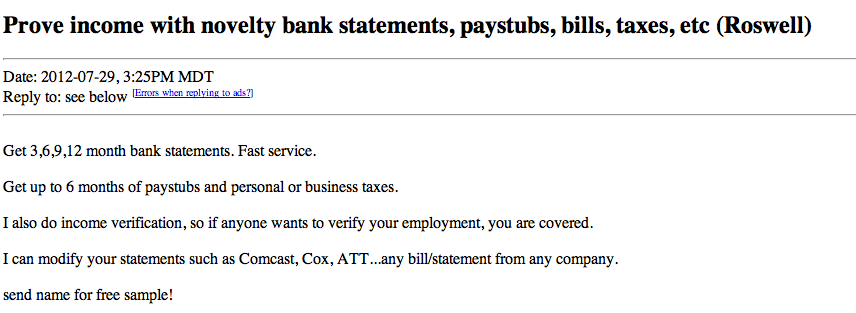
Underwriters industrywide are also reporting that stacking, splitting, double funding, and fake statements are on the rise. It certainly brings back some nostalgia for veterans and not the good kind. A screenshot of a current ad on craigslist that is directed at bad apple merchants:
A new chapter opened for Merchant Cash Advance (This is soooo last month but a great read if you missed it).
http://greensheet.com/emagazine.php?issue_number=120602&story_id=3088
Is the loan shortage a banking problem or a merchant problem? Ami Kassar makes the case in his New York Times column.
“Where are the leads? I need the leads. Can you tell me where the leads are?” We literally get asked daily where to get leads from. We recommend:
http://SmallBusinessLoanRates.com
http://meridianleads.com
By the way… for every company that says cold calling doesn’t work, there’s a company getting rich doing just that. Same goes for SEO, mailers, e-mail blasts, PPC, and so. Marketing is an art form. Just because it doesn’t work for you, doesn’t mean it doesn’t work period. Keep doing what you’re doing. Too many ISOs/agents/marketing directors abandon campaigns after 30-60 days. Practice makes perfect!
Have you abandoned social media? We ask this question: What looks worse to a prospect?
Not having a business twitter account or having one but failing to tweet at all in the last 8 months?
Not having a business blog or having one but failing to add any new blog posts in over a year?
We didn’t spend much time researching hard data but we would surmise that freshness is a psychological component to a prospect’s shopping experience. If a business blogged regularly on their site up until May, 2011 and then stopped, might a merchant think the entire business itself is abandoned or gone? Is a facebook fan page with 1 post from 8 months ago a positive or negative selling point? WE SAY: If you build it, maintain it. Nothing brings down your presence on the Internet like abandonment. We understand that smaller companies might not have the manpower, time, or creative energy to write informative articles or engage people through social networking, especially when it’s hard to measure the results and value it creates. Consider the value you might actually be losing by projecting to the world that you have given up. It’s like operating a store with a sign out front that says “THIS BUILDING HAS BEEN CONDEMNED” even though you are actually open for business. If WE stopped posting articles for a year, would you still come back several times a month?

Here are two examples of MCA firms that keep it FRESH!:
http://unitedcapitalsource.com/blog/
http://takechargecapital.com/category/blog/
Don’t you just love MCA? We do! Visit our site again soon.
– Merchant Processing Resource
../../
To Fund or Not to Fund in Hawaii
June 1, 2012 Aloha! The Resource’s main operator is “busy” vacationing in Hawaii, hence the long gap in site news. But since we’ve got Hawaii on the brain, we figured now is a good time to discuss Merchant Cash Advance (MCA) financing in a state that practically exists in its own universe.
Ask underwriters from different firms about how they approach applications from Hawaii and you’ll get some opposing views. Some will argue that the distance is too vast to risk their capital. A business tucked away in the middle of a remote Pacific island may feel less bound by their contractual terms since there is a very small likelihood that a funder will fly thousands of miles to enforce it. “What consequences am I really facing from a company light years away in New York City?,” a Hawaiian merchant might ask themselves. This is a negative Hobbesian view that promotes the idea that merchants are inherently corrupt and that they need a fear of recourse to honor their contracts. There’s a reason that the MCA industry feels particularly vulnerable.
The nature of the transaction provides funders with barely any recourse, giving credit to the psychology that being worlds apart is more than just a paranoid insecurity. When MCAs are structured as a sale, it is not possible to report a delinquency to the credit bureaus since no credit has been extended. Lawyers will argue that MCA funders are protected by their iron-clad contracts which grant numerous advantages to the funders in the event a merchant breaches their contract. However, if a funder files a lawsuit in Brooklyn, NY, how likely is it that a merchant in Hawaii will fly there to respond to it?
Merchant Cash and Capital may have had reason to hate the state back in 2007, when they got burned by Hawaii Travel Network, a Hawaii-based travel agency for an amount close to $1 Million. However, they have continued to fund businesses there without prejudice.
At the end of the day, underwriters must leave their fears at home and rely on data analysis to make decisions. When the financial crisis hit, there was plenty of real data to support why funding in California, Nevada, and Florida was a bad idea. Many local economies got beat up really bad. It’s no wonder that when people started losing their homes to foreclosure, they began to forgo all of their financial obligations in order to get by. It was then that Hobbes’ theory of humanity was more appropriately applied, as merchants reverted to a state of nature and put self-preservation above all else. “If the recourse for defaulting on an MCA is just a lawsuit then so be it,” said a hypothetical business owner who had just lost 60% of his 401k and was hiding out from the Repo Man.
While Hawaii wasn’t exactly made a poster child for economic devastation, it was hit pretty hard by the loss of Americans’ disposable income. 80% of Maui’s economy is related to tourism. That means they are inevitably affected by problems on the mainland. However, one factor that makes Hawaii all the more resilient, is its location. In April 2012, the number of Canadian and Japanese tourists combined outnumbered visitors arriving from the eastern half of the United States. So in hard times, Hawaii may go down, but it will not go out!
Besides, while many mainland states are now coming to terms that the economy is still stagnating, Hawaii earned more income from tourists this past April than in any other April in history. Sure, there are problems, political qualms, and flaws in the state’s infrastructure, but it is really not that much unlike the rest of the country (except for the fact that it is way cooler 😛 ). Many of the vacation destinations feel more like America than some parts of mainland America.
 So does the MCA industry really have anything to fear in Hawaii? It depends on the risk tolerance. Travel agencies and tour companies have historically been shunned by funders, although that’s changed a lot in the last six months. Even established tour companies can disappear overnight. Tour companies in exotic locations walk a thin line every second of operation. They face constant injury liability, state and local law restrictions, and pressure from the property owners on which the tours explore to meet a certain standard of care. It can’t be omitted that a few bad online reviews can cause all their potential customers to book with their competitors instead. The Internet is the public’s best resource for researching vacation activities. No one wants to book a tour that has poor feedback.
Major resorts and hotels are the lifeblood of local economies there. If a big hotel fails, all the small businesses in the near vicinity will go right down with it. Some of the best restaurants in the state are on the grounds of a major resort, highlighting that nearly everything is tied to tourism. The weather too can be fickle.
If a funder can tolerate those risks, and they’re not unlike many of the other vacation destinations in the country, than we say, go for it! But when a Hawaiian MCA deal goes bad and the business phone number is disconnected, go ahead and file your lawsuit in Brooklyn and see how much good it does. You might end up imagining that the merchant has shrugged off your contract to spend their afternoons surfing instead. You’ll kick yourself for doing a deal in such a faraway land.
After being in Hawaii for just a week, I received a phone call from a friend to update me on MCA industry events. Truth is, I didn’t care what he had to say. It’s way too nice here to care about what’s going on elsewhere. If our website goes down next week, you may start to imagine that we have shrugged off the Resource to spend our afternoons surfing instead.
Don’t laugh, because you would be right. The rules change when you’re thousands of miles from the rest of the world. Mahalo and Aloha!

-AltFinanceDaily
../../
Note: No Hawaiians were injured during the course of this blog post.