8 Advances Are Better Than 1
September 11, 2012Things just got interesting. Your merchant processing $20,000 a month got approved for $26,000 and it was hard fought. Bad credit and some other issues would normally have forced this deal to go the starter route, but not this time. This time you can reflect back on the past few weeks of sweet talking the underwriter and know that it’s starting to pay off. Maybe it was the fact that you obnoxiously concluded every e-mail to him or her with a <3 or 🙂 just to make them feel extra special even if it was in response to a deal of yours they moronically declined.
I understand why you had to decline my client with 720 credit. We’ll get the next one! <3 :-)
And now this time you’re chalking up a tally on the closer board for a deal that shouldn’t have gotten done…that is until your client claims to have received a contract for $50,000 from another source. “There’s no way that can be true,” you tell them while rolling your eyes in frustration. This always happens at the finish line. Someone comes in and shouts out wild figures just to steal their attention away for a minute. But what if there really was a company offering 250% of processing volume to merchants who teeter on the subprime/starter threshold?
Sure there are ACH funders out there who will step in and say “based on their gross sales we might be able to give this merchant 500% of their processing volume!” and the like, but very few people are doing this from a split processing perspective.
We’ve been speaking with Heather Francis at Merchant Cash Group (MCG) and they plan to formally announce the details of their Fast Funding Equity program in the next couple of weeks. Without going into all qualifying parameters merchants must meet to be eligible, we’ve learned that these advances will be disbursed in 8 fixed monthly installments rather than the entire lump sum upfront. And that’s the catch. Under this program the merchant might be contracted for $50,000 but only receive a deposit for $6,000 today. However, there would be no future “renewal agreements” to negotiate or sign. Additional funds would be sprinkled into the merchant’s bank account on a near constant basis of every 6 weeks.
MCG might not win the deal every time with this program but they’re going to give a lot of account reps a run for their money. We all know the pitch of verbally promising additional funds in 3-6 months from the date of the initial advance, which is based mainly on hope that the account will perform and that the funder won’t play games. Put that up against 7 renewals in writing and it’s fair to say we’ve got a good match on our hands. There are some other special incentives for MCG account reps on the Fast Funding Equity program that are being leaked on the DailyFunder Forum.
———————————
G-Day
 Today was G-Day in the Merchant Cash Advance arena. GoDaddy.com’s servers were taken down singlehandedly by a jerk (let’s be real here) in the hacker group known as Anonymous. But this time we couldn’t all point and laugh like when it happened to Sony, Yahoo, or LinkedIn. No, this time thousands of MCA agents, underwriters, and staffers wondered why they stopped receiving e-mails after 2pm EST. This time Internet leads stopped coming in, internal databases stopped responding, and websites stopped loading. This time we learned that almost everyone uses GoDaddy for something no matter how much they brag about their systems and technology.
We didn’t take a poll of which companies were affected (we couldn’t because our e-mail was down!), but we did participate in the mass hysteria with several other people that were affected. As this very website went down around 2pm today, we lost contact with our database and e-mail servers. One ISO reported that their website, e-mail, and even their VOIP phones were down (You can have GoDaddy phones?). Another reported that their system was so connected to their GoDaddy servers that they couldn’t even print, scan, or fax! If you’re not a fan of Mondays, today was certainly a good day to make up an excuse to leave early. With systems crashing nationwide, chances are your stapler may not have been stapling right and your boss would have had no choice but to send you home.
Strangely, we have run into the hacker group Anonymous before. Back when they hacked Sony in 2011, they sent a 5 page blistering explanation of why they did it to the U.S. Federal Government. They included a link to our site on page 4 to an area that is now deprecated. That area outlined the basics of PCI compliance. For a week, our analytics showed that most of our web traffic originated from the Department of Homeland Security, Department of Justice, and the FBI. Boy, that was fun. Read that report and see our citation below:
———————————
Who To Beat in 2012
“How’s your month going?” we asked. “Pretty slow, but that’s because it’s August,” said a lot of companies we spoke to. August is typically a slow month in the world of MCA. Account reps go on vacation, small business owners hit the beach, and America subconsciously puts everything on the back burner until after Labor Day. That was quite the opposite for 2 New York based MCA firms, United Capital Source and YellowStone Capital, both of whom reportedly broke single month funding records.
According to YellowStone Capital’s posts on LinkedIn, they funded $11,125,000 in August alone. With that, they gave a special thanks to RapidAdvance, GBR Funding, The Business Backer, Max Advance, On Deck Capital, Promac and Snap Advances.
———————————
Add This To Your Data Points!
Companies that actively work to gain Facebook fans and Twitter followers are 20% less likely to be delinquent on their Merchant Cash Advance. Seriously. Kabbage, a company we mention in blurbs every so often operates independently from the rest of the industry by targeting e-bay sellers, independent Amazon stores, and social media retailers. Some people feel that they are not a serious challenger to the status quo and that their tactics, methods, and headlines are merely shock value fodder for the rest of us to laugh at while we all rant and rave about ACH deals being the hottest thing since Square. The founder of twitter (Jack Dorsey) started Square and it has completely disrupted the payments market that quite frankly was used to disruptions until Dorsey turned everything upside down. We believe Kabbage is a company everyone should keep an eye on.
On another note, our favorite part of Kabbage’s recent press release is actually the level of interest banks are expressing in their business model.
While the firm said it is open to establishing alliances with credit unions, banks have expressed more interest in seeing how they can leverage the technology platform to serve its customers.
-Kabbage
Fresh off our rant about John Tozzi’s recent article in BusinessWeek that concluded Wells Fargo was essentially evil for being involved with MCA companies, we’ve become suddenly self-conscious of what journalists might think. Little do they know that America’s big banks have been joined at the hip with the MCA industry for a while now. Banks are still lending to small businesses, we’re just all doing it on their behalves. TRUTH!
– Merchant Processing Resource
../../
Follow The Money – MCA
September 8, 2012John Tozzi of BusinessWeek is just about the only journalist that follows the Merchant Cash Advance (MCA) industry. We use the verb “follows” loosely since he manages to write maybe one article per year on the subject. Rarely flattering, he does at least provide something that other writers do not: Substance. In his lastest piece, Wells Fargo Plays Both Sides of the Cash Advance Debate, Tozzi reminded us of something we’ve failed to address in this blog: big banks aren’t just becoming interested in MCA, they’ve already been involved in it for a long time. It also made painfully clear a message we’ve been trying to communicate for years, that ultra low interest rates are simply not feasible in small business lending.
Tozzi accuses Wells Fargo of sponsoring a small business lender that is directly attacking MCA companies while at the same time financing the companies being attacked. California based Opportunity Fund recently began offering a loan program that is…wait for it…repaid by withholding a percentage of credit card sales. They call it EasyPay and they’ve made no effort to hide their belief that they’ve achieved some kind of higher moral ground by charging only 12% APR. In their press release yesterday, they pounced on the competition:
While similar card-based payment systems exist in the private sector in the form of merchant advance loans, they routinely carry exorbitant interest rates that range from 104-177 percent. By contrast, EasyPay loans carry an annual interest rate of just 12 percent.
-Opportunity Fund
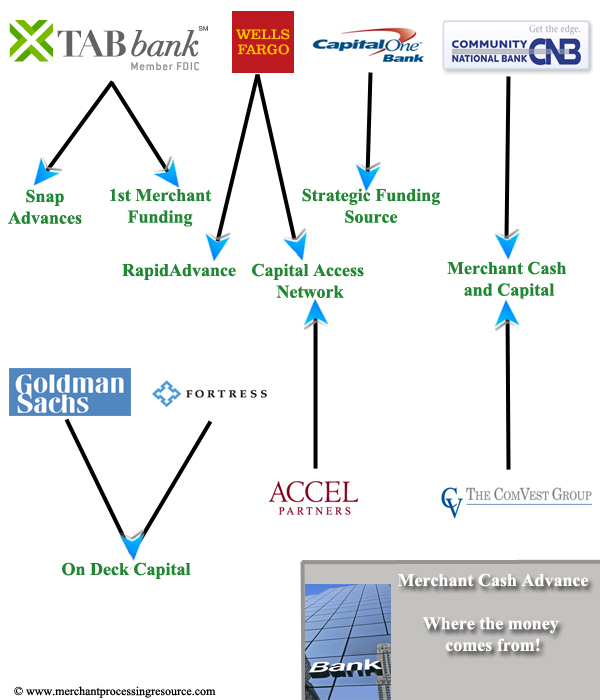
Wells Fargo awarded them cash and their “hypocrisy” is apparently history. Why? Wells Fargo has also backed prominent MCA providers RapidAdvance and Capital Access Network. This might come as news to some people, but not to us. What Tozzi may not realize is the main driver of the MCA industry has been and continues to be…banks. Sorry to break it to the small minority of people that suspect MCAs are part of some shadow banking system. Most small businesses are unaware that their funds may indirectly be coming from Capital One, Community National Bank, or even Wells Fargo!
And let’s come to terms with another hard fact about small business lending. Opportunity Fund is proof that you can charge 12% a year and be guaranteed to lose money. In the BusinessWeek interview: “At that rate, the nonprofit is not covering its costs, says Marco Lucioni, the lending director who created the product. Opportunity Fund subsidizes the loans to keep them cheap.”
Subsidies? Whhaaaaa??? Oh you didn’t know? Opportunity Fund is a registered 501(c)(3), a charity. Don’t get us wrong, we love charity and we think it’s wonderful that small businesses in California may be eligible for an EasyPay loan. We can’t help but be bothered though that a charity is attacking the private sector for charging “too much” when they acknowledge that their own rate of 12% (more than double the allowable interest rate on an SBA loan) is entirely unprofitable. We’ve made this charge over and over and over again. The world we lived in where business loans regularly came in at 5% annually was really just an artificial market caused by the SBA’s agreement to reimburse banks for all defaulted loans. But in the real private sector where there is no tax payer default guarantee, or charitable donors to put downward pressure on cost, it becomes clear that the MCA industry is the free market as it should be.
We also reject the characterization that MCAs are “expensive” since there are literally hundreds of funding companies and a thousand ways to structure a deal. That’s the problem with journalists that only drop in once a year or so, Tozzi has no idea how much has changed. Merchant Cash Advance simply means short-term business financing. The costs may be the equivalent of 1% APR or 200%. It could be a purchase of future sales or a fixed daily repayment loan. It might have everything to do with credit card sales or nothing to do with them at all.
The use of the split-funding method by a charitable business lender definitely highlights just how mainstream the ideas of the MCA industry have become. Hopefully they are prepared to deal with the rapidly evolving technology environment. They just might learn there’s a reason that Wells Fargo is also playing the other side. Companies like RapidAdvance and Capital Access Network are well-oiled machines and are respected by the small businesses that fund them. Tozzi calls this awkward. We think the banks in the diagram would beg to differ…
Follow the money and you’ll see why the MCA industry is a bet anyone would make.
– Merchant Processing Resource
../../
Notice: the diagram may illustrate relationships that are out of date and omits that nature of the financing arrangement.
The Funders of Summer
August 2, 2012What’s new? Who funded? What happened? Merchant Processing Resource will try to give you a glimpse into the Merchant Cash Advance (MCA) universe:
We all know salespeople love to fund, but underwriters?!! This banner hangs on the wall of the underwriting department at mid-sized MCA firm, Rapid Capital Funding:

Holy Moses Batman! $10 Million in a month?! Yellowstone Capital is reporting a new personal monthly funding record of $10,245,000.

There has been an influx of really creative instructional/promotional videos about MCA lately. Cartoons are really “in” right now:
PayPal white labeled a Merchant Cash Advance program in the U.K.
Will the mega banks be next?
It feels like 2006 all over again says First Annapolis Consulting in a recent article:
This seems to be the same bullish sentiment that surrounded the industry in 2006, when there was a constant influx of new MCA providers into the industry and what appeared to be unlimited financial sources. What might be different now is the experience accumulated in the industry during the recession. In the last few years, and as a result of the mounting losses that the industry suffered during the economic crisis, MCA players have implemented more conservative risk management practices and procedures.
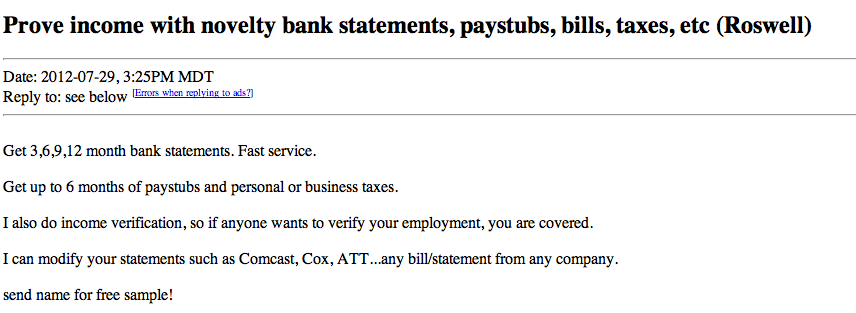
Underwriters industrywide are also reporting that stacking, splitting, double funding, and fake statements are on the rise. It certainly brings back some nostalgia for veterans and not the good kind. A screenshot of a current ad on craigslist that is directed at bad apple merchants:
A new chapter opened for Merchant Cash Advance (This is soooo last month but a great read if you missed it).
http://greensheet.com/emagazine.php?issue_number=120602&story_id=3088
Is the loan shortage a banking problem or a merchant problem? Ami Kassar makes the case in his New York Times column.
“Where are the leads? I need the leads. Can you tell me where the leads are?” We literally get asked daily where to get leads from. We recommend:
http://SmallBusinessLoanRates.com
http://meridianleads.com
By the way… for every company that says cold calling doesn’t work, there’s a company getting rich doing just that. Same goes for SEO, mailers, e-mail blasts, PPC, and so. Marketing is an art form. Just because it doesn’t work for you, doesn’t mean it doesn’t work period. Keep doing what you’re doing. Too many ISOs/agents/marketing directors abandon campaigns after 30-60 days. Practice makes perfect!
Have you abandoned social media? We ask this question: What looks worse to a prospect?
Not having a business twitter account or having one but failing to tweet at all in the last 8 months?
Not having a business blog or having one but failing to add any new blog posts in over a year?
We didn’t spend much time researching hard data but we would surmise that freshness is a psychological component to a prospect’s shopping experience. If a business blogged regularly on their site up until May, 2011 and then stopped, might a merchant think the entire business itself is abandoned or gone? Is a facebook fan page with 1 post from 8 months ago a positive or negative selling point? WE SAY: If you build it, maintain it. Nothing brings down your presence on the Internet like abandonment. We understand that smaller companies might not have the manpower, time, or creative energy to write informative articles or engage people through social networking, especially when it’s hard to measure the results and value it creates. Consider the value you might actually be losing by projecting to the world that you have given up. It’s like operating a store with a sign out front that says “THIS BUILDING HAS BEEN CONDEMNED” even though you are actually open for business. If WE stopped posting articles for a year, would you still come back several times a month?

Here are two examples of MCA firms that keep it FRESH!:
http://unitedcapitalsource.com/blog/
http://takechargecapital.com/category/blog/
Don’t you just love MCA? We do! Visit our site again soon.
– Merchant Processing Resource
../../
The American Obsession With Startups
June 20, 2012Hi, I was just driving down 3rd Street and I saw an old building that had a For Sale sign on it. So I was just thinking it would be a great place to open a restaurant. It would have a really big outdoor eating area and I’ve always dreamed of owning my own restaurant. Lord knows I love food. I can’t talk long but I Googled loans on the Internet and you guys came up so I wanted to know if I could get a $4 million loan or line of credit to buy the building, fix it up, and make it into a Mexican restaurant, or maybe even Italian! Is that something you could do? I would need the money by friday…
This is the real transcript of a call to a Merchant Cash Advance brokerage. Don’t let anyone tell you that the U.S. is not a capitalistic society. Opportunity and entrepreneurship is so ingrained into the very fabric of our being that even self-proclaimed communists and socialists cast away their utopian worker ideals for the chance and self-satisfaction of turning something small into something big. We’re also an impulsive society, a trait partially due to our obsession with immediate self-gratification, but more to do with the fact that opportunities come and go in the blink of an eye. It is for these reasons that an individual who was taught to do market research, create a business plan, and mull things over is instead flying down the road with one hand on the wheel while the other hand is furiously applying for a $4 million loan to finance an opportunity he thought up 7 seconds ago.
How many other people driving down this road thought the same thing? How many of them have access to that kind of capital? Some might and so for the ones that don’t, the fear that someone is going to beat them to it turns them into unrealistic cash demanding lunatics. It’s true. The full service Merchant Cash Advance shops should probably offer John (the name we’re going to assign to the guy driving down the road) a proposal to help him create a business plan, form an LLC, and obtain the necessary licenses. These services would come with a price, a price that many people like John misinterpret as obstacles to be handled once he’s received the $4 Million. As John continues driving down the road, the dream of starting a restaurant is repeatedly crushed as he makes phone call after phone call to business lenders he found on the Internet. “There’s just no help for startups,” he concludes, and decides to hold off until the economy gets better before giving it another shot.
For 37 minutes that day, John was one of the many millions of startup businesses searching for capital. For the Merchant Cash Advance brokerage, he may have been one of the few hundred phone calls an account rep was bogged down with, while trying to help businesses that have been open for at least 1 year. The account reps have probably heard it all. “I want to start a home-based gas station“, “I need twenty million dollars for a good idea that I can’t tell you what it is because I don’t want anyone to steal the idea“, “I just got an LLC and I need $100,000 to come up with some business ideas“, “I’m gonna start an online shoe store and I need money to buy my first computer so I can get on the Internet.” We’re not poking fun at entrepreneurs since there are plenty of those who are really serious. But for the millions that call first and think second, they’re creating a disease unique to the U.S. It’s called startup fatigue. Business lenders are losing so much money by just talking to non-business owners, that they’ve taken to putting up big signs to ward them off.

The Internet is a great example because the cost of one click to the lender’s website can reach as high as $20. So how then does one tactfully express that their financing programs are for existing businesses only? It’s an art form that many have difficulty mastering. Advertisements, which are usually created to rope people in are instead being crafted to keep people out. “Hey Startups, GET OUT AND STAY OUT!” is the marketing campaign some lenders might be considering rolling out next quarter.

We expect that at this point in our post, startup specialists have already stopped reading and have instead taken to writing us long e-mails explaining how ignorant we are.
“DEAR MPR,
You are dumb. There are tons of startup lenders out there just begging for business.”
We’ll welcome any e-mails like this. Maybe these companies will stop hiding in the shadows and we can finally start helping people.
Raharney Capital, the organization that owns Merchant Processing Resource has a division that connects existing small businesses with financing companies. Coincidentally, they encounter a lot of pre-operational startups and continuously face the dilemma of how to service them.
Their first attempt to refer them out was with Go Big Network, a gargantuan networking service specifically for startups to obtain capital. Their homepage touts:
We help entrepreneurs find funding.
Over 300,000 Startups Have Used Go BIG to Connection with Millions of Dollars in Funding. Join today to connect with our network of over 20,000 investors.
They’ve been around for years and their advertisements can be seen all over the web. Inquiries about referring startups to them for a fee went nowhere as Go Big Network made abundantly clear that they did not want affiliates. Further attempts to refer them the business (even free of charge) went unanswered. It seems that even the startup masters don’t want to deal with more startups.
So we took to LinkedIn discussion groups and replied to the many individuals claiming to be angel investors or startup lenders. All of them backtracked on their original statements, with most eventually revealing that they were really looking for businesses that have been operating two years with positive cash flow. Are they liars? Not really. A young business is technically still a startup. What we did find though is that some Merchant Cash Advance providers are funding businesses that have been open for as little as three months. Not bad! (Check out: Capital Stack, Yellowstone Capital, United Capital Source, and Merchant Cash and Capital)
We thought we struck gold when we joined Startup Specialists, expecting to find lenders swarming the discussions with startup lending spam. Instead, we found no mention of financing at all. Interestingly though, this group was abuzz with activity. Thought you were cool because your post got 1 thumbs up? Thought that nothing was happening on LinkedIn? Some posts in this group are receiving hundreds or THOUSANDS of engaging, thoughtful responses! Sadly, no one seems to know where the money is, but that doesn’t seem to matter to them.
While writing this, our own inbox has grown considerably bigger and our voicemail box more full. Many are reaching out to us with questions about startup financing. The fatigue is slowly starting to set in.
One is a voicemail from Google, asking us to reactivate our Adwords campaign, something this site experimented with in the past with $100 in free ad credits. In their message, the account rep mentions that they have reviewed our site and can help startup lenders like ourselves create successful ads(what gave them this impression?). In startup-obsessed America, a stable, sustainable, and somewhat aged business is a mythical beast. Even Google has somehow mistaken our small business information site to be startup information. Too many people assume that small business means the act of trying to start a business. “Do You Have An Existing Business?” a bank advertisement might ask. Tons of people who don’t will still answer ‘yes‘ simply because the idea exists in their mind. It’s a beautiful thing in America to think that way, but getting off the ground and generating revenue shouldn’t be like winning the lottery, a game that you’ll never win but is fun to dream about.
We have interviewed writers for our site, some for volunteer positions, others to be paid. While instructing them to use small business as the subject matter, almost all of them revert to writing about starting a business. Marketing companies have also made the same mistake by pitching us their proposal to make cool videos for the site and then go on to create a demo video that talks about starting a business. One company actually asked us to provide a script and still they CHANGED IT to talk about how Merchant Processing Resource is a premier helper of startups. WHAT?!!!
By now, we’re running a high fever and the doctors suspect we have startup fatigue. Eleven more people have left voicemails, to request $300, $10,000, or $100,000,000 because they have this really sweet idea to make a restaurant named Chesster’s, (Chester’s with a double ‘s’) because each dining table will have a chessboard on it with chess pieces. Boo ya!! They haven’t worked out all the details yet but they thought the name was brilliant and oh yea… they need the money by tomorrow.
We’ll refer them to SCORE, a nonprofit association dedicated to helping small businesses get off the ground, grow and achieve their goals through education and mentorship. They may not get financing, but they will get HELP. And that’s really what Americans need. There isn’t a lending problem, there’s a helping problem.
Entrepreneurs like Mark Zuckerberg made it tougher for all of us. His progression went from random idea to scooping up cash from a classmate, to billionaire CEO of a publicly traded empire. He didn’t sit down with a SCORE mentor, do market research, and consult with a lawyer about how best to structure an organization. These are things he would have considered as obstacles to achieving his dream before someone else beat him to it. “I need the money by friday because this is going to be big,” Zuckerberg might have told a Merchant Cash Advance account rep who had heard the same story 97 times that morning alone.
Zuckerberg’s whirlwind success story portrays him as a role model genius, a boy who acted and capitalized on the split second window of opportunity while all the pieces fell into place after the fact. The rest of America so badly wants to replicate that. Too many people envision themselves in an interview with a New York Times reporter two years from now to talk about how they were driving down 3rd Street and the idea of starting a home-based gas station just popped into their heads, prompting them to Google business loans, and the rest of their billion dollar story is history. Similarly, when that doesn’t happen, just as many people chalk up their failure to a bad economy, Obama’s unwillingness to help, or the big bad banks indifference to the little guy.
It’s okay to go slow and get your ducks in a row. Hell, doing it this way is probably more honorable than what Zuckerberg did. You don’t need the funds by tomorrow, friday, or even next week. What you need is proof that you can provide a product or service for a profit and then to carefully plan and structure an organization that will last. Raising money should be a contingency for expanding sales, not for registering your LLC or to solidify an idea.
There’s a reason that the topic of small business is inundated with information on how to start one. So many fail to get off the ground. There are conflicting and sensational statistics that claim that 9 out of every 10 startups fail. In startup-obsessed America, it’s probably more than that. We would argue that John’s wild foray into entrepreneurship started when he spotted available space for a restaurant and failed when his first instinct was to search for lenders. In the meantime, a few financial firms got caught in the cross fire and spent money to answer his phone calls. Both sides were left frustrated since neither got what they wanted.
In today’s world there is a growing anti-startup movement. Americans want jobs to feed their families and lenders prefer to invest only in existing businesses. The problem is that without startups, fewer businesses will become established (bad for lenders) and fewer jobs will be created (bad for Americans). Our only hope then to turn the tide is to embrace the startups, not shun them. The message shouldn’t be: Get lost you potential job creating jerks! Every lender (and Merchant Cash Advance provider) should have a model to assist startups in some way. It’s okay to charge for this service and profit from it by the way. Any potential business owner who enters the startup arena expecting not to pay anything out of pocket is dreaming.
If America associates small business with starting a business, can a lender really parade themselves as a small business champion if their public message is to send startups packing? We don’t think they can. Similarly, individuals need to do their part and calm their impulses. Drawing up a plan, forming an LLC, and obtaining the necessary licenses aren’t annoying obstacles to take care of after the fact. You can’t really expect to raise capital on a wild whim while you’re flying down the street talking about a random building you saw on the side of the road. Imagine how crazy that sounds to a lender?
Patience and hard work, we say. That goes for the entrepreneurs and lenders alike. Let’s help each other, not hate each other. It won’t be easy, but then again success isn’t supposed to be like winning the lottery, a game that you’ll never win but is fun to dream about.
A Merchant Cash Advance Fad or Future?
May 11, 2012We were recently asked the following questions:
What do you think has caused this explosion of bank-only and loan products in the MCA space? Will they last?
 It’s said that 50% of all marriages end in divorce. So after years of a happy marriage and several offspring (starter advance, premium advance, and lockbox), the Merchant Cash Advance industry is seemingly ready to part ways from merchant processing. Back in the Mid 2000’s, the two did everything together. But now it seems every time a funder receives an application, there’s a note attached to it from the reseller that says “this needs to be ACH.” What began as a temporary work around for POS equipment that couldn’t be converted, has turned into a full blown fixed debit ACH love affair. Will this product boom last? How did this even happen?
Here are several of our theories, some of which may even contradict each other:
1. The Merchant Cash Advance industry has grown uninhibited for so long, that some companies do not see any harm in collecting fixed payments. A projected 6 month advance could take 18 months to complete due to a slowdown in merchant account sales, a risk that some funders are no longer willing to take.
2. At least one state (::cough:: California ::cough::)has been nagging Merchant Cash Advance providers to obtain a lending license even if they’re truly purchasing future revenues. If you have a lending license, you might as well actually lend money. Hence, more fixed term and fixed payment deals are being done.
3. Sales agents are constantly talking about upfront commissions and closing fees. It seems like none of them are earning merchant account residuals anymore or don’t see the long term value in them. Should we be surprised if an agent pushes to get an account funded on ACH instead of waiting 6 weeks to convert a Micros POS?
4. Payment technology has evolved too much. There are tons of ways to circumvent a funder’s split. Anyone can whip out their smart phone and swipe a card through an attachable device. There’s also the ability to get terminals and POS technology for free from virtually ever merchant services provider in the country. Instead of worrying about whether or not the merchant is going to secretly use Square or PayPal to bypass the split, it’s beginning to make more sense to pull funds from the bank account instead. At least if they end up using Square, PayPal or 10 other processors, those sales will end up in the bank account anyway.
5. “I have to change my processor? Ugh!” How many times have sales agents heard that? It only takes 1 sales agent in a 5 way deal competition to ruin it for everyone else by offering a fixed debit repayment program. No one wants to be caught without the ability to present the same alternative.
6. There are so many businesses that don’t accept credit cards, accept them with such low frequency, or in such a small proportion to their cash sales. It may seem like everyone is doing fixed debit ACH deals now, but in reality a lot of these businesses would never have qualified for a Merchant Cash Advance previously. The merchant pool has grown to include anyone that owns a small business instead of anyone that owns a small business that does at least $5,000 a month in credit cards and batches out 15x times consistently.
We think #6 is the biggest part of it, but certainly this shift in the parameters of eligibility and the widespread ability to ACH is cannibalizing the sector that would normally qualify for split-funding. The rate at which the industry is doing ACH deals may slow down but it’s very unlikely it will ever go away. Is this is all a fad? We think not…
– AltFinanceDaily
../../
Subprime Lending and The ETA Expo in Vegas!
April 12, 2012Are we really still saying “banks aren’t lending”? We are, and apparently everybody else is too, because it’s still true. Time Magazine just published a piece that promotes the idea that bank lending is so dead that people wouldn’t even lend money to themselves. Could this be more evidence that banks are no longer necessary to a recovery or economic growth?
We recently scolded the Huffington Post over an article casually claiming that businesses had no financing options other than to pawn off their jewelry. That led us to create a mini-petition in which many players within the Merchant Cash Advance industry could politely inform them of their omission. We are happy to report that individuals from more than 40 MCA companies have participated in the petition so far. “40?! Only 40?!!” If you think 40 is small, you should keep in mind that there are only so many MCA companies in the country. We encourage anyone who has not participated to do so HERE.
Huffington Post hasn’t responded yet but we expect they will be forced to as the emails keeping rolling in!
————————
Woo-hoo! Vegas!! YEAHH!!! (April 17th – April 19th)
As the Merchant Cash Advance industry has evolved, we find it kind of interesting that the we have adopted the Electronic Transactions Association Expo has our own official trade show. Split-processing or ACH collection are both electronic payments, but we believe piggybacking on other industries could potentially be keeping MCA in the shadows. Whenever there’s a trade show, whether it be payment processing, restaurant associations, or other, the Merchant Cash Advance guys seem to show up but they’re never hosting the event.
 Now that the volume of MCA transactions per year is in the billions of dollars, it may be time to starting pulling ourselves out of the booths and onto the big stage. Don’t get us wrong. The ETA Expo is the most valuable place for the MCA space to meet, greet, close deals, learn, partner up, promote yourself, and party, and it’s important that we maintain a big presence there. We can’t help but imagine what could be if wholesalers, equipment vendors, distributors, and retail business owners were coming to the Annual Merchant Cash Advance Industry Expo. Attendees would get pez dispensers shaped like credit card terminals and the candy would be green and shaped like money. As long as we had pez, we wouldn’t need a big fancy dance show:
Thoughts on this anyone? Are you going to be at the ETA Expo? Comment below.
Merchant Cash Advance On Huffington Post / Just Call it a Coupon!
March 16, 2012An article was published by the Huffington Post today that explained the need for Merchant Cash Advance providers. Though some of it was described in an unflattering light, it conveyed some important messages.
- Real business owners explain that banks both big and small are not interested in lending to them
- One woman is quoted as saying: “If I ever write a book on how to open a restaurant, the first chapter is going to be ‘Banks Are Not Your Friends.'”
- A direct funding provider revealed that demand for merchant cash advances increased by 15 percent to 20 percent in 2011 and that 70% of businesses use more than 1 advance.
 Our favorite line and perhaps the most important thing you can take away from this article is the quote by the CEO of AmeriMerchant. “[Merchant Cash Advance] is less expensive than [offering] a Groupon for 50 percent off or putting inventory on sale for 30 percent off.” Isn’t it ironic that the Groupon/e-coupon/social coupon concept is today’s business as usual and is at the same time significantly more costly than what the media considers to be expensive financing?
LivingSocial has 60 million members worldwide and they operate much in the same way that Groupon does. Let’s discuss this. According to wikipedia, Groupon’s business model works as follows:
For example, an $80 massage could be purchased by the consumer for $40 through Groupon, and then Groupon and the retailer would split the $40. That is, the retailer gives a massage valued at $80 and gets approximately $20 from Groupon for it (under a 50%/50% split).
So the 50% discount to the consumer is actually a 75% loss of revenue for the business owner. This practice is publicly accepted as fair, practical, and a way to increase your sales. If that’s the case, should’t financing that costs $2,800 to receive $10,000 be considered a bargain? We think so. Expensive is in the eye of the beholder. The media has a funny way of convincing people that a 75% discount is a great deal but financing costs of 28% are astronomical. Not to say that 28% is cheap, but there is only one reason that low rate bank loans even existed in the first place. The SBA is willing to cover up to 90% of the defaults and charge it to the taxpayers. That’s an advantage the rest of the private sector doesn’t get.
We can’t help but think what would be if the Merchant Cash Advance concept was rebranded as a powerful social marketing tool to drive sales. What if a Merchant Cash Advance provider purchased $12,800 of a store’s future sales in exchange for $10,000 today and then mass marketed that business to local consumers through mailing lists, iphone apps, and website ads to drive customers to the store. That would allow the Merchant Cash Advance provider to recoup their purchase as fast as possible and at the same time create viral growth for the business. The technology already exists and businesses are already willing to accept 75% losses. Isn’t it time they all started getting a lot more bang for their buck?
It’s not expensive when it’s spun that way is it? Sayonara Groupon and LivingSocial! Merchant Cash Advance is the sleeping giant at your doorstep.
– AltFinanceDaily
../../
Let’s Play ‘Solve That UCC Filing!’
August 23, 2011
Underwriters have shared with us that it is more challenging than ever to determine if a merchant has an existing MCA balance already. Integrity Payment Systems, a merchant processor in Chicago, recently stated that they have signed on nearly 100 split funding partners. This is astounding given that we only list 24 officially recognized funding firms in our database. Sounds like we could use an update.
The challenge is not so much that WE don’t know who is funding merchants, but rather MCA firms don’t know. We’ll be the first ones to tell you that a retrieval percentage used to be black and white on a merchant statement. If not, you couldn’t miss that big fat UCC-1 lien by a known MCA firm. Those were the easy days when you saw “Secured Party: Fast Capital” and you could phone them up to verify a balance or find out what the scoop was.
Nowadays, there are lockbox programs, ACH debit programs (both variable and fixed payments), and a whole slew of creative structures to make MCA financing possible. The North American Merchant Advance Association(NAMAA) has an exclusive live network of funding activity. That means any NAMAA member can login to make sure that another member doesn’t already have an outstanding balance with the merchant they are about to fund. This database is an invaluable tool to the industry’s success and yet it has one major flaw, there are ONLY 12 members!
So let’s run through a scenario:
——
Mr. MCA Underwriter is analyzing an application and supporting documents. There is nothing being deducted from the 6 months worth of merchant statements. The bank statements look clean. The credit is good. Everything is pointing towards an approval until they do a UCC search. There are a few terminated UCC’s from over 5 years ago by Bank of America, back when bank lending actually existed. There is nothing since then, except for one by a so called ‘ABC LLC’. There is an address for ABC LLC but there is no contact information for them and a web search reveals nothing about their location or what it is. The UCC language is generic and indicates that it is a lien on the debtors property. Mr. MCA Underwriter has seen plenty like it before but asks the merchant about it anyway. The merchant indicates ABC LLC leased them all their equipment including a new oven and freezer. Everything adds up, the deal is approved, and subsequently funded.
Five days later Mr. MCA Underwiter gets a call from an upset individual with accusations that the merchant’s processing receivables already belong to someone else, an ABC LLC. The individual is a reseller of MCAs normally but has funded 5 clients with his own money(a trend becoming more popular. Read here). He funds those deals under a nondescript company, ABC LLC so that nobody will figure out what it is and solicit his client. Mr. MCA Underwriter explains there was no evidence of repayment of a MCA. It turns out the merchant defaulted 7 months prior and hence the 6 months worth of documentation were clean.
—-
For the past few years, it has been very common for resellers to search UCC databases by secured party, thus revealing ALL of the clients that particular secured party or MCA provider has funded in that state. Those clients are then solicited with the appeal of better rates on a MCA and incentives to get bought out. For some MCA providers, this has had a disastrous effect on retention.
ABC LLC successfully protected themselves on that front because no one was able to identify them as a MCA provider. Thus there was little chance their clients would be revealed. However, the strategy backfired when it became unclear that the merchant’s future credit card receivables had been sold.
ABC LLC’s strategy is becoming extremely common. Many MCA providers are resorting to using code names as the secured party to throw UCC hunters off the trail. We list a lot of those code names HERE. Combine that with the fact that hundreds of people are now funding their own accounts and we have a big mess of no UCCs, confusing UCCs, and incorrectly filed UCCs(some funders are filing them in the state they operate in instead of the state the merchant operates in).
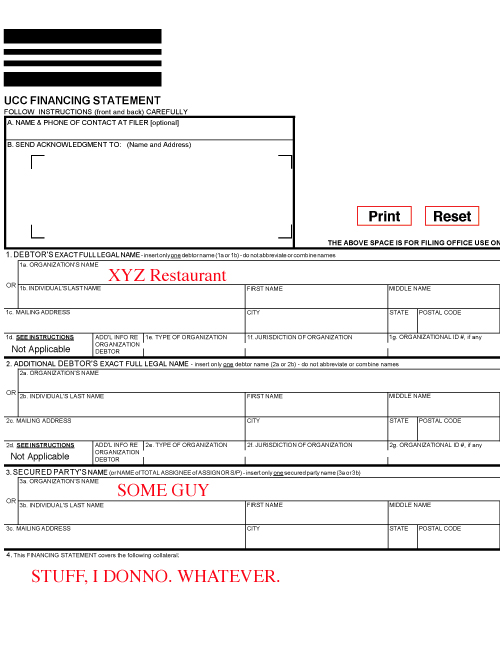
Mr. MCA Underwriter is facing a lack of clues and it would not be surprising if the industry starts to see a resurgence in advance stacking. If anyone would like to anonymously share UCC code names that we do not have included in our records, please e-mail them to merchantprocessingresource@gmail.com
As the industry evolves, so will the issues. In our opinion, MCA providers should be plainly clear on the arrangement they have with their clients. No judge is going to listen to a story about code names, misleading UCC language, or why you don’t file at all. A UCC-1 is intended to be a public notice and is meant to be found. Small businesses will benefit by the expansion of the MCA industry but poor use of UCCs will inhibit the rate of growth.
And that’s our 2 cents…
-The Merchant Cash Advance Resource
../../merchantcashadvanceresource.htm