
Ready to Trade ONDK and LC?
November 16, 2014 On November 10th, OnDeck Capital finally made their S-1 public. Immediate reactions from inside the industry were mixed. The bears criticized the years of losses while the bulls pointed out that the tide is turning. With a profitable 3rd quarter, OnDeck’s bet on the long game might finally be proving itself.
And without delving into their S-1 for now, the industry should be bracing itself for change. The mysterious world of daily funders (financial companies that deal in daily payments) is about to come under the scrutiny from another body, stock analysts.
Unlike journalists which have bruised the industry with sensational headlines and surface level criticism (high costs, light regulation), analysts will be tasked with truly understanding the fundamentals of nonbank business lending. Not to mention that everyday retail investors looking for an edge will want to learn more about the industry than what a single company’s quarterly financials will tell them.
Daytraders might make decisions based on melodramatic stories but those buying and holding for the long run will be conducting something that’s rarely taken place in this industry, research. Expect these questions to be asked and deeply considered:
- Who are OnDeck’s competitors? (and not just the top 3, but the hundreds that follow them)
- What are ISOs/brokers and how do they operate?
- How do they generate deal flow?
- What is Merchant Cash Advance and how is it similar or different to OnDeck?
- What is the real regulatory environment? (Because there are actually applicable regulations despite articles that say there aren’t any)
- Why does OnDeck collect payments daily?
- Why is OnDeck’s model so much different than Lending Club’s?
Look for the last bullet point to be explored greatly. If OnDeck and Lending Club are both innovative small business lenders broadly targeting the same market, why is OnDeck charging an average of 50% APR paid daily over 6 months and Lending Club charging as low as 5.9% APR paid monthly up to 5 years?
Their products couldn’t possibly be more different. And while Lending Club’s IPO path has curiously stalled, there is nothing to indicate that it will not proceed. That means we should expect comparisons between the two upcoming tickers LC and ONDK, a lot of them.
Details about commissions, closing fees, marketing practices, and transparency will be talked about in open forums by the general public. If it’s controversial, it will be debated. If it’s unique, it will be scrutinized. To an extent, OnDeck, Lending Club, and many of their competitors will cede control of their destiny to the general investing public.
There are folks in the industry giddy over the chance to buy and sell stock in both companies. They have years of experience on the front lines. But just as they’re gearing up to trade ONDK and LC, so too is everyone else.
Get ready for major change…








Do Opportunities Abound?
June 8, 2014 Just recently I found myself in an office surrounded by some folks who had each worked in the merchant cash advance business for more than 10 years. The first generation of MCA pioneers are still out there of course but it’s rare to be in the presence of so many at one time. It was weird. Weirder still was the realization that no matter how much things have changed, some things continue to be exactly the same.
Me: You guys looking to recruit ISOs?
Them: Damn right
As far as the industry is concerned, these guys might as well have fought in ‘Nam. They’re from another generation where life was hard and men were still men. When businesses couldn’t get bank loans, these guys were splitting payments with their bare hands and reprogramming credit card machines with nothing more than a paper clip and a ball of twine. Funding a deal wasn’t a product of technology, it was one of sweat, tears, and blood. Have you ever bled for your deals?
This August I celebrate my 8th year in the industry. Next month marks the 4 year anniversary of this blog. I enjoy reading some of my posts from back then, particularly since most of them discuss the ordeals of credit card processing. A lot of what I’ve written no longer applies and some of what I’m writing these days will be outdated years from now. As I approach 600 articles and blog posts on this subject matter, I’ve had to stop and ask myself if everything has already been written. What more can possibly be said about this business? Perhaps the tale of the industry has already been told and I am on my way to retelling exaggerated stories to anyone who will listen. I don’t want to be that wrinkled up old man swaying back and forth in a rocking chair talking about how ISOs got it so easy these days.
 Sadly, even the name of the website is reflective of a previous era. This is the Merchant Processing Resource, not exactly what you’d expect a top destination to be called on the subject of alternative business lending.
But the story’s not finished. Every passing month is filled with events that inspire a dozen new chapters, which is more than one man can keep up with. Last month at the LendIt conference, I got a glimpse of just how many opportunities still lie ahead.
Some alternative business financing companies such as Funding Circle and DealStruck are diverging away from merchant cash advance and going back to the traditional roots of term lending. Funding Circle is doing it with a 21st century twist, by making their system peer-to-peer based.
Still other firms have sprung up around LendingClub’s and Prosper’s APIs and offer their users ways to make better loan investment decisions.
And even among the players we’re all familiar with, there is innovation, growth, and new ideas. Just recently CAN Capital launched CAN Connect, a software application that can be integrated with any other company’s software. According to CAN’s release,
Through CAN Connect™, merchants will be able to receive a CAN Instant Quote™ based solely on data provided by the partner. Once the merchant elects to proceed, they are taken through a simple online application process and can obtain access to working capital without ever leaving the partner’s platform.
Indeed technology has even allowed me to become a lender myself,

My LendingClub portfolio, which is still very young and made up by hundreds of $25 consumer loan contributions has a current Net Annualized Return of more than 10%. Contrast that against the average U.S. savings account that pays out less than 1%.
While it’s certainly not the 54% yield that OnDeck Capital enjoys, there are levels of risk and markets set up for just about anyone interested in alternative lending.
And what might come next may not all be broker/funder related. As the industry flies in a thousand different directions, entire new industries and services are going to grow up around them. That brings me back full circle. Has everything already been written? 4 years of blogging here and this might as well be my first day.
Some things haven’t changed a bit, but the rest of it, well… we must soldier on in this strange new world.
Do you see opportunities ahead? Discuss with industry insiders on DailyFunder.
A Look at Data Security
May 17, 2014 In the latest issue of DailyFunder, Cheryl Conner explored data security in the alternative business lending industry. Its basis was rooted in the ETA’s 2008 Merchant Cash Advance White Paper that stated Merchant Cash Advance companies must be PCI compliant.
That white paper was drafted in a different era, particularly when 99% of all transactions required a payment processing split rather than ACH debits. It’s true also that it specified companies “that handle sensitive payment related information”, namely cardholder data as part of its regular business operation.
Credit card processors that engage directly in issuing merchant cash advances are naturally already subject to PCI compliance, but for the funding companies that aren’t in the processing business, they’re basically off the hook. Indeed a spokesperson for the PCI Security Standards Organization informed Conner that “PCI standards apply to payment card data branded by one of the five founding brands, which means any entity that accepts, processes, transmits or stores account data from a PCI branded payment card should be applying PCI DSS for the protection of that data.” She went on to say that PCI DSS doesn’t apply to bank account data.
 So while PCI compliance does not have a place in alternative business lending, it raised the question as to whether or not there were other privacy regulations that do, particularly the Gramm-Leach-Bliley Act (“GLBA”) of 1999. According to the FTC, the GLBA “requires financial institutions – companies that offer consumers financial products or services like loans, financial or investment advice, or insurance – to explain their information-sharing practices to their customers and to safeguard sensitive data.” The law is broad enough to cover any financial institution that is engaging in activities that are financial in nature.
The GLBA imposes a host of requirements on these financial institutions, including the need to establish an information security program to protect customer information.
But as is the recurring theme in alternative business lending, such rules do not govern institutions that engage in business-to-business transactions. On the FTC’s website, it states:
Under the Rule, a “consumer” is someone who obtains or has obtained a financial product or service from a financial institution that is to be used primarily for personal, family, or household purposes, or that person’s legal representative. The term “consumer” does not apply to commercial clients, like sole proprietorships. Therefore, where your client is not an individual, or is an individual seeking your product or service for a business purpose, the Privacy Rule does not apply to you.
Similarly, I’ve been told that the Consumer Financial Protection Bureau does not have jurisdiction over business-to-business transactions, even if one party is a sole proprietor. In a business-to-consumer transaction, there’s an assumption that the consumer may not be as sophisticated as the business and thus deserving of protections. In the course of two businesses engaging in business, it would be extremely difficult to draft rules that only protected one side as both are free market equals.
While there may not necessarily be any laws that regulate security or privacy in commercial transactions, there are plenty of benefits to following GBLA-like guidelines. For one, it could be used to build goodwill with clients. Additionally, security and privacy are sure to be examined during the course of a due diligence audit by potential investors. In this day and age, a breach of privacy or security could permanently disrupt a business’s ability to maintain the good faith of the public.
Do you feel that alternative business lenders are doing a good job?
—-
Note: I am not a lawyer and this post should not be considered legal advice.
Square Bears Attack
April 21, 2014It was the PR nightmare that wouldn’t end. With Easter Sunday still warm on everyone’s minds, bloggers went for the jugular over Square’s acquisition rumors. Whether based on fact or fiction (nobody seemed to know for sure), Alistair Barr, Douglas Macmillan, and Evelyn Rusli of the Wall Street Journal single-handedly hit Jack Dorsey’s famous payment company with a fresh dose of healthy skepticism. With that came the revelation that Square had lost $100 million in 2013, a dangerously large figure for a company that is apparently plagued with shrinking margins, not growing ones.

What was happening behind the scenes at Square differed in dramatic context depending on which news site you read. Some writers claimed Square executives were considering a well thought-out strategic acquisition in light of a liquidity shortfall, while others insinuated that Jack Dorsey had last been seen raging drunk at a Market Street Starbucks wearing nothing other than flip flops. He reportedly told spectators that a 2% swipe fee was impossible and then he fled out the back door as four Baristas tried to wrestle him down.
When an IPO was taken off the agenda in February, some analysts wondered if their historic rise had come at a cost. In the Wall Street Journal article, it was alleged that the company was potentially less than a year away from insolvency. The quote was, “During the first quarter of 2014, a Square executive told a potential acquirer that the company had nine months before it would hit a predetermined ‘cushion’ of funds set aside as a last resort.” Thanks to the new credit facility they landed this month of nearly $200 million, they should have no problem with cash flow.
 But questions remain. People supposedly close to Square confirm that the company had practically begged Visa and Google to acquire them. Though there were stiff denials from all parties throughout the day, it made for some enticing headlines. Square Bears were out in droves today:
Square Is Losing Millions Of Dollars And Wants To Sell – Huffington Post
Why Square Needs To Sell Itself And Do It Quickly – Forbes
Mobile payment startup Square plans sale as losses widen – Reuters
Did Jack Dorsey Do the Math on Square – UpStart Business Journal
Square denies sell-out plans; all eyes on the dicey-looking financials – ZDNet
Mobile-Payments Startup Square Discusses Possible Sale
Company Faces Wider Loss, Less Cash; Google Considered Potential Acquisition – Wall Street Journal
What should also be of note is Square’s recent venture into the merchant cash advance business, which in practice should be a major liquidity drain. One has to wonder if this is a good time to position themselves as a working capital provider when they’re hemorrhaging cash from their payments operations. Besides, providing funding to micro-merchants in return for a split of their future card sales is an incredibly risky business model. One thing the established players in that market have learned is that it’s really easy to lose money if you don’t know what you’re doing.
I sure hope they know what they’re in for. Otherwise Dorsey might really run off drunk to Starbucks.
Merchant Cash Advance Syndication: Crowdfunding?
March 28, 2014 You might not have known this, but one of the most lucrative opportunities in merchant cash advance is the ability to participate in deals. It’s a phenomenon Paul A. Rianda, Esq addressed in DailyFunder’s March/April issue with his piece, So You Want to Participate?
Syndication is industry jargon of course. You probably know the concept by its sexier pop culture name, crowdfunding. For all the shadowy rumors and misinformation that circulates out there about merchant cash advance companies, they’re similar to the trendy financial tech companies that have become darlings of the mainstream media.
Did you know that many merchant cash advances are crowdfunded? To date, no online marketplace has been able to gain traction in the public domain aside from perhaps FundersCloud, so crowdfunding in this industry happens almost entirely behind the scenes. There is so much crowdfunding taking place that it’s becoming something of a novelty for one party to bear 100% of the risk in a merchant cash advance transaction. Big broker shops chip in their own funds as do underwriters, account reps, specialty finance firms, hedge funds, lenders, and even friends and family members of the aforementioned.
Merchant cash advance companies find themselves playing the role of servicer quite often, which is coincidentally the model that Lending Club is built on. A $25,000 advance to an auto repair shop could be collectively funded by 10 parties, but serviced by only 1. Each participant is referred to as a syndicate. This is not quite the same system as peer-to-peer lending because syndicates are not random strangers. Syndication is typically only open to businesses, and most often ones that are familiar with the transaction such as the company brokering the deal itself.
In the immediate aftermath of the ’08-’09 financial crisis, some merchant cash advance companies became very mistrusting of brokers and deal pipelines were going nowhere. Underwriters had a list of solid rebuttals for deals they weren’t comfortable with. “If you want us to approve this deal so bad, why don’t you fund it yourself!,” underwriters would say. Such language was intended to put a broker’s objections over a declined deal to bed. But with all the money being spent to originate these deals, it wasn’t long until brokers stumbled upon a solution to put anxious merchant cash advance companies at ease. “Fund it myself? I’d love to, but I just can’t put up ALL of the cash.”
And so some brokers started off by reinvesting their commissions into the deals they made happen. That earned them a nice return, which in turn got reinvested into additional deals. Fast forward a few years later and deals are being parceled out by the truckload to brokers, underwriters, investors, lenders, and friends. There’s a lot of money to be made in commissions but anybody who’s anybody in this business has a syndication portfolio. The appetite for it is heavy. Wealthy individuals and investors spend their days cold calling merchant cash advance companies, brokers, and even me, trying to get their money into these deals. They know the ROI is high and they want in.
 That’s the interesting twist about crowdfunding in the merchant cash advance industry. You can’t get in on it unless you know somebody. There are no online exchanges for anonymous investors to sign up and pay in. It requires back door meetings, contracts, and typically advice from sound legal counsel. A certain level of business acumen and financial prowess are needed to be considered. These transactions are fraught with risk.
In Lending Club’s peer-to-peer model, investors can participate in a “note” with an investment as small as $25. This is a world apart from merchant cash advance where it is commonplace to contribute a minimum of $500 per deal but can range up to well over $100,000.
Lending Club defines diversification as the possession of more than 100 notes. At $25 a pop, an investor would only need to spend $2,500. With merchant cash advance, 100 deals could be $50,000 or $10,000,000. By that measure, syndication is crowdfunding at the grownup’s table, a table that doesn’t care about sexy labels to appease silicon valley, only yield.
Strange merchant cash advance jargon keeps the industry shrouded in mystery. Did you know that split-funding and split-processing are terms often used interchangeably? Or that they have a different meaning than splitting? Or that the split refers to something else entirely?
Do you know what a holdback is or a withhold? How about a stack, a 2nd, a grasshopper, an ISO, an ACH deal, a junk, a reup, a batch, a residual, a purchase price, a factor rate, or a UCC lead?
Paul Rianda did a great job detailing the risks of syndication, but there is one thing he left unsaid, and that’s if you’re going to participate in merchant cash advances, you better be able to keep up with the conversation.
At face value, syndication is nothing more than crowdfunding. But if your reup blows up because some random UCC hunting ISO stacked an ACH on top of your split while junking him hard and upping the factor with a shorter turn, you just might curse the hopper that ignored your holdback and did a 2nd. And on that note, perhaps it’s better that the industry refrain from adopting mainstream terminology. We wouldn’t want everybody to think this business is easy. Because it’s not.
One factor to consider is the actual product being crowdfunded. In equity crowfunding, participants pool funds together to buy shares of a business. In crowdlending, participants pool funds together to make a loan. But in merchant cash advance syndication, participants pool capital to purchase future revenues of a business. An assessment is made to predict the pace of future income and a discounted price is paid to the business owner upfront. That purchase price is commonly known as the advance amount.
Syndication has more in common with equity crowdfunding than crowdlending. If you buy future revenues and the business fails, then your purchase becomes worthless. There is typically no recourse against the business owner personally unless they purposely interfere with the revenue stream and breach the agreement. Sound a bit complicated? It is, but crowdfunding in this space is prevalent nonetheless. To get in on it, you need to know someone, and to do it intelligently, you better know what the risks are.
If you want to sit at the grownup’s table and syndicate, consult with an attorney first. There’s a reason this industry hasn’t adopted sexy labels. It isn’t like anything else.
Lending Club Threatens The Status Quo
March 20, 2014 In late 2013, consumer peer-to-peer lender Lending Club announced their plans to start offering small business loans. That caused a stir in the merchant cash advance world for a few weeks, but the hype died down. The general consensus was that there would be little to no overlap between the applicants each target.
To this day, I continue to doubt that the overlap will be anything less than substantial. Nik Milanovic of Funding Circle would probably disagree with me. The main argument has been that Lending Club will only target small business owners with good credit, which assumes that businesses with anything less are the only users of merchant cash advances. Not to give anyone’s figures away, but I have seen data to suggest that a large segment of merchant cash advance users have FICO scores in excess of 660. Somewhere along the line we convinced ourselves that merchant cash advances were for businesses with really bad credit. That was never the purpose it was intended for, though it’s true that many applicants have low scores.
Historically, merchant cash advances were for businesses that posed a cash flow risk to banks. Split-processing eliminated that risk by withholding a percentage of card sales automatically through the payment company processing the business’s transactions. Funders today that rely on bank debits for repayment don’t have that safeguard, but they make up for the risk they take by doing something banks don’t do, require payments to be made daily instead of monthly. This allows businesses to manage their cash flow throughout the month and enables the funder to compound their earnings daily. It’s a phenomenon I wrote about in the March/April issue of DailyFunder (Razzle Dazzle Debits & Splits: Daily is the Secret Sauce)
According to the Wall Street Journal, Lending Club will require a minimum of 2 years in business and participation will initially only be open to institutional investors.
Lending Club’s website states that they will recoup funds on a monthly basis via ACH and that interest rates range from 5.9% APR to 29.9% APR + an origination fee. Terms range from 1 to 5 years and there are no early payment penalties.
TechCrunch openly pegs CAN Capital and OnDeck Capital as chief rivals for Lending Club in the space. CAN has enjoyed frontrunner status in the industry since 1998 and while they have been tested in the last 2 years, they haven’t come up against something like this.
In the same Wall Street Journal story, Lending Club’s CEO, Renaud Laplanche lays out who his competitors are with his quote, “The rates provide an alternative to short-term lenders and cash-advance companies that sometimes charge more than the equivalent of 50% annually.”
But will the impact be felt right away? In Laplanche’s interview with Fortune, he claims that it’s very likely they’ll focus on the 750+ FICO segment first, where institutional investors will be comfortable. But make no mistake about it, that will change quick, especially with a probable IPO in the next 8 months.
Is Lending Club really all that big? To draw a comparison, RapidAdvance got a $100 million enterprise valuation when they got bought out by Rockbridge Growth Equity about 6 months ago. Lending Club on the other hand was valued at around $2.3 billion at that time. It took OnDeck Capital 7 years to fund $1 Billion in loans. Lending Club is funding a billion dollars in loans every 3 and a half months. Granted, they’ve all been consumer loans, but let’s not kid ourselves about their capabilities.
Lending Club is funding more consumer loans than the entire merchant cash advance industry is doing combined. Thanks to the peer-to-peer model, they have infinity capital at their disposal. We can pretend that no one with good credit ever applied for a merchant cash advance or we can acknowledge the 3 billion pound gorilla in the room.
Lending Club and other peer-to-peer lenders that follow them will disrupt the alternative business lending status quo.
—
Previous articles on this subject:
Will Peer-to-Peer Lending Burn the Alternative Lending Market?
Lending Club Business Loans are Here
Peer-to-Peer Lending will Meet MCA Financing
News from the Space
November 18, 2013 American Express recently teamed up with Heartland Payment Systems to provide split-processing loans tied to all card transactions rather than just American Express exclusively. The max loan size is $750,000. Prior to this deal American Express and other merchant cash advance companies rarely competed head-to-head. Unless a small business was processing substantial AMEX, they weren’t a candidate for American Express Merchant Financing. I expect them to make similar deals with other card processors.
Lending Club got a valuation boost with a $57 million investment from Yuri Milner’s DST Global and Coatue Management LLC. They’re now worth about $2.3 billion. They are expected to go public in 2014 which will be especially significant given their plans to enter the small business lending space as early as January. Today, alternative small business lenders worth tens of millions or hundreds of millions of dollars are the big shots in the industry. Expect major disruption if Lending Club achieves an IPO valuation in the tens of billions.
Zazma put their own spin on lending by financing the purchases small businesses make. Funds are actually wired directly to the suppliers instead of to the borrower. For now they are only doing up to $5,000 at one time, which is typically the minimum sized deal for the merchant cash advance industry.
ISO&Agent published a great article about merchant cash advance titled, Taming the Wild Frontier.
The end of the year is coming and Capital Access Network, which is now CAN Capital projects they will finish with $800 million in transactions for 2013. 15 years after they started, they are still the biggest in the business.
MCA Track – A Merchant Cash Advance Back End
July 6, 2013Running your funding business off of excel spreadsheets or clunky old software that wasn’t meant for the Merchant Cash Advance (MCA) market? You might want to consider using something that was both made and used by MCA people. A couple weeks ago, Benchmark Merchant Solutions gave me a private demo of their all-in-one back end system to manage incoming and outgoing payments for both split-funding and ACH deals.
It had a lot of nice features and certainly would make it possible to manage your books with ease. The reports are very easy to produce, read, and make sense of. Alerts can be set up for merchants that have not processed for any gap of time you set. ACH rejects are automatically recorded and flagged.

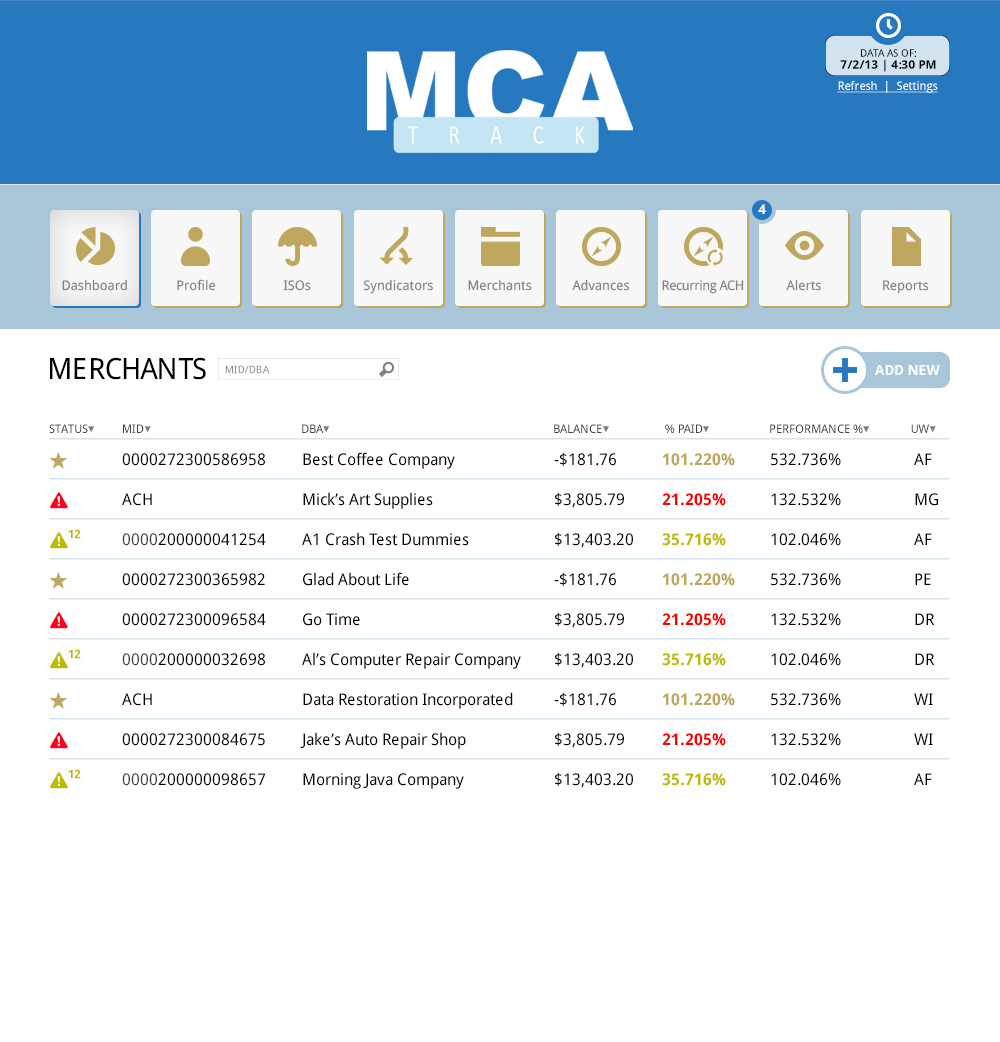
At the current moment, the only direct split-funding integration it has is with Benchmark Merchant Solutions. They will be directly integrating with other processors in the coming month. The system uses a proprietary ACH provider.
Contact: Zalman Notik
Phone: 212-444-9567
zalman.notik@mcatrack.com
Benchmark Merchant Solutions is a registered ISO and MSP of Deutsche Bank AG, New York. This is not a paid ad or review. The Benchmark team is run by solid folks.
Having issues with your books? Make it easy with MCA Track.
– Merchant Processing Resource
../../
MPR.mobi on iPad, iPhone, and Android