
California Bill Seeks to Rein in Debt Settlement Companies That Target MCAs / Business Loan Borrowers
July 7, 2025AB-1166 in California has been quietly moving through the legislature in California since February. The bill seeks to amend the Fair Debt Settlement Practices Act to include commercial financing recipients with consumer borrowers as a covered and protected group. Per the bill, “Commercial Financing means an accounts receivable purchase transaction, including factoring, asset-based lending transaction, commercial loan, commercial open-end credit plan, or lease financing transaction intended by the recipient for use primarily for other than personal, family, or household purposes.”
If it became law, debt settlement providers would be prohibited from engaging in misleading practices, have to provide specific disclosures, allow the business owner to cancel the debt settlement agreement at any time, have to provide monthly statements, itemize their compensation, and more.
The full text can be read here. It recently passed through the Senate Banking and Financial Institutions committee on July 2.
The Battle Against MCA in Texas
June 12, 2025David Roitblat is the founder and CEO of Better Accounting Solutions, an accounting firm based in New York City, and a leading authority in specialized accounting for merchant cash advance companies.To connect with David or schedule a call about working with Better Accounting Solutions, email david@betteraccountingsolutions.com.
 Texas, a state associated with limited government intervention and freedom of business to operate and succeed in a capitalist society, stands at a crossroads.
Governor Greg Abbott has until June 22nd to decide whether to sign House Bill 700 into law—a decision that could fundamentally reshape how small businesses access capital in the Lone Star State. If he signs it, or simply lets the deadline pass without action, this sweeping legislation will take effect on September 1, 2025. The action will potentially cut off vital funding sources for thousands of Texas entrepreneurs, in a direct assault on the merchant cash advance industry that has been a lifeline for the people of his state.
The stakes couldn’t be higher. While supporters frame HB 700 as consumer protection, this bill targets sales-based financing—financial tools that have become lifelines for small businesses shut out of traditional bank lending.
Small business owners know the frustration of walking into a bank and walking out empty-handed all too well. Traditional lenders have tightened their belts, especially for newer businesses, minority-owned enterprises, and companies in industries deemed “risky.” When a restaurant owner needs quick capital to fix a broken freezer, or a contractor requires funds to purchase materials for a big job, they can’t wait weeks for a bank’s approval process. They need solutions now.
That’s where alternatives come in. Revenue-based financing provides capital based on future sales, not credit scores or lengthy financial histories. Yes, they can be more expensive than bank loans—but they’re also available when banks say no.
This financing drives business growth, job creation, and the health of Main Street. When small businesses can access capital quickly, they expand, hire employees, and strengthen their communities.
HB 700 goes far beyond simple disclosure requirements. While transparency is important—and most responsible providers already provide clear terms—this bill creates a regulatory maze that could price many providers out of the Texas market entirely.
The bill imposes sweeping new requirements that will fundamentally change how sales-based financing companies operate in Texas. Companies providing commercial sales-based financing must register with the Office of Consumer Credit Commissioner by December 31, 2026, including both direct providers and brokers, with mandatory annual renewals and fees.
For any financing under $1 million, sales-based financing providers must provide extensive disclosures covering everything from total financing amounts and disbursement details to payment schedules, additional fees, prepayment penalties, and even broker compensation arrangements. The operational restrictions go much deeper, voiding confession of judgment clauses entirely and requiring companies to obtain recipient signatures on all disclosures before finalizing any transaction.
Perhaps most problematic is the prohibition on automatic debiting of recipient accounts unless companies hold a “validly perfected first-priority security interest”—a legal standard that’s nearly impossible to meet in practice and effectively kills the streamlined payment processes that make revenue-based financing work for the funders, and by extension, the merchants.
The Finance Commission of Texas gains broad authority to identify and prohibit “unfair, deceptive, or abusive” practices, though interestingly, they cannot set maximum interest rates or fees. Violations carry steep civil penalties of $10,000 each, and the law applies to any provider offering services to Texas recipients via the Internet, regardless of where the company is physically located. These aren’t minor regulatory adjustments—they represent a complete overhaul that could drive legitimate capital providers out of the Texas market entirely.
This isn’t just bureaucratic red tape. It’s a fundamental misunderstanding of how modern business financing works. Revenue-based financing depends on streamlined payment processes tied to daily sales. Without this mechanism, the entire business model becomes unworkable.
If HB 700 becomes law, the consequences will ripple through Texas’s economy. Small businesses already struggling with inflation, labor shortages, and supply chain disruptions will lose access to flexible financing options. Rural businesses, minority-owned enterprises, and startups will be hit hardest—exactly the businesses Texas should be supporting.
The irony is stark. Texas has built its reputation as a business-friendly state, attracting companies fleeing overregulation in other states. HB 700 threatens to undermine that competitive advantage by making it harder for small businesses to access the capital they need to grow.
The voices of actual small business owners have been largely absent from this debate. Many don’t even know this legislation exists, despite its potential impact on their operations. Those who are aware express frustration that lawmakers are making decisions about their financing options without understanding their real-world needs.
Governor Abbott faces a clear choice. He can sign legislation that will likely drive responsible funders out of Texas, or he can recognize that small businesses need access to diverse financing options.
The goal should be protecting businesses from truly predatory practices while preserving their ability to access capital when traditional banks won’t help. That requires nuanced policy, not broad restrictions that treat all alternative finance providers as predators.
The battle against MCA regulation in Texas isn’t really about merchant cash advances—it’s about whether Texas will remain a place where small businesses can find the capital they need to thrive. Governor Abbott’s decision will determine not just the fate of HB 700, but the future of small business financing in Texas.
The countdown has begun. Texas small businesses are watching and waiting.
Texas Passes Law Limiting Sales-Based Financing to 1st Positions Only (and more)
May 29, 2025 The Texas House of Representatives has adopted the Senate’s controversial Commercial Sales-Based Financing amendment that prohibits a sales-based financing provider from automatically debiting any merchant in the state unless they are in a perfected 1st position. With the governor’s signature it will be law. As previously outlined, Texas had introduced its own commercial financing disclosure bill which included many extra requirements such as broker registration, state regulatory oversight, and now… a prohibition on any sales-based financing (with a particular aim at MCAs) where payments are debited that is not a true 1st position with a perfected security interest. It bears mentioning that 1st position here means 1st position out of any other claim altogether, not just other MCAs.
The passed bill, which is the Senate version on the right hand side of this document, includes the following language:
CERTAIN AUTOMATIC DEBITS PROHIBITED.
A provider or commercial sales-based financing broker may not establish a mechanism for automatically debiting a recipient’s deposit account unless the provider or broker holds a validly perfected security interest in the recipient’s account under Chapter 9, Business & Commerce Code, with a first priority against the claims of all other persons.
While the law specifies sales-based financing, broadly encompassing either a purchase transaction (MCA) or a loan where the payments ebb and flow with sales activity (revenue based finance loan), companies with a special bank relationship are exempt from the law. The exemption applies to: “a bank, out-of-state bank, bank holding company, credit union, federal credit union, out-of-state credit union, or any subsidiary or affiliate of those financial institutions.”
Though the House had until Monday to decide on adopting the Senate’s amendment, the 98 Yeas to the 23 Nays made it a done deal at the very end of yesterday’s legislative session. It now simply awaits the governor’s signature.
Texas Commercial Sales-Based Financing Bill Gets Last Minute ACH Ban Amendment
May 27, 2025The Commercial Sales-Based Financing bill that passed through the Texas House of Representatives two weeks ago has now also passed through the Senate, but with a rather controversial amendment. In the Senate version, passed yesterday, and viewable on the right hand side of this document, sales-based financing providers would not be allowed to automatically debit a merchant’s account unless they have a “validly perfected security interest in the recipient’s account under Chapter 9, Business & Commerce Code, with a first priority against the claims of all other persons.” That means any sales-based funding (like an MCA or revenue-based financing loan) would be prohibited from debiting merchants automatically unless they were in true first position. And not just a first position MCA, but first position on all arrangements the merchant has altogether. AND it would have to be perfected in accordance with this statute.
The Senate Amendment:
CERTAIN AUTOMATIC DEBITS PROHIBITED.
A provider or commercial sales-based financing broker may not establish a mechanism for automatically debiting a recipient’s deposit account unless the provider or broker holds a validly perfected security interest in the recipient’s account under Chapter 9, Business & Commerce Code, with a first priority against the claims of all other persons.
Since the main difference between what the Senate and House passed is that one sentence prohibiting automatic debits, they have until June 2nd to decide which version of the passed bill is final.
Sales-based financing is broad. While the term encompasses sales-based purchase transactions (MCAs), firms like Walmart and PayPal engage in loan-based sales-based financing. Both firms, for example, are registered sales-based financing providers in the state of Virginia.
The Texas Senate amendment language is new. It does not resemble anything passed in a state commercial financing disclosure law to date.
An estimated 10% of all sales-based financing in the US takes place with Texas-based businesses.
Congressman Dan Meuser Visits CFG Merchant Solutions™ to Discuss Small Business Finance and Regulatory Trends
April 24, 2025
CFG Merchant Solutions™ (CFGMS™), a leading provider of revenue-based financing, was honored to welcome Congressman Dan Meuser (R-PA, 9th Congressional District) to its New York office for a discussion on the evolving landscape of small business finance and the importance of regulatory transparency.
During his visit, Congressman Meuser engaged with CFGMS leadership and staff to exchange insights on the current regulatory climate impacting small business funders. As a prominent member of the House Financial Services Committee—where he serves as Chair of the Subcommittee on Oversight and Investigations—and the House Small Business Committee, Rep. Meuser’s visit underscored his ongoing efforts to ensure small businesses have access to responsible, innovative funding solutions.
“CFGMS is committed to setting the highest standards of compliance, disclosure and transparency in our industry,” said Bill Gallagher, President at CFG Merchant Solutions. “We’re proud to work alongside policymakers like Congressman Meuser who understand the critical role small businesses play in our economy and who are advocating for smart, balanced regulation.”
Rep. Meuser has represented Pennsylvania’s 9th Congressional District since 2019. Prior to his election to Congress, he served as Pennsylvania’s Secretary of Revenue, where he was credited with making the department more efficient and customer focused. Earlier in his career, he was an executive at Pride Mobility Products, helping the company grow from $2 million to over $400 million in annual sales.
CFGMS continues to lead the industry in championing ethical, growth-driven funding practices for small businesses across the country. The company remains steadfast in its mission to expand access to capital while fostering transparency and accountability.
About CFG Merchant Solutions™
CFG Merchant Solutions™ (“CFGMS™”) is an independent, technology-enabled alternative funding platform focused on providing capital access to small and mid-sized businesses that have historically been underserved by traditional financial institutions and may have experienced challenges obtaining timely financing. CFGMS™ uses its historical transactional data, proprietary underwriting, predictive analytics, and electronic payment technologies and platforms to assess risk, and provide access to flexible and timely capital.
Media Contact:
Nick DeFeis
Head of Marketing
CFG Merchant Solutions™
(844) 662 – 3467
ndefeis@cfgms.com
cfgmerchantsolutions.com
NY Reminds MCA Industry That Annual Reports are Due April 30 (and how to know if this applies to your organization)
April 11, 2025 On April 10, the New York Department of Financial Services (NYDFS) sent an e-mail alert to remind providers of “sales-based financing” (New York’s term for merchant cash advance) that providers must file a report analyzing the annual percentage rates (or APRs) on transactions completed in New York. The report is required only for providers that use the so-called “opt-in” method of estimating APRs in the disclosures required by the New York Commercial Financing Disclosure Law (CFDL).
If you are currently asking yourself whether your organization uses the “opt-in” method, then there is a good chance that you are and don’t know it. The explanation of the opt-in method, its connection to APR, and the annual filing requirement, are all buried deeply within NYDFS regulations that are difficult to understand, and not very easy to explain. That said, here’s a simplified explanation.
As you may know, the CFDL is a disclosure law that requires providers of sales-based financing (and most other forms of commercial financing) to provide a set of disclosures designed to provide businesses with information about the cost of the financing they are obtaining.
Sales-based financing is a unique financial product because payments are based on a percentage of business revenue. The initial fixed payment is supposed to be a factor of this agreed percentage and the estimated average revenue of the business. Under the NYDFS regulations, there are two permitted methods for estimating this revenue. The first involves looking back at the historic revenue of the business and estimating future revenue based on a review of past revenue. In the NYDFS regulations, this is called the “historical method”. There are rigid rules for using the historical method. For example, the time period for the look-back generally must be no less than four months and no more than 12 months. You must use that period for all transactions in the state. There are a number of exceptions to these general rules. Another requirement is that, once you decide on the look-back period, you must record this decision in an internal document that identifies the effective date of this decision. You must do the same any time you change the look-back period.
The “opt-in method” is essentially any method that does not conform to the rules for the historical method. In other words, unless you are following the rules for the historical method, you are using the opt-in method.
If you are using the opt-in method, then you have to provide a report to NYDFS no later than April 30 of each year. Currently, the report must include the following information covering the period of the preceding calendar year:
- For each transaction, the estimated APRs disclosed to the recipient and actual retrospective APRs of completed transactions.
- The annual mean of all differences between the estimated APRs disclosed to the recipient and actual retrospective APRs of completed transactions, which mean shall be reported both weighted by financing amount, and unweighted.
- A statement of any unusual and extraordinary circumstances impacting the provider’s deviation between estimated and actual APR.
Making this report is not a task for the faint-hearted. A comparison of estimated APR to “actual retrospective” APR requires tracking the performance of all completed transactions in New York for the year and calculating APRs based on the exact date and exact amount of every payment!
Note that the reporting is exclusively focused on APR, not revenue. What does average business revenue have to do with APR? To paraphrase Michael Corleone . . . my answer is this Senator: Nothing.
The NYDFS seems to be under the impression that the estimated APR on a sales-based financing transaction can be manipulated by aggressively interpreting average sales revenue, which would (so the theory goes) lower the initial fixed payment and increase the effective term of the transaction. There are some very good reasons to conclude that this theory is deeply flawed. For example, reducing the payment and lengthening the term would lower the estimated APR. But it will also result in a lower actual retrospective APR. There is nothing manipulative about it. A provider need not manipulate the average revenue estimate to provide a lower payment and longer effective term.
Setting aside the point that it was unnecessary to create rules for estimating average sales revenue, it should be clear that few providers would knowingly put themselves in the position of having to file this annual APR report. How can you ensure that you do not trigger this reporting requirement? Make sure your organization is complying with the rules for the historical method.
Small Business Truth in Lending Bill Under Consideration in Maryland
March 27, 2025The “Small Business Truth in Lending” Bill introduced in Maryland on January 24, 2025, is continuing to advance through the state’s legislature. Among the finer details in the bill is an APR disclosure requirement on commercial finance transactions. The bill has attracted testimony from various organizations including the Responsible Business Lending Coalition, Revenue Based Finance Coalition, Innovative Lending Platform Association, Electronic Transactions Association, Rapid Finance, the Maryland Transportation Builders and Materials Association, and the Maryland Bankers Association. The majority have argued against the bill’s APR requirement. The combined testimonies are available here.
The bill’s path can be followed here.
Jack Dorsey is Satoshi Nakamoto?
February 25, 2025If you’ve seen the analysis that connects Jack Dorsey to Satoshi Nakamoto floating around the web, that was researched by yours truly. I first proposed the possibility on February 24, 2024 and have since discovered a lot of compelling evidence to really support it. Here is a link to the recent tweet that went viral on the matter and a mirror of that tweet with source links. This is hardly all that I have. I did tag Dorsey so that he could see it but he did not reply to it or directly weigh in.
I have been following Dorsey’s company Square for AltFinanceDaily since 2011.
In early 2024, a legal trial commenced on the matter of Satoshi Nakamoto’s identity (Crypto Open Patent Alliance v Craig Steven Wright) for which Dorsey played a key role to prove that an individual named Craig Wright was NOT Satoshi. Wright had been claiming such for some time.
As part of the trial, a large trove of new emails and testimony surrounding Bitcoin’s founding were disclosed, including many emails written by Satoshi himself (Emails with Martti Malmi / Emails with Nicholas Bohm). Before the judge made a ruling on the outcome, Dorsey made interesting remarks in Block’s Q1 2024 earnings announcement on May 2, 2024. He mentioned Satoshi the person as the basis for the company’s crypto strategy. While skeptics have chalked this up to simple fandom or ideology, it was wholly unnecessary to reference Satoshi the person and potentially risky if he doesn’t know Satoshi’s true identity. Coinbase, for example, lists “the identification of Satoshi Nakamoto, the pseudonymous person or persons who developed Bitcoin, or the transfer of Satoshi’s Bitcoins” as a risk factor to revenue. Block makes no such disclosure despite nearly half of the company’s revenue being derived from Bitcoin sales.
From Dorsey’s Block shareholder letter on May 2, 2024:
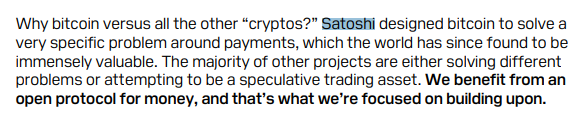

These statements could have been made without referencing Satoshi by name, especially in an era where longtime Bitcoin advocates have sought to minimize the influence of Satoshi the individual today. However, these statements would be very fitting if the CEO was speaking about himself.
Block has also self-published a book titled My First Bitcoin and the Legend of Satoshi Nakamoto which glorifies Satoshi and concludes by stating that “Satoshi’s vision is having an impact all around the world.” Hard copy print versions of the book were also made and distributed. AltFinanceDaily obtained a copy.
That viral post again with source links can be found here. I am not an investor in bitcoin or Block. My experience with Bitcoin over the past 10+ years is as a payments mechanism, namely as peer-to-peer cash.
My email is sean@debanked.com