AltFinanceDaily’s Next Issue Shipping Soon
August 3, 2015Are you ready for another issue of AltFinanceDaily Magazine?!
In this edition, we explore the Australian market, the commission chargeback debate here at home, the quest for national bank charters, a deeper look at the Midden v. Midland case and MORE!
Haven’t been receiving the print edition in the mail? You need to SUBSCRIBE for that. It’s free.
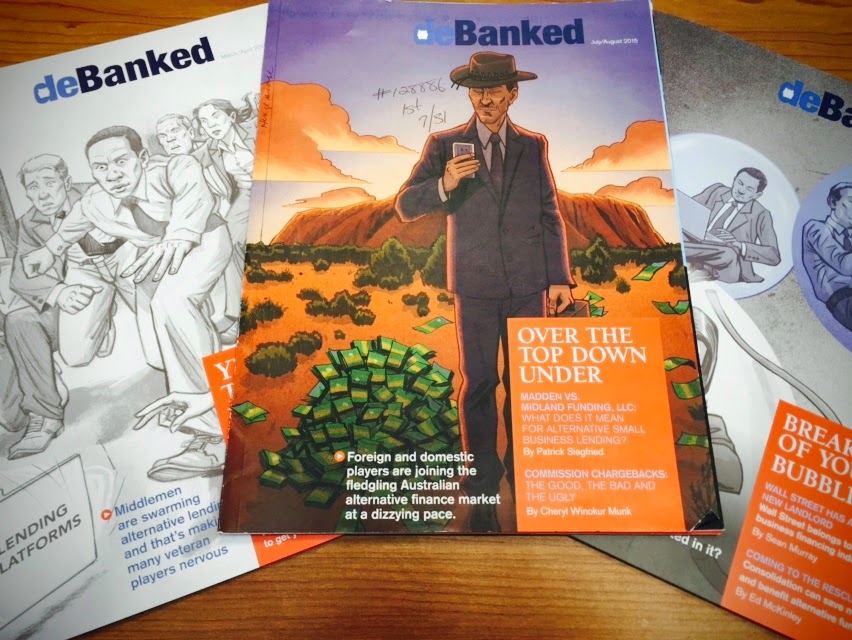
We distribute thousands of copies to ISOs, brokers, lenders, funders, and other players in the alternative business lending ecosystem. Want to be included in future issues? Drop me a line at sean@debanked.com
Alibaba Teams Up with Capify to Make Business Loans
July 21, 2015 Hours after AmeriMerchant announced it had been rolled up into an international business lending conglomerate known as Capify, The Australian Financial Review released a story that said Alibaba (NYSE:BABA) would already be teaming up with them. The partnership’s goal is to offer small business loans to 1.9 million Australian customers.
The story quotes Alibaba executive Michael Mang. “The purpose of the collaboration with Capify is to increase traffic and encourage more people to buy things on the internet. We’re not competing with banks and we’re not trying to create competition here. Buying and selling is the core of our business,” Mang told the Financial Review.
John De Bree, the former Managing Director of Australia-based AUSvance is now Australia’s Managing Director of Capify. De Bree reportedly said, “while there is technically no limit to SME’s access to capital, it expects to lend around $40 million to Australian SMEs over the next 12 months.”
AmeriMerchant joined UK-based United Kapital, Australia-based AUSvance, and Canada-based True North Capital to be a “global provider of alternative finance solutions, including business loans and additional working capital products, to small and medium-sized businesses.” AmeriMerchant’s founder David Goldin became the conglomerate’s CEO and President.
Capify Consolidates Four Companies Including AmeriMerchant Under One Umbrella
July 21, 2015 What do US-based AmeriMerchant, UK-based United Kapital, Australia-based AUSvance, and Canada-based True North Capital all have in common? They’re now all under the Capify Umbrella. According to a press release issued earlier today,”Capify will now operate under one unified name to serve as a global conglomerate provider of alternative finance solutions, including business loans and additional working capital products, to small and medium-sized businesses. Capiota, United Kapital’s business loan product provider, will also be included in the global rebrand as a part of Capify’s UK office.”
The consolidation of an Australia-based funding company is notable since that country’s commercial financing landscape is the subject of an upcoming magazine feature story of AltFinanceDaily’s July/August issue due to be distributed in a couple weeks. In that story, AUSvance’s John de Bree said of American interest over there, “I’m very surprised, the American market’s 15 times the size of ours.”
But as our readers will learn when the story is published, that market is just beginning to heat up.
David Goldin, the founder and CEO of AmeriMerchant will continue to be the consolidated company’s CEO and President. For those not familiar with his background, the release states:
Goldin created this business enterprise with no outside capital or funding and grew the company to more than 200 employees combined globally in all four offices. He entered the alternative lending space in 2002, after previously selling his startup company to Winstar Communications, a multi-billion dollar publicly-traded company at the time of the sale. Goldin has overcome many business obstacles including winning a ground-breaking patent lawsuit that threatened to end the U.S. alternative finance industry in its infancy stages. Via its proprietary underwriting technology platform, the company has demonstrated low default rates especially during the 2007-2009 global recession, a challenging time that resulted in the collapse of many alternative funding companies.
You can check out the full press release here.
Strategic Funding Source Increases Borrowing Capacity to $90 Million with New Revolving Credit Facility Led by CapitalSource
July 15, 2015 Strategic Funding Source, Inc., a leading provider of direct financing to small and midsize businesses, today announced that it has closed on a $90 million revolving credit facility. Led by CapitalSource, a division of Pacific Western Bank, the loan agreement includes continued participation from East West Bank and the addition of BankUnited to the lending group.
“Gaining access to the capital needed to grow continues to be an issue for many of America’s hard working small business owners and our industry plays a crucial role in addressing that need,” said Andrew Reiser, Chairman and Chief Executive Officer, Strategic Funding Source. “With the support of our outstanding bank partners we have now more than doubled our borrowing capacity. Coupled with the $110 million line of equity financing we secured from Pine Brook in August 2014, we are poised to significantly expand our footprint in the robust and evolving small business lending space.”
Strategic Funding Source provides loans and cash advances to small businesses by combining advanced technology and insight based on years of experience as small business owners and financial industry experts. The company works directly with small business owners to identify their capital requirements and creates flexible, tailored financing options that suit their individual business models.
About Strategic Funding Source, Inc.
Strategic Funding Source finances the future of small businesses utilizing advanced technology and human insight. Established in 2006, the Company is headquartered in New York City and maintains regional offices in Virginia, Washington state, and Florida. Strategic Funding Source has served thousands of small business clients across the U.S. and Australia. Visit www.sfscapital.com to learn more about the Company, its financing products and partnership opportunities.
Letter From the Editor – July/August 2015
July 1, 2015 G’day mates,
Merchant cash advance and similar financial solutions have expanded beyond the United States. Canada was always the next logical option but it’s made its way far beyond that, all the way to Australia. And in the land down under, Australian natives are competing with American-based companies for market share. There’s not a lot of information available about the landscape there so we went out and got the inside scoop, fair dinkum!
Speaking of international, the race is on here at home to obtain a national or state bank charter. Loans allow for much more customization than is possible with merchant cash advances, noted Glenn Goldman, CEO of Credibly. But is the industry setting itself up for a stable future or are some companies betraying their roots as a bank alternative by in essence becoming banks themselves?
And even while the crowd cheers for charters, a baffling appellate court ruling in New York State threatens to undermine that strategy completely. If you haven’t heard of Madden v. Midland Funding, we’ve got some information about it inside.
I must note that AltFinanceDaily celebrated its 5-year anniversary this past July. The world was much simpler when I started it. In 2010, I was able to quantify the industry’s size with ease, but today it’s a challenge to define what the industry even is, let alone calculate how big it is.
Everything is evolving and quickly, but some things still say the same, like when a broker’s commission is pulled back because a deal defaulted. Shouldn’t lenders take full responsibility for their own underwriting decisions? Not all brokers thought so apparently when we asked them. It appears that today’s broker is thinking more like a lender and if long-term growth is one of their goals, they’re probably thinking about becoming a lender themselves. That of course brings us right back to bank charters and court rulings to make that possible.
And if those topics are exhausting to think about, then sit back, relax and let us guide you through the beautiful Australian Outback. From Uluru to a kangaroo, alternative lending is never out of reach.
–Sean Murray
The Dumbest Guy in the Room
May 11, 2015 “This is the absolute dumbest thing I’ve ever seen,” she said while raising her voice. She was visibly agitated as if someone had just attempted to pass off a child’s crayon drawing as their doctoral dissertation. I began to laugh, not at her, but at the irony of the truth she was going on about.
“So what would need to be different in order for this to be a more viable idea? Like what would I need to change and come back with?” I asked.
“Come back?! COME BACK?! Don’t come back,” she shouted while taking my business plan and literally crumpling it into a ball and throwing it on the ground. She then got up and left. She was shaking from the rage. I was the dumbest person she ever encountered and it took effort for her not to kill me.
This experience happened to me three years ago when a NYC-based Venture Capital group sent out invitations to a free seminar and workshop. I liked the refreshing thought of hearing what VCs had to say, especially those not familiar with the merchant cash advance industry. Besides, I had a few concepts I wanted to get feedback on, and thought this would be a great opportunity to do it.
The seminar was more of a fireside chat, held by a zen-like VC I’ll refer to as Rain. He was in his mid-30s, wore a long flowy purple velvet shirt and sat indian style and barefoot in the front of the room. It was a stark contrast to the attendees in the audience, all of whom were wearing suits. Rain walked the crowd through his experience as a VC, most of which seemed to be an annoyance to him. Startups were full of personal drama of which he often got roped into. There was always a partner who was an idiot, a delusion the founder(s) couldn’t see past, or an insatiable need for additional funds.
And during the Q&A at the end, an attendee asked him if he would ever consider using a VC to raise money if he were not a VC himself. “Put the phones down guys, this stays here,” he said. “I wouldn’t.”
However confusing that might come across as, it didn’t change the energy in the room. Just about everyone who attended had an idea for a startup and desperately wanted VC funding.
Afterwards, you were allowed to schedule a one-on-one with one of their startup experts to develop your ideas further. It sounded cool and it was free, so I signed up.
I drafted up a concise business plan based upon a model that was just starting to take root in the merchant cash advance industry. It had its own little twist and I’m sure flaws too, but I believed this one-on-one would be a helpful conversation where I could get honest feedback without giving anything away to potential competitors.
Three minutes into the meeting, I was being scolded. “What do you mean it would break even for the first 2 years?!”
“Oh, well what I’m try –,” I attempted to respond. She talked over me. “You mean to tell me you would make no money in the first 2 years? Are you starting a charity?!”
“Well I was under the impress–,” I started, but she kept going. “This is the absolute dumbest thing I’ve ever seen.”
 It was the hardest no I had ever gone through. I looked around the room to see if the other one-on-ones being conducted were going the same way. They weren’t. Everyone else looked to be cozying up to each other, crunching numbers, sharing laughs, and possibly on their way to even getting funded.
Not me though. I was the dumbest guy in the room, too dumb to even come back with something better. It was a humiliating moment considering I thought this was supposed to be an instructional meeting where the experts would essentially help you master a business plan.
As I walked out of the office towards the elevator, I noticed that even the cheery receptionist who had excitedly welcomed me in, ignored me with her head down as I walked out.
There goes the dumbest guy that ever existed, I imagined she was thinking.
My world spinning as the elevator descended, I tried to recount how it went wrong so quickly. I had showed her a pro-forma P&L that broke even for the first two years as I would reinvest 100% of the profits back into marketing to scale. I personally didn’t like it that way. I wanted to make money, but everyone around me was bleeding red and raising tens of millions along the way. I had started to believe that sacrificing any shred of profitability in exchange for growth is what got investors excited.
My expert didn’t share that view. A business that wasn’t profitable wasn’t a business. It was dumb, and not just regular dumb, but the dumbest thing that anyone ever thought of. EVER.
A couple of days later when I had shaken off the blow to my self esteem, I was thankful for the experience. She was a New Yorker to the core and so was I. I had no inner desire to start a business that didn’t make money (for the sake of disrupting or whatever), but I was being swept up in the craze of companies that were doing just that. She brought me back to reality, though she left a lasting imprint of a boot on my ass.
Three years later, companies with models similar to the one I had cooked up have raised hundreds of millions of dollars. They don’t break even. They lose money, lots of it. But they are looked upon and celebrated as some of the brightest guys in the room. Many of those guys are smarter than me and are probably executing their concepts way better than I ever could. But the lose-a-lot-of-money and grow model isn’t meant for everyone. It all depends on who you’re talking to.
In HBO’s Silicon Valley, a hit that many view as more of a reality show than a sitcom, they poke fun at a truth purveying the California startup scene. Forget profits, the show explains, just having revenues hurts your chances of raising money.
 “If you have no revenue, you can say you are pre-revenue,” says the show’s billionaire Russ Hanneman. “You’re a potential pure play. It’s not about how much you earn; it’s about what you’re worth. And who’s worth the most? Companies that lose money! Pinterest, Snapchat, no revenue. Amazon has lost money for the last 20 years, and that Bezos motherfucker is the king!”
Two years ago, Bezos was worth $25 billion and was the 20th richest person in the world. Some experts might say a business model that loses money for 20 years would qualify as the new winner for dumbest thing that ever existed ever. It’s apparently just the opposite.
But once you find an investor that believes in the loss model, do you take the money and then go out and disrupt, hoping that somehow you’ll end up a billionaire?
Loan broker Ami Kassar is faced with that very dilemma. In his recent blog post, he wrote about the offer he has on the table from a VC, “While I could substantially grow my top line – the chances of making any profit are small and the chances of losing money are high.”
Fictional billionaire Russ Hanneman would surely approve, but over in realityville, Kassar is balking. “I can only speculate that they’re more interested in market share – than profits. Their investors want growth. They’re on the venture capital treadmill.”
Admittedly, I poked fun at Kassar, an entrepreneur I’ve often sparred with online. “Should I be worried that in their quest for growth they will build a train and run me over?” He asked in his blog.
Of course I linked to it in the following manner:

Kassar concludes that sustainable long term value is the only logical way forward. Is he wrong?
The current investment atmosphere where anybody with a model and a programmer is raising hundreds of millions of dollars to basically see how fast they can spend it all, is affecting those that have always believed in profits and longevity.
In another post by Kassar just a week earlier, he wrote, “Am I missing the boat and doing something wrong? That’s how I have felt lately as I’ve watched the emergence of the online small-business financing space. It seems every other week I wake up to another announcement about a company in the small-business financing space who has raised a lot of money from venture capitalists at a really high valuation.”
Just last week, consumer lending startup Affirm raised $275 million in a Series B round. Many people in the alternative lending community had never heard of Affirm but they are apparently so good that they can raise a quarter billion dollars.
Investors are scrambling. They don’t want to be left out. On multiple occasions, I have heard of investors skipping basic due diligence in a rush to capture a deal. Some of those deals blew up in a matter of weeks, others in months when they realized they didn’t even know who the owners were or what financial standing they were in.
Lending Club and OnDeck have received billion dollar valuations. That’s what everybody wants, though the market has temporarily cooled on OnDeck, a company that has lost money for almost eight straight years.
Even Shark Tank investor Kevin Harrington has gotten in on it, through his new business loan marketplace, Ventury Capital.
One thing looks certain three years after I met with that expert. The supposed dumbest thing that could ever be conceived of ever has made tons of people millionaires.
A year ago, Kevin Roose of New York Magazine wrote this of profitless startups, “They’re simply taking millions of dollars in venture capital with the hope of keeping prices low, pushing rivals out of the market, and eventually finding a way to turn a profit.” It can be predatory pricing, Roose argues. Basically large venture backed companies can sell below their cost using unlimited funds until the competition is out of business. Then with the entire market all to themselves, they can figure out a model towards profitability.
There seems to be a lot of this happening in the alternative lending space where the lenders backed by hundreds of millions of dollars are not only undercutting the competition at a loss, but they’re running lobbying campaigns that accuse their profitable brethren of being greedy and predatory. The media and general public eat this message up. There is no defense for a lender who has been accused of charging too much by one charging less even if the one charging less will need to declare bankruptcy if it does not raise a fresh round of new capital to sustain operations.
Only the rare observer can read between the lines as Forbes contributor Marc Prosser did. In his own research, he discovered that, “a company which loans money to small businesses at an interest rate of more than 50% was losing money.”
Though I won’t name names, there are a few players out there that believe the answer to their cycle of losses is to push regulatory agencies to attack profitable companies, or at least constrain them through penalties and new laws. Essentially, if it looks like they can’t win the war of attrition, then they might as well stick the government on them.
Speaking of the war of attrition, the race to bring costs to merchants down to zero doesn’t seem to be having the desired effect on the competition. In OnDeck’s Q4 earnings call for example, CEO Noah Breslow said the following:
Overall this market is still characterized by extreme fragmentation. The behavior that we see with our customers is that they might research other competitive options online but then when they actually apply to OnDeck and receive that offer, they kind of have this bird in hand dynamic, and there’s so much search cost associated with going out and looking at other places and so much uncertainty around that, they typically just take that offer that OnDeck has provided to them.
Translation: Once merchants have an offer from somewhere, they go with it. There is no price-competitive marketplace on the macro level.
OnDeck has been undercutting the entire merchant cash advance industry for years. None of their competitors have gone out of business, at least not because of a profit squeeze. Instead, everyone is growing, OnDeck included.
So why lose money?
In the case of OnDeck, they can argue that growth has allowed them to expand into Canada and Australia. They’ve forged partnerships with Prosper and Angie’s List. They’ve acquired more data because they’ve done more deals than most. And who is another billion dollar company likely to partner with in the lending space? Probably the one doing 10x the volume of everyone else, the one whose name is all over the place. They have the advantage to win the partnerships.
Five years from now, when the competition is trying to catch up in volume, all the lucrative partnerships might be snatched up already. Maybe it really is about who can spend the most the fastest. It’s a depressing thought.
Some startup vets will you tell that the most important aspect is actually the team. The CEO of 140 Proof for example has written, “You succeed or fail not on the strength of your idea or your product, but on the strength of your team. Venture capitalists fund teams, not business plans.”
With that in mind, I tried to imagine how that meeting three years ago would’ve turned out had I showed up with OnDeck’s CEO Noah Breslow and Lending Club’s CEO Renaud Laplanche in tow. “We’re going to disrupt lending,” I imagine the three of us tell the fierce startup expert.
The expert knew nothing about me. As far as she knew, I was just some random guy off the street holding a stack of papers with an incredulous plot to dominate the lending industry. I had never worked for a bank. I was young. I had no partner. I didn’t graduate from Harvard or MIT. It probably looked pretty ridiculous. “Duhhh so whaddya think?” I imagined I appeared to her.
With her guard down, she had no reason to hold back from saying what she really felt, that the plan was the absolute dumbest thing she’s ever seen.
Might the dumbest guy in the room only be that because he believed what she said? Or did she have it right all along?
OnDeck Q1 2015 Earnings Call
May 4, 2015OnDeck (ONDK) is scheduled to release Q1 2015 earnings today at 5pm EST. Anyone can register to listen to the call via web HERE or by dialing in through (877)201-0168 with conference ID 23530259.
OnDeck closed Friday at $19.29, just 8 cents below where it closed leading up to the 2014 Q4 and year-end earnings call on February 23rd. By that measure, the stock has been relatively flat.
Recently, the company announced expansions into Canada and Australia, though analysts such as Henry Coffey of Sterne Agee remain skeptical.
“If the opportunity is so large in the U.S., why go halfway around the world to lose money?” Coffey told the Wall Street Journal.
The Street doesn’t see eye to eye on OnDeck. Compass Point issued a sell rating with a price target of $14 while Deutsche Bank issued a buy rating with a price target of $28. Meanwhile, news media continue to disseminate incorrect information about the company by often times referring to them as a peer-to-peer lender.
OnDeck has never been a peer-to-peer lender.
In April, the company announced a strategic partnership with Prosper, though the extent of their collaboration is uncertain.
OnDeck predicted a net loss for all of 2015 in their 2014 year-end report. Consequently, it is likely OnDeck will report a loss today for Q1, though analysts expect year over year revenue growth of almost double.
STRATEGIC FUNDING SOURCE NAMES ALAN NUSSBAUM VICE PRESIDENT OF BUSINESS DEVELOPMENT
April 20, 2015NEW YORK (April 20, 2015) – Strategic Funding Source, Inc., a leading provider of small business financing, today announced that Alan Nussbaum has joined the company as Vice President of Business Development.
In his role, Nussbaum will be responsible for developing untapped affinity relationships and other industry opportunities including the opening of new channels in emerging markets, which seek access to capital. He will report to David Sederholt, the Chief Operating Officer of Strategic Funding Source and will be based at the company’s New York City headquarters.
Nussbaum is one of the early entrants to the small business alternative financing industry and spent over 16 years leading sales initiatives with CAN Capital, the largest company in the industry. During his tenure at CAN Capital, he contributed to the growth of the company by developing diverse sales channels and will now bring his years of experience to Strategic Funding Source. As with several executives of Strategic Funding Source, Nussbaum started his career as the owner operator of small businesses, which included restaurants and a food service supply company.
“We’re pleased to welcome Alan to the management team at Strategic Funding Source,” said Sederholt. “I have known him for over 20 years as a respected member of the industry and look forward to him contributing his vast experience and insights to our company.”
“Over the course of my career, I have seen alternative finance products evolve into the mainstream direct solution for small businesses,” said Nussbaum. “I’m excited to join Strategic Funding Source, which has never forgotten the importance of people in their relationships. The company has a proven record as a leader and innovator that combines technology with a human touch. I look forward to helping both Strategic Funding Source and the small businesses we serve continue to grow.”
Nussbaum is a graduate of Pratt Institute in Brooklyn, N.Y.
About Strategic Funding Source, Inc.
Strategic Funding Source finances the future of small businesses utilizing advanced technology and human insight. Established in 2006, the company is headquartered in New York City and maintains regional offices in Virginia, Washington state, and Florida. The company has served thousands of small business clients across the U.S. and Australia, having financed over $800MM since inception. Visit www.sfscapital.com to learn more about Strategic Funding Source, its financing products and partnership opportunities.