
Capify Appoints Think Business Loans Founder as Director of Strategic Initiatives
July 18, 2024 Capify, a leading SME lender, has appointed Jamie Stewart as Director of Strategic Initiatives. Jamie, the founder and former MD of Think Business Loans, brings extensive experience and SME expertise to Capify. In his role at Think, he successfully oversaw the deployment of over £1 billion in funding to more than 10,000 customers, prior to its sale to Bionic in 2019. Since then, Jamie set up Anidea, a Strategic Consultancy firm.
Jamie’s arrival marks another milestone during a significant growth phase for Capify. Having leveraged a new £100 million credit line from Pollen Street Capital earlier this year, the company has made a succession of senior team appointments recently and is actively developing an expanded product suite.
“I’m thrilled to join the team at Capify as Director of Strategic Initiatives,” said Jamie Stewart. “Capify is a pioneer in the alternative lending space, with a solid foundation and a clear vision for the future. As a forward-thinking entrepreneurial company with a new range of innovative products, Capify is poised for significant growth. I look forward to collaborating with the team to develop new partnerships that will further enhance our ability to provide quick, reliable funding solutions to SMEs.”
Founded in the UK in 2008 during the global financial crisis, Capify has become a vital financial resource for small and medium-sized businesses. Recognised for its commitment to excellence, Capify was awarded SME Lender of the Year (up to £1m) at the UK Credit Awards last year. Originally launched in the United States in 2002, Capify was one of the world’s first online alternative financing companies for SMEs. Since its creation, Capify has supported over 20,000 businesses and funded over £1.2 billion to help SMEs achieve their growth ambitions.
John Rozenbroek, COO/CFO at Capify, commented, “We’re delighted to welcome Jamie to the Capify team. His extensive experience in SME lending and his proven ability to drive strategic growth are exactly what we need as we expand our operations and introduce new products. Jamie’s insight and leadership will be invaluable in achieving our mission to support SMEs with the funding they need to thrive.”
“Jamie’s appointment underscores our commitment to strategic growth and innovation, ensuring it remains at the forefront of the alternative finance industry, delivering unparalleled service and support to SMEs in the UK”.
ABOUT CAPIFY
Capify is an online lender that provides flexible financing solutions to SMEs seeking working capital to sustain or grow their business. Originally started in the US over twenty years ago, the fintech business now operates in the UK and Australia and has served these markets for over 15 years. In that time, it has provided finance to thousands of businesses, ensuring the vibrant and vital SME community can meet the challenges of today and the opportunities of tomorrow.
For more details about Capify, visit:
http://www.capify.co.uk
Media enquiries
Ash Yazdani, Marketing Director
ayazdani@capify.co.uk
Northteq’s January Product Release Delivers Enhanced Lending and Pricing Solutions
January 23, 2024MINNEAPOLIS, MINNESOTA (January 23, 2024) – Northteq, Inc., a leading provider of Salesforce loan origination solutions, is thrilled to announce a range of new features and enhancements in our January Product Release. This release focuses on making operations smoother, expanding financial product options, and improving vendor and partner collaboration. It is all about making things better and easier in the world of equipment finance. We are excited about continuing to evolve our Aurora LOS and Partner Portal and know these enhancements will open new possibilities for our clients. Here is a glimpse of what we are rolling out:
Expanded Product and Pricing Offerings
- Enhanced Asset-Based Pricing: We are transforming the way you price in Aurora. The updated asset-based pricing feature, powered by TValue, allows for individualized pricing of each asset with different rates, residuals, and more. Asset pricing can be rolled up on the application or into a blended rate as suits your business needs.
- Line of Credit Capabilities: Introduce new revenue streams with our Line of Credit product featuring the same automated credit decision-making in Aurora that you love. After approval, you can auto-approve an application against an approved borrower line of credit.
- Enhanced Residuals: Experience a breakthrough in pricing flexibility with advanced residual pricing tables that accommodate both currency amounts and percentages, automatically calculating the corresponding value on the equipment record. The dynamic residual pricing feature enhancement is seamlessly integrated into program residuals, improving reliability and efficiency of pricing and quotes.
- Flexible Payment Frequency Options: Updated to offer a multi-select field, catering to a wider range of client preferences and requirements.
Vendor and Partner Portal Advancements
- Vendor Enabled TValue Pricing: We’re supercharging our Aurora Partner Portal with TValue’s industry-leading calculations and data. This means more accurate quotes and risk-based pricing options, right at your vendor’s fingertips.
- Streamlined Partner Portal Quotes: Improved integration and handling of quotes from the Partner Portal to the LOS for better efficiency and accuracy.
- Single-Page Borrower Application: An updated, more intuitive application process designed to improve completion rates and user satisfaction.
But that’s not all. We’re also rolling out enhancements across our Salesforce partner apps and integrations including Ocrolus, Middesk, TValue, Paynet, Experian, Transunion, Equifax, and OFAC. Expect improvements in user experience, performance enhancements, and essential bug fixes.
Our January 2024 release is part of Northteq’s continuous commitment to refining and advancing our platforms. As we innovate and adapt, we look forward to more impactful enhancements in our upcoming releases this year, each one bringing fresh advancements to the industry. This update is a key part of our ongoing mission to align our technology with the ever-changing market needs and to continuously improve the equipment finance lending experience. Check out the full list of upgraded products and features here.
This is just the beginning of what we have planned for the year. Stay tuned for what’s next at Northteq – we’re just getting started on a year full of innovation!
About Northteq
Northteq, Inc. is a Minneapolis, Minnesota-based fintech company that has helped over 175 lenders provide their customers, vendors, and employees with intuitive, thoughtfully designed lending solutions. Aurora, Northteq’s flagship product, is an automated, Salesforce powered loan origination system and partner portal. They also offer turnkey Salesforce apps created through key partnerships with fintech industry leaders including Middesk, PayNet, FICO, Equifax, Experian, D&B, TimeValue, LexisNexis, Nintex, Ocrolus, Plaid, and many more.
Northteq is now primarily owned by Arthur Ventures, a respected Minneapolis-based early growth capital firm known for leading investments in B2B software companies. This partnership positions Northteq for continued growth and innovation. Since 2013, Arthur Ventures has partnered with over 50 companies across the United States and Canada. For more information, please visit northteq.com.
The Merchant Marketplace Announces Its New Launch with Industry Powerhouse Executive
September 19, 2022 BALDWIN, NEW YORK SEPTEMBER 19, 2022 – The Merchant Marketplace, a leading fintech platform provider of direct financing to small and midsize businesses, announced today the launch of its new leadership with backing from industry powerhouse executives. The company’s new leadership team brings over 75 years of collective financial, technology, and business experience within its core leadership group: Adam Schwartz as CEO and Kevin Harrington, the Original Shark Tank Investor, will serve as a Strategic Partner. This partnership will revolutionize how merchants and independent sales organizations (ISO’s) obtain capital for growing their merchant’s businesses, changing the game for entrepreneurs throughout the United States.
“We are looking to change the industry by using a true fintech platform to facilitate transactions amongst ISO’s, merchants, and the Merchant Marketplace,” said Merchant Marketplace CEO Adam Schwartz. “We understand the challenges many small business owners face when trying to secure financing to help make their dreams a reality. The Merchant Marketplace is happy to be a resource for entrepreneurs by providing them access to capital so they can build a successful business.”
The Merchant Marketplace created a proprietary syndication platform that offers real time data and full transparency. In most instances, the company will offer ISO’s a two percent syndication as bonus for every deal that it funds, with the ability to syndicate more funding if needed. ISO’s can earn another stream of income by being vested in every deal they fund with the Merchant Marketplace, as well as earn a referral fee. The platform also offers a profit-sharing program and technology tutorials to show ISO’s how to engage with the platform to help achieve the best end results.

“The merchant cash advance market has been witnessing an escalation in growth over the past few years with the help of innovation. Our technology integrates with over 25 different third parties to give us complete insights into our merchants, giving us the ability to make offers with lightning speed and efficiency. We understand the needs of our clients and we want them to be part of the process. We do not want to be seen as just another funder; we want to be seen as a business partner for our ISO’s,” said Merchant Marketplace Director of ISO Relations, Justin Strull.
For questions on the service and to sign up as an ISO, contact Justin Strull at 516-980-4932 or email in to justin@merchantmarketplace.com
About Kevin Harrington
As an original “shark” on the hit TV show Shark Tank, the creator of the infomercial, pioneer of the As Seen on TV brand, and co-founding board member of the Entrepreneur’s Organization, Kevin Harrington has pushed past all the questions and excuses to repeatedly enjoy 100X success. His legendary work behind the scenes of business ventures has produced more than $5 billion in global sales, the launch of more than 500 products, and the making of dozens of millionaires. He’s launched massively successful products like The Food Saver, Ginsu Knives, The Great Wok of China, The Flying Lure, and many more. He has worked with amazing celebrities turned entrepreneurs including, Billie Mays, Tony Little, Jack LaLanne, and George Foreman to name a few. Kevin’s been called the Entrepreneur’s Entrepreneur and the Entrepreneur Answer Man, because he knows the challenges unique to start-ups and he has a special passion for helping entrepreneurs succeed.
Women Discuss Strategies to Grow Their Businesses
March 30, 2022 The U.S. Small Business Administration (SBA) held its 2022 Women’s Business Summit this week. The summit was a two-day event that consisted of virtual panels, workshops and fireside chats. The event was held in co-sponsorship with the Nasdaq Entrepreneurial Center.
Remarks were made by United States Vice President Kamala Harris, along with other notable panelists. Harris stated, “Women small business owners power the economy of our nation.”
“Women small business owners face many unique challenges, many lack access to paid leave, affordable child care and the capital to grow,” Harris made clear.
Harris noted, “Through SBA we have opened women business centers in every state of our country, 141 in total.” These centers connect women business owners with the tools and resources to succeed. Kamala later declared that the fight to pass legislation for women for affordable child care and paid leave will continue.
During the Innovation and Investment panel, Marianne Markowitz, CEO of First Women’s Bank, discussed how there is a gender gap in the lending market.
“We launched last year as the only women-founded, women-owned bank in the country that’s focused on closing the gender lending gap at a national level,” said Markowitz.
 Women only receive 2% of all the investments in America. Markowitz discussed that women are being introduced to the wrong loans and capital. Many women are relying on personal credit and sometimes lean on equity at the wrong stage of their business. Markowitz provides women with the proper education to make the right choice, fully understand and be prepared for when they apply for loans.
Mekaelia Davis, Director of Inclusive Economies, Surdna Foundation, explained how the consolidation of the banking industry has removed a great amount of financial institutions. This has had a negative impact on relationships with financial partners, leading to more predatory actions online taking the place of financial institutions.
“New York City Small Business Founder Collective estimated there is nearly annually $45 billion of unmet capital, most demand coming from Bronx, Eastern Brooklyn, Queens,” according to Davis.
Susan Au Allen, CEO and National President of the U.S. Pan Asian American Chamber of Commerce explained that even if women are educated they are not aware of all of the services that the SBA offers.
“For the Asian American community and the women community it is a structural problem, a systemic structural obstacle that we have faced,” Allen asserted.
The Associate Administrator of SBA’s Office of Investment and Innovation, Bailey DeVries, described what they have done for small business, “We have provided over $100 billion worth of small business through the SBIC program and currently manage over $34 billion worth of assets through those partnerships.”
The summit provided women with an opportunity to become further educated on how to succeed in their small businesses.
Ireland is Funding Fintech Through Government Investment
November 2, 2021 The Irish government has taken a serious liking to fintech. With a broad history of being active in financial services, the nation believes they can attract companies from around the world to reap the benefits of employing Irish citizens, while also tapping a major source of export revenue through an up-and-coming industry.
With access to capital for small businesses just as difficult here as it is in the US, a new fintech company looking for start-up cash may be able to turn to Dublin to get a major investment, rather than dealing with a retail investor or a venture capital firm here in the states. Enterprise Ireland, the organzation that runs these programs, is trying to tempt fintech companies looking for a fresh start or an international expansion to start that process in Ireland.
“Enterprise Ireland is the trade development and venture capital arm of the Irish Government,” said Claire Verville, Senior Vice President of Fintech and Financial Services at Enterprise Ireland. “We are a semi state agency and our mandate is to help support indigenous Irish enterprise to grow and expand in global markets.”
Just like in the United States, it is extremely difficult for an Irish business to walk into a big bank and get a loan. It’s in these situations where the Irish government has decided to make a direct investment themselves. Through Enterprise Ireland, according to Verville, the Irish government can provide capital to startups across a range of areas, in exchange for things like loan repayment or government equity in the company.
“In addition to the kind of more traditional trade development stuff that you would see from any government promoting their indigenous businesses abroad, we do invest directly in companies through equity and participate directly as a [limited partner] in funds to funds.”
Verville spoke about how the Irish government has been looking to extend funding to fintech startups for some time. “Our fintech portfolio is over 200 companies now, we have been one of the most active investors in Europe in a long time. We are one of the most active global investors across all sectors, and we’re really focused on early stage capital for fintech.”
 When asked about the decision making process that goes into Irish investments, Verville portrayed it the same as if it was a private firm making the same move. “We will vet like any other investment, make sure we’re comfortable with it, make sure that the business is verifiable, and that we understand the track record of the team,” she said.
Through investing in fintech, Enterprise Ireland appears to believe they will give their small business owners better access to capital. If the industry can create a Euro-American hub in Ireland, the latest tech and funding innovations will develop there, giving access to that technology to Irish businesses first. If Irish small business lenders can use Irish technology to help an Irish merchant, everyone wins.
With financial innovation in Europe being leaps ahead of the US, Verville believes the Irish employees working in finance would be better suited to deal with some of these new innovations over Americans because of their familiarity with these systems that are already in place. She hinted at things like EMV cards being around in Ireland for years at the consumer level before they ever made it to the United States.
As far as incentive for profit, Enterprise Ireland isn’t concerned with the success of their investment from a financial perspective as other investment groups are. They instead focus on things like employment numbers and longterm sustainability for those jobs acquired through their efforts in investing in industries like fintech.
“Because we are attached to the government, we aren’t a money-making mission as far as venture capitalists go. We are focused on employment in Ireland, which is partly why it’s so important that the companies are founded in Ireland and that they are building their employee base in Ireland, and on export revenue.”
Verville spoke about how only when businesses in Ireland do well, Enterprise Ireland only does well, too. “We do make money off some of our investments, and that’s government money. We get our budget set by the government department every year, just like any other government agency.”
To be eligible for funding from Enterprise Ireland, a business needs to be based in Ireland, have an Irish LLC, and must have a significant amount of Irish employees. According to Verville, the Irish market is ripe for American small businesses, especially alternative finance.
SEC Mentions Ban of PFOF, Robinhood Suffers
August 31, 2021 SEC Chairman Gary Gensler told Barron’s on Monday that a ban of payment for order flow (PFOF) may soon be implemented by regulators and the controversial business model for companies like Robinhood may be coming to an end.
Gensler has gone on record as an opponent of PFOF, where wholesale market makers send client orders to brokers in exchange for a fee. Gensler and many other regulators have claimed that the PFOF business model is a major conflict-of-interest.
In response to the release, Robinhood’s stock fell to $43.64 per share shortly after Gensler’s thoughts were publicized. A nearly 7% skid in price may be the tip of the iceberg for the company if the SEC does indeed have plans to end PFOF. Robinhood’s business model of zero-commission trading may have to be reconstructed should something like this occur.
The PFOF model was heavily criticized in February during the federal hearing regarding Robinhood’s trading limits to counteract the GameStop short squeeze. Robinhood CEO Vlad Tenev was criticized at the hearings by the House Financial Services Committee in regard to how the PFOF business model supported biased relationships with companies like Citadel and Melvin Capital during the controversy.
Despite the overall success of Robinhood’s shares since going public earlier this month, the group has had some recent roadblocks besides the latest regulatory sentiments. PayPal is considering a stock trading platform in the United States, sources say.
With federal regulators and new competition breathing down the company’s neck, Robinhood may be due for drastic changes sooner than later.
New Jersey Legalizes Recreational Marijuana
November 4, 2020One chill result from the 2020 election was the legalization of recreational marijuana in New Jersey for adult use. In a 2-1 victory, Option One on New Jersey ballots passed, paving the way for a regulated environment for recreational use, possession, and cultivation in the Garden State.
4:20 PM.
Time to legalize it. pic.twitter.com/157WC7qgof
— Governor Phil Murphy (@GovMurphy) October 28, 2020
Before the vote, Gov. Murphy showed support
We did it, New Jersey!
Public Question #1 to legalize adult-use marijuana passed overwhelmingly tonight, a huge step forward for racial and social justice and our economy. Thank you to @NJCAN2020 and all the advocates for standing on the right side of history.
— Phil Murphy (@PhilMurphyNJ) November 4, 2020
The amendment was billed as not only a chance to increase tax revenue but as civil rights reform. Advocates argued that prohibition laws disproportionately harmed minority communities.
The change was initially put before the legislature in 2017 but failed to pass by 2019. A bipartisan supermajority put the choice up to the public referendum. Appearing in Willingboro on Tuesday, long time advocate of legalization, Gov. Phil Murphy, spoke on voting day in last-minute support.
“I got to supporting it first and foremost due to social justice,” Murphy said. “We inherited when I became governor the largest white, nonwhite gap of persons incarcerated in America, and the biggest contributor to that was low-end drug offenses.”
New Jersey was one of four states with legalization on the ballot, and all succeeded, bringing adult use to Arizona, Montana, and South Dakota as well. After Tuesday, more than 111 million Americans- a third of the country live in a state where recreational marijuana is legal.
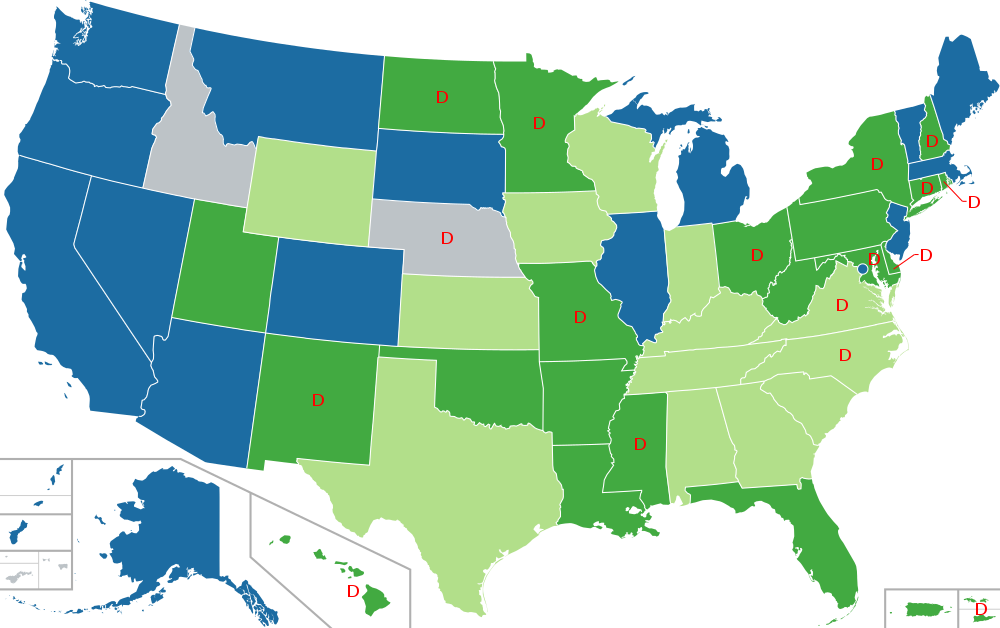
Image SourceKEY
Blue = Legal
Dark Green = Legal for medical use
Light Green = Legal for medical use – limited THC content
Grey = Prohibited for any use
D = Decriminalized
Cannabis legalization advocates, like Doctors For Cannabis Regulation (DFCR), saw the day as a significant victory for industry and social progress. Dr. David Nathan founded DFCR in 2015, where he serves as president of the board. Dr. Nathan stood up and spoke out against the prohibition of marijuana 11 years ago and said he was one of the first accredited mainstream physicians to do so.
“I’m not a medical cannabis physician, I’m a psychiatrist who sees how much damage cannabis prohibition does compared to the drug itself,” Dr. Nathan said. “I’ve really been given the platform to speak up, but at the same time, it was hard to get colleagues to speak up on an issue.”
After working for NJ United for Marijuana Reform, Dr. Nathan founded DFCR to create an organization to facilitate physicians who wanted to get involved at a national level. The success of Tuesday’s vote demonstrates how far legal cannabis advocation has come, from a resounding no to a majority yes.
“A lot of doctors who understood cannabis prohibition as a tragedy and a mistake were concerned about what their peers would think about them if they spoke out,” Dr. Nathan said. “Now we’ve got a group of highly respected physicians organized and advocating strongly, not just for legalization but much more importantly for effective regulation.”
Dr. Nathan sees the NJ amendment as a significant chance for improvement in public health. Despite legalization, it is unclear how the new law will go into effect. Per the amendment, the state will create a regulatory framework and tax the sale of marijuana at 6.625%, but implementation is up for debate.
Legislators still have to agree on how a new Cannabis Regulatory Commission will function. The state will also have to choose how decriminalization, possession limits, growing limits work, and forgiveness of past marijuana crimes.
All of which will be figured out and are necessary to the fair implementation of the passage of the amendment, Dr. Nathan said.
But those changes may come fast. NJ, like many states, is hurting during the COVID recession. Last month New Jersey officials approved a budget that is set to borrow $4.5 billion from the Federal Reserve to plug pandemic-sized holes in state spending.
Basing estimates on Colorado’s experience after legalizing cannabis in 2014, the state legislature predicts NJ could see tax revenues of up to $126 million a year from recreational sales.
“According to the Colorado Department of Revenue, retail cannabis sales, excluding medical cannabis, totaled $1.2 billion in calendar year 2018,” The report said. “Assuming New Jersey experiences similar per capita sales of recreational cannabis as Colorado, total retail cannabis sales for New Jersey could reach $1.9 billion, yielding sales tax revenues of up to $125.6 million annually at the current 6.625 percent sales tax rate.”
With such high revenues, some suspect New Jersey to lead the way for other northeastern states; income will spur jealous neighboring Pennsylvania and New York to legalization in competition.
“If this gives both Pennsylvania and New York a push, that would be great,” Dr. Nathan said. “I do think it’s going to have an impact, now that there will be a state right in the middle of the Mid Atlantic that is going to have regulated sales.”
But even with tristate legalization, the cannabis industry faces a problem with funding.
Most firms in cannabis supply chains- from growers to dispensaries- are small businesses that suffer from a lack of access to bank funding. Because marijuana is an illegal Section 1 drug like Heroin on a federal level, banks and venture capitalists have their hands tied when it comes to credit. But with Tuesday’s victories for legalization, federal regulation is closure to changing.
“I think that each state that adopts, sends a stronger message to the federal government,” Dr. Nathan said. “The voters in those states are giving resounding victories to the notion that cannabis should be de-scheduled not rescheduled, and then regulated.”
deBanked has been following the SAFE Banking Act since it passed in the House last year, a piece of legislation that hopes to address cannabis banking problems by allowing legal pot firms to open banking deposit accounts.
The law was bundled into the HEROES act with the rest of business aid projects, stuck between the GOP-controlled Senate and the blue House since the summer. Depending on the Senate’s layout when ballots are fully counted, financial institutions that have left pot companies de-banked may be-danked.
Status of Par Funding
November 2, 2020 According to the latest status report filed by the Receiver in the Par Funding SEC case:
“The Receiver and his consultants at Development Specialists, Inc. (“DSI”) have re-hired several employees of Par Funding/Full Spectrum Processing, and remain engaged in the process of communicating with Par Funding’s more than 1,300 merchants to reconcile accounts, discuss the status of collections, and to collect account receivables. Through October 29, 2020, the Receivership Entities have combined cash on hand in excess of $42 million, excluding approximately $1.8 million in funds due to Par Funding that are pending release from various ACH processing companies.”
The Receiver has also asked the judge to expand the Receivership to include additional companies including two “related MCA” entities known as Capital Source 2000, Inc. and Fast Advance Funding, LLC.
At this stage of the litigation, a reboot of the company is becoming less and less likely.
A press release/article published on October 13th appears to plead on behalf of the Par defendants, by saying that the “whole process has unfolded mysteriously” and that “the actions of the receiver make it seem like a verdict had already been issued, before due process could take its course.”