
Online Lenders Are Waiting On The Bench For The PPP To Be Refreshed
April 16, 2020 This week proved mixed for many fintech and non-bank lenders who received approval from the SBA to issue Paycheck Protection Program funds, only for the $349 billion allotted to the program to run dry almost immediately afterwards.
On Wednesday evening Senator Marco Rubio tweeted that the funds would run short, leaving at least 700,000 small businesses who applied in purgatory without PPP financing. But more money may be made available, as Treasury Secretary Steven Mnuchin said in a statement on Wednesday that “We urge Congress to appropriate additional funds for the Paycheck Protection Program – a critical and overwhelmingly bipartisan program – at which point we will once again be able to process loan applications, issue loan numbers, and protect millions more paychecks.”
BlueVine, OnDeck, Funding Circle, PayPal, Intuit, and Square were among the group of non-bank lenders who were recently approved. While unfortunately late to the party, these businesses will be well-positioned to quickly roll out funding once further PPP money is allocated.
“Millions of small businesses need relief more than ever right now, and providing that relief quickly and diligently is our top priority,” BlueVine CEO Eyal Lifshitz told AltFinanceDaily. “While most PPP lenders have limited their efforts to existing customers, our aim is to support and protect all small businesses. Using our data and engineering resources, we want to ensure both existing customers and other small businesses seeking relief, are aware of and have access to PPP loans. We will remain a trusted advisor to small businesses and work to get fast capital solutions to those in need.”
Lifshitz’s comment echoes concerns that have plagued the SBA since the announcement of these funds: that its systems, and the processes of the banks it works with to issue this money, are outdated and insufficient to face a financial crisis of this magnitude and speed. Now weeks into the program, businesses are reporting a lack of communication from both their bank and the SBA; and, most importantly for many, no PPP funds in their accounts.
Marketplace Lending Association Members Take Steps To Help Borrowers During The Coronavirus Crisis
March 17, 2020 Members of the Marketplace Lending Association are taking steps to alleviate financial pressure facing borrowers during the recent crisis.
“This includes providing impacted borrowers with forbearance, loan extensions, and other repayment flexibility that is typically provided to borrowers impacted by natural disasters. During the time of payment forbearance, marketplace lenders are also electing not to report borrowers as ‘late on payment’ to the credit bureaus,” a letter to senior members of Congress signed by Exec Director Nathaniel Hoopes states. “Members are also waiving any late fees for borrowers in forbearance due to the COVID-19 pandemic, posting helplines on company homepages, and communicating options via company servicing portals.”
Members of the MLA include:
- Affirm
- Avant
- Funding Circle
- LendingClub
- Marlette Funding
- Prosper
- SoFi
- Upstart
- College Ave Student Loans
- Commonbond
- LendingPoint
- PeerStreet
- Yieldstreet
- Arcadia Funds, LLC
- Citadel SPV
- Colchis Capital
- Community Investment Management
- cross river
- dv01
- eOriginal
- Equifax
- experian
- Fintech Credit Innovations Inc.
- FutureFuel
- Laurel road
- LendIt
- pwc
- Scratch
- SouthEast bank
- TransUnion
- tuition.io
- VantageScore
- Victory Park Capital
- WebBank
The End Of An Era – AltFinanceDaily Through The Decade
December 30, 2019
AltFinanceDaily estimated that approximately $524 million worth of merchant cash advances had been funded in 2010.
In 2019, merchant cash advances and daily payment small business loan products exceed more than $20 billion a year in originations.

First Funds
Merchant Cash and Capital
Business Financial Services
AmeriMerchant
Greystone Business Resources
Strategic Funding Source
Fast Capital
Sterling Funding
iFunds
Kabbage
OnDeck
Square Capital
Amazon Lending
Funding Circle USA
Yellowstone Capital
Entrust Cash Advance
Merchants Capital Access
Merchant Resources International
American Finance Solutions
Nations Advance
Bankcard Funding
Rapid Capital Funding
Paramount Merchant Funding
















Online Small Business Borrowing Decisions Not Driven By Costs or Disclosures, Fed Study Finds
December 23, 2019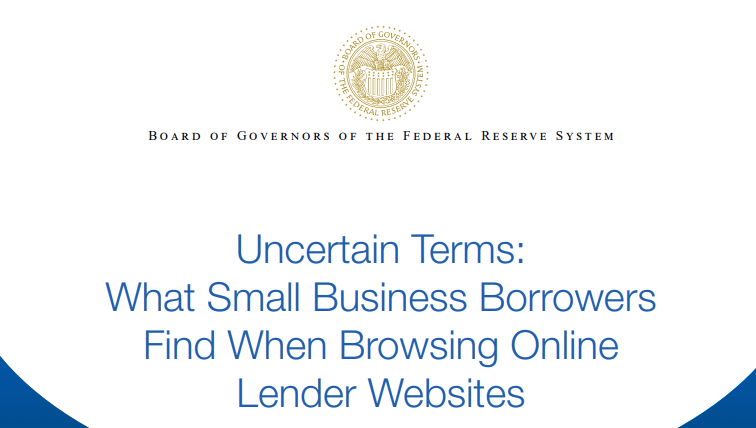 A new study on transparency conducted by the Federal Reserve on non-bank small business finance providers indicates that borrowers are not driven by costs or disclosures. The #1 reason for a business to apply with an online lender was the speed of the process, the study showed. #2 was the likelihood of being funded. Cost ranked near the bottom of the list.
While a focus group pointed out many areas that are ripe for improvement, the Fed was left to conclude that “clearer information—in the form of standardized disclosures—will not necessarily alter the decisions of some small business borrowers about whether and where to obtain financing.”
The Fed further commented that some loan applicants revealed that they had already “committed the expected loan proceeds” before a lender could even present rates and terms. Others borrowers wished they could know their approved rate and terms before even providing a lender with any data. These findings seem to undermine the potential value of enhanced uniformity in disclosures.
The report, which attempts to paint a bleak picture of online lending in spite of the data, seems to validate what online lenders have been saying all along, that speed is supreme. Even where transparency is lacking, it cannot be overstated that big banks scored lower on transparency than online lenders did.
Uncertain Terms: What Small Business Borrowers Find When Browsing Online Lender Websites evaluated BFS Capital, CAN Capital, Credibly, Fundation, Funding Circle, Kabbage, Lending Club, National Funding, OnDeck, Rapid Finance, PayPal Working Capital, and Square Capital.
Is The Definition Of Accredited Investor Ripe For Change?
October 26, 2019
 The definition of accredited investor, which the SEC is tackling this year, is causing a fair amount of debate.
At issue is the fact that under federal securities laws only persons who are accredited investors may participate in certain types of securities offerings.
As it now stands, to be deemed an accredited investor, a person needs to earn income of more than $200,000 ($300,000 with a spouse) in each of the prior two years and reasonably expect to earn the same for the current year. Alternatively, the person needs to have a net worth of $1 million or more (alone or with a spouse), excluding the value of a primary residence.
The goal of these rules, of course, is investor protection. In theory, the rules are supposed to ensure investors are sophisticated enough to invest in riskier investments and, on top of that, have adequate cushioning against the risk of financial loss.
The trouble, critics say, is that the rules aren’t doing a very good job of achieving these objectives. There’s widespread agreement that the current definition is flawed. Where it gets trickier is in deciding how it should be fixed.
 There are some who say the current bar is too high, others who say it’s too low. Some contend that the wealth-based test should be scrapped altogether in favor of a sophistication test. Others promote a sliding scale approach to investing in riskier offerings. This would allow all investors to participate, but in increments that are proportional to their wealth—similar to what happens in the crowdfunding arena today. Some industry players support a combination of measures, a sophistication test in connection with a sliding scale, to maximize investor protection and still open the playing field for others who can’t participate today based on their income or net worth.
The varying opinions are likely to be debated by the SEC as it reviews the accredited investor definition, which it’s required to do every four years by a provision in the Dodd-Frank Act. The SEC is taking the opportunity to do a broad-based review of the regulatory framework for investing in alternative assets; the accredited investor definition is just one of the areas on its docket to examine. The comment period for this review ended on August 30th.
At this point, what the SEC actually decides to do about the accredited investor definition is anybody’s guess. The thrust of these conversations is likely to focus on what constitutes an appropriate degree of protection, which is where many of the disagreements—and alternative suggestions on how to best accomplish this— come into play.
VETTING THE VARIOUS OPINIONS
On one hand, consumer advocates want to maintain the highest degree of investor protection possible. The concern is that consumers generally don’t have enough prowess or information to safely invest in unregistered offerings, which can carry more risk than registered investments.
“We don’t want the definition to be any weaker than it is now because that would do the vast majority of consumers a disservice,” says Brian Young, public policy manager at the National Consumers League. “With these exempt products, there are a lot of unknown variables and there’s a lot more vulnerability,” he says.
One suggestion that’s being proposed is to raise the wealth and income levels to adjust for inflation. It’s a step in the right direction because it would further limit who is eligible to be considered an accredited investor, says Barbara Roper, director of investor protection for the Consumer Federation of America. “The levels haven’t kept pace with inflation since they were set,” she says.
This alone, however, wouldn’t be sufficient to protect investors, consumer advocates say, since there are plenty of wealthy people who have little to no investment prowess.
“Just changing it to correct for inflation doesn’t change it to correct for sophistication and still places investors at risk,” says Ed Mierzwinski, who oversees U.S. PIRG’s federal consumer program, helping to lead national efforts to improve consumer credit reporting laws, identity theft protections, product safety regulations and more.
On this point consumer advocates and industry professionals seem to agree: that limits based on income or net worth aren’t all that useful.
 Roper of the Consumer Federation of America gives the example of a 64-year-old who has $200k in income or $1 million of assets in his or her retirement accounts. This doesn’t mean he or she is financially literate, let alone sophisticated enough to take part in certain types of riskier alternative investments, she says. “That would be an inappropriate investment recommendation if it were made by your broker or investment advisor,” she says.
Some industry professionals also find fault with the wealth test, but, unlike consumer advocates, they’d like to see more investors allowed to participate, not fewer. It’s not right, they contend, that a wide range of highly educated people are prevented from investing in certain offerings because of arbitrary limits on net worth and income.
Many promising investment opportunities are not even being offered to a huge majority of American investors, based on the standards that exist today, according to Nat Hoopes, executive director of the Marketplace Lending Association, an industry trade organization.
“By harmonizing and simplifying complex rules and adjusting the current accredited investor standards, my hope is that the SEC will find that they can permit many more Americans to gain access to a wider range of well regulated investment opportunities, without leaving those citizens exposed to fraud or abuse. Done right, changes from the SEC in this area will help to promote more equality of opportunity in our economy, without adding new red tape,” he says.
Brew Johnson, co-founder and chief executive of PeerStreet, an online platform for investing in real estate debt, says it’s “crazy” that people who are highly educated—such as MBAs, accountants, attorneys and other businesspersons can’t invest in certain offerings simply because they don’t have the income or wealth levels. He takes issue with the fact that he didn’t qualify to invest on his own platform when it was first getting off the ground. Some of his employees today also don’t qualify to invest in the platform they are helping to build, which is troubling, he says.
“You don’t want people to make terrible decisions. But the idea that the average person is too dumb to make decisions with their money…is offensive,” Johnson says. Today, there’s much more readily available information and transparency—a significant change from when the rules were first put in place—when only the largest investors had access to the types of information necessary to make critical investment decisions, he says.
Johnson doesn’t take issue with the goal of protecting investors from getting into things they don’t understand. Rather, he says, “I don’t believe wealth is a determiner of sophistication.”
ALTERNATIVE PROPOSALS TO A WEALTH-BASED TEST
That’s where another idea being floated by members of the Marketplace Lending Association and others may come in. The thought is to create a new way to measure an investor’s level of sophistication and ability to withstand loss. An example of this could be some kind of test to identify investors who are deemed to have sufficient investment prowess, despite falling below the SEC’s threshold based on wealth or net worth, to participate in certain types of offerings.
It’s an option that, if adopted, could open up the playing field to additional investors—while still trying to accomplish the SEC’s goal of investor protection, industry participants say.
Ryan Metcalf, head of U.S. Regulatory Affairs at Funding Circle, says the Financial Industry Regulatory Authority Inc. (FINRA) could develop a test to be administered online when an investor who doesn’t meet the wealth or income bar wants to invest. This would allow quick-decisions to be made. People who want to invest a few thousand dollars shouldn’t have to do it in person; this would be too onerous, he says.
 There could even be different tests based on what investors are seeking to invest in, says Mark Atalla, owner and managing director at private lending firm Carlyle Capital.
For a private placement in a mortgage fund, there could be questions related to the risks involved there, whereas for a private placement in a start-up technology company, there could be other types of questions pertaining to risk. The goal would be to ensure the investor has a sufficient level of understanding about the particular products they are considering.
Otherwise, Atalla says, there’s too much room for people to lose on a large scale. “These are people’s livelihoods you’re responsible for at the end of the day,” he says. “I think it’s important for investors to understand what they are really doing.”
Some industry professionals say there may be too many practical limitations for this type of an assessment to work. Certainly details would have to be worked out including what the scope of the test or tests should be. Decisions would also have to be made about who would be in charge of creating and administering a test or tests and how and where they would be administrated, among other things.
In theory, if someone can pass a test to show he or she is knowledgeable about investing, the person should be able to invest, says PeerStreet’s Johnson, adding that there’s something to be said about people accepting personal responsibility for their decisions, provided they have been given adequate information from which to make informed, knowledgeable decisions. “The devil is in the details of what [this type of test] would look like,” he says.
Another idea being floated—that could stand on its own or be implemented together with a sophistication test—is to allow all investors to invest on a scale that’s similar to the crowdfunding exemption. Under rules adopted by the SEC in 2015, the general public now has the opportunity to participate in the early capital raising activities of start-up and early-stage companies and businesses by way of crowdfunding. Because of the risks involved with this type of investing, however, investors are limited in how they can invest during any 12-month period in these transactions. The limitation depends on the person’s net worth and annual income.
Some industry watchers say the sliding scale idea is a viable one because it would allow more investors a chance to participate in more risky offerings, while providing a safety net for loss.
This type of model has the potential to offer investors a reasonable amount of protection, says Vincent Petrescu, chief executive of truCrowd, Inc., an equity crowdfunding portal that connects startups and emerging businesses with non-accredited and accredited investors. “If you have less money, you are allowed to invest less, but you still can play your hand,” he says.
Johnson of PeerStreet also supports this approach because it allows investors who otherwise wouldn’t have access a chance to broaden their exposure to areas that could potentially allow them to increase their wealth.
Certainly, questions about this approach persist as well. What should the investment limits be? Would it depend on the type of investment? Would investors need to self-certify as they do in crowdfunding, or would their information need to be verified by a third party? These questions and more are also likely to be probed more deeply during an SEC review.
The Marketplace Lending Association would also like employees of private funds to qualify as accredited investors for investments in their employers funds. The trade group contends that a private fund’s employees likely have sufficient access to the information necessary to make informed decisions about investments in their employer’s funds.
The suggestion would be for the SEC to consider adding a new category of the definition to include “knowledgeable employees” of “covered companies” as those terms are defined in Rule 3c-5 of the Investment Company Act.
Industry watchers are hopeful to have some clarity on these issues within the coming months, so stay tuned.
“The SEC’s mandate is to protect investors, which sometimes is needed,” says Petrescu of truCrowd, the equity crowdfunding portal. “There needs to be checks and balances,” he says.
Stripe Ventures Into Merchant Cash Advance Financing
September 6, 2019 Stripe, a payments firm lauded as the world’s most valuable private fintech company (at $22.5B), has officially launched a merchant cash advance product.
Dozens of news outlets have announced that the company is providing loans, but that’s not all, AltFinanceDaily has learned. Both loans and merchant cash advances are available.
The company’s FAQ page originally explained the “Capital” product as a merchant cash advance but it’s since been updated to reflect that they offer access to both merchant cash advances and loans. An official Stripe spokesperson also clarified that an offer could be an MCA or a loan. The updated FAQ says that funding terms would be available in the customer dashboard, in the funding contract, and that which one a customer qualifies for depends on the specifics of their business.
Stripe merchant account customers can find out if they’re eligible for funding in their dashboard. If they’re not, they can still send Stripe a note through the dashboard to signal that they’re interested, say how much they’re looking for, and select what they plan to do with the funds. Stripe says they will not review your credit report and that all offers are based solely on Stripe transaction history.
The new product will not disrupt the separate integration with Funding Circle, according to a statement provided to Digital Transactions. Stripe customers can still apply to Funding Circle by connecting their Stripe account. Funding Circle offers term loans that range from six months to five years.
Stripe’s MCA product is currently only available in the US, but the company’s founders, Patrick and John Collison, brothers, hail from an unlikely place, rural Ireland. The company handles tens of billions of dollars in payments a year across 34 countries.
Like other recent entrants into the small business funding space, Stripe’s advantage is its ability to tap into its existing customer base. Other payments companies such as PayPal and Square, for example, were among the top four largest originators (for which public data is available) of alternative small business funding in 2018.
Note: This article has been updated to reflect the changes made on Stripe’s website as well as an additional clarification from the company.
Lending Club Still Logging Losses, But Not For Long?
August 9, 2019 LendingClub released its second quarter report this Tuesday.
Loan originations reached a new high of $3.1B, but the year-over-year growth rate for the quarter clocked in at only 11%, down from the 18% growth experienced the three straight previous quarters in a row. The company also generated a net loss of $10.6M. Beyond Q2 however, this appears to be in line with their plan for 2019, as they are forecasting to have a loss ranging from $23-38 million by year’s end, much better than the 2018 loss of $128.2M and 2017 loss of $154M.
“Since I took over as CEO three years ago, we have increased originations by 60% while tripling contribution dollars. We are leveraging our data, scale and marketplace model to execute with discipline and compound our competitive advantages,” LendingClub CEO Scott Sanborn asserted to investors in the earnings call. “Better use of data, increased automation and new communications approaches have increased our conversion rate, reduced our unit cost of operations and accelerated time to approval. For example, in Q2, 72 percent of our personal loan customers went from application to approval within 24 hours – that is up from 46 percent only a year ago.”
LendingClub’s recent decision to forward small business loan inquiries to Funding Circle and Opportunity Fund, did not come up. Funding Circle similarly did not elaborate on any developments relating to this partnership in their August 8th, 2019 H1 report.
Lending Club aimed its focus on the Select Plus Platform, a program that aims to make it easier for prospective investors to find borrowers who might otherwise be unseen due to their non-conformity to certain criteria, broadening the range of those who receive loans. “It really is addressing customers across the credit spectrum,” Sanborn told an investor when asked about Select Plus, “All of this fitting into the broader product-to-platform idea of just opening up our marketplace to other people who can serve the consumers that we have validated identity and income, and assessed credit worthiness, how else can we serve them not just through our own efforts but through the efforts of others.”
Canada’s Alternative Financing Market Is Taking Off
May 20, 2019

Canadians have been slow out of the gate when it comes to mass adoption of alternative financing, but times are changing, presenting opportunities and challenges for those who focus on this growing market.
Historically, the Canadian credit market has traditionally been dominated by a few main banks; consumers or businesses that weren’t approved for funding through them didn’t have a multitude of options. The door, however, is starting to unlock, as awareness increases about financing alternatives and speed and convenience become more important, especially to younger Canadians.
Indeed, the Canada alternative finance market experienced considerable growth in 2017—the latest period for which data is available. Market volume reached $867.6 million, up 159 percent from $334.5 million in 2016, according to a report by the Cambridge Centre for Alternative Finance and the Ivey Business School at Western University. Balance sheet business lending makes up the largest proportion of Canadian alternative finance, accounting for 57 percent of the market; overall, this model grew 378 percent to $494 million in 2017, according to the report.
Industry participants say the growth trajectory in Canada is continuing. It’s being driven by a number of factors, including tightening credit standards by banks, growing market demand for quick and easy funding and broader awareness of alternative financing products.
 To meet this growing demand, new alternative financing companies are coming to the market all the time, says Vlad Sherbatov, president and co-founder of Smarter Loans, which works with about three dozen of Canada’s top financing companies. He predicts that over time more players will enter the market—from within Canada and also from the U.S.—and that product types will continue to grow as demand and understanding of the benefits of alternative finance become more well-known. Notably, 42 percent of firms that reported volumes in Canada were primarily headquartered in the U.S., according to the Cambridge report.
To be sure, the Canadian market is much smaller than the U.S. and alternative finance isn’t ever expected to overtake it in size or scope. That’s because while the country is huge from a geographic standpoint, it’s not as densely populated as the U.S., and businesses are clustered primarily in a few key regions.
To put things in perspective, Canada has an estimated population of around 37 million compared with the U.S.’s roughly 327 million. On the business front, Canada is similar to California in terms of the size and scope of its small business market, estimates Paul Pitcher, managing partner at SharpShooter, a Toronto-based funder, who also operates First Down Funding in Annapolis, Md.
Nonetheless, alternative lenders and funders in Canada are becoming more of a force to be reckoned with by a number of measures. Indeed, a majority of Canadians now look to online lenders as a viable alternative to traditional financial institutions, according to the 2018 State of Alternative Lending in Canada, a study conducted by online comparison service Smarter Loans.
Of the 1,160 Canadians surveyed about the loan products they have recently received, only 29 percent sought funding from a traditional financial institution, such as a bank, the study found. At the same time, interest in alternative loans has been on an upward trajectory since 2013. Twenty-four percent of respondents indicated they sought their first loan with an alternative lender in 2018. Overall, nearly 54 percent of respondents submitted their first application with a non-traditional lender within the past three years, according to the report.
Like in the U.S., there’s a mix of alternative financing companies in Canada. A number of companies offer factoring and invoicing and payday loans. But there’s a growing number focused on consumer and business lending as well as merchant cash advance.

Some major players in the Canadian alternative lending or funding landscape include Fairstone Financial (formerly CitiFinancial Canada), an established non-bank lender that recently began offering online personal loans in select provinces; Lendified, an online small business lender; Thinking Capital, an online small business lender and funder; easyfinancial, the business arm of alternative financial company goeasy Ltd. that focuses on lending to non-prime consumers; OnDeck, which offers small business financing loans and lines of credit; and Progressa, which provides consolidation loans to consumers.
By comparison, the merchant cash advance space has fewer players; it is primarily dominated by Thinking Capital and less than a dozen smaller companies, although momentum in the space is increasing, industry participants say.
“The U.S. got there 10 years ago, we’re still catching up,” says Avi Bernstein, chief executive and co-founder of 2M7 Financial Solutions, a Toronto-based merchant cash advance company.
OPPORTUNITIES ABOUND
In terms of opportunities, Canada has a population that is very used to dealing with major banks and who are actively looking for alternative solutions that are faster and more convenient, says Sherbatov of Smarter Loans. This is especially true for the younger population, which is more tech-savvy and prefers to deal with finances on the go, he says.
Because the alternative financing landscape is not as developed in Canada, new and innovative products can really make a significant impact and capture market share. “We think this is one of the key reasons why there’s been such an influx of international companies, from the U.S. and U.K. for example, that are looking to enter the Canadian market,” he says.
Just recently, for example, Funding Circle announced it would establish operations in Canada during the second half of 2019. “Canada’s stable, growing economy coupled with good access to credit data and progressive regulatory environment made it the obvious choice,” said Tom Eilon, managing director of Funding Circle Canada, in a March press release announcing the expansion. “The most important factor [in coming to Canada] though was the clear need for additional funding options among Canadian SMEs,” he said.
OnDeck, meanwhile, recently solidified its existing business in Canada through the purchase of Evolocity Financial Group, a Montreal-based small business funder. The combined firm represents a significantly expanded Canadian footprint for both companies. OnDeck began doing business in Canada in 2014 and has originated more than CAD$200 million in online small business loans there since entering the market. For its part, Evolocity has provided over CAD$240 million of financing to Canadian small businesses since 2010.
“There is an enormous need among underserved Canadian small businesses to access capital quickly and easily online, supported by trusted and knowledgeable customer service experts,” Noah Breslow, OnDeck’s chairman and chief executive, said in a December 2018 press release announcing the firms’ nuptials.
There are also a number of home grown Canadian companies that are benefiting from the growth in the alternative financing market.
2M7 Financial Solutions, which focuses on merchant cash advances, is one of these companies. It was founded in 2008 to meet the growing credit needs within the small and medium-sized business market at a time when businesses were having trouble in this regard.
But only in the past few years has MCA in Canada really started picking up to the point where Bernstein, the chief executive, says the company now receives applications from about 200 to 300 companies a month, which represents more than 50 percent growth from last year.
“We’re seeing more quality businesses, more quality merchants applying and the average funding size has gone up as well,” he says.
NAVIGATING THROUGH CHALLENGES
Despite heightened growth possibilities, there are also significant headwinds facing companies that are seeking to crack the Canadian alternative financing market. For various reasons, some companies have even chosen to pull back or out of Canada and focus their efforts elsewhere. Avant, for example, which offers personal loans in the U.S., is no longer accepting new loan applications in Canada at this time, according to its website. Capify also recently exited the Canadian business it entered in 2007, even as it continues to bulk up in the U.K. and Australia.
One of the challenges alternative lenders face in Canada is distrust of change. Since Canadians are so used to dealing with only a few major financial institutions to handle all their finances, they are skeptical to change this behavior, especially when the customer experience shifts from physical branches to online apps and mobile devices, says Sherbatov of Smarter Loans. He notes that adoption of fintech products in Canada has lagged in recent years, partially because there has been a lack of awareness and trust in new financial products available.
One way Smarter Loans has been working to strengthen this trust is by launching a “Smarter Loans Quality Badge,” which acts as a certification for alternative financing companies on its platform. It is issued to select companies that meet specified quality standards, including transparency in fees, responsible lending practices, customer support and more, he says.
 The Canadian Lenders Association, whose members include lenders and merchant cash advance companies, has also been working to promote the growing industry and foster safe and ethical lending practices. For example, it recently began rolling out the SMART Box pricing disclosure model and comparison tool that was introduced to small businesses in the U.S. in 2016.
Another challenge that impacts alternative lenders in the consumer space is having restricted access to alternative data sources. Because of especially strict consumer privacy laws, access is “substantially more limited” than it is in any other geography,” says Jason Mullins, president and chief executive of goeasy, a lending company based in Mississauga, Ontario, that provides consumer leasing, unsecured and secured personal loans and merchant point-of-sale financing.
From a lending perspective, goeasy focuses on the non-prime consumer—generally those with credit scores of under 700. Mullins says the market consists of roughly 7 million Canadians, about a quarter of the population of Canadians with credit scores. The non-prime consumer market is huge and has tremendous potential, he says, but it’s not for the faint of heart.
Another issue facing alternative lenders is the relative difficulty of raising loan capital from institutional lenders, says Ali Pourdad, co-founder and chief executive of Progressa, which recently reached the $100 million milestone in funded loans for underserved Canadian consumers. “The onus is on the alternative lenders to ensure they have good lending practices and are underwriting responsibly,” he says.
What’s more, household debt to income ratios in Canada are getting progressively worse, with Canadians taking on too much debt relative to what they can afford, Pourdad says. As the situation has been deteriorating over time, there is inherently more risk to originators as well as the capital that backs them. “Originators, now more than ever, have to be cautious about their lending practices and ensure their underwriting is sound and that they are being responsible,” he says.
On the small business side of alternative lending, getting the message out to would-be customers can be a challenge in Canada. In U.S. there are thousands of ISOs reaching out to businesses, whereas in Canada, most funders have a direct sales force, with a much smaller portion of their revenue coming from referral partners, says Adam Benaroch, president of CanaCap, a small business funder based in Montreal.
He predicts this will change over time as the business matures and more funders enter the space, giving ISOs the ability to offer a broader array of financing products at competitive rates. “I think we’re going to see pricing go down and more opportunities develop, and as this happens, the business is going to grow, which is exactly what has happened in the U.S,” he says.
Generally speaking, Canadian businesses are still somewhat skeptical of merchant cash advance and require considerable hand-holding to become comfortable with the idea.
“You can’t wait for them to come to you, you have to go to them and explain what the products are,” says Pitcher of SharpShooter, the MCA funding company.
While Pitcher predicts more companies will continue to enter the Canadian alternative financing market, he doesn’t think it will be completely overrun by new entrants—the market simply isn’t big enough, he says. “It’s not for everyone,” he says.